The picks
The best window fans with a thermostat
A window fan without a thermostat is a fan you have to wake up to turn off. This is the only feature in the category that buys you a night's sleep.
By Sawyer V. · Published
The short answer
The Lasko W09550 twin window fan — an adjustable thermostat you set to a temperature, two independently reversible motors, and 22 to 31 W for up to 560 CFM. It stops the fan once the room reaches your setting instead of pulling 55°F air over you at 4am. If your window is wider than 32 inches, the Vornado Transom has automatic temperature control, a remote and a five-year warranty.
Fan & Frost earns a commission when you buy through our links, at no cost to you. It never changes a ranking, and we say so when the right answer is the cheaper unit or nothing at all. Full disclosure · How we pick.

At a glance
The picks, ranked
Tap any row to jump to the full reasoning. Prices are live from Amazon where we have them, and read “check price” where we don’t — never a number we cannot verify today.
| # | Product | Best for | Price |
|---|---|---|---|
| 1 | Best overall Lasko Twin Window Fan with Remote An adjustable thermostat plus two independently reversible motors on 22-31 W — the only window fan here where you set an actual temperature. | A bedroom sash window 24 to 32 inches wide, run overnight without supervision | |
| 2 | 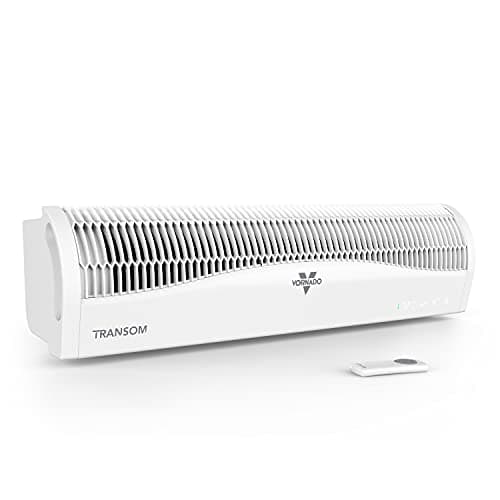 Best for a wide window Vornado Transom Window Fan Automatic temperature control, electronic reversal, four speeds and a remote, in a 6.75-inch-high body with a five-year warranty. | An opening 26 to 40 inches wide, with only 10 inches of height to work with | |
| 3 | 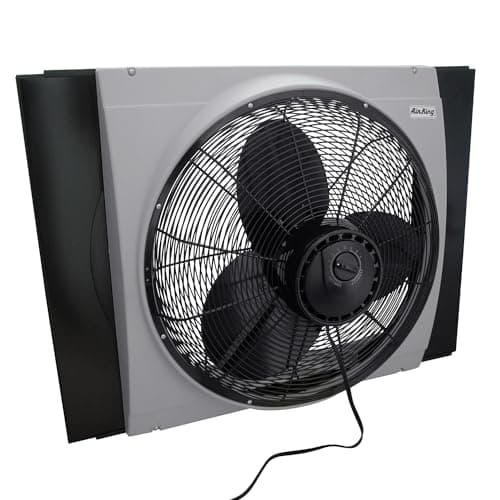 If you would rather have air than automation Air King 20" Whole House Window Fan 3,560 CFM on 170 W with published noise figures — six times the airflow of the thermostat fans, and no thermostat at all. | A large window, and a household willing to turn a fan off by hand | |
| — | 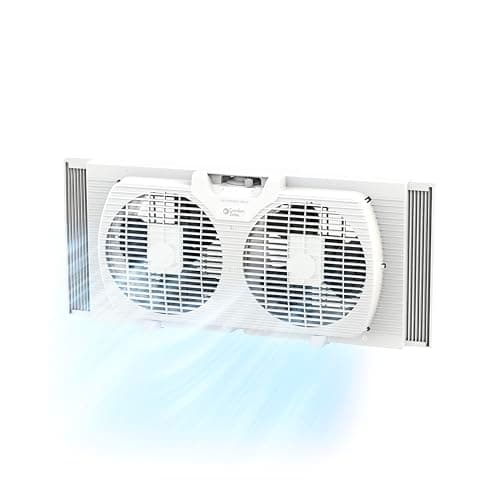 The one to skip if the thermostat is the point Comfort Zone 9" Twin Window Fan Two 9-inch fans with a manual reversible airflow control. Comfort Zone publishes no thermostat, no airflow and no wattage for it. | A cheap second window fan, where someone will be awake to switch it off |
Every other window fan feature is a convenience. A thermostat is the one that changes what the fan is for, because it is the only one that works while you are asleep.
The problem it solves is specific and familiar. You put a fan in the window at 10pm because the house is 82°F and outside is 72°F. By 4am outside is 55°F, the fan is still running, and you are awake and cold. A thermostat stops the fan at the temperature you asked for and leaves it off.
The distinction
Adjustable, automatic, and marketing
Three different things get called a thermostat in this category and only the first is what most people are looking for.
- Adjustable thermostat. You set a target temperature on a dial. The fan runs until the room reaches it, then cycles off. This is the Lasko.
- Automatic temperature control. The fan manages itself against sensed temperature without you choosing a number. This is the Vornado, and it is genuinely useful — just not the same thing.
- A timer. Turns the fan off after a set number of hours regardless of temperature. Useful, frequently described in listings alongside the word thermostat, and not a thermostat. Fans with timers are a separate category.
The comparison
What each fan publishes
| Fan | Temperature control | CFM | Watts | Window width |
|---|---|---|---|---|
| Lasko W09550 twin | Adjustable thermostat | 560 | 22-31 W | 24-32 in |
| Vornado Transom | Automatic | Not published | Not published | 26-40 in |
| Air King 9166F | None | 3,560 | 115-170 W | 27-38 in |
| Comfort Zone CZ319WT | None | Not published | Not published | 22.25-33 in |
Every figure is from the manufacturer’s own product page. “None” means the specification lists no temperature control.
This one is not a DIY job
Set the thermostat a couple of degrees above where you want to wake up. A window fan keeps pulling outdoor air for a while after it cycles off, and a room that is still losing heat to a 55°F night will drift past your setting rather than stopping at it.
Buying
What to check before you buy
- Measure the opening, width and height. Every fan here states a width range; the ones that fit a 32-inch window do not fit a 38-inch one. A sash window is also typically wider than it is tall when open, which is the geometry the whole category assumes. If your window is a slider or a casement, start here.
- Independent motors, if the fan has two. One intake and one exhaust in the same window produces real cross-flow. Twin fans that only run together do not.
- Electronic reversal, if you will switch between morning intake and evening exhaust. The alternative is lifting the fan out and turning it round.
- A published wattage, so you can tell what running it all night costs. Two of the four fans here publish one.
Say the unwelcome thing
Do not rely on a thermostat to decide when to open the window.
A window fan thermostat measures the room, not the outdoor air. If it is 88°F outside at 7pm and 84°F inside, a thermostat set to 75°F will run the fan continuously and make the house hotter, because it is pulling in air warmer than the air it is pushing out.
Check an outdoor thermometer before you start the fan. The thermostat handles the end of the night; it cannot handle the beginning of it.
In full
Every pick, and what is wrong with it
Published specifications only, each linked to the page it came from. Where a manufacturer publishes nothing, the row says so — we do not fill blanks in.
1. Best overall
Lasko Twin Window Fan with Remote
Lasko · model W09550
An adjustable thermostat plus two independently reversible motors on 22-31 W — the only window fan here where you set an actual temperature.
An adjustable thermostat is a different thing from an automatic one. You choose the temperature; the fan runs until the room reaches it and then stops. That is the feature that makes an overnight window fan a set-and-forget object rather than something you get up to deal with.
Two independently controlled motors is the other reason this one wins. Both can run as intake, both as exhaust, or one each way, which produces a deliberate cross-flow through a single window — the thing a box fan in the same opening cannot do.
22 W to 31 W for up to 560 CFM published. An eight-hour night is 4.5¢ at 18.34¢/kWh, or $1.36 across a month of them. A box fan doing a worse job in the same window costs $4.49.
4.9 inches deep and 8.0 lb, with the remote included. Measure the width of the opening before you buy: 24 to 32 inches is the whole fit range.
The honest gaps: Lasko publishes no noise figure, and 560 CFM is modest. Twin versus single window fans.
What’s wrong with it
Fits only 24 to 32 inch openings, 560 CFM is a quarter of what a whole-house window fan moves, and the warranty is one year against Vornado's five.
Running cost — W09550
| Nameplate power | 22 W – 31 W | manufacturer's published figure |
|---|---|---|
| Energy, 8-hour night | 0.25 kWh | 31 ÷ 1000 × 8 |
| Cost per hour | 0.6¢ | at 18.34¢/kWh |
| Cost per 8-hour night | 4.5¢ | on the highest speed |
| Cost per 30 nights | $1.36 | 7.4 kWh |
| Same month, lowest speed | 97¢ | at 22 W |
Rate: 18.34¢/kWh, the US average residential price for June 2026 (EIA Electric Power Monthly, Table 5.3). Yours will differ — swap it in: (watts ÷ 1000) × hours × your rate.
| Power | 22 W - 31 W at 120 V |
|---|---|
| Air delivery | Up to 560 CFM |
| Window fit | 24 - 32 in wide |
| Modes | Intake, exhaust or exchange (independent motors) |
| Thermostat | Adjustable |
| Speeds | 3 |
| Dimensions | 12.9 H x 24.0 W x 4.9 D in |
| Weight | 8.0 lb |
| Warranty | 1 year |
Every figure above is from Lasko product page, W09550. Blanks are shown as “not published” rather than filled in.
2. Best for a wide window
Vornado Transom Window Fan
Vornado · model Transom
Automatic temperature control, electronic reversal, four speeds and a remote, in a 6.75-inch-high body with a five-year warranty.
26 to 40 inches of width and only 10 inches of minimum clearance. That combination is unusual and it is the reason to buy this one: a wide, shallow opening defeats most of the category.
Automatic temperature control rather than an adjustable set point. The distinction matters: the fan manages itself against the temperature it senses, which is convenient, but you are not choosing the number.
Electronic reversal means intake and exhaust swap at the touch of the remote rather than by physically turning the fan around, and four speeds gives finer control than the usual three.
The enclosure is weather-resistant and UV-protected, which is what you want in a fan that spends summer sitting in an open window, and the five-year warranty is the longest here by four years.
What is missing is everything numeric. No CFM, no wattage. We are not going to estimate either.
What’s wrong with it
Vornado publishes no airflow and no wattage at all, so neither performance nor running cost can be calculated. Automatic control is not the same as setting a temperature.
Running cost
Vornado does not publish a wattage for the Transom, so we cannot calculate what it costs to run. We are not going to estimate one. If Vornado publishes a nameplate figure, this block will show the arithmetic.
| Modes | Intake or exhaust, reversed electronically |
|---|---|
| Speeds | 4 |
| Window fit | 26 - 40 in wide |
| Opening required | 10 in minimum clearance |
| Height | 6.75 in |
| Thermostat | Automatic temperature control |
| Remote | Included |
| Enclosure | Weather resistant, UV protected |
| Air delivery | Not published |
| Power | Not published |
| Warranty | 5 years |
Every figure above is from Vornado product page, Transom window fan. Blanks are shown as “not published” rather than filled in.
3. If you would rather have air than automation
Air King 20" Whole House Window Fan
Air King · model 9166F
3,560 CFM on 170 W with published noise figures — six times the airflow of the thermostat fans, and no thermostat at all.
It is worth seeing what the thermostat costs you, because it is a lot of air.
3,560 / 3,120 / 2,510 CFM on 170 / 145 / 115 W and 64 / 57 / 50 dB published — the only fan on this page with a stated noise figure. Against 560 CFM from the Lasko, this is a different class of machine: it changes the air in a house rather than ventilating a room.
Storm Guard lets the window close behind it, which seals the opening properly rather than propping it.
17¢ a night on low, against 4.5¢ for the Lasko. You are paying four times as much to move six times the air, and setting an alarm instead of a thermostat.
What’s wrong with it
No temperature control of any kind, 36.6 lb, and it needs an opening 27 to 38 inches wide by 26.25 inches high. This is installed equipment.
Running cost — 9166F
| Nameplate power | 115 W – 170 W | manufacturer's published figure |
|---|---|---|
| Energy, 8-hour night | 1.36 kWh | 170 ÷ 1000 × 8 |
| Cost per hour | 3.1¢ | at 18.34¢/kWh |
| Cost per 8-hour night | 25¢ | on the highest speed |
| Cost per 30 nights | $7.48 | 40.8 kWh |
| Same month, lowest speed | $5.06 | at 115 W |
Rate: 18.34¢/kWh, the US average residential price for June 2026 (EIA Electric Power Monthly, Table 5.3). Yours will differ — swap it in: (watts ÷ 1000) × hours × your rate.
| Air delivery | 3,560 / 3,120 / 2,510 CFM (high / medium / low) |
|---|---|
| Power | 170 / 145 / 115 W (1.4 / 1.2 / 1.0 A) |
| Efficiency | 20.9 CFM per watt on high, 21.8 on low (our arithmetic) |
| Noise | 64 / 57 / 50 dB (high / medium / low) |
| Blade | 20 in |
| Speeds | 3 |
| Window required | 27 - 38 in wide x 26.25 in high |
| Dimensions | 26.75 W x 11.25 D x 26.25 H in |
| Weight | 36.6 lb |
| Storm Guard | Window can close behind the fan |
| Mounting | Hardware included |
| ENERGY STAR | No program exists for window fans |
Every figure above is from Air King whole house window fan product page, models 9155 and 9166F. Blanks are shown as “not published” rather than filled in.
Skip this one
Comfort Zone 9" Twin Window Fan
Comfort Zone · model CZ319WT
Two 9-inch fans with a manual reversible airflow control. Comfort Zone publishes no thermostat, no airflow and no wattage for it.
It turns up in thermostat searches and it should not. Comfort Zone’s specification for this fan lists no thermostat, and no automatic temperature control of any kind.
What it does have is a manual reversible airflow control, two 9-inch fans, a fit range of 22.25 to 33 inches — wider at the narrow end than the Lasko — and a removable fabric cover.
No published air delivery and no published power. As a cheap second fan for a cross-flow pair it is fine. As the answer to this page’s question it is not an answer.
What’s wrong with it
Reversal is a manual control rather than an electronic one, there is no temperature control at all, and nothing numeric is published.
Running cost
Comfort Zone does not publish a wattage for the CZ319WT, so we cannot calculate what it costs to run. We are not going to estimate one. If Comfort Zone publishes a nameplate figure, this block will show the arithmetic.
| Modes | Intake or exhaust, reversed by a manual control |
|---|---|
| Speeds | 2 |
| Blades | Two 9 in fans |
| Window fit | 22.25 - 33 in wide |
| Opening required | Not published |
| Air delivery | Not published |
| Power | Not published |
| Cover | Removable fabric cover |
| Warranty | 1 year |
Every figure above is from Comfort Zone product page, CZ319WT. Blanks are shown as “not published” rather than filled in.
We are not linking a buy button for this one. If you want to look at it anyway, it is easy enough to find — but we would rather send you to something that fits your room.
Questions people actually ask
Frequently asked
What is the best window fan with a thermostat?
The Lasko W09550 twin window fan. It is the only one here with an adjustable thermostat you set to a temperature, it runs two motors independently so one can be intake and one exhaust, and it draws 22 to 31 W for a published 560 CFM.
Do window fans have thermostats?
Some do, and fewer than listings suggest. Lasko publishes an adjustable thermostat on its twin window fan and Vornado publishes automatic temperature control on the Transom. Several fans sold as thermostat models list no temperature control at all on the manufacturer's own specification page.
What is the difference between an adjustable thermostat and automatic temperature control on a fan?
With an adjustable thermostat you set a target temperature and the fan cycles off when the room reaches it. With automatic temperature control the fan manages itself against the temperature it senses and you do not choose the number. A timer, which turns the fan off after a set number of hours regardless of temperature, is neither.
Should I set a window fan thermostat to the temperature I want?
Set it a couple of degrees higher. A room that is losing heat to cool night air keeps cooling for a while after the fan cycles off, so a fan set to exactly your target will usually overshoot it by morning.
How much does a thermostat window fan cost to run overnight?
About 4.5¢ for an eight-hour night at 18.34¢/kWh on the 31 W setting, or $1.36 across a month of nights. A box fan doing the same job in the same window costs about $4.49. Box fan vs window fan.
Will a window fan thermostat know when it is hotter outside than inside?
No. It measures the room, not the outdoor air. Running a window fan when the outside air is warmer than the inside air makes the house hotter, and no thermostat on the market prevents that — you have to check an outdoor temperature before you start it.
Sources
Where these numbers came from
- Lasko W09550 twin window fan — adjustable thermostat, 22-31 W, up to 560 CFM, 24-32 in fit
- Vornado Transom window fan — automatic temperature control, 4 speeds, 26-40 in fit, 5-year warranty
- Air King whole house window fan, 9166F — 3,560/3,120/2,510 CFM on 170/145/115 W, 64/57/50 dB
- Comfort Zone CZ319WT twin window fan — manual reversible control, 22.25-33 in fit
- EIA Electric Power Monthly, Table 5.3 — electricity rate
Read next
Where to go from here
Back to Fans, or read how we pick.