Guide and picks
How to fix a wobbling ceiling fan
Everyone reaches for the balance kit. It fixes the least common cause, which is why people so often use the whole kit and still have a wobble.
By Sawyer V. · Published
The short answer
Check in this order: mounting bracket and box, then screws, then blade height, then blade warp — and only then reach for the balance kit. Most wobble comes from a loose mounting or one blade sitting at a different height, not from an out-of-balance blade. Measure each blade tip to the ceiling; if one differs by more than about an eighth of an inch, that is your fault and no amount of stick-on weight will fix it.
Fan & Frost earns a commission when you buy through our links, at no cost to you. It never changes a ranking, and we say so when the right answer is the cheaper unit or nothing at all. Full disclosure · How we pick.
At a glance
The picks, ranked
Tap any row to jump to the full reasoning. Prices are live from Amazon where we have them, and read “check price” where we don’t — never a number we cannot verify today.
| # | Product | Best for | Price |
|---|---|---|---|
| 1 | 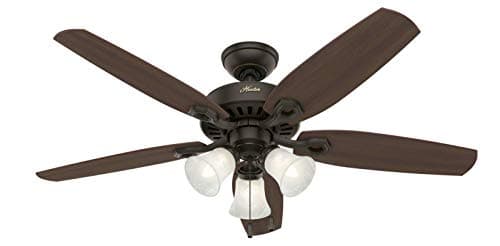 When repair is not worth it Hunter Vespucci 52" Ceiling Fan 366.7 CFM per watt on 13.9 W, and 1.8 W on low — a modern fan that costs a fraction of an old one to run. | Replacing an old wobbling fan rather than nursing it | |
| 2 | 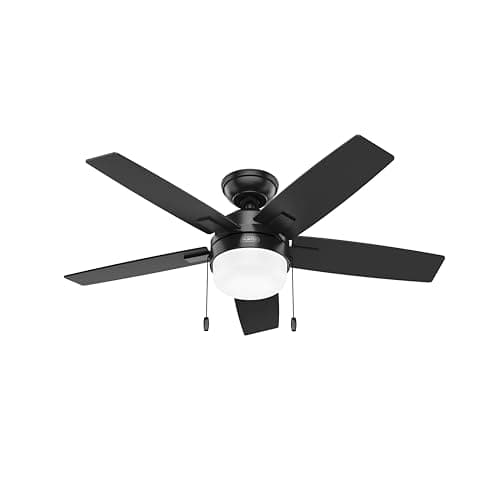 The mount that cannot wobble the same way Hunter Anisten 44" Hugger Ceiling Fan A flush-mount hugger at 295.9 CFM per watt — no downrod, so no downrod-related wobble. | A replacement where the existing downrod is part of the problem | |
| 3 | 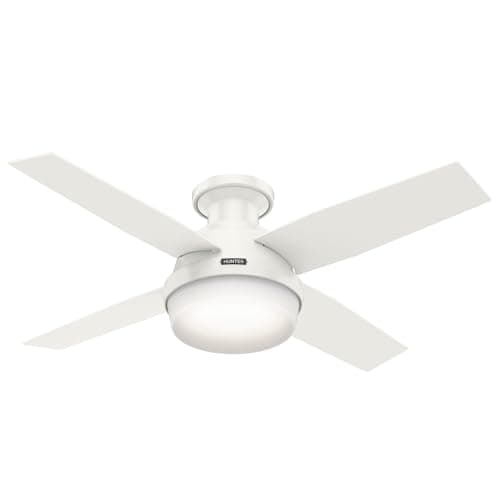 Least wobble-prone by physics Hunter Martindale 44" Ceiling Fan 44 inches and 10.1 W — a smaller disc turning a lighter blade set, which is inherently more tolerant of small errors. | A room where you want the quietest, steadiest running possible | |
| — | 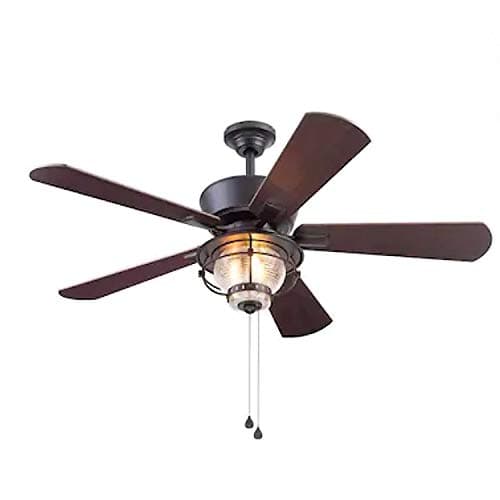 The span that punishes a sloppy install Harbor Breeze Cando 84" Ceiling Fan 422.2 CFM per watt and outstanding efficiency, on an 84-inch span that magnifies every fraction of an inch of error. | A large space — installed properly, on a rated box |
A wobbling ceiling fan is unnerving mostly because of what it implies. In practice the fan is very unlikely to come down — but the wobble is telling you something is not right, and the fault is usually not the one people go looking for.
Diagnose first
Four causes, in order of likelihood
Work through these in sequence. Each takes a couple of minutes, and each is more common than the one after it.
- The mounting. Turn the fan off, wait for it to stop, and take hold of the motor housing. Push it gently side to side. Any movement at all means the fault is above the fan, and nothing you do to the blades will help. Check the bracket screws into the box, and check the box itself is secure and fan-rated.
- The downrod and canopy. Confirm the rod is fully seated in the coupling, the cross-pin is in place, and the set screws are tight. Slide the canopy down to look. A rod that is a fraction out of square at the top produces a visible circle at the tips.
- Blade height. This is the most common cause people skip. See below.
- Blade weight or warp. Genuinely the least common, and the only one a balance kit addresses.
The measurement
Measure blade height before anything else
This is the test that resolves most wobbles, and it needs a ruler and five minutes.
With the fan off, measure from the ceiling down to the tip of one blade. Then rotate the blades by hand and measure each of the others at the same point — move the blade to where the first one was, so you are measuring at one fixed location rather than at four different spots on the ceiling.
Every blade should be within about an eighth of an inch of the others. If one is out, that is your wobble, and no stick-on weight will correct it — you are trying to balance a fan that is not flat.
The usual fixes, in order:
- Tighten every blade-to-bracket screw and every bracket-to-motor screw. Loose fixings let a blade droop.
- Check the bracket itself is not bent. Blade irons get knocked during cleaning and during installation. A bent one can usually be gently trued.
- Swap two blades round. If the high spot follows the blade, the blade is warped. If it stays put, the bracket or the mounting is at fault. This one test separates the two most confusing cases.
Why size matters
A big fan shows the same fault more
Wobble amplitude is a function of span. A blade tip on an 84-inch fan sits twice as far from the axis as a tip on a 42-inch fan, so the same angular error traces twice the circle.
Two practical consequences:
- Large fans need a better install, not a better fan. The tolerance you can get away with on a 42-inch fan will be visible on a 72-inch one.
- An oversized fan in a small room wobbles more and is wrong anyway. If a big fan has been shaking in a modest space, replacing it with a correctly sized 44-inch fan fixes the wobble and the sizing together.
None of this means large fans are a bad idea — certified data shows they are substantially more efficient, at 422.2 CFM per watt at 84 inches against 242.3 at 42. It means the mounting deserves proportionate care.
This one is not a DIY job
The electrical box is the part that actually matters for safety. A ceiling fan must hang from a box listed for fan support. A standard lighting box is designed for a static load and is not rated for the dynamic, rotating load of a fan.
A fan-rated box is marked as such, and it is either braced between joists or screwed directly to solid blocking. If you cannot confirm what is up there, that is the thing to establish before you spend time balancing blades — and it is a job for an electrician if the answer is unclear.
Always kill the power at the breaker before removing a canopy, not just at the wall switch.
A wobble that appears suddenly on a fan that used to run true deserves the mounting check first and immediately. Gradual wobble is usually blades; sudden wobble is usually fixings.
Last resort
Using the balance kit properly
If the mount is solid, the rod is seated, every screw is tight and all four blades measure within an eighth of an inch — now the kit is the right tool.
- Clip the plastic weight to the trailing edge of one blade, halfway along, and run the fan on the speed where the wobble is worst.
- Move the clip to each blade in turn. One of them will make the wobble noticeably better; that is the blade to weight.
- On that blade, slide the clip inward and outward to find the position where the wobble is least.
- Stick the adhesive weight to the top of the blade, in line with the clip position, and remove the clip.
Clean the blade before sticking anything to it. The adhesive fails on dust, and a weight that falls off later reintroduces the imbalance you just corrected. Dust is worth removing anyway — an uneven dust load on old blades is itself a cause of wobble that develops slowly over a season.
Say the unwelcome thing
Do not start with the balance kit.
It comes in the box with most fans, it is free, and it is the obvious thing to try. It also addresses the least common cause, which is why so many people work through the entire kit and still have a wobble.
A balance weight compensates for a blade that is slightly heavier than its neighbors. It does nothing for a loose bracket, an unseated downrod, a bent blade iron or a box that is not fan-rated — and in the case of a loose mounting, it hides a symptom you want to be seeing.
Five minutes with a ruler and a screwdriver resolves most wobbles. Reach for the weights only once those have come up clean.
In full
Every pick, and what is wrong with it
Published specifications only, each linked to the page it came from. Where a manufacturer publishes nothing, the row says so — we do not fill blanks in.
1. When repair is not worth it
Hunter Vespucci 52" Ceiling Fan
Hunter · model Vespucci
366.7 CFM per watt on 13.9 W, and 1.8 W on low — a modern fan that costs a fraction of an old one to run.
Worth saying plainly: sometimes the fix is a new fan. A warped blade set is frequently unavailable for an older model, and a worn motor bearing is not economically repairable.
The running-cost case makes that decision easier than it used to be. 13.9 W on high and 1.8 W on low, at 366.7 CFM per watt certified. An older AC-motor fan typically draws several times that for the same airflow.
A three-year component warranty, and a new fan arrives with a matched, factory-balanced blade set — which is the thing you have been trying to recreate.
What’s wrong with it
No light kit, so if the old fan was your only ceiling fixture you have a second problem to solve.
Running cost — Vespucci
| Nameplate power | 1.8 W – 13.9 W | manufacturer's published figure |
|---|---|---|
| Energy, 8-hour night | 0.11 kWh | 13.9 ÷ 1000 × 8 |
| Cost per hour | 0.3¢ | at 18.34¢/kWh |
| Cost per 8-hour night | 2.0¢ | on the highest speed |
| Cost per 30 nights | 61¢ | 3.3 kWh |
| Same month, lowest speed | 7.9¢ | at 1.8 W |
Rate: 18.34¢/kWh, the US average residential price for June 2026 (EIA Electric Power Monthly, Table 5.3). Yours will differ — swap it in: (watts ÷ 1000) × hours × your rate.
| Blade span | 52 in |
|---|---|
| Efficiency | 366.7 CFM per watt |
| Power, high speed | 13.9 W |
| Power, low speed | 1.8 W |
| Standby power | 0.8 W |
| Type | Indoor, fan only (no light kit) |
| Warranty | 3 years, components |
| ENERGY STAR | Certified |
Every figure above is from ENERGY STAR Certified Ceiling Fans dataset. Blanks are shown as “not published” rather than filled in.
2. The mount that cannot wobble the same way
Hunter Anisten 44" Hugger Ceiling Fan
Hunter · model 44 Anisten
A flush-mount hugger at 295.9 CFM per watt — no downrod, so no downrod-related wobble.
A large share of ceiling fan wobble originates at the downrod — the ball-and-socket hanger, the pin, or a rod that is not seated square. A flush-mount fan removes that entire failure mode by not having one.
The mechanism is leverage. A downrod puts the rotating mass twelve or eighteen inches below its anchor point, so a small angular error at the top becomes a visible circle at the blade tips. Mount the motor tight to the ceiling and the same error barely shows.
295.9 CFM per watt, 12.5 W high, 1.6 W low. About a three percent efficiency penalty against the same brand’s standard-mount 44-inch fan — a smaller penalty than the reputation suggests.
What’s wrong with it
12.5 W against the Martindale's 10.1 for the same 44-inch span, which is roughly what the flush mount costs.
Running cost — 44 Anisten
| Nameplate power | 1.6 W – 12.5 W | manufacturer's published figure |
|---|---|---|
| Energy, 8-hour night | 0.10 kWh | 12.5 ÷ 1000 × 8 |
| Cost per hour | 0.2¢ | at 18.34¢/kWh |
| Cost per 8-hour night | 1.8¢ | on the highest speed |
| Cost per 30 nights | 55¢ | 3.0 kWh |
| Same month, lowest speed | 7.0¢ | at 1.6 W |
Rate: 18.34¢/kWh, the US average residential price for June 2026 (EIA Electric Power Monthly, Table 5.3). Yours will differ — swap it in: (watts ÷ 1000) × hours × your rate.
| Blade span | 44 in |
|---|---|
| Efficiency | 295.9 CFM per watt |
| Power, high speed | 12.5 W |
| Power, low speed | 1.6 W |
| Standby power | 0.3 W |
| Type | Indoor hugger (flush mount), fan only |
| Warranty | 3 years, components |
| ENERGY STAR | Certified |
Every figure above is from ENERGY STAR Certified Ceiling Fans dataset. Blanks are shown as “not published” rather than filled in.
3. Least wobble-prone by physics
Hunter Martindale 44" Ceiling Fan
Hunter · model 44in Martindale
44 inches and 10.1 W — a smaller disc turning a lighter blade set, which is inherently more tolerant of small errors.
Wobble amplitude scales with span. Two fans with the identical angular error show very different circles at the tips, because the tip is further out on the bigger fan.
That is worth knowing when a replacement is on the table. If an oversized fan has been wobbling in a modest room, going down a size solves two problems at once — less amplification of any residual imbalance, and a fan actually matched to the space.
304.5 CFM per watt on 10.1 W, and 1.1 W on low, the lowest certified low-speed draw we hold data for.
What’s wrong with it
44 inches covers a normal room rather than a large one, and there is no light kit.
Running cost — 44in Martindale
| Nameplate power | 1.1 W – 10.1 W | manufacturer's published figure |
|---|---|---|
| Energy, 8-hour night | 0.08 kWh | 10.1 ÷ 1000 × 8 |
| Cost per hour | 0.2¢ | at 18.34¢/kWh |
| Cost per 8-hour night | 1.5¢ | on the highest speed |
| Cost per 30 nights | 44¢ | 2.4 kWh |
| Same month, lowest speed | 4.8¢ | at 1.1 W |
Rate: 18.34¢/kWh, the US average residential price for June 2026 (EIA Electric Power Monthly, Table 5.3). Yours will differ — swap it in: (watts ÷ 1000) × hours × your rate.
| Blade span | 44 in |
|---|---|
| Efficiency | 304.5 CFM per watt |
| Power, high speed | 10.1 W |
| Power, low speed | 1.1 W |
| Standby power | 0.4 W |
| Type | Indoor, fan only |
| Warranty | 3 years, components |
| ENERGY STAR | Certified |
Every figure above is from ENERGY STAR Certified Ceiling Fans dataset. Blanks are shown as “not published” rather than filled in.
Skip this one
Harbor Breeze Cando 84" Ceiling Fan
Harbor Breeze · model 84" Cando
422.2 CFM per watt and outstanding efficiency, on an 84-inch span that magnifies every fraction of an inch of error.
Listed here as a caution rather than a criticism. This is the most efficient certified fan we hold data for, at 422.2 CFM per watt.
It is also 84 inches across, and that geometry is unforgiving. The same angular error that produces a barely visible movement on a 42-inch fan produces an obvious circle at these tips, because the tip travels twice as far from the axis.
If you are buying a large fan, treat the mounting as the main event: a fan-rated box, solid blocking, the downrod fully seated with its pin in place, and every blade screw tight. Get that right and it runs true. Get it approximately right and you will be reading this page again.
What’s wrong with it
Not a fault of the fan. A span this large simply demands a correct mount and a true blade set, and shows you immediately if it does not have one.
Running cost — 84" Cando
| Nameplate power | 6 W – 30.6 W | manufacturer's published figure |
|---|---|---|
| Energy, 8-hour night | 0.24 kWh | 30.6 ÷ 1000 × 8 |
| Cost per hour | 0.6¢ | at 18.34¢/kWh |
| Cost per 8-hour night | 4.5¢ | on the highest speed |
| Cost per 30 nights | $1.35 | 7.3 kWh |
| Same month, lowest speed | 26¢ | at 6 W |
Rate: 18.34¢/kWh, the US average residential price for June 2026 (EIA Electric Power Monthly, Table 5.3). Yours will differ — swap it in: (watts ÷ 1000) × hours × your rate.
| Blade span | 84 in |
|---|---|
| Efficiency | 422.2 CFM per watt |
| Power, high speed | 30.6 W |
| Power, low speed | 6.0 W |
| Type | Outdoor ceiling fan |
| ENERGY STAR | Certified |
Every figure above is from ENERGY STAR Certified Ceiling Fans dataset. Blanks are shown as “not published” rather than filled in.
We are not linking a buy button for this one. If you want to look at it anyway, it is easy enough to find — but we would rather send you to something that fits your room.
Questions people actually ask
Frequently asked
Why is my ceiling fan wobbling?
Most often a loose mounting bracket or box, an unseated downrod, or one blade sitting at a different height from the others. Genuine blade imbalance — the thing a balance kit fixes — is the least common of the four causes.
How do I check ceiling fan blade height?
With the fan off, measure from the ceiling to one blade tip. Then rotate each other blade to that same spot and measure again, so you are comparing at one fixed location. Every blade should be within about an eighth of an inch.
Is a wobbling ceiling fan dangerous?
It is very unlikely to fall, but it is telling you something is loose. Check the mounting first: hold the motor housing with the fan stopped and push gently side to side. Any movement means the fault is above the fan, and it should be fixed before anything else.
Does a balance kit always work?
Only for genuine blade imbalance, which is the least common cause. It does nothing for a loose bracket, an unseated downrod, a bent blade iron, or a box that is not fan-rated — which is why people so often use the whole kit and still have a wobble.
Do bigger ceiling fans wobble more?
They show the same fault more. Wobble amplitude scales with span, so a blade tip on an 84-inch fan traces twice the circle of a 42-inch fan for the identical angular error. Large fans need a proportionately better mounting, not a better fan.
How do I tell if a blade is warped or the bracket is bent?
Swap two blades round. If the high spot moves with the blade, the blade is warped. If it stays in the same position, the bracket or the mounting is at fault. That single test separates the two most confusing cases.
Sources
Where these numbers came from
Read next
Where to go from here
Back to Whole-House Airflow, or read how we pick.