The picks
The best window fans for exhaust, and the opening nobody mentions
Pulling hot air out only works if an equal volume of air can get back in. That is the part the box does not tell you.
By Sawyer V. · Published
The short answer
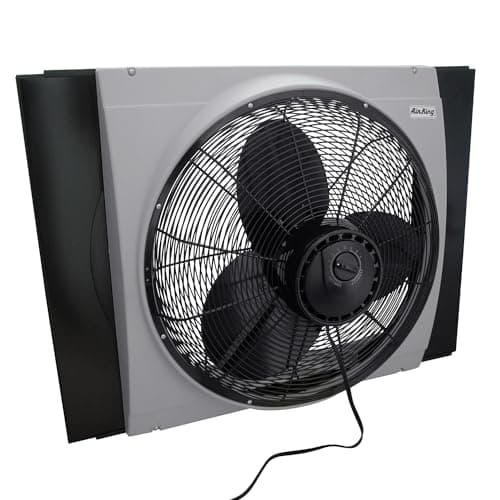
A fan can only push out as much air as the house can let back in. Pick a fan that reverses without being dismounted, seal the opening it sits in, and then open a second window on the coolest side of the house. For a whole floor that is the 20-inch Air King at 3,560 CFM; for one room, a reversible twin is enough.
Fan & Frost earns a commission when you buy through our links, at no cost to you. It never changes a ranking, and we say so when the right answer is the cheaper unit or nothing at all. Full disclosure · How we pick.
At a glance
The picks, ranked
Tap any row to jump to the full reasoning. Prices are live from Amazon where we have them, and read “check price” where we don’t — never a number we cannot verify today.
| # | Product | Best for | Price |
|---|---|---|---|
| 1 | Best overall Air King 20" Whole House Window Fan 3,560 CFM on high, reversible, and the Storm Guard housing lets the window close behind it — the most air any window fan here moves out. | Emptying the heat out of a whole floor after sunset | |
| 2 | 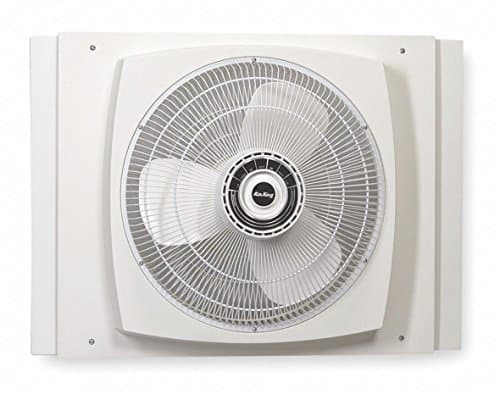 Most air per watt Air King 16" Whole House Window Fan 2,470 CFM on 90 W is 27.4 CFM per watt, the most efficient window fan we can source published figures for, at 15 lb. | A shorter opening, or a fan one person has to lift | |
| 3 | 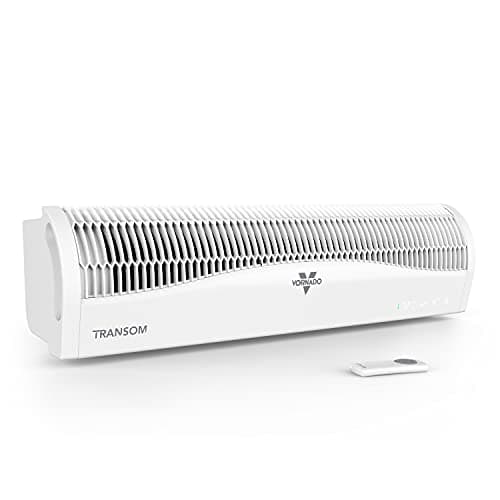 Best for a low sash Vornado Transom Window Fan Reverses to exhaust at the touch of a button, needs only 10 inches of clearance, and holds a set temperature on its own. | A window that barely opens, in a room you sleep in | |
| 4 | 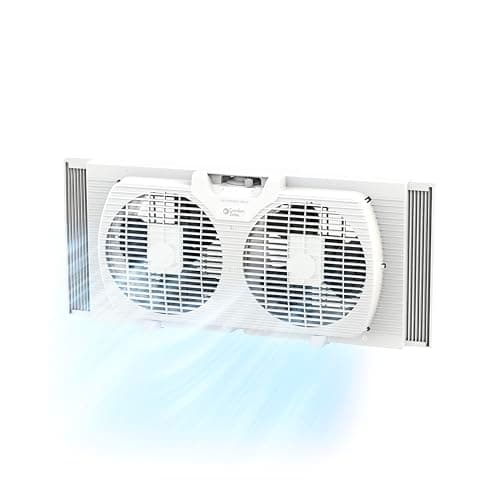 Cheapest true reversal Comfort Zone 9" Twin Window Fan Two 9-inch fans with a reversible airflow control, fitting openings from 22.25 inches wide — the least you can spend and still exhaust. | A rental, or a fan that moves from room to room | |
| — | 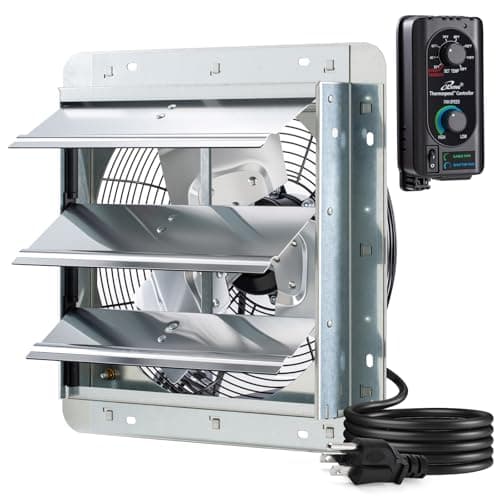 The one to skip for a window iLIVING 12" Wall-Mounted Shutter Exhaust Fan 960 CFM on 65 W and a built-in thermostat, for less than a proper window fan — and it needs a framed hole in a wall to work at all. | A wall you are willing to cut, not a window you want back |
The physics
Exhaust is not intake with the switch flipped
An intake fan and an exhaust fan do the same mechanical work in opposite directions, but they fail in completely different ways.
Blow air into a room and the room leaks it back out everywhere at once — under the door, around the sash, through the gap where the accordion panels do not quite meet. The fan wins anyway, because it is pushing air at a target and every leak still carries outdoor air inward.
Pull air out of that same room and those leaks become the problem. The fan will move its rated volume only if an equal volume can get back into the house from outside. If the room is sealed, the easiest path back in is the gap around the fan itself, and the fan spends the night recycling the same hot air past its own blades. Nothing gets cooler and the meter still turns.
This one is not a DIY job
How we ranked
What separates an exhaust fan from a fan that can face backwards
Airflow is not the first question here. Whether the fan can be reversed without being taken out of the window, and whether the opening it sits in can be closed around it, both matter more — because an exhaust setup that is awkward to switch simply does not get switched. In order:
- How it reverses. From a control, or by lifting the fan out and turning it around. Only the first one survives contact with a real night.
- How well the opening seals. Storm Guard housings, accordion panels and foam blocks all do this to different standards, and every square inch left open is air the fan pulls back in.
- Whether airflow is published at all. Two of the four manufacturers here publish a CFM figure. Two publish nothing, and we say so on their cards rather than quoting a number from a retail listing.
- CFM per watt, our own division on published airflow and published wattage, because no certification program covers window fans.
- Minimum opening. Height, almost always — this is what rules fans out, not width.
- Control. A thermostat and a remote decide whether the fan is still doing the right thing at 3 a.m.
The arithmetic
How fast each fan actually empties a room
Ventilation is sized on air changes: room volume divided by airflow gives the time for one complete change. The formula the rest of this site uses is CFM needed = (volume × air changes per hour) ÷ 60, and it rearranges to minutes per change = volume ÷ CFM.
Room volume is floor area times ceiling height. At a standard 8-foot ceiling, the two fans that publish airflow land here:
| Room, at 8 ft | Volume | 16 in, 2,470 CFM | 20 in, 3,560 CFM |
|---|---|---|---|
| 120 sq ft bedroom | 960 cu ft | 23 seconds | 16 seconds |
| 200 sq ft room | 1,600 cu ft | 39 seconds | 27 seconds |
| 400 sq ft living room | 3,200 cu ft | 1 min 18 s | 54 seconds |
| 1,200 sq ft floor | 9,600 cu ft | 3 min 53 s | 2 min 42 s |
| 2,000 sq ft house | 16,000 cu ft | 6 min 29 s | 4 min 30 s |
Two things follow from that table, and they are the whole argument of this page.
For a single room, fan size is not your constraint. A bedroom is theoretically flushed in under half a minute by either fan. Nobody experiences that, because the house cannot feed air in that fast — which is another way of saying the inlet, not the fan, sets the real rate.
For a whole floor, size is the constraint. Once you are trying to move 9,600 cubic feet, the difference between four minutes and six and a half is the difference between finishing before bed and still running at midnight.
These are free-air ratings divided by room volume. A real install, with a partly blocked grille, panels that do not seal and an inlet smaller than the fan, moves less. How much less is not something we can put a number on: no certification program measures window fans, so every figure on this page is a manufacturer claim or our arithmetic on one.
The other half
The inlet is part of the machine
Buying a second fan is the usual instinct when exhaust underperforms. An open window is free and almost always the better fix.
- Open one window on the coolest side of the house, shaded, and as far from the exhaust fan as the layout allows. Air takes the shortest path between two openings, so the distance between them is what decides how much of the house it crosses.
- Open the inlet wider than the fan. A restricted inlet throttles the fan more than a restricted outlet does, because the fan is trying to pull against it.
- Open the doors in between, or at least leave a real gap under them. A closed bedroom door reduces a whole-house exhaust to a one-room exhaust.
- Run it when outside is cooler than inside, not before. In most of the country that is after sunset and again at dawn; the daily temperature curve decides it, not the clock.
- Turn it off if the air conditioner is running. They are opposite machines: one spends money cooling air and the other throws it outside.
One safety note that applies to any strong exhaust fan in a closed house. Pulling air out lowers indoor pressure slightly, and a depressurized house can draw combustion gases back down the flue of a gas water heater, furnace or fireplace. An open inlet window prevents that as well — it is the same fix, which is the best argument for never skipping it.
Cost
What running one all night costs
Only two fans on this page publish wattage, so only two have a running cost. At 18.34¢/kWh:
| Fan, on high | 8-hour night | 30 nights |
|---|---|---|
| Air King 16 in, 90 W | 13¢ | $3.96 |
| Air King 20 in, 170 W | 25¢ | $7.48 |
| iLIVING shutter fan, 65 W | 9.5¢ | $2.86 |
Even the thirstiest fan here runs a full night for less than the daily standing charge on most utility bills. The comparison that matters is not between these fans; it is between any of them and the air conditioner they let you leave off, which is worked through in how much electricity a fan actually uses.
Before you buy
Measure these four things
- The clear opening height, with the window fully open. Under 22 inches rules out both Air Kings; under 10 rules out everything here.
- The clear opening width, which sets whether the panels or foam blocks can close the gap either side of the fan.
- Where the second opening is going to be. If the only other window is in the same room, you have a room fan, not a house fan, and you should buy accordingly.
- Whether the sash can close onto or behind the fan, which decides both weather and security for anything left running overnight.
Say the unwelcome thing
Do not buy a bigger fan to fix a small inlet.
It is the most common upgrade after a disappointing first night, and it is the one that cannot work. A fan pulling against a restricted inlet is already limited by the inlet; doubling the fan doubles the wattage and the noise, and moves very little extra air.
Open a second window first, wider than the fan, on the cool side of the house. It costs nothing, it takes a minute, and it is usually the difference people mistake for needing more fan.
If after that the fan really is the limit — a whole floor, a long open plan, a house that holds the day’s heat — then 3,560 CFM and a housing that seals is the honest upgrade, and it is a different purchase from a twin window fan rather than a bigger version of one.
In full
Every pick, and what is wrong with it
Published specifications only, each linked to the page it came from. Where a manufacturer publishes nothing, the row says so — we do not fill blanks in.
1. Best overall
Air King 20" Whole House Window Fan
Air King · model 9166F
3,560 CFM on high, reversible, and the Storm Guard housing lets the window close behind it — the most air any window fan here moves out.
Air King publishes what almost nobody else in this category does: airflow and wattage at every speed, on their own product page. The 20-inch model moves 3,560 / 3,120 / 2,510 CFM on 170 / 145 / 115 W, and it does that in either direction — Air King’s own wording is that the fan “can be set for intake or exhaust.”
Put that number against a room. A 400-square-foot living room with an 8-foot ceiling holds 3,200 cubic feet of air, so on high this fan clears it in about 54 seconds. A 2,000-square-foot floor takes roughly four and a half minutes. That is the difference between a fan that stirs a room and one that genuinely empties it.
Storm Guard matters more in exhaust than in intake. It lets the window close behind the fan, which does two things when you are blowing air out: it seals the gap you would otherwise be pulling air straight back in through, and it means a fan running overnight is not an open, unlockable window.
Running it is cheap for what it does. On high it costs 25¢ for an eight-hour night at 18.34¢/kWh, or $7.48 across thirty of them. An air conditioner doing the same job to the same room is a different order of money — that comparison is in what each cooling method actually costs.
What’s wrong with it
36.6 lb, and it needs an opening 27 to 38 inches wide by 26.25 inches high — the largest window requirement of any fan here.
Running cost — 9166F
| Nameplate power | 115 W – 170 W | manufacturer's published figure |
|---|---|---|
| Energy, 8-hour night | 1.36 kWh | 170 ÷ 1000 × 8 |
| Cost per hour | 3.1¢ | at 18.34¢/kWh |
| Cost per 8-hour night | 25¢ | on the highest speed |
| Cost per 30 nights | $7.48 | 40.8 kWh |
| Same month, lowest speed | $5.06 | at 115 W |
Rate: 18.34¢/kWh, the US average residential price for June 2026 (EIA Electric Power Monthly, Table 5.3). Yours will differ — swap it in: (watts ÷ 1000) × hours × your rate.
| Air delivery | 3,560 / 3,120 / 2,510 CFM (high / medium / low) |
|---|---|
| Power | 170 / 145 / 115 W (1.4 / 1.2 / 1.0 A) |
| Efficiency | 20.9 CFM per watt on high, 21.8 on low (our arithmetic) |
| Noise | 64 / 57 / 50 dB (high / medium / low) |
| Blade | 20 in |
| Speeds | 3 |
| Window required | 27 - 38 in wide x 26.25 in high |
| Dimensions | 26.75 W x 11.25 D x 26.25 H in |
| Weight | 36.6 lb |
| Storm Guard | Window can close behind the fan |
| Mounting | Hardware included |
| ENERGY STAR | No program exists for window fans |
Every figure above is from Air King whole house window fan product page, models 9155 and 9166F. Blanks are shown as “not published” rather than filled in.
2. Most air per watt
Air King 16" Whole House Window Fan
Air King · model 9155
2,470 CFM on 90 W is 27.4 CFM per watt, the most efficient window fan we can source published figures for, at 15 lb.
The 16-inch model gives up about 31% of the airflow and takes back more than that in efficiency: 27.4 CFM per watt on high against 20.9 for the 20-inch, on our arithmetic from Air King’s published figures. Nobody certifies window fans, so that division is the only efficiency number that exists for them.
It is also the one that fits more windows. It needs 22 inches of height rather than 26.25, and it weighs 15 lb rather than 36.6 — which matters because an exhaust fan tends to get moved around the house chasing whichever room is hottest, rather than installed once for the season.
2,470 CFM still clears a 400-square-foot room in about 78 seconds. For a single floor of a normal house, the smaller fan is not a compromise; it is the better-argued buy. If your opening is an awkward shape, the numbers that decide it are in window fans for casement and sliding windows.
What’s wrong with it
Still needs 26.5 inches of width, has no thermostat and no remote, and Air King publishes no noise figure for it.
Running cost — 9155
| Nameplate power | 52 W – 90 W | manufacturer's published figure |
|---|---|---|
| Energy, 8-hour night | 0.72 kWh | 90 ÷ 1000 × 8 |
| Cost per hour | 1.7¢ | at 18.34¢/kWh |
| Cost per 8-hour night | 13¢ | on the highest speed |
| Cost per 30 nights | $3.96 | 21.6 kWh |
| Same month, lowest speed | $2.29 | at 52 W |
Rate: 18.34¢/kWh, the US average residential price for June 2026 (EIA Electric Power Monthly, Table 5.3). Yours will differ — swap it in: (watts ÷ 1000) × hours × your rate.
| Air delivery | 2,470 / 1,700 / 1,360 CFM (high / medium / low) |
|---|---|
| Power | 90 / 65 / 52 W (0.8 / 0.6 / 0.5 A) |
| Efficiency | 27.4 CFM per watt on high, 26.2 on low (our arithmetic) |
| Blade | 16 in |
| Speeds | 3 |
| Window required | 26.5 - 34.5 in wide x 22 in high |
| Dimensions | 26.5 W x 8.25 D x 22 H in |
| Weight | 15.0 lb |
| Storm Guard | Window can close behind the fan |
| Mounting | Hardware included |
| Noise | Not published |
| ENERGY STAR | No program exists for window fans |
Every figure above is from Air King whole house window fan product page, models 9155 and 9166F. Blanks are shown as “not published” rather than filled in.
3. Best for a low sash
Vornado Transom Window Fan
Vornado · model Transom
Reverses to exhaust at the touch of a button, needs only 10 inches of clearance, and holds a set temperature on its own.
Every other fan on this page needs 22 inches of vertical opening or more. The Transom asks for 10 inches of clearance and is 6.75 inches tall, which makes it the answer for a sash that only lifts a hand’s width — a very common situation in apartments with window stops.
Vornado reverses it electronically, so switching a room from drawing in cool night air to pushing out the day’s heat does not mean unmounting anything. The automatic temperature control cycles the fan against a set point, and the remote means that happens without getting up.
It fits windows 26 to 40 inches wide on foam blocks rather than accordion panels, the enclosure is UV-protected and weather resistant, and it carries a five-year warranty — five times the cover on the cheap twins.
One honest caveat, and it is the reason this is not the top pick: Vornado publishes no CFM and no wattage for it. That is consistent with how they specify their circulators, but it means we cannot tell you what it moves, what it costs to run, or how it compares per watt. Everything above is a capability; none of it is a flow rate.
What’s wrong with it
No published airflow or wattage at all, so no CFM-per-watt figure and no running cost can be computed for it.
Running cost
Vornado does not publish a wattage for the Transom, so we cannot calculate what it costs to run. We are not going to estimate one. If Vornado publishes a nameplate figure, this block will show the arithmetic.
| Modes | Intake or exhaust, reversed electronically |
|---|---|
| Speeds | 4 |
| Window fit | 26 - 40 in wide |
| Opening required | 10 in minimum clearance |
| Height | 6.75 in |
| Thermostat | Automatic temperature control |
| Remote | Included |
| Enclosure | Weather resistant, UV protected |
| Air delivery | Not published |
| Power | Not published |
| Warranty | 5 years |
Every figure above is from Vornado product page, Transom window fan. Blanks are shown as “not published” rather than filled in.
4. Cheapest true reversal
Comfort Zone 9" Twin Window Fan
Comfort Zone · model CZ319WT
Two 9-inch fans with a reversible airflow control, fitting openings from 22.25 inches wide — the least you can spend and still exhaust.
The important word on this fan is control. Plenty of cheap twin window fans are “reversible” only in the sense that you can take the fan out of the window, turn the whole housing around and put it back. This one reverses from a control on the unit, which is what makes overnight switching realistic.
It is also the most forgiving on width. The expanders run from 22.25 to 33 inches, so it covers narrow openings that every whole-house fan here rules out, and the whole thing is light enough to carry upstairs one-handed.
What you give up is knowing anything. Comfort Zone publishes no CFM and no wattage; the retail listing quotes an air speed of 9.84 feet per second, which is a velocity at the blade and not a flow rate, so it cannot be converted into either. Two 9-inch fans will not move what a 16-inch whole-house fan moves, and we are not going to guess by how much.
What’s wrong with it
Two speeds, a one-year warranty, and no published airflow or power figures — you are buying a category, not a specification.
Running cost
Comfort Zone does not publish a wattage for the CZ319WT, so we cannot calculate what it costs to run. We are not going to estimate one. If Comfort Zone publishes a nameplate figure, this block will show the arithmetic.
| Modes | Intake or exhaust, reversed by a manual control |
|---|---|
| Speeds | 2 |
| Blades | Two 9 in fans |
| Window fit | 22.25 - 33 in wide |
| Opening required | Not published |
| Air delivery | Not published |
| Power | Not published |
| Cover | Removable fabric cover |
| Warranty | 1 year |
Every figure above is from Comfort Zone product page, CZ319WT. Blanks are shown as “not published” rather than filled in.
Skip this one
iLIVING 12" Wall-Mounted Shutter Exhaust Fan
iLIVING · model ILG8SF12V-ST
960 CFM on 65 W and a built-in thermostat, for less than a proper window fan — and it needs a framed hole in a wall to work at all.
This is the fan that search results hand you when you type “exhaust fan.” On paper it looks like a bargain: 960 CFM on 65 W is 14.8 CFM per watt, it has automatic aluminum shutters, and the supplied controller holds a temperature between 32 and 130 degrees.
It is a wall fan. Mounting it means cutting and framing an opening, wiring it in place and giving up that piece of wall permanently. There is no sash to close behind it and no accordion panel to fill the gap, because it was never designed to sit in a window. It belongs in a garage, a shed or a shop — where, to be fair, it is a good buy, and it turns up in garage exhaust fans for exactly that reason.
Judged as a window fan it also loses on its own numbers. 960 CFM is less than half of what the 16-inch window fan moves, at 14.8 CFM per watt against 27.4. You would be cutting a hole in your house for less air, less efficiently, with no way to undo it in October.
What’s wrong with it
Permanent installation in a cut wall opening, no window mounting of any kind, and less airflow per watt than either Air King.
Running cost — ILG8SF12V-ST
| Nameplate power | 65 W | manufacturer's published figure |
|---|---|---|
| Energy, 8-hour night | 0.52 kWh | 65 ÷ 1000 × 8 |
| Cost per hour | 1.2¢ | at 18.34¢/kWh |
| Cost per 8-hour night | 9.5¢ | on the highest speed |
| Cost per 30 nights | $2.86 | 15.6 kWh |
Rate: 18.34¢/kWh, the US average residential price for June 2026 (EIA Electric Power Monthly, Table 5.3). Yours will differ — swap it in: (watts ÷ 1000) × hours × your rate.
| Air delivery | 960 CFM |
|---|---|
| Power | 65 W (115 V, 0.6 A, 1/20 HP) |
| Efficiency | 14.8 CFM per watt (our arithmetic) |
| Speed | 1,650 RPM, variable with the supplied controller |
| Blade | 12 in steel |
| Shutters | Automatic aluminum |
| Control | Thermospeed controller, 32 - 130 F |
| Coverage | Up to 1,400 sq ft |
| Noise | Under 65 dB |
| Mounting | Wall mount, into a cut and framed opening |
| Listing | UL / cUL |
Every figure above is from iLiving USA product page, ILG8SF12V-ST. Blanks are shown as “not published” rather than filled in.
We are not linking a buy button for this one. If you want to look at it anyway, it is easy enough to find — but we would rather send you to something that fits your room.
Questions people actually ask
Frequently asked
Should a window fan blow in or out?
Out, when the air indoors is hotter than the air outside and you can open a second window elsewhere. In, when you want cool outdoor air delivered to one specific room. The fan does the same work either way; what changes is which room gets the fresh air first.
Do I need two window fans, one in and one out?
Usually not. A second fan costs money and watts to do what an open window on the cool side of the house does for free. Two fans help only when the two openings are far apart and the path between them is broken up by doors and corners.
Can any window fan be used for exhaust?
Only if it reverses. Some fans reverse from a control on the unit or a remote, which is the kind worth buying. Others reverse only by dismounting the fan and physically turning it around, which nobody keeps doing twice a day.
How many CFM do I need to exhaust a room?
Divide the room volume by how many minutes you will accept for one complete air change. A 400-square-foot room with an 8-foot ceiling is 3,200 cubic feet, so a one-minute change needs about 3,200 CFM and a three-minute change needs about 1,070. Sizing a fan to a room.
Is a window fan or an exhaust fan better for cooling a room?
A window fan, because it is reversible and reversible is what a house needs. A wall-mounted shutter exhaust fan moves air one way only, has to be installed in a cut opening, and cannot be moved to whichever room is hottest tonight.
Is it safe to run a window fan on exhaust all night?
Yes, with one condition: leave a window open elsewhere. A strong exhaust fan in a closed-up house lowers indoor pressure, which in a home with a gas furnace, water heater or fireplace can pull combustion gases back down the flue. An open inlet prevents it. Leaving a fan running overnight.
Sources
Where these numbers came from
- Air King whole house window fan product page — models 9155 and 9166F: CFM, watts and amps at each speed, blade size, required window size, dimensions, weight, Storm Guard, and the statement that the fan can be set for intake or exhaust
- Vornado product page, Transom — four speeds, electronic reversal to exhaust, 26 to 40 in window fit, 10 in minimum clearance, 6.75 in height, automatic temperature control, remote, UV-protected weather-resistant enclosure, 5-year warranty; no CFM or wattage published
- Comfort Zone product page, CZ319WT — two 9 in fans, two speeds, reversible airflow control, 22.25 to 33 in width range, removable fabric cover, 1-year warranty; no CFM or wattage published
- iLiving USA product page, ILG8SF12V-ST — 960 CFM, 65 W at 115 V and 0.6 A, 1,650 RPM, 12 in steel blade, automatic aluminum shutters, Thermospeed controller 32 to 130 F, coverage to 1,400 sq ft, under 65 dB, UL/cUL listed
- EIA Electric Power Monthly, Table 5.3 — average residential electricity price
Read next
Where to go from here
Back to Fans, or read how we pick.