The picks
Through-the-wall air conditioners: when the window is not an option
The permanent version of a window unit: nothing blocks the glass, nothing comes out in October. The trade is a hole in your wall and about two CEER points.
By Sawyer V. · Published
The short answer
The Friedrich WCVT10B10B is the efficiency pick: 10,100 BTU at CEER 14.2, 533.5 kWh a year, on the Most Efficient list. The Midea MAT10R1FWTK matches it closely at half the weight. Expect CEER around 14 rather than a window unit’s 16 — the sleeve restricts airflow.
Fan & Frost earns a commission when you buy through our links, at no cost to you. It never changes a ranking, and we say so when the right answer is the cheaper unit or nothing at all. Full disclosure · How we pick.

At a glance
The picks, ranked
Tap any row to jump to the full reasoning. Prices are live from Amazon where we have them, and read “check price” where we don’t — never a number we cannot verify today.
| # | Product | Best for | Price |
|---|---|---|---|
| 1 | Best efficiency Friedrich Through-the-Wall Air Conditioner, 10,100 BTU CEER 14.2 is the highest in the certified through-the-wall data, and it is on the ENERGY STAR Most Efficient list. | 400-450 sq ft, in an existing standard sleeve | |
| 2 | Best weight for the capacity Midea Through-the-Wall Air Conditioner, 10,000 BTU 56.2 lb against the Friedrich's 110, for CEER 14.1 and 531.9 kWh a year — essentially the same running cost at half the mass. | The same 400-450 sq ft, when you have to install it yourself | |
| 3 | 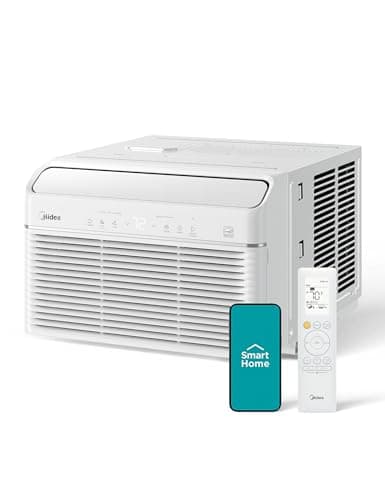 For a smaller room Midea Through-the-Wall Air Conditioner, 8,000 BTU 8,000 BTU at CEER 14.1 and 425.5 kWh a year — the right capacity for the rooms these usually go in. | 300-350 sq ft, which is most bedrooms and offices | |
| — | 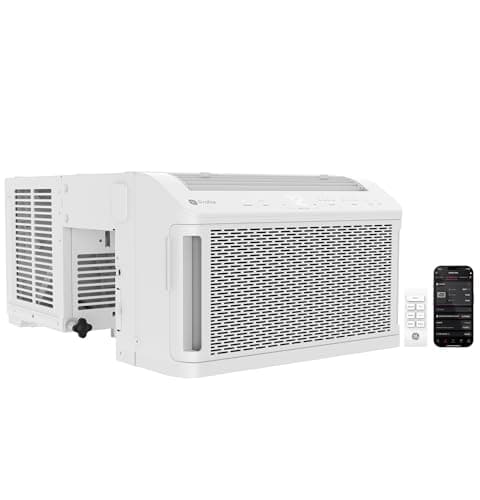 What you give up GE Profile ClearView Window Air Conditioner, 8,000 BTU CEER 16 and 375 kWh a year, at 46.2 lb — the same capacity, better efficiency, no hole in the wall. | Anyone who could use a window after all |
A through-the-wall air conditioner does the same job as a window unit from a permanent opening in the wall instead of the window. It is the format hotels and apartment buildings use, and for a homeowner it solves one specific problem: keeping the window free, all year.
The trade
You give up about two CEER points
The efficiency gap between through-the-wall and window units is consistent and worth understanding before you commit to construction.
| Unit | Type | BTU | CEER | kWh/yr | Cost/yr |
|---|---|---|---|---|---|
| GE Profile PWJV08W | Window | 8,000 | 16 | 375 | $69 |
| Midea MAT08R1FWTK | Through-wall | 8,000 | 14.1 | 425.5 | $78 |
| Midea MAT10R1FWTK | Through-wall | 10,000 | 14.1 | 531.9 | $98 |
| Friedrich WCVT10B10B | Through-wall | 10,100 | 14.2 | 533.5 | $98 |
From the ENERGY STAR certified dataset; costs are our arithmetic at 18.34¢/kWh.
Why the penalty exists: a window unit sits in an open window with air free to move around its sides and back. A through-the-wall unit sits in a closed metal sleeve, which restricts airflow over the condenser and forces the unit to work harder to reject the same heat. It is a geometry problem, not a build-quality one, and no manufacturer engineers around it.
Roughly $9.26 a year at 8,000 BTU. Over a decade that is real, and it is the honest cost of keeping the window.
The deciding factor
The sleeve, and whether you already have one
This is the whole practical question, and it splits buyers into two very different situations.
If you have an existing sleeve — common in condos, apartments and houses where a previous owner installed one — through-the-wall is straightforward and often the obvious choice. Measure the sleeve’s internal dimensions precisely, then buy a unit that fits it. Sleeve sizes are not standardized across brands, and a unit that is an inch too wide is a return.
Also check whether the sleeve is a “slide-out chassis” type and whether it is insulated. Old uninsulated sleeves leak heat and can be worth replacing while the wall is open.
If you do not have a sleeve, you are contemplating cutting a hole through an exterior wall, and the calculation changes completely.
This one is not a DIY job
Creating a new through-the-wall opening is not a DIY job. It means cutting an exterior wall, which may be load-bearing, and framing a properly supported opening with a lintel or header. You must also know what is inside the wall before you cut: electrical runs, plumbing, and gas lines are all routed through exterior walls.
Get a licensed contractor. The install cost frequently exceeds the price of the unit, and that is the honest number to weigh against a window unit costing less to buy and less to run.
Flashing and weatherproofing matter as much as the structural work. A badly sealed sleeve is a permanent water path into your wall cavity, and that damage is expensive and slow to discover.
When it is right
Four cases where it is genuinely the answer
- You already have a sleeve. The construction cost is already paid. Just measure carefully and buy to fit.
- The window is the only light or the only egress. In a small bedroom, giving up half the window for four months is a real loss, and in some jurisdictions blocking an egress window is not permitted at all.
- Casement or slider windows. Neither takes a conventional window unit. Through-the-wall and a portable are the two options, and the wall unit is far more efficient.
- You want it permanent. No seasonal install, no uninstall, no storage, no annual re-sealing. For a room used year-round this genuinely matters.
Say the unwelcome thing
Do not put a window unit in a wall sleeve.
They look interchangeable and they are not. A window air conditioner vents heat from its sides and back, because in a window those surfaces sit in open air. A through-the-wall unit vents from the back only, because it is designed to sit inside a closed sleeve.
Put a window unit in a sleeve and the side vents are blocked. It recirculates its own hot exhaust, loses capacity, runs hot, and shortens the compressor’s life. Units are labeled for this reason.
Some models are certified for both. If yours is, the manual will say so explicitly — if it does not, assume it is not.
Before ordering
Five measurements to take first
- Sleeve internal width, height and depth, to the nearest eighth of an inch. Not the outside of the trim.
- Electrical. What outlet is behind or beside the sleeve, and on what circuit? Larger units may need a dedicated one, and some run on 208/230 V.
- Wall thickness. Standard sleeves suit a particular range; a thick masonry wall may need an extension.
- Drainage. Where does condensate go, and does the sleeve slope very slightly outward so it drains away from the wall?
- Capacity, from the room. 8,000 BTU for 300–350 sq ft, 10,000 for 400–450 — size it properly, because oversizing here is as bad as anywhere else.
And if the room has no exterior wall at all, this format is not available to you — the windowless-room page covers what is left.
In full
Every pick, and what is wrong with it
Published specifications only, each linked to the page it came from. Where a manufacturer publishes nothing, the row says so — we do not fill blanks in.
1. Best efficiency
Friedrich Through-the-Wall Air Conditioner, 10,100 BTU
Friedrich · model WCVT10B10B
CEER 14.2 is the highest in the certified through-the-wall data, and it is on the ENERGY STAR Most Efficient list.
10,100 BTU at CEER 14.2, 533.5 kWh a year — about $98 at 18.34¢/kWh for a season. That is the best efficiency figure in the certified through-the-wall set we pulled, and it earns Most Efficient listing.
A variable-speed compressor is doing the work here, same as in the better window units: it modulates rather than cycling hard, which both improves the numbers and dehumidifies properly.
110 lb is the specification to plan around. A through-the-wall install puts the unit at waist or chest height in a sleeve, which means you are lifting the full weight to that height and then pushing it horizontally into place. Two people and something to rest it on partway.
What’s wrong with it
110 lb. That is roughly double the Midea for the same capacity, and lifting it into a sleeve at chest height is genuinely a two-person job with a platform.
Running cost — WCVT10B10B
| Annual energy use | 533.5 kWh | ENERGY STAR certified figure |
|---|---|---|
| Annual cost | $98 | 533.5 × 18.34¢/kWh |
| Per cooling month | $24 | spread over a four-month season |
The annual figure is the certified value from the ENERGY STAR Certified Room Air Conditioners dataset, which models a standard cooling season rather than your actual summer. It is more useful than a nameplate wattage here, because a variable-speed compressor spends most of its life well below nameplate.
Rate: 18.34¢/kWh, the US average residential price for June 2026 (EIA Electric Power Monthly, Table 5.3). Yours will differ — swap it in: (watts ÷ 1000) × hours × your rate.
| Cooling capacity | 10,100 BTU/h |
|---|---|
| CEER | 14.2 |
| Annual energy use | 533.5 kWh/yr |
| Weight | 110.0 lb |
| Refrigerant | R-32 |
| Installation | Through the wall (existing sleeve required) |
| Compressor | Variable speed |
| ENERGY STAR | Certified, and on the Most Efficient list |
Every figure above is from ENERGY STAR Certified Room Air Conditioners dataset. Blanks are shown as “not published” rather than filled in.
2. Best weight for the capacity
Midea Through-the-Wall Air Conditioner, 10,000 BTU
Midea · model MAT10R1FWTK
56.2 lb against the Friedrich's 110, for CEER 14.1 and 531.9 kWh a year — essentially the same running cost at half the mass.
531.9 kWh a year — about $98, marginally better than the Friedrich despite the 0.1 lower CEER, because the capacities differ slightly.
For practical purposes these two are the same machine on running cost. The difference is 56.2 lb against 110 lb, and for anyone doing the install themselves that decides it.
Also on the Most Efficient list, R-32 refrigerant, variable-speed compressor. Midea makes a large share of this category under many brand names, so equivalent units appear under other labels — check the certified data rather than the badge.
What’s wrong with it
0.1 CEER behind the Friedrich, which is noise rather than signal. Midea publishes no dimensions in the certified dataset, so measure your sleeve and check the spec sheet before ordering.
Running cost — MAT10R1FWTK
| Annual energy use | 531.9 kWh | ENERGY STAR certified figure |
|---|---|---|
| Annual cost | $98 | 531.9 × 18.34¢/kWh |
| Per cooling month | $24 | spread over a four-month season |
The annual figure is the certified value from the ENERGY STAR Certified Room Air Conditioners dataset, which models a standard cooling season rather than your actual summer. It is more useful than a nameplate wattage here, because a variable-speed compressor spends most of its life well below nameplate.
Rate: 18.34¢/kWh, the US average residential price for June 2026 (EIA Electric Power Monthly, Table 5.3). Yours will differ — swap it in: (watts ÷ 1000) × hours × your rate.
| Cooling capacity | 10,000 BTU/h |
|---|---|
| CEER | 14.1 |
| Annual energy use | 531.9 kWh/yr |
| Weight | 56.2 lb |
| Refrigerant | R-32 |
| Installation | Through the wall (existing sleeve required) |
| Compressor | Variable speed |
| ENERGY STAR | Certified, and on the Most Efficient list |
Every figure above is from ENERGY STAR Certified Room Air Conditioners dataset. Blanks are shown as “not published” rather than filled in.
3. For a smaller room
Midea Through-the-Wall Air Conditioner, 8,000 BTU
Midea · model MAT08R1FWTK
8,000 BTU at CEER 14.1 and 425.5 kWh a year — the right capacity for the rooms these usually go in.
Most through-the-wall installations serve a bedroom, a home office or a hotel-style room, and 8,000 BTU covers 300–350 sq ft on the ENERGY STAR table — which is most of them.
425.5 kWh a year, about $78. Most Efficient listed.
Worth seeing the gap plainly: a certified 8,000 BTU window unit uses 375 kWh for the same capacity — $69 against $78. About $9.26 a year is the price of keeping your window.
What’s wrong with it
CEER 14.1 against a comparable window unit's 16 means roughly 50 kWh a year more for the same cooling. That is the sleeve tax, and it is unavoidable in this format.
Running cost — MAT08R1FWTK
| Annual energy use | 425.5 kWh | ENERGY STAR certified figure |
|---|---|---|
| Annual cost | $78 | 425.5 × 18.34¢/kWh |
| Per cooling month | $20 | spread over a four-month season |
The annual figure is the certified value from the ENERGY STAR Certified Room Air Conditioners dataset, which models a standard cooling season rather than your actual summer. It is more useful than a nameplate wattage here, because a variable-speed compressor spends most of its life well below nameplate.
Rate: 18.34¢/kWh, the US average residential price for June 2026 (EIA Electric Power Monthly, Table 5.3). Yours will differ — swap it in: (watts ÷ 1000) × hours × your rate.
| Cooling capacity | 8,000 BTU/h |
|---|---|
| CEER | 14.1 |
| Annual energy use | 425.5 kWh/yr |
| Refrigerant | R-32 |
| Installation | Through the wall (existing sleeve required) |
| Compressor | Variable speed |
| ENERGY STAR | Certified, and on the Most Efficient list |
Every figure above is from ENERGY STAR Certified Room Air Conditioners dataset. Blanks are shown as “not published” rather than filled in.
Skip this one
GE Profile ClearView Window Air Conditioner, 8,000 BTU
GE Profile · model PWJV08W
CEER 16 and 375 kWh a year, at 46.2 lb — the same capacity, better efficiency, no hole in the wall.
Included so the trade is explicit rather than implied. Before cutting a wall, it is worth confirming a window unit genuinely will not work.
CEER 16 against 14.1, and 375 kWh against 425.5 for the same 8,000 BTU. It is also 46.2 lb rather than 53.8, cheaper to buy, and requires no construction.
The reasons to accept the through-the-wall penalty are real: a window you cannot spare, a casement that will not take a unit, a room where the window is the only light, or an existing sleeve left by a previous owner. If none applies, buy the window unit.
What’s wrong with it
It occupies the window for the season and has to come out and be stored. If keeping the window clear year-round is the whole reason you are here, this does not do that.
Running cost — PWJV08W
| Annual energy use | 375 kWh | ENERGY STAR certified figure |
|---|---|---|
| Annual cost | $69 | 375 × 18.34¢/kWh |
| Per cooling month | $17 | spread over a four-month season |
The annual figure is the certified value from the ENERGY STAR Certified Room Air Conditioners dataset, which models a standard cooling season rather than your actual summer. It is more useful than a nameplate wattage here, because a variable-speed compressor spends most of its life well below nameplate.
Rate: 18.34¢/kWh, the US average residential price for June 2026 (EIA Electric Power Monthly, Table 5.3). Yours will differ — swap it in: (watts ÷ 1000) × hours × your rate.
| Cooling capacity | 8,000 BTU/h |
|---|---|
| CEER | 16 |
| Annual energy use | 375 kWh/yr |
| vs federal standard | 47% less energy |
| Dimensions | 12.6 H x 18.6 W x 15.3 D in |
| Weight | 46.2 lb |
| Refrigerant | R-32 |
| Installation | Does not straddle the windowsill |
| Compressor | Variable speed |
| ENERGY STAR | Certified, and on the Most Efficient list |
Every figure above is from ENERGY STAR Certified Room Air Conditioners dataset. Blanks are shown as “not published” rather than filled in.
We are not linking a buy button for this one. If you want to look at it anyway, it is easy enough to find — but we would rather send you to something that fits your room.
Questions people actually ask
Frequently asked
What is a through-the-wall air conditioner?
An air conditioner that sits in a permanent metal sleeve set into an exterior wall rather than in a window. It does the same job as a window unit, keeps the window clear year-round, and never needs seasonal removal.
Are through-the-wall air conditioners less efficient than window units?
Yes, by roughly two CEER points. The certified data shows through-the-wall units around CEER 14.1 to 14.2 against 16 for comparable window units — at 8,000 BTU that is 425.5 kWh a year against 375, or about $9.26 more annually. The sleeve restricts airflow over the condenser.
Can I put a window air conditioner in a wall sleeve?
No, unless the unit is explicitly certified for both. A window unit vents heat from its sides and back; a wall sleeve blocks the sides, so it recirculates its own exhaust, loses capacity and runs hot. Through-the-wall units are designed to vent from the back only.
How much does it cost to install a through-the-wall air conditioner?
If you have an existing sleeve, effectively nothing beyond the unit. If you need a new opening cut, the install frequently costs more than the air conditioner — it means cutting a possibly load-bearing exterior wall, framing a supported opening, and weatherproofing it. That is licensed-contractor work.
What size through-the-wall air conditioner do I need?
The same ENERGY STAR sizing table as any room unit: 8,000 BTU for 300 to 350 sq ft, 10,000 for 400 to 450. Oversizing causes the same short-cycling and poor dehumidification here as it does in a window. Size it properly.
Are wall sleeves a standard size?
No — sizes vary between manufacturers, which is the most common reason a replacement unit does not fit. Measure the internal width, height and depth of your existing sleeve to the nearest eighth of an inch before ordering anything.
Sources
Where these numbers came from
Read next
Where to go from here
Back to Air Conditioners, or read how we pick.