Head to head
Evaporative cooler vs dehumidifier
These are not alternatives to each other. They are opposites, and in a humid room the cooler wins the fight — which is exactly the outcome you did not want.
By Sawyer V. · Published
The short answer
An evaporative cooler deliberately raises humidity; a dehumidifier lowers it. If your discomfort is heat in dry air, the cooler is the right machine. If it is mugginess, damp or condensation, it is the worst possible purchase and the dehumidifier is the answer. The scale is not close: the Hessaire MC37M’s 10.3-gallon tank is 39 liters of water, against the best household-name dehumidifier’s certified 23.5 liters a day of removal.
Fan & Frost earns a commission when you buy through our links, at no cost to you. It never changes a ranking, and we say so when the right answer is the cheaper unit or nothing at all. Full disclosure · How we pick.
At a glance
The picks, ranked
Tap any row to jump to the full reasoning. Prices are live from Amazon where we have them, and read “check price” where we don’t — never a number we cannot verify today.
| # | Product | Best for | Price |
|---|---|---|---|
| 1 | 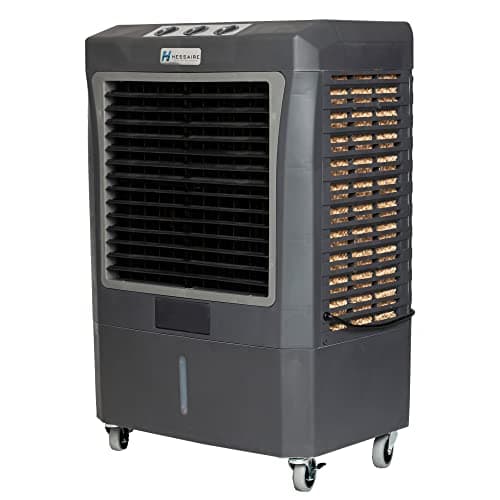 The evaporative cooler case Hessaire MC37M Mobile Evaporative Cooler 3,100 CFM on 250 W, our arithmetic 12.4 CFM per watt, with a 10.3-gallon tank and continuous hookup. It cools by adding water, which is the feature and the limit in one sentence. | Hot, dry air — a Southwest summer, a garage, a workshop, a patio — where the air has the capacity to take water and cooling is the whole job | |
| 2 | 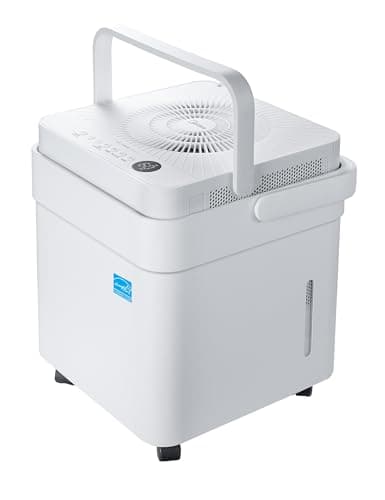 The dehumidifier case Midea Dehumidifier, 50 pints/day 49.67 pints a day — 23.5 liters — at a certified IEF of 2.08 L/kWh, which is about 9 cents per liter removed. The only household-name brand above the certified efficiency ceiling. | Muggy air, damp smells, mold in cold corners, condensation on glass — any discomfort where the water in the air is the problem rather than the temperature |
People arrive at this comparison from a real place: a room that is hot and sticky, and two machines that both claim to fix it. They do not both fix it. One of them makes it worse in a way that is easy to quantify.
Head to head
Every published figure, side by side
| Hessaire MC37M | Midea 50-pint | |
|---|---|---|
| Effect on humidity | Raises it | Lowers it |
| Effect on temperature | Lowers it | Raises it slightly |
| Water | Consumes it, 10.3 gal tank | Collects it, 23.5 L/day |
| Power | 250 W | Not published |
| Air delivery | 3,100 CFM | Not published |
| Federal efficiency rating | None exists | IEF 2.08 L/kWh, certified |
| Cost of eight hours | 37¢ | Not calculable from published data |
| Works best in | Dry air | Humid air |
| Fails in | Humid air | Air below about 60 F |
| Noise | Not published | Not published |
Hessaire figures from its own product page; Midea figures from the ENERGY STAR Certified Dehumidifiers dataset. Liters, CFM per watt and the running cost are our arithmetic. Note the asymmetry: the dehumidifier is rated on a federal test and publishes no wattage, while the cooler publishes its wattage and is rated by nobody.
Read the first two rows again. Every line after them follows from the fact that these machines push the room in opposite directions on both axes at once.
The arithmetic
One tank against a day of dehumidifying
The most useful way to see the scale mismatch is to put the cooler’s tank next to the dehumidifier’s certified capacity.
- The cooler’s tank holds 10.3 US gallons — 39.0 liters by our conversion at 3.785 liters per gallon. Every liter of it that evaporates goes into the air of the space being cooled.
- The dehumidifier removes a certified 23.5 liters a day at the federal test condition, which is the best figure any household-name brand achieves.
- So one tank is about 1.66 days of that machine’s output. A cooler working through a tank a day puts water into a room two-thirds faster than the best mainstream dehumidifier can take it out.
That calculation carries one assumption we have to flag, because Hessaire publishes no consumption rate: it assumes the cooler empties its tank in a day. Whether it takes half a day or two days changes the ratio, and no published figure settles it. The order of magnitude is what matters, and it is not in doubt — a cooler’s whole function is to evaporate tens of liters.
This one is not a DIY job
Running both in one room is the specific mistake this page exists to prevent. They will not balance out at a comfortable middle; they will each give the other permanent work, you will pay for both, and on the arithmetic above the cooler is the stronger machine. If you find yourself wanting both, the room needs refrigeration or ventilation rather than either of these. Cooler against air conditioner.
The decision
One reading picks the machine
The EPA publishes an indoor target of “below 60 percent (ideally between 30 and 50 percent) relative humidity”. Take a reading in the room that is uncomfortable, at the hour it is worst, and the choice makes itself.
| Reading in the room | What you have | Machine |
|---|---|---|
| Below 30% | Hot, dry air with capacity to spare | Evaporative cooler |
| 30 - 50% | Inside the published band | Cooler if it is hot; neither if not |
| 50 - 60% | Upper half of the band | Dehumidifier, or refrigeration |
| Above 60% | Outside the band; mold risk | Dehumidifier. A cooler is the wrong buy |
Band from the EPA’s mold and moisture guidance; the machine column is ours. The reason to measure rather than judge by feel is that muggy and dry both register as “uncomfortable and hot”.
There is a geographic shortcut that works most of the time, and it is the one the category is built on: evaporative cooling is a dry-climate technology. In the arid Southwest it is the efficient answer. On the Gulf Coast it is close to useless, for the same physical reason. Where in the country each one works.
One room, both problems
If the room is hot and muggy
This is the case that sends people to this comparison, and the honest answer is that neither machine is the right one.
- An air conditioner does both jobs at once. Refrigeration cools the air below its dew point, so water condenses out and drains away — cooler and drier, from one machine. That is the actual answer to hot and muggy. Window units on certified efficiency.
- A fan plus a dehumidifier is the budget version. The dehumidifier takes the water out and the fan makes the resulting drier air feel several degrees cooler against skin. Together they cost a fraction of refrigeration. Why dry air at the same temperature feels cooler.
- Ventilation, if the outdoor air is drier. Free, and in many climates true for several hours a day.
Say the unwelcome thing
Do not buy an evaporative cooler to make a muggy room comfortable.
It is the single most common wrong purchase in this category, and it fails for a structural reason rather than a quality one. Evaporative cooling only produces cooling in proportion to how much water the air can still absorb. In already-humid air there is little capacity left, so you get a small temperature drop and a large humidity rise — the exact trade that makes a room feel worse.
The same applies to running one in a closed room of any climate. A cooler needs an open window or door to exhaust the air it has humidified; sealed up, it saturates its own supply and stops cooling within an hour or two. The humidity ceiling, in detail.
In full
Every pick, and what is wrong with it
Published specifications only, each linked to the page it came from. Where a manufacturer publishes nothing, the row says so — we do not fill blanks in.
1. The evaporative cooler case
Hessaire MC37M Mobile Evaporative Cooler
Hessaire · model MC37M
3,100 CFM on 250 W, our arithmetic 12.4 CFM per watt, with a 10.3-gallon tank and continuous hookup. It cools by adding water, which is the feature and the limit in one sentence.
3,100 CFM on 250 W / 2.4 A, published, with a 10.3-gallon water tank and continuous-hookup capability. Our arithmetic gives 12.4 CFM per watt, and eight hours of running costs 37¢ at 18.34¢/kWh.
Against refrigeration those are extraordinary numbers — a comparable air conditioner draws four to five times the power. The reason is that an evaporative cooler does not run a compressor; it trades water for temperature, pulling heat out of the air to evaporate moisture into it.
Which means the cooling and the humidifying are the same event. There is no setting that gives you one without the other, and no version of this machine that dehumidifies. Why the two cannot be separated.
Hessaire publishes no water consumption rate for it — only the tank size — so we cannot tell you liters per hour. What the tank size does tell you is the order of magnitude: 10.3 gallons is 39.0 liters by our conversion, all of it destined for the air in the room.
What’s wrong with it
It raises the humidity of whatever it cools, by design and by a lot. In air that is already muggy it adds discomfort rather than removing it, and in a closed room it will defeat a dehumidifier running alongside it.
Running cost — MC37M
| Nameplate power | 250 W | manufacturer's published figure |
|---|---|---|
| Energy, 8-hour night | 2.00 kWh | 250 ÷ 1000 × 8 |
| Cost per hour | 4.6¢ | at 18.34¢/kWh |
| Cost per 8-hour night | 37¢ | on the highest speed |
| Cost per 30 nights | $11 | 60.0 kWh |
Rate: 18.34¢/kWh, the US average residential price for June 2026 (EIA Electric Power Monthly, Table 5.3). Yours will differ — swap it in: (watts ÷ 1000) × hours × your rate.
| Air delivery | 3,100 CFM |
|---|---|
| Power | 250 W / 2.4 A |
| Water tank | 10.3 gallons, continuous hookup capable |
| Dimensions | 24 L x 16 W x 38 H in |
| Weight | 40 lb |
| Pads | Industrial-grade cooling pads |
| Coverage claim | Not published on the product page |
Every figure above is from Hessaire product page, MC37M. Blanks are shown as “not published” rather than filled in.
2. The dehumidifier case
Midea Dehumidifier, 50 pints/day
Midea · model MDUDMB-50AEN8-BB0F
49.67 pints a day — 23.5 liters — at a certified IEF of 2.08 L/kWh, which is about 9 cents per liter removed. The only household-name brand above the certified efficiency ceiling.
49.67 pints a day on DOE Appendix X1 — about 23.5 liters by our conversion — at a certified IEF of 2.08 L/kWh and 515 kWh a year, around $94 at 18.34¢/kWh on a constant run.
IEF is liters removed per kilowatt-hour, so it converts straight into a price: 8.8¢ a liter. That is the cleanest cost figure in home cooling, and it exists because dehumidifiers are tested on a common federal procedure while evaporative coolers are not tested at all.
The honest side effect is heat. A dehumidifier is a closed loop: it condenses water onto a cold coil and rejects that heat, plus the compressor’s waste heat, back into the same room. Expect it to make a hot room slightly hotter and considerably more bearable. When an air conditioner is the better answer.
No dehumidifier publishes a noise figure — the certified dataset has no acoustic field for any of its 559 models — which is the one spec you would most want for a machine running in a living space.
What’s wrong with it
It warms the room it dries, because all the electricity it uses plus the latent heat of the condensed water ends up as heat in the space. In a hot muggy room it makes you more comfortable and the thermometer worse.
Running cost — MDUDMB-50AEN8-BB0F
| Annual energy use | 515 kWh | ENERGY STAR certified figure |
|---|---|---|
| Annual cost | $94 | 515 × 18.34¢/kWh |
| Per cooling month | $24 | spread over a four-month season |
The annual figure is the certified value from the ENERGY STAR Certified Dehumidifiers dataset, which models a standard cooling season rather than your actual summer. It is more useful than a nameplate wattage here, because a variable-speed compressor spends most of its life well below nameplate.
Rate: 18.34¢/kWh, the US average residential price for June 2026 (EIA Electric Power Monthly, Table 5.3). Yours will differ — swap it in: (watts ÷ 1000) × hours × your rate.
| Water removal | 49.67 pints/day (DOE Appendix X1) |
|---|---|
| Efficiency (IEF) | 2.08 L/kWh |
| Annual energy use | 515 kWh/yr |
| Refrigerant | HFC-32 (GWP 675) |
| Connected | No |
| Noise | Not published in the certified dataset |
| ENERGY STAR | Certified |
Every figure above is from ENERGY STAR Certified Dehumidifiers dataset. Blanks are shown as “not published” rather than filled in.
Questions people actually ask
Frequently asked
Is an evaporative cooler or a dehumidifier better?
They are opposites, so it depends entirely on the problem. An evaporative cooler lowers temperature by raising humidity, which works in dry air and fails in humid air. A dehumidifier lowers humidity and slightly raises temperature. Measure the room: the EPA's published target is below 60 percent and ideally 30 to 50 percent relative humidity.
Can you use an evaporative cooler and a dehumidifier together?
No — they cancel each other and you pay for both. The scale is lopsided too: the Hessaire's 10.3-gallon tank is 39 liters of water destined for the air, against a certified 23.5 liters a day of removal from the best household-name dehumidifier. The cooler wins that fight.
Does an evaporative cooler make a room humid?
Yes, necessarily — the cooling and the humidifying are the same event. Heat is removed from the air to evaporate water into it, so there is no setting that cools without adding moisture and no version of the machine that dehumidifies. Why they cannot be separated.
My room is hot and muggy. Which machine do I need?
Neither of these two. An air conditioner cools the air below its dew point, so it removes water and heat in one machine — that is the real answer to hot and humid. The cheaper version is a dehumidifier plus a fan: the dehumidifier takes the water out and the fan makes the drier air feel cooler on skin. Dehumidifier or air conditioner.
How much water does an evaporative cooler use?
Hessaire publishes a 10.3-gallon tank size for the MC37M and no consumption rate, so we cannot give you liters per hour for it. The tank is 39 liters, and all of it is intended to end up in the air — which is enough to establish the order of magnitude even without a rate. Water use, as far as it is published.
Does a dehumidifier cool a room?
No, it warms it slightly. All the electricity it uses becomes heat in the room, and so does the latent heat released when water vapor condenses on its coil. The room feels cooler because drier air lets sweat evaporate, but the thermometer goes the other way.
Which is cheaper to run?
They are not comparable, and the reason is worth knowing. The Hessaire publishes 250 W, so eight hours costs about 37 cents. The Midea publishes no wattage at all — dehumidifiers are rated on IEF instead, at 2.08 liters per kilowatt-hour here, or about 9 cents per liter of water removed. One is priced by the hour and the other by the liter.
Sources
Where these numbers came from
- Hessaire product page, MC37M — 3,100 CFM, 250 W / 2.4 A, 10.3-gallon tank with continuous hookup
- ENERGY STAR Certified Dehumidifiers dataset — certified IEF 2.08 L/kWh, 49.67 pints/day on DOE Appendix X1, 515 kWh/yr
- EPA, A Brief Guide to Mold, Moisture and Your Home — keep indoor humidity below 60 percent, ideally between 30 and 50 percent
- EIA Electric Power Monthly, Table 5.3 — electricity rate
Read next
Where to go from here
Back to Evaporative Coolers, or read how we pick.