Guide and picks
Window air conditioner support brackets
It is a published field on every certified unit, it decides part of your installation, and almost nobody reads it before ordering.
By Sawyer V. · Published
The short answer
234 of 485 certified room air conditioners require a support bracket and 251 do not — and it does not simply track weight. The median weight of bracket-required units is 57.3 lb against 56 lb for the rest; the requirement follows the mounting design instead. Check the field before you buy, and fit one anyway on any above-ground-floor window: a bracket transfers the load to the exterior wall rather than the sash and sill.
Fan & Frost earns a commission when you buy through our links, at no cost to you. It never changes a ranking, and we say so when the right answer is the cheaper unit or nothing at all. Full disclosure · How we pick.

At a glance
The picks, ranked
Tap any row to jump to the full reasoning. Prices are live from Amazon where we have them, and read “check price” where we don’t — never a number we cannot verify today.
| # | Product | Best for | Price |
|---|---|---|---|
| 1 | Lightest, and no bracket required Midea Window Air Conditioner, 6,000 BTU 31.6 lb at CEER 16 and 281.3 kWh — no support bracket required, and the lowest annual energy of any certified unit. | A small room where you want the simplest possible install | |
| 2 | 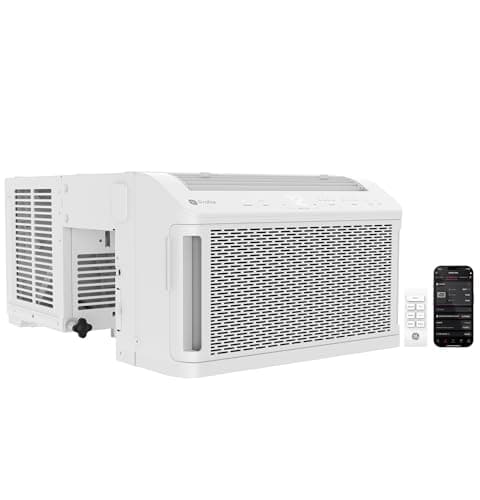 No bracket at a useful capacity GE Profile ClearView Window Air Conditioner, 8,000 BTU 8,000 BTU at CEER 16 and 375 kWh, 46.2 lb, and no support bracket required. | A normal bedroom or office, installed without extra hardware | |
| 3 | Bracket required, and obviously so Friedrich Kuhl Window Air Conditioner, 12,700 BTU 12,700 BTU at CEER 16.8 — the class efficiency leader, at 110 lb with a required support bracket. | A large room, professionally installed | |
| — | The weight where this stops being optional Brothers Window Air Conditioner, 18,000 BTU 18,000 BTU at CEER 16 and 843.8 kWh, at 94.4 lb. The numbers are good; the handling is the problem. | A very large room — with the install properly organized |
A support bracket is a metal frame that fixes to the exterior wall below the window and carries the outdoor end of an air conditioner. It is one of the few installation questions with a published answer, and almost nobody looks it up.
Our analysis
Nearly half of certified units require one
The ENERGY STAR Certified Room Air Conditioners dataset records support bracket requirement for every unit. Across all 485 records:
| Bracket | Units | Mean weight | Median weight |
|---|---|---|---|
| Required | 234 | 71.3 lb | 57.3 lb |
| Not required | 251 | 60.6 lb | 56.0 lb |
Computed by us from the ENERGY STAR Certified Room Air Conditioners dataset.
The interesting detail is the difference between the means and the medians.
The means differ by 10.7 lb. The medians differ by 1.3. That means the mean is being pulled up by a heavy tail — the 160 lb maximum in the bracket-required group against 129 lb in the other — rather than by a general weight difference.
So the requirement does not simply track weight. A typical bracket-required unit weighs almost exactly the same as a typical unit that does not need one. What it tracks is mounting design: saddle-style units that hang over the sill put far more mass outside the building, and the load path is what matters, not the number on the box.
The practical consequence: you cannot infer the requirement from the weight. Read the field.
This one is not a DIY job
Fit one above the ground floor regardless of what the manufacturer requires. “Not required” means the unit is designed to be carried by the sash and sill. A bracket transfers that load to the exterior wall instead, which removes the failure mode entirely rather than relying on a window frame you did not build and cannot inspect.
Check your building rules first. Many apartment buildings and some municipalities have specific requirements about securing window units, and some restrict street-facing installations. Ask before you buy, not after.
If the window frame is rotten, cracked, or moves when you press on it, stop. A bracket fixed into deteriorated structure is not a solution. That is a repair first.
Types
The two kinds, and which suits what
Wall-mounted brackets bolt into the exterior wall below the window and carry the unit on an arm or a shelf. They are the stronger arrangement because the load goes into masonry or framing rather than into the window. They also require drilling into the building envelope, which is the part that needs permission in most rentals and many buildings.
Sill-mounted or no-drill brackets clamp to the windowsill and use an adjustable leg or diagonal strut for support. Nothing penetrates the exterior wall, which makes them the practical option in a rental. They put the load into the sill and the frame rather than the wall, so they depend entirely on the sill being sound.
Both have weight ratings. Check the rating against the unit’s published weight with a real margin — and remember that a 110 lb saddle unit is a different proposition from a 31.6 lb one.
Fitting
Getting it right
- Fit the bracket before the unit, and check it is level side to side while empty.
- Set the drainage tilt at the bracket. Most brackets adjust, and this is where you get the very slight backward tilt that drains condensate outside rather than onto your floor — unless your manual specifies level, as several U-shaped models do. The drainage detail.
- Load-test it before you trust it. Lean on it. Any movement, flex or creak means it is not ready.
- The bracket does not replace the flange screws. You still fix the top flange to the sash and fit the sash lock. The bracket carries weight; the screws stop the sash being raised.
- Check it again each season. Fixings loosen, sealant perishes, and exterior brackets weather.
Buying
Reading the requirement before you order
The support bracket field is published for every certified unit alongside CEER, annual kWh, dimensions and weight. It is worth checking at the same moment you check whether the unit fits your window, because it changes what the purchase costs and what the install involves.
Two units in this class illustrate the range: the TCL T12WV4S at 12,000 BTU, 51.8 lb and no bracket required, against the Friedrich at 12,700 BTU, 110 lb, saddle-mounted, bracket required. Nearly the same capacity; entirely different installations.
Say the unwelcome thing
Do not skip the flange screws because you fitted a bracket.
A bracket makes an install feel solid, and that feeling is exactly why people skip the two screws that fix the top flange to the sash.
The bracket and the screws do different jobs. The bracket carries the weight. The screws stop the sash being raised — and if the sash goes up, nothing is holding the unit horizontally, bracket or not.
Someone tries to open the window, or the sash cords let go on an older frame, and a well-supported unit can still tip out of the opening.
Fit both, plus the sash lock bracket above the sash. It takes ninety seconds. The full install sequence.
In full
Every pick, and what is wrong with it
Published specifications only, each linked to the page it came from. Where a manufacturer publishes nothing, the row says so — we do not fill blanks in.
1. Lightest, and no bracket required
Midea Window Air Conditioner, 6,000 BTU
Midea · model MAW06S1KWT-A
31.6 lb at CEER 16 and 281.3 kWh — no support bracket required, and the lowest annual energy of any certified unit.
31.6 lb and no support bracket required. That combination makes this the least demanding install in the certified field.
281.3 kWh a year, about $52 for a season, at CEER 16 and 45% below the federal standard. On the Most Efficient list.
Worth stressing that no-bracket-required is not the same as no-bracket-advisable. Above the ground floor, fitting one is worth doing regardless of what the manufacturer requires — the load path matters more than the mass.
12.1 H x 16.0 W x 13.3 D inches, R-32, variable-speed.
What’s wrong with it
6,000 BTU covers a small room only, and it does nothing for a large or sunny space.
Running cost — MAW06S1KWT-A
| Annual energy use | 281.3 kWh | ENERGY STAR certified figure |
|---|---|---|
| Annual cost | $52 | 281.3 × 18.34¢/kWh |
| Per cooling month | $13 | spread over a four-month season |
The annual figure is the certified value from the ENERGY STAR Certified Room Air Conditioners dataset, which models a standard cooling season rather than your actual summer. It is more useful than a nameplate wattage here, because a variable-speed compressor spends most of its life well below nameplate.
Rate: 18.34¢/kWh, the US average residential price for June 2026 (EIA Electric Power Monthly, Table 5.3). Yours will differ — swap it in: (watts ÷ 1000) × hours × your rate.
| Cooling capacity | 6,000 BTU/h |
|---|---|
| CEER | 16 |
| Annual energy use | 281.3 kWh/yr |
| vs federal standard | 45% less energy |
| Dimensions | 12.1 H x 16.0 W x 13.3 D in |
| Weight | 31.6 lb |
| Installation | Does not straddle the windowsill |
| Support bracket | Not required |
| Compressor | Variable speed |
| Refrigerant | R-32 |
| ENERGY STAR | Certified, and on the Most Efficient list |
Every figure above is from ENERGY STAR Certified Room Air Conditioners dataset. Blanks are shown as “not published” rather than filled in.
2. No bracket at a useful capacity
GE Profile ClearView Window Air Conditioner, 8,000 BTU
GE Profile · model PWJV08W
8,000 BTU at CEER 16 and 375 kWh, 46.2 lb, and no support bracket required.
46.2 lb, no bracket required, at the top of the 8,000 BTU efficiency class. For most rooms this is the sweet spot between capacity and install difficulty.
375 kWh a year, about $69 for a season, and 47% less energy than the federal standard.
At 15.3 inches deep it is the shallowest certified unit in its class, which reduces the cantilevered mass outside the sill — part of why it does not need a bracket.
What’s wrong with it
46.2 lb is still firmly a two-person lift over a sill, bracket or not.
Running cost — PWJV08W
| Annual energy use | 375 kWh | ENERGY STAR certified figure |
|---|---|---|
| Annual cost | $69 | 375 × 18.34¢/kWh |
| Per cooling month | $17 | spread over a four-month season |
The annual figure is the certified value from the ENERGY STAR Certified Room Air Conditioners dataset, which models a standard cooling season rather than your actual summer. It is more useful than a nameplate wattage here, because a variable-speed compressor spends most of its life well below nameplate.
Rate: 18.34¢/kWh, the US average residential price for June 2026 (EIA Electric Power Monthly, Table 5.3). Yours will differ — swap it in: (watts ÷ 1000) × hours × your rate.
| Cooling capacity | 8,000 BTU/h |
|---|---|
| CEER | 16 |
| Annual energy use | 375 kWh/yr |
| vs federal standard | 47% less energy |
| Dimensions | 12.6 H x 18.6 W x 15.3 D in |
| Weight | 46.2 lb |
| Refrigerant | R-32 |
| Installation | Does not straddle the windowsill |
| Compressor | Variable speed |
| ENERGY STAR | Certified, and on the Most Efficient list |
Every figure above is from ENERGY STAR Certified Room Air Conditioners dataset. Blanks are shown as “not published” rather than filled in.
3. Bracket required, and obviously so
Friedrich Kuhl Window Air Conditioner, 12,700 BTU
Friedrich · model KCVS12B30B
12,700 BTU at CEER 16.8 — the class efficiency leader, at 110 lb with a required support bracket.
The clearest case for a bracket in the certified data. 110 lb hanging over a windowsill, with 29 inches of depth putting a large share of that mass outside the building.
CEER 16.8 and 567 kWh a year, about $104 for a season, and 54% below the federal standard — the best cooling-only figure in its capacity band.
The saddle design is why it is both efficient and heavy: a much larger outdoor coil hanging over the sill. Across the certified field, saddle units average 31.3 inches deep and 104.3 lb.
Treat the bracket as part of the purchase, and treat the install as a planned job.
What’s wrong with it
110 lb, 29 inches deep, straddles the windowsill. The bracket is the least of what this install involves.
Running cost — KCVS12B30B
| Annual energy use | 567 kWh | ENERGY STAR certified figure |
|---|---|---|
| Annual cost | $104 | 567 × 18.34¢/kWh |
| Per cooling month | $26 | spread over a four-month season |
The annual figure is the certified value from the ENERGY STAR Certified Room Air Conditioners dataset, which models a standard cooling season rather than your actual summer. It is more useful than a nameplate wattage here, because a variable-speed compressor spends most of its life well below nameplate.
Rate: 18.34¢/kWh, the US average residential price for June 2026 (EIA Electric Power Monthly, Table 5.3). Yours will differ — swap it in: (watts ÷ 1000) × hours × your rate.
| Cooling capacity | 12,700 BTU/h |
|---|---|
| CEER | 16.8 |
| Annual energy use | 567 kWh/yr |
| vs federal standard | 54% less energy |
| Dimensions | 15.9 H x 25.9 W x 29.0 D in |
| Weight | 110.0 lb |
| Installation | Straddles the windowsill |
| Support bracket | Required |
| Compressor | Variable speed |
| Refrigerant | R-32 |
| ENERGY STAR | Certified, and on the Most Efficient list |
Every figure above is from ENERGY STAR Certified Room Air Conditioners dataset. Blanks are shown as “not published” rather than filled in.
Skip this one
Brothers Window Air Conditioner, 18,000 BTU
Brothers · model 102387
18,000 BTU at CEER 16 and 843.8 kWh, at 94.4 lb. The numbers are good; the handling is the problem.
Listed as a caution on handling rather than a criticism of the machine. CEER 16 at 18,000 BTU is a strong figure at that capacity, and 50% below the federal standard.
843.8 kWh a year, about $155 for a season — the highest on this site, because it is the largest machine.
94.4 lb is the issue. Whatever the manufacturer requires, a unit at this weight above the ground floor deserves a bracket and deserves help, and the failure mode if it goes wrong is not recoverable.
What’s wrong with it
94.4 lb over a sill is beyond what two people should be manoeuvring at arm's length without proper support.
Running cost — 102387
| Annual energy use | 843.8 kWh | ENERGY STAR certified figure |
|---|---|---|
| Annual cost | $155 | 843.8 × 18.34¢/kWh |
| Per cooling month | $39 | spread over a four-month season |
The annual figure is the certified value from the ENERGY STAR Certified Room Air Conditioners dataset, which models a standard cooling season rather than your actual summer. It is more useful than a nameplate wattage here, because a variable-speed compressor spends most of its life well below nameplate.
Rate: 18.34¢/kWh, the US average residential price for June 2026 (EIA Electric Power Monthly, Table 5.3). Yours will differ — swap it in: (watts ÷ 1000) × hours × your rate.
| Cooling capacity | 18,000 BTU/h |
|---|---|
| CEER | 16 |
| Annual energy use | 843.8 kWh/yr |
| vs federal standard | 50% less energy |
| Dimensions | 17.9 H x 25.4 W x 23.6 D in |
| Weight | 94.4 lb |
| Refrigerant | R-32 |
| Installation | Does not straddle the windowsill |
| Compressor | Variable speed |
| ENERGY STAR | Certified |
Every figure above is from ENERGY STAR Certified Room Air Conditioners dataset. Blanks are shown as “not published” rather than filled in.
We are not linking a buy button for this one. If you want to look at it anyway, it is easy enough to find — but we would rather send you to something that fits your room.
Questions people actually ask
Frequently asked
Does my window air conditioner need a support bracket?
Check the certified data — 234 of 485 units require one and 251 do not. Above the ground floor it is worth fitting regardless, because a bracket transfers the load to the exterior wall rather than to the sash and sill.
Do heavier air conditioners always need brackets?
No, and this surprises people. The median weight of bracket-required units is 57.3 lb against 56.0 lb for those that do not need one. The requirement tracks mounting design — saddle units put far more mass outside the building — not the number on the box.
What kinds of window air conditioner bracket are there?
Wall-mounted brackets bolt into the exterior wall and are stronger, since the load goes into masonry or framing. Sill-mounted no-drill brackets clamp to the windowsill with an adjustable leg, which suits rentals but depends entirely on the sill being sound.
Can I install a window air conditioner without a bracket?
If the manufacturer does not require one and the window frame is sound, yes — the unit is designed to be carried by the sash and sill. Above the ground floor, a bracket is still worth fitting because it removes that dependency entirely.
Does a bracket replace the flange screws?
No. They do different jobs: the bracket carries the weight, and the screws stop the sash being raised. If the sash goes up, nothing holds the unit horizontally regardless of how well it is supported from below.
How do I set the drainage tilt with a bracket?
At the bracket — most adjust. You want the outdoor end very slightly lower so condensate drains outside, unless your manual specifies level, as several U-shaped models do. Set it level side to side first. Drainage in detail.
Sources
Where these numbers came from
Read next
Where to go from here
Back to Air Conditioners, or read how we pick.