Head to head
Air King 9723 vs Amazon Basics box fan
A commercial box fan against the cheapest credible one. The gap is about a third of the price and almost all of the documentation.
By Sawyer V. · Published
The short answer
Pay the difference for the Air King 9723 if the fan will work for a living — it publishes 2,163 CFM on 105 W and runs a rated 1/25 HP motor in a steel body. The Amazon Basics fan publishes 67 W and nothing else, and that 67 W is the lowest full-speed draw of any box fan we hold data for. For a spare room used three weeks a year, the cheap one is the right call.
Fan & Frost earns a commission when you buy through our links, at no cost to you. It never changes a ranking, and we say so when the right answer is the cheaper unit or nothing at all. Full disclosure · How we pick.
At a glance
The picks, ranked
Tap any row to jump to the full reasoning. Prices are live from Amazon where we have them, and read “check price” where we don’t — never a number we cannot verify today.
| # | Product | Best for | Price |
|---|---|---|---|
| 1 | 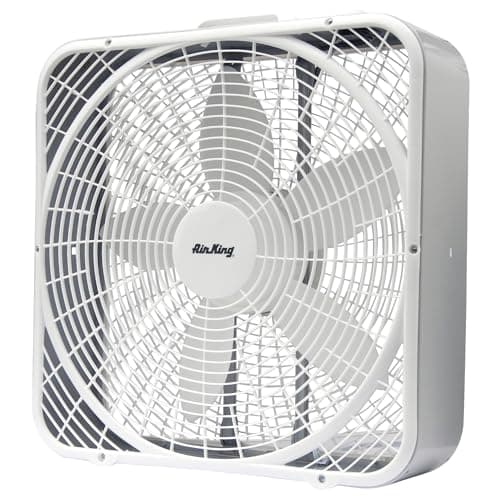 The Air King case Air King 9723 20" Commercial Grade Box Fan 2,163 CFM on 105 W with published blade speed and amperage, on a permanently lubricated commercial motor. The only box fan whose airflow can be checked. | A garage, workshop or any fan that runs most of the day, most of the summer | |
| 2 | 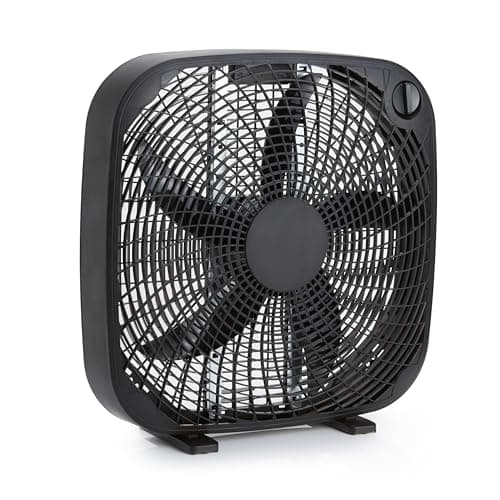 The Amazon Basics case Amazon Basics 20" 3-Speed Box Fan 67 W published — the lowest full-speed draw of any box fan here — with five blades and a carry handle at the bottom of the market. | A spare room, a second fan for a cross-flow pair, or any fan used a few weeks a year |
This is the most common real decision in the category: the fan that costs about a third more and publishes a specification sheet, against the one that costs less and publishes a single number.
Head to head
What each one publishes
| Air King 9723 | Amazon Basics | |
|---|---|---|
| Air delivery, high | 2,163 CFM | Not published |
| Power | 105 / 87 / 65 W | 67 W, speed not stated |
| CFM per watt | 20.6 high, 22.5 low | Not calculable |
| Blade speed | 1,220 / 1,075 / 855 RPM | Not published |
| Blade | 20 in | 20 in, 5 blades |
| Speeds | 3 | 3 |
| Motor | 1/25 HP, permanently lubricated | Not published |
| Depth | 6.38 in | 6.8 in |
| Weight | 11.4 lb | Not stated in title |
| Noise | Not published | Not published |
| Warranty | Not published | Not published on the listing |
Each figure is the manufacturer’s own; CFM per watt is our arithmetic. Prices checked 11 October 2026: $46.25 and $34.08. The buttons above carry the live price and the date it was read.
The arithmetic
Over five summers the electricity dwarfs the price gap
The purchase difference is about twelve dollars. Running either fan eight hours a night through a 90-night summer costs $14 for the Air King on high and $8.85 for the Amazon Basics — a gap of about $5.02 a year, which closes the purchase difference in roughly two summers if you run both flat out.
Run the Air King on low instead and it draws 65 W for 1,463 CFM, which is less power than the budget fan and a published amount of air. That is the configuration that makes the better fan also the cheaper one to own. The full low-wattage comparison.
This one is not a DIY job
Buy two of the cheap one before you buy one of either. A single box fan in a room mostly stirs the air that is already there. One in a window blowing out and one in a window on the opposite side blowing in exchanges it, and two budget fans cost less than one commercial fan. How to set that up.
Which one
How to choose
- Spare room, a few weeks a year: Amazon Basics. You are buying the shape, and the shape is the same.
- Garage or workshop, most days: Air King. The rated motor is the whole point and a cheap fan replaced twice costs more.
- You need to size the airflow: Air King. It is the only one of the two with a number to size against.
- Lowest running cost on full speed: Amazon Basics at 67 W — but the Air King’s 65 W low setting beats it while publishing 1,463 CFM.
Say the unwelcome thing
Do not expect either of these to work in a window.
Both are over six inches deep and a double-hung sash generally needs under five inches to close on top of a fan. Stood in front of an open window they still help; sealed into it, neither fits.
A purpose-built window fan publishes 27.4 CFM per watt against the Air King’s 20.6, because it is sealed into the opening and nothing recirculates around the frame.
In full
Every pick, and what is wrong with it
Published specifications only, each linked to the page it came from. Where a manufacturer publishes nothing, the row says so — we do not fill blanks in.
1. The Air King case
Air King 9723 20" Commercial Grade Box Fan
Air King · model 9723
2,163 CFM on 105 W with published blade speed and amperage, on a permanently lubricated commercial motor. The only box fan whose airflow can be checked.
2,163 / 1,900 / 1,463 CFM on 105 / 87 / 65 W at 1,220 / 1,075 / 855 RPM. The budget fan publishes one number; this one publishes nine.
What that buys you practically is the ability to size the fan. At 20.6 CFM per watt on high and 22.5 on low (our arithmetic), you can work out whether 2,163 CFM turns over your garage fast enough before you buy. You cannot do that arithmetic against an unpublished figure.
1/25 HP, permanently lubricated, steel body. This is the part that justifies the price over a season rather than over a weekend. A fan running eight hours a day in dusty air is a different duty cycle from a fan running on a bedside table in August.
15¢ for an eight-hour run on high at 18.34¢/kWh, 9.5¢ on low.
The honest gaps: no published decibel figure, and 6.38 inches of depth, which is too deep for a sash window to close on top of.
What’s wrong with it
Roughly a third more money, 11.4 lb against a lighter budget fan, no published noise figure, and visibly a commercial object.
Running cost — 9723
| Nameplate power | 65 W – 105 W | manufacturer's published figure |
|---|---|---|
| Energy, 8-hour night | 0.84 kWh | 105 ÷ 1000 × 8 |
| Cost per hour | 1.9¢ | at 18.34¢/kWh |
| Cost per 8-hour night | 15¢ | on the highest speed |
| Cost per 30 nights | $4.62 | 25.2 kWh |
| Same month, lowest speed | $2.86 | at 65 W |
Rate: 18.34¢/kWh, the US average residential price for June 2026 (EIA Electric Power Monthly, Table 5.3). Yours will differ — swap it in: (watts ÷ 1000) × hours × your rate.
| Air delivery | 2,163 / 1,900 / 1,463 CFM (high / medium / low) |
|---|---|
| Power | 105 / 87 / 65 W (0.94 / 0.72 / 0.56 A) |
| Efficiency | 20.6 CFM per watt on high, 22.5 on low (our arithmetic) |
| Blade speed | 1,220 / 1,075 / 855 RPM |
| Blade | 20 in |
| Speeds | 3 |
| Motor | 1/25 HP, 120 V, 1 phase |
| Dimensions | 21.38 W x 6.38 D x 22.5 H in |
| Weight | 11.4 lb |
| Oscillation | No |
| Noise | Not published |
Every figure above is from Air King commercial box fan product page, model 9723. Blanks are shown as “not published” rather than filled in.
2. The Amazon Basics case
Amazon Basics 20" 3-Speed Box Fan
Amazon Basics · model 20-inch 3-speed box fan
67 W published — the lowest full-speed draw of any box fan here — with five blades and a carry handle at the bottom of the market.
The useful surprise is that this fan publishes something its direct rivals do not: 67 W, stated on the listing along with 20-inch, 5 blades and 20.86 W x 6.8 D x 21.33 H inches. Amazon Basics is Amazon's own brand, so that listing is the manufacturer's page.
67 W is the lowest full-speed figure of any box fan we hold data for — against 102 W for the Lasko, 105 for the Air King and 120 for the Vornado. An eight-hour night is 9.8¢, or $8.85 across a 90-night summer.
Be precise about what that does and does not mean. It is the lowest full-speed draw; it is not the lowest figure outright, because the Air King publishes 65 W on its low setting and tells you it still moves 1,463 CFM there. Less power with no airflow figure attached is not efficiency, it is just less power.
Where this fan genuinely wins is as the second fan in a cross-flow pair. Two cheap fans in opposite windows move air through a house in a way one good fan cannot, and they cost less together than one commercial fan.
What’s wrong with it
No airflow, blade speed, noise figure or warranty term on the listing, and 6.8 inches deep, so it cannot sit in a sash window either.
Running cost — 20-inch 3-speed box fan
| Nameplate power | 67 W | manufacturer's published figure |
|---|---|---|
| Energy, 8-hour night | 0.54 kWh | 67 ÷ 1000 × 8 |
| Cost per hour | 1.2¢ | at 18.34¢/kWh |
| Cost per 8-hour night | 9.8¢ | on the highest speed |
| Cost per 30 nights | $2.95 | 16.1 kWh |
Rate: 18.34¢/kWh, the US average residential price for June 2026 (EIA Electric Power Monthly, Table 5.3). Yours will differ — swap it in: (watts ÷ 1000) × hours × your rate.
| Power | 67 W (speed not specified) |
|---|---|
| Speeds | 3 |
| Blade | 20 in, 5 blades |
| Dimensions | 20.86 W x 6.8 D x 21.33 H in |
| Handle | Carry handle |
| Air delivery (CFM) | Not published |
| Blade speed | Not published |
| Noise | Not published |
| Warranty | Not published on the listing |
Every figure above is from Amazon Basics product listing, 20-inch 3-speed box fan. Blanks are shown as “not published” rather than filled in.
Questions people actually ask
Frequently asked
Is the Air King 9723 worth more than an Amazon Basics box fan?
For a fan that runs most days, yes: it publishes 2,163 CFM on 105 W and uses a rated 1/25 HP permanently lubricated motor, so you can size it and expect it to survive dusty duty. For a spare room used a few weeks a year the Amazon Basics fan is the same shape for less money.
How many watts does the Amazon Basics box fan use?
67 W, stated on its own listing, though the speed that figure applies to is not specified. That is the lowest full-speed draw of any box fan we hold data for — against 102 W for Lasko, 105 for Air King and 120 for Vornado.
Which box fan moves more air?
Only the Air King publishes an answer: 2,163 CFM on high and 1,463 CFM on low. Amazon publishes no airflow figure for its fan, so the comparison cannot be made on air — which is itself the most useful thing to know about it. The most powerful box fans.
Which is cheaper to run?
On full speed the Amazon Basics fan, at 9.8¢ for an eight-hour night against 15¢ at 18.34¢/kWh. But the Air King's low setting draws 65 W — less than the budget fan — and still publishes 1,463 CFM, so run on low the better fan is also the cheaper one.
Can I put either of these in a window?
Not sealed into one. The Air King is 6.38 inches deep and the Amazon Basics 6.8, and a sash window generally needs under five inches of depth to close on top of a fan. Both work stood in front of an open window.
Does a cheaper box fan wear out faster?
Neither maker publishes a motor rating for the budget fan, so there is no way to compare directly. What is published is that the Air King uses a 1/25 HP permanently lubricated commercial motor in a steel body, which is the specification that exists because commercial buyers ask for duty cycles. How long a fan lasts.
Sources
Where these numbers came from
- Air King commercial box fan specifications, model 9723 — 2,163/1,900/1,463 CFM on 105/87/65 W
- Amazon Basics 20-inch 3-speed box fan — 67 W, 5 blades, 20.86 x 6.8 x 21.33 in
- Air King whole house window fan, 9155 — 2,470 CFM on 90 W, 27.4 CFM per watt
- EIA Electric Power Monthly, Table 5.3 — electricity rate
Read next
Where to go from here
Back to Fans, or read how we pick.