The picks
The best 10,000 BTU air conditioners
This is the most crowded size on the market, and the crowding is mostly one manufacturer filing the same unit sixteen ways.
By Sawyer V. · Published
The short answer
Buy a CEER 16 unit — they use 468.8 kWh a year against 500 for the CEER 15 versions of the same size, and only the 16s carry Most Efficient. The catch is that Midea files 16 different certified 10,000 BTU models ranging across both, so the suffix on the box is the whole decision. The lightest certified 16 is 46.5 lb and needs no bracket.
Fan & Frost earns a commission when you buy through our links, at no cost to you. It never changes a ranking, and we say so when the right answer is the cheaper unit or nothing at all. Full disclosure · How we pick.

At a glance
The picks, ranked
Tap any row to jump to the full reasoning. Prices are live from Amazon where we have them, and read “check price” where we don’t — never a number we cannot verify today.
| # | Product | Best for | Price |
|---|---|---|---|
| 1 | Best overall Midea Window Air Conditioner, 10,000 BTU CEER 16 and 468.8 kWh a year at 47.2 lb, with no support bracket required — the efficiency ceiling of the class in the lightest practical body. | Most rooms, and anyone who cannot fit a support bracket | |
| 2 | Best that straddles the window TCL Window Air Conditioner, 10,000 BTU CEER 16 at 49.6 lb, mounted straddling the window so the sash closes through the unit rather than resting on top of it. | A window you still want to be able to open | |
| 3 | 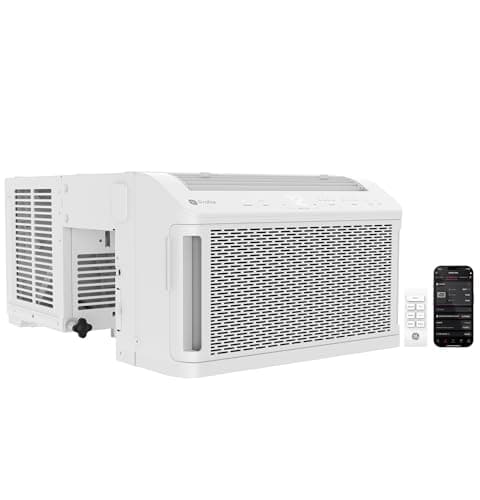 Best for a deep wall GE Profile ClearView Window Air Conditioner, 10,000 BTU CEER 16 with the ClearView body that keeps the glass clear, filed under plain 'GE' rather than 'GE Profile'. | A thick wall, a deep reveal, or a window you want to see out of | |
| — | 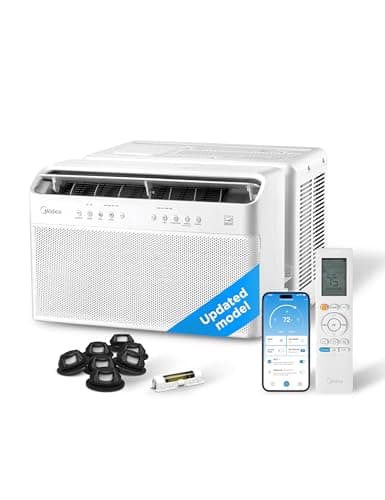 The suffix to avoid Midea U-Shaped Window Air Conditioner, 10,000 BTU (V1) CEER 15 and 500 kWh a year, no Most Efficient badge, a bracket required and a 1-year warranty — from the same family as a CEER 16 unit. | Nothing this list does not do better |
Ten thousand BTU is the busiest rung on the ladder. It is the size people land on when a bedroom unit was too small and a large-room unit felt like overkill, and manufacturers have responded by filing an enormous number of certified models into it.
The result is that the usual buying advice — pick a good brand — does almost nothing here. The spread within a single brand at a single size is larger than the spread between brands.
The finding
Midea files sixteen certified 10,000 BTU models
Pulling the ENERGY STAR certified room air conditioner dataset and filtering to Midea models containing “MAW10” returns sixteen distinct certified records. They are not sixteen different air conditioners in any meaningful sense. They are one product line, filed sixteen ways, and they do not perform the same.
| Model | CEER | kWh/yr | Weight | Bracket |
|---|---|---|---|---|
| MAW10V1KYWT-S | 16 | 468.8 | 46.5 lb | Not required |
| MAW10RV1KWT | 16 | 468.8 | 46.5 lb | Not required |
| MAW10V1WWT | 16 | 468.8 | 47.2 lb | Not required |
| MAW10U1QWT | 16 | 468.8 | 54.7 lb | Required |
| MAW10U2QWT | 16 | 468.8 | 54.7 lb | Required |
| MAW10U1KWT | 16 | 468.8 | 57.1 lb | Required |
| MAW10RV1CWT | 15 | 500 | 46.1 lb | Not required |
| MAW10S1VWT-A | 15 | 500 | 46.1 lb | Not required |
| MAW10V1QWT | 15 | 500 | 53.1 lb | Required |
| MAW10V1UWT | 15 | 500 | 54.0 lb | Not required |
| MAW10W1QWT | 15 | 500 | 54.0 lb | Not required |
Eleven of the sixteen are shown; the remainder repeat these figures under further suffixes. Read the table as a warning rather than a shopping list. MAW10V1WWT and MAW10V1QWT differ by one letter, and that letter is worth 31.2 kWh a year and the Most Efficient badge.
Nothing on a retail listing photograph distinguishes them. The only reliable move is to find the full model number in the listing text, then check it against the certified dataset before you click buy.
Size
Is 10,000 BTU actually your size?
Before buying into this class at all, check that you belong in it. ENERGY STAR’s sizing guidance puts 10,000 BTU at roughly 400 to 450 square feet, and the manufacturers above claim 350 to 450 depending on model.
That spread is not sloppiness. Coverage claims are marketing figures with no shared test procedure behind them, where BTU is a measured capacity. Size on the square footage and the adjustments, not on the box copy — the full BTU chart and what to add for sun, ceilings and occupancy.
Oversizing is the more common error and the more expensive one. A unit with too much capacity satisfies the thermostat fast, shuts off, and never runs long enough to pull moisture out of the air — so the room reads cool and feels clammy. Why that feels worse than a warmer, drier room.
Running cost
What the class costs to run
The certified annual figure is the honest comparator here, because it already builds in a standard duty cycle rather than assuming your unit runs flat out.
| Certified rating | Annual energy | Annual cost |
|---|---|---|
| CEER 16 (Most Efficient) | 468.8 kWh | $86 |
| CEER 15 | 500 kWh | $92 |
| CEER 14.7 | 525.5 kWh | $96 |
The gap between best and worst in this size class is about $10 a year at 18.34¢/kWh. That is not enough to justify replacing a working unit, and it is comfortably enough to decide between two you are choosing from today.
This one is not a DIY job
Ten thousand BTU sits near the top of what a standard 115 V 15 A household circuit handles comfortably alongside anything else. Every unit here runs on 115 V, but give it its own outlet and do not put it on an extension lead.
Bracket
The bracket question decides more than efficiency
Half this class requires a support bracket and half does not, and the requirement does not track weight the way you would expect. The 46.5 lb Midea variants need no bracket; the 49.6 lb TCL does. The certified field records the requirement per model, and it follows the chassis design rather than the mass.
If you rent, if your window frame is vinyl, or if the opening is above ground level over a walkway, treat “bracket not required” as a hard filter rather than a nice-to-have. The bracket is the part people skip, and it is the part that stops the unit leaving the window.
Alternatives
Where else 10,000 BTU of cooling comes from
A window unit is not the only shape this capacity comes in, and at this size the alternatives are genuinely competitive.
- A through-the-wall unit if the window matters more than the wall — what that install involves.
- A portable if nothing can be mounted at all, at a real efficiency cost — the comparison in full.
- A mini-split if this is a permanent room and you will also want heat — certified mini-split efficiency.
- A 9,500 BTU window heat pump, which at CEER 17.6 is the most efficient certified room unit in the entire dataset — at 129 lb, with everything that implies.
Say the unwelcome thing
Do not buy on the coverage claim printed on the box.
Across the certified 10,000 BTU models in this article, manufacturers claim anywhere from 350 to 450 square feet for the same measured capacity. The BTU figure is tested; the square-footage figure is not.
Two units with identical certified output can advertise a 29% difference in coverage, which means at least one of them is wrong for your room. Work from the sizing chart, adjust for sun exposure and ceiling height, and treat the box as packaging.
If the number you arrive at is under 400 square feet, you are probably in 8,000 BTU territory and will get a quieter, cheaper, lighter unit for it.
In full
Every pick, and what is wrong with it
Published specifications only, each linked to the page it came from. Where a manufacturer publishes nothing, the row says so — we do not fill blanks in.
1. Best overall
Midea Window Air Conditioner, 10,000 BTU
Midea · model MAW10V1WWT
CEER 16 and 468.8 kWh a year at 47.2 lb, with no support bracket required — the efficiency ceiling of the class in the lightest practical body.
The combination that matters at this size: the top certified efficiency, a weight one person can lift to a sill, and no bracket to drill.
CEER 16 and 468.8 kWh a year — about $86 a year at 18.34¢/kWh. That is 47% less energy than the federal standard allows, and it is on the Most Efficient list.
47.2 lb and no support bracket required. At 10,000 BTU that is unusual, and it is the spec that decides whether this is a job or an afternoon — a bracket is a separate purchase and a separate problem.
R-32 refrigerant and a variable-speed compressor, like every certified room unit now sold. What the refrigerant change means.
What’s wrong with it
The certified dataset publishes no noise figure, and the model code is one letter from a less efficient sibling.
Running cost — MAW10V1WWT
| Annual energy use | 468.8 kWh | ENERGY STAR certified figure |
|---|---|---|
| Annual cost | $86 | 468.8 × 18.34¢/kWh |
| Per cooling month | $21 | spread over a four-month season |
The annual figure is the certified value from the ENERGY STAR Certified Room Air Conditioners dataset, which models a standard cooling season rather than your actual summer. It is more useful than a nameplate wattage here, because a variable-speed compressor spends most of its life well below nameplate.
Rate: 18.34¢/kWh, the US average residential price for June 2026 (EIA Electric Power Monthly, Table 5.3). Yours will differ — swap it in: (watts ÷ 1000) × hours × your rate.
| Cooling capacity | 10,000 BTU/h |
|---|---|
| CEER | 16 |
| Annual energy use | 468.8 kWh/yr |
| vs federal standard | 47% less energy |
| Dimensions | 13.6 H x 19.0 W x 18.6 D in |
| Weight | 47.2 lb |
| Refrigerant | R-32 |
| Installation | Does not straddle the windowsill |
| Support bracket | Not required |
| Compressor | Variable speed |
| Noise | Not published in the certified dataset |
| ENERGY STAR | Certified, and on the Most Efficient list |
Every figure above is from ENERGY STAR Certified Room Air Conditioners dataset. Blanks are shown as “not published” rather than filled in.
2. Best that straddles the window
TCL Window Air Conditioner, 10,000 BTU
TCL · model T10WV3S
CEER 16 at 49.6 lb, mounted straddling the window so the sash closes through the unit rather than resting on top of it.
The saddle-style mount is the reason to pick this over the one above, and it is a genuine reason.
Straddles the window, so the sash closes through the middle of the unit. You keep the top half of the window for light and, in a fire, for egress — the same idea as the U-shaped units.
CEER 16, 468.8 kWh a year, Most Efficient certified. Identical certified efficiency to the pick above — you are choosing on mounting, not on running cost.
49.6 lb, and a support bracket is required. At 15.2 inches tall it is the deepest sash intrusion of the group, so measure the opening before ordering.
What’s wrong with it
It needs a support bracket, and at 15.2 inches it is the tallest of the CEER 16 group.
Running cost — T10WV3S
| Annual energy use | 468.8 kWh | ENERGY STAR certified figure |
|---|---|---|
| Annual cost | $86 | 468.8 × 18.34¢/kWh |
| Per cooling month | $21 | spread over a four-month season |
The annual figure is the certified value from the ENERGY STAR Certified Room Air Conditioners dataset, which models a standard cooling season rather than your actual summer. It is more useful than a nameplate wattage here, because a variable-speed compressor spends most of its life well below nameplate.
Rate: 18.34¢/kWh, the US average residential price for June 2026 (EIA Electric Power Monthly, Table 5.3). Yours will differ — swap it in: (watts ÷ 1000) × hours × your rate.
| Cooling capacity | 10,000 BTU/h |
|---|---|
| CEER | 16 |
| Annual energy use | 468.8 kWh/yr |
| vs federal standard | 47% less energy |
| Dimensions | 15.2 H x 19.8 W x 21.5 D in |
| Weight | 49.6 lb |
| Refrigerant | R-32 |
| Installation | Straddles the window |
| Support bracket | Required |
| Compressor | Variable speed |
| Noise | Not published in the certified dataset |
| ENERGY STAR | Certified, and on the Most Efficient list |
Every figure above is from ENERGY STAR Certified Room Air Conditioners dataset. Blanks are shown as “not published” rather than filled in.
3. Best for a deep wall
GE Profile ClearView Window Air Conditioner, 10,000 BTU
GE · model PWJV10W
CEER 16 with the ClearView body that keeps the glass clear, filed under plain 'GE' rather than 'GE Profile'.
The ClearView design sits low in the opening so the window above it stays glass rather than plastic, which in a small room is worth more than the spec sheet suggests.
CEER 16 and 468.8 kWh a year, Most Efficient certified, 47% under the federal standard.
70.1 lb is the honest cost. That is a two-person lift, and a bracket is required on top of it — getting a heavy unit into a window safely.
A filing quirk worth knowing: this is certified under the brand name “GE”. GE files room air conditioners under three different brand names with quite different results, and the badge follows the filing, not the logo.
What’s wrong with it
70.1 lb is 49% heavier than the lightest CEER 16 in this class, and it still needs a bracket.
Running cost — PWJV10W
| Annual energy use | 468.8 kWh | ENERGY STAR certified figure |
|---|---|---|
| Annual cost | $86 | 468.8 × 18.34¢/kWh |
| Per cooling month | $21 | spread over a four-month season |
The annual figure is the certified value from the ENERGY STAR Certified Room Air Conditioners dataset, which models a standard cooling season rather than your actual summer. It is more useful than a nameplate wattage here, because a variable-speed compressor spends most of its life well below nameplate.
Rate: 18.34¢/kWh, the US average residential price for June 2026 (EIA Electric Power Monthly, Table 5.3). Yours will differ — swap it in: (watts ÷ 1000) × hours × your rate.
| Cooling capacity | 10,000 BTU/h |
|---|---|
| CEER | 16 |
| Annual energy use | 468.8 kWh/yr |
| vs federal standard | 47% less energy |
| Dimensions | 14.5 H x 19.0 W x 19.8 D in |
| Weight | 70.1 lb |
| Refrigerant | R-32 |
| Installation | Does not straddle the windowsill |
| Support bracket | Required |
| Compressor | Variable speed |
| Filed under | Brand name "GE", not "GE Profile" |
| ENERGY STAR | Certified, and on the Most Efficient list |
Every figure above is from ENERGY STAR Certified Room Air Conditioners dataset. Blanks are shown as “not published” rather than filled in.
Skip this one
Midea U-Shaped Window Air Conditioner, 10,000 BTU (V1)
Midea · model MAW10V1QWT
CEER 15 and 500 kWh a year, no Most Efficient badge, a bracket required and a 1-year warranty — from the same family as a CEER 16 unit.
This is the clearest illustration of the trap in this size class, and it is not a bad air conditioner. It is simply the wrong member of its own family.
CEER 15 and 500 kWh a year against 468.8 for the CEER 16 units above — $5.72 a year more at 18.34¢/kWh, every year you own it. It is 38% under the federal standard where they are 47%, and it is not on the Most Efficient list.
A bracket is required and it weighs 53.1 lb, so it is heavier and harder to fit than the pick at the top.
One year of warranty. Midea’s own U2 version of the same U-shaped unit publishes three, alongside CEER 16 and a 45% efficiency claim rather than 35%. Same shape, same app, same 32 dBA — the U2 is the one to buy if you want this body style.
What’s wrong with it
It is 6.7% more electricity a year than its own siblings for no advantage the spec sheet shows.
Running cost — MAW10V1QWT
| Annual energy use | 500 kWh | ENERGY STAR certified figure |
|---|---|---|
| Annual cost | $92 | 500 × 18.34¢/kWh |
| Per cooling month | $23 | spread over a four-month season |
The annual figure is the certified value from the Midea product page, MAW10V1QWT, with certified figures from the ENERGY STAR Room Air Conditioners dataset, which models a standard cooling season rather than your actual summer. It is more useful than a nameplate wattage here, because a variable-speed compressor spends most of its life well below nameplate.
Rate: 18.34¢/kWh, the US average residential price for June 2026 (EIA Electric Power Monthly, Table 5.3). Yours will differ — swap it in: (watts ÷ 1000) × hours × your rate.
| Cooling capacity | 10,000 BTU/h DOE |
|---|---|
| CEER | 15 |
| Annual energy use | 500 kWh/yr |
| vs federal standard | 38% less energy |
| Coverage claim | Up to 450 sq ft |
| Noise | As low as 32 dBA |
| Smart control | SmartHome app, Apple Watch, voice assistants |
| Dimensions | 13.5 H x 19.2 W x 22.0 D in |
| Weight | 53.1 lb certified / 54.01 lb published |
| Refrigerant | R-32 |
| Installation | U-shape; straddles the window |
| Support bracket | Required |
| Compressor | Variable speed, up to 35% more efficient (manufacturer claim) |
| Warranty | 1 year |
| ENERGY STAR | Certified; NOT on the Most Efficient list |
Every figure above is from Midea product page, MAW10V1QWT, with certified figures from the ENERGY STAR Room Air Conditioners dataset. Blanks are shown as “not published” rather than filled in.
We are not linking a buy button for this one. If you want to look at it anyway, it is easy enough to find — but we would rather send you to something that fits your room.
Questions people actually ask
Frequently asked
What size room does a 10,000 BTU air conditioner cool?
Roughly 400 to 450 square feet under ENERGY STAR sizing guidance. Manufacturers of certified 10,000 BTU units claim anywhere from 350 to 450 square feet for the same measured capacity, so work from the sizing chart rather than the box. The BTU chart.
What is the most efficient 10,000 BTU air conditioner?
Several models share the top certified figure of CEER 16 and 468.8 kWh a year, which is 47% under the federal standard. The lightest of them weighs 46.5 lb and needs no support bracket. Nothing in this size class is certified above CEER 16.
Why do two air conditioners with the same model name have different CEER ratings?
Because manufacturers file many certified variants under near-identical model codes. Midea alone files sixteen certified 10,000 BTU models, spanning CEER 15 to 16 and 468.8 to 500 kWh a year. Check the full model number against the certified dataset before buying.
How much does a 10,000 BTU air conditioner cost to run?
A CEER 16 unit uses 468.8 kWh a year, about $86 at the current average residential rate. A CEER 14.7 unit of similar size uses 525.5 kWh, roughly $96. Running costs in full.
Do all 10,000 BTU air conditioners need a support bracket?
No, and the requirement does not follow weight. The certified dataset records it per model — some 46.5 lb units need no bracket while a 49.6 lb unit does, because the requirement follows chassis design. If you rent or have vinyl window frames, treat it as a hard filter. Brackets explained.
Is 10,000 BTU too big for a bedroom?
Usually yes. Most bedrooms fall well under 400 square feet, and an oversized unit cools fast, shuts off, and never runs long enough to remove humidity — so the room reads cool and feels clammy. An 8,000 BTU unit is quieter and cheaper. The 8,000 BTU class.
Sources
Where these numbers came from
- ENERGY STAR Certified Room Air Conditioners dataset — CEER, annual kWh, weight, bracket requirement and Most Efficient status for every model cited
- Midea product page, MAW10V1QWT — 450 sq ft claim, 32 dBA, 1-year warranty, 35% efficiency claim
- Midea product page, MAW10U2QWT — 350 sq ft claim, 32 dBA, 3-year warranty, 45% efficiency claim
- ENERGY STAR room air conditioner sizing guidance
- EIA Electric Power Monthly, Table 5.3 — average residential electricity price
Read next
Where to go from here
Back to Air Conditioners, or read how we pick.