Guide and picks
How to clean a bathroom exhaust fan
The grille is the part you can see and the least of the problem. What actually blocks a bathroom fan is the wheel behind it.
By Sawyer V. · Published
The short answer
Kill the power at the breaker, drop the grille, and clean grille, blower wheel, motor housing, then the duct termination. The wheel is the part that matters — a felted layer of dust changes its blade shape and costs airflow you cannot see from below. Certified figures like 110 CFM at 16.7 CFM per watt assume a clean fan and a clear duct; yours has neither after a couple of years.
Fan & Frost earns a commission when you buy through our links, at no cost to you. It never changes a ranking, and we say so when the right answer is the cheaper unit or nothing at all. Full disclosure · How we pick.

At a glance
The picks, ranked
Tap any row to jump to the full reasoning. Prices are live from Amazon where we have them, and read “check price” where we don’t — never a number we cannot verify today.
| # | Product | Best for | Price |
|---|---|---|---|
| 1 | 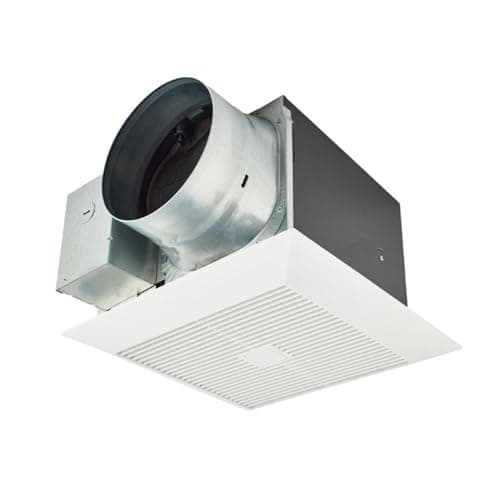 The figures you are trying to preserve Panasonic WhisperGreen Select FV-0511VK3 Ventilation Fan 110 CFM at 16.7 CFM per watt and 0.1 sones — measured on a clean fan at 0.25 in w.g., not in your ceiling. | Seeing what a clean, certified fan actually delivers | |
| 2 | Simplest to clean Ortech ODD-70-1 Ventilation Fan One speed, no lighting, 75 CFM at 16.7 CFM per watt through a 4-inch duct — nothing extra to take apart. | A retrofit where you want fewer parts to maintain | |
| 3 | 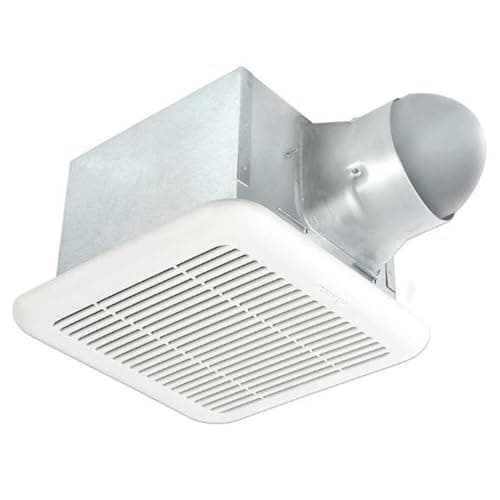 Least penalty for running it slow Delta BreezSignature SIG80-110 Ventilation Fan 0.1 sones with 15.3 and 15.4 CFM per watt at its two speeds — essentially flat, which is unusual. | A fan you clean rarely and want efficient at any setting | |
| — | 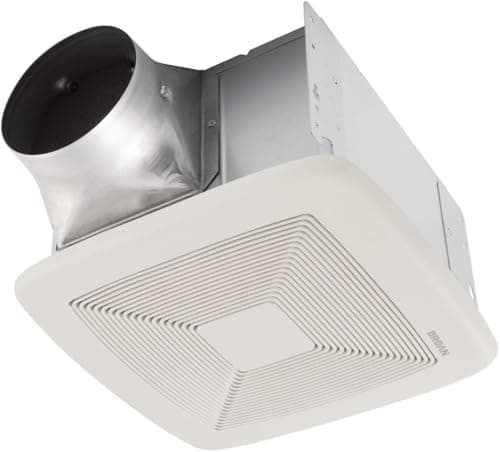 More fan than most bathrooms need Broan-NuTone Premium Ventilation Fan 154.4 CFM at 14.2 CFM per watt, and 1.4 sones — fourteen times the perceived loudness of the 0.1-sone picks. | A large utility room — not a normal bathroom |
A bathroom fan is out of sight and out of mind until the mirror stops clearing. By then it has usually lost a large share of its airflow, and almost none of that loss is at the grille.
Where the airflow goes
The blower wheel, not the grille
Most bathroom fans use a squirrel-cage blower — a drum of small curved blades, sitting above the grille where you cannot see it.
Bathroom air carries dust, lint and aerosol residue from sprays and products, and it is humid. That combination felts onto the blades as a soft gray layer that follows their curve.
Each blade is a small aerofoil, and the layer changes its shape. The wheel moves less air per revolution while the motor works exactly as hard. Three consequences:
- Airflow drops with no change in noise, so the fan sounds like it is working. This is why people conclude it is undersized rather than dirty.
- The motor runs hotter, because it is doing the same work with dust also insulating it.
- Uneven loading causes noise — dust never deposits equally, so a rattle or a beat develops slowly.
The grille itself blocks some airflow when it is furred over, and it is genuinely worth cleaning. It is not where most of the loss is.
This one is not a DIY job
Kill the power at the breaker, not the wall switch. You are reaching into a ceiling void with mains wiring in it, and fans with humidity sensors or timers can start on their own with the wall switch off.
Work from a proper step ladder, not a chair or the edge of a bath.
Wear eye protection. Everything you dislodge falls directly toward your face.
Do not soak the motor. The grille and the blower wheel can be washed once removed; the motor and the housing get a vacuum and a dry brush.
The procedure
Step by step
- Kill the breaker and confirm the fan will not run.
- Remove the grille. Most pull straight down against spring clips that squeeze inward. Some have a central screw. Do not force it — look for the clips first.
- Wash the grille in warm soapy water, let it dry fully, and set it aside. A furred grille alone can cost noticeable airflow.
- Vacuum the visible housing and duct opening with a brush attachment before you disturb anything else.
- Remove the blower assembly if it comes out. Many units have a plug and a single screw or a twist-lock retaining the motor and wheel together. If it does not come out easily, do not force it — vacuum and brush it in place.
- Clean the wheel properly. Out of the housing, a soft brush and warm soapy water; in place, a vacuum plus a dry brush between every blade. This is the step that recovers the airflow.
- Wipe the motor housing and clear its cooling vents — dry only.
- Dry everything fully, reassemble, restore power.
Do not skip
The duct and the outside termination
Certified CFM is measured against 0.25 inches of water gauge. A real duct run frequently presents more than that before it has collected anything, and it collects plenty.
Three things to check while you are up there:
- Sags in flexible duct. A dip in a flex run collects condensate and lint, and every sag is added resistance. Support the duct so it runs as straight as the route allows.
- The exterior flap or cap. This is the most overlooked part of the whole system. Flaps stick shut with paint, debris or nesting, and a fan pushing against a jammed flap moves almost nothing while sounding entirely normal from inside.
- Where it actually terminates. A duct ending in an attic dumps moisture into the roof structure. That is a building problem rather than a ventilation one, and it needs fixing regardless of how the fan performs.
Check it worked
The paper test
Run the fan and hold a single sheet of paper flat against the grille. A healthy fan holds it there against gravity without help.
If it falls, the airflow is inadequate and you have not finished. Work back through the list: wheel, duct sags, exterior flap.
It is a crude test and it is genuinely useful, because it distinguishes a fan that sounds fine from one that is actually moving air — which is exactly the failure mode dust produces.
How often
Frequency
Once a year is a reasonable default for a normal family bathroom, and it takes twenty minutes. More often if the fan runs continuously, or if the bathroom sees heavy use.
Do it before the season you rely on it rather than after, and check the exterior flap at the same time — it is the part most likely to have failed without any sign from inside.
Say the unwelcome thing
Do not replace a bathroom fan that has only lost airflow.
“It does not clear the mirror any more” is the usual reason people buy a new bathroom fan, and it is the symptom most reliably fixed with a brush.
Dust on the blower wheel degrades airflow gradually enough that you never notice a day-to-day change, and it does not alter the noise — so the fan sounds exactly as it always did while moving a fraction of the air.
Clean the wheel, clear the duct and check the exterior flap first. Then run the paper test.
If it genuinely still fails after that, the replacement case is strong: certified fans now reach 0.1 sones at 16.7 CFM per watt, against a category median of 4.7.
In full
Every pick, and what is wrong with it
Published specifications only, each linked to the page it came from. Where a manufacturer publishes nothing, the row says so — we do not fill blanks in.
1. The figures you are trying to preserve
Panasonic WhisperGreen Select FV-0511VK3 Ventilation Fan
Panasonic · model FV-0511VK3
110 CFM at 16.7 CFM per watt and 0.1 sones — measured on a clean fan at 0.25 in w.g., not in your ceiling.
0.1 sones and 16.7 CFM per watt at 110 CFM, against a category median of 4.7. Both figures come from a laboratory test on a clean fan.
That is a fair basis for comparing one fan against another. It is not a promise about what a two-year-old fan does in a real ceiling with a real duct.
Its middle speed is the efficient one: 18.4 CFM per watt at 80 CFM, against 16.7 at 110 and 14.7 at 50. Continuous running on medium is both quieter and cheaper than intermittent bursts on high.
What’s wrong with it
The certified dataset publishes no wattage for it, so you cannot compute a running cost from the listing directly.
Running cost
Panasonic does not publish a wattage for the FV-0511VK3, so we cannot calculate what it costs to run. We are not going to estimate one. If Panasonic publishes a nameplate figure, this block will show the arithmetic.
| Noise | 0.1 sones |
|---|---|
| Air delivery, high | 110 CFM at 0.25 in w.g. |
| Air delivery, medium | 80 CFM |
| Air delivery, low | 50 CFM |
| Efficacy, high | 16.7 CFM per watt |
| Efficacy, medium | 18.4 CFM per watt |
| Efficacy, low | 14.7 CFM per watt |
| Duct size | 6 in diameter |
| Speeds | 3 or more |
| Lighting | None |
| Power | Not published in the certified dataset |
| ENERGY STAR | Certified, and on the Most Efficient list |
Every figure above is from ENERGY STAR Certified Ventilating Fans dataset. Blanks are shown as “not published” rather than filled in.
2. Simplest to clean
Ortech ODD-70-1 Ventilation Fan
Ortech · model ODD-70-1
One speed, no lighting, 75 CFM at 16.7 CFM per watt through a 4-inch duct — nothing extra to take apart.
Maintenance difficulty tracks part count, and this is a deliberately plain product: one speed, no lamp, no sensor, no controller.
16.7 CFM per watt through a 4-inch duct matches the best 6-inch fan on efficacy, which matters if your existing duct is 4-inch and staying that way — enlarging a run through a ceiling and roof is real construction.
0.4 sones is still below the 0.7 category median, so it is quieter than most of what is sold despite being four times the 0.1-sone units.
On the Most Efficient list, which only 80 of 912 certified bathroom fans reach.
What’s wrong with it
0.4 sones is four times the quietest fans here, and one fixed speed gives you no tuning at all.
Running cost
Ortech does not publish a wattage for the ODD-70-1, so we cannot calculate what it costs to run. We are not going to estimate one. If Ortech publishes a nameplate figure, this block will show the arithmetic.
| Noise | 0.4 sones |
|---|---|
| Air delivery | 75 CFM at 0.25 in w.g. |
| Efficacy | 16.7 CFM per watt |
| Duct size | 4 in diameter |
| Speeds | 1 |
| Lighting | None |
| Power | Not published in the certified dataset |
| ENERGY STAR | Certified, and on the Most Efficient list |
Every figure above is from ENERGY STAR Certified Ventilating Fans dataset. Blanks are shown as “not published” rather than filled in.
3. Least penalty for running it slow
Delta BreezSignature SIG80-110 Ventilation Fan
Delta · model SIG80-110
0.1 sones with 15.3 and 15.4 CFM per watt at its two speeds — essentially flat, which is unusual.
Most fans lose efficiency badly away from their best speed — the Broan PTE511RK drops from 14.5 to 9.8 CFM per watt between high and low.
This one runs 15.3 and 15.4 CFM per watt at its two settings. Effectively flat.
That is relevant on a maintenance page because a fan that has lost airflow to dust is, in effect, being asked to work harder for less. A flat efficiency curve means less compounding when conditions are not ideal.
0.1 sones, field-selectable at 110 or 80 CFM, 6-inch duct, Most Efficient listed.
What’s wrong with it
15.3 CFM per watt is a point behind the best, and two speeds gives less room to tune than three.
Running cost
Delta does not publish a wattage for the SIG80-110, so we cannot calculate what it costs to run. We are not going to estimate one. If Delta publishes a nameplate figure, this block will show the arithmetic.
| Noise | 0.1 sones |
|---|---|
| Air delivery, high | 110 CFM at 0.25 in w.g. |
| Air delivery, low | 80 CFM |
| Efficacy, high | 15.3 CFM per watt |
| Efficacy, low | 15.4 CFM per watt |
| Duct size | 6 in diameter |
| Speeds | 2, field-selectable |
| Lighting | None |
| Power | Not published in the certified dataset |
| ENERGY STAR | Certified, and on the Most Efficient list |
Every figure above is from ENERGY STAR Certified Ventilating Fans dataset. Blanks are shown as “not published” rather than filled in.
Skip this one
Broan-NuTone Premium Ventilation Fan
Broan-NuTone · model PREMIUM series
154.4 CFM at 14.2 CFM per watt, and 1.4 sones — fourteen times the perceived loudness of the 0.1-sone picks.
Listed as a skip because of why people arrive at it. A fan that no longer clears steam feels undersized, so the instinct is to buy up.
It is a good product — 14.2 CFM per watt at 154.4 CFM is strong. But 1.4 sones is fourteen times the perceived loudness of a 0.1-sone fan, because the sone scale is linear.
And a louder fan is a fan people switch off, which is worse than a quieter one running continuously on medium.
Clean the fan and clear the duct first. If it still cannot clear steam after that, then size up — and this belongs in a garage or utility space.
What’s wrong with it
Buying a bigger fan is the usual response to one that has lost airflow, and cleaning the one you have is almost always the right move instead.
Running cost
Broan-NuTone does not publish a wattage for the PREMIUM series, so we cannot calculate what it costs to run. We are not going to estimate one. If Broan-NuTone publishes a nameplate figure, this block will show the arithmetic.
| Air delivery | 154.4 CFM at 0.25 in w.g. |
|---|---|
| Efficacy | 14.2 CFM per watt |
| Noise | 1.4 sones |
| Duct size | 6 in diameter |
| Unit type | Ceiling-mounted, bathroom/utility room |
| Power | Not published in the certified dataset |
| ENERGY STAR | Certified |
Every figure above is from ENERGY STAR Certified Ventilating Fans dataset. Blanks are shown as “not published” rather than filled in.
We are not linking a buy button for this one. If you want to look at it anyway, it is easy enough to find — but we would rather send you to something that fits your room.
Questions people actually ask
Frequently asked
How do you clean a bathroom exhaust fan?
Kill the breaker, drop the grille and wash it, then vacuum the housing and clean the blower wheel — that is the step that recovers airflow. Finish by checking the duct for sags and confirming the exterior flap opens freely.
Why has my bathroom fan lost suction?
Usually a felted layer of dust on the blower wheel, which changes each blade's shape so it moves less air per revolution. The motor works just as hard and the noise does not change, which is why people assume the fan is undersized rather than dirty.
How often should you clean a bathroom exhaust fan?
About once a year for a normal family bathroom, and it takes roughly twenty minutes. More often if the fan runs continuously or the bathroom sees heavy use. Do it before the season you rely on it rather than after.
How do I test if my bathroom fan is working?
Hold a single sheet of paper flat against the running grille. A healthy fan holds it there against gravity. If it falls, airflow is inadequate — work back through the blower wheel, duct sags and the exterior flap.
What is the part people forget to check?
The exterior flap or cap. It sticks shut with paint, debris or nesting, and a fan pushing against a jammed flap moves almost nothing while sounding completely normal from inside the bathroom.
Should I run a bathroom fan on high or medium?
Medium, usually. Across 351 certified multi-speed bathroom fans, 71.8% move air more efficiently below full speed — one certified model manages 18.4 CFM per watt at 80 CFM against 16.7 at 110. The full speed analysis.
Sources
Where these numbers came from
Read next
Where to go from here
Back to Whole-House Airflow, or read how we pick.