The picks
The best U-shaped and saddle window air conditioners
The one genuine design innovation in window air conditioners this decade, and the one specification you must check before ordering.
By Sawyer V. · Published
The short answer
A U-shaped unit lets the sash close through the middle of it, so the window still opens and the compressor sits outside the closed sash — which is why these are noticeably quieter indoors. The efficiency leader is CEER 15.1 at 298 kWh a year. The warning: saddle-style units average 31.3 inches deep and 104.3 lb against roughly 21 inches and 63 lb for everything else.
Fan & Frost earns a commission when you buy through our links, at no cost to you. It never changes a ranking, and we say so when the right answer is the cheaper unit or nothing at all. Full disclosure · How we pick.
At a glance
The picks, ranked
Tap any row to jump to the full reasoning. Prices are live from Amazon where we have them, and read “check price” where we don’t — never a number we cannot verify today.
| # | Product | Best for | Price |
|---|---|---|---|
| 1 | Best overall Midea U-Shaped Window Air Conditioner, 6,000 BTU CEER 15.1 and 298 kWh a year at 53.1 lb, no bracket required — the U-shape done at the size most rooms need. | A bedroom or study with a standard double-hung window | |
| 2 | 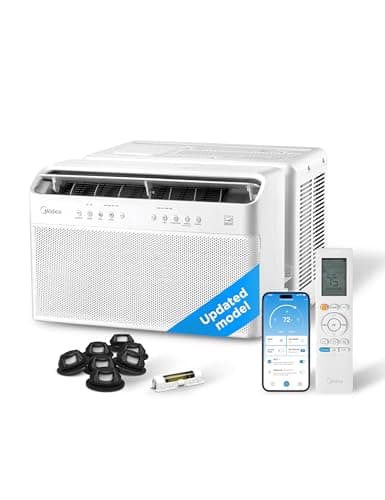 Best for a main room Midea U-Shaped Window Air Conditioner, 8,000 BTU 8,000 BTU at CEER 15 and 400 kWh a year, in the same U-shape and the same 13.5 inch height. | A living room or larger bedroom | |
| 3 | Best saddle unit Midea Window Heat Pump Air Conditioner, 9,500 BTU CEER 17.6 and 404.8 kWh a year with reverse-cycle heating — the highest CEER of any certified room unit. | A room that needs heating as well, in a window that can take the weight | |
| — | The one that does need a bracket Gradient CCHP11 Window Heat Pump, 9,300 BTU CEER 16.8 and 415.2 kWh with heating — but 140 lb and a support bracket required. | A saddle installation where the structure has been checked |
The U-shaped window air conditioner is the only meaningful design change this category has seen in years, and it is genuinely good. It also carries one specification that catches people out.
The design
What the U-shape actually does
A conventional window unit is a single box that sits in the opening. The sash comes down onto the top of it, and the whole machine — compressor included — is in the plane of the window.
A U-shaped unit is split into two halves joined at the bottom, with a channel between them. The sash closes down into that channel, so the window shuts against the unit rather than on top of it. Three things follow:
- The compressor is outside the closed sash. The glass and the frame sit between you and the noisiest component, which is why these are consistently reported as quieter indoors. Note that this is a design argument, not a measured one — no window air conditioner publishes a certified noise rating.
- The window still opens. You can raise the sash for ventilation without uninstalling anything, which in a small room is a real gain.
- The seal is better. The sash closes into a channel rather than onto a flat top, which is a more forgiving joint to make airtight.
The catch
Saddle-style units are much heavier than everything else
This is the finding that matters most, and it applies to the broader family of units that straddle the sill.
| Mounting | Average depth | Average weight |
|---|---|---|
| Saddle style (straddles the sill) | 31.3 in | 104.3 lb |
| Every other mounting type | about 21 in | about 63 lb |
Two-thirds heavier and half again as deep, on average. The two saddle heat pumps in this roundup weigh 129 and 140 lb; the conventional 6,000 BTU efficiency leader weighs 31.6 lb.
Counter-intuitively, the heavier saddle units frequently need no support bracket — the design bears on the sill and frame rather than cantilevering out. The certified data shows bracket requirement is essentially uncorrelated with weight: median 57.3 lb for units that require one against 56.0 lb for units that do not. What it actually tracks.
That does not make 129 lb easy. It still has to be carried, lifted and positioned over an open window, and above ground level that is a job with real consequences.
Fit
Measure before you order
The U-shape has a narrower set of windows it works in than a conventional unit, and returning one is unpleasant.
- It needs a vertically opening sash. Single-hung or double-hung. A casement that cranks outward or a slider will not work — and no certified unit is recorded as casement-capable at all.
- Check the sash height clearance. The units here are 13.5 to 24.0 inches tall and the window must open at least that far. The 24 inch saddle units are the ones that fail this test.
- Check the depth outside. These project further outward than a conventional unit — 31.3 inches on average — which matters near a walkway, a neighboring wall or a balcony rail.
- Check the sill. The unit sits astride it, so a sill with an unusual profile, a deep interior stool or an exterior storm window can all interfere.
- Check your building rules. Some leases and associations restrict what may project from a window.
Efficiency
Is the U-shape worth an efficiency point?
Comparing like sizes across the certified data:
- 6,000 BTU: best conventional is CEER 16 at 281.3 kWh; best U-shape is CEER 15.1 at 298 kWh. A gap of $3.06 a year.
- 8,000 BTU: best conventional is CEER 16 at 375 kWh; U-shape is CEER 15 at 400 kWh. A gap of $4.58 a year.
- Saddle heat pumps invert this entirely — CEER 17.6 is the highest of any certified room unit, in a saddle format.
So the U-shape costs roughly $4.58 a year at typical sizes, which is a modest price for a window that still opens and a quieter room. It is not a compromise you should agonize over.
This one is not a DIY job
A 129 lb unit going into a window is a two-person job with a plan, and above ground level it deserves professional help. The weight has to be controlled while the unit is partly outside the building.
Do not infer the bracket requirement from the weight. The certified data shows they are essentially uncorrelated — read the manual for your specific model, and follow it on screws, tilt and side curtains.
Some saddle units require a bracket and some do not, and two units of almost identical weight in this roundup differ on exactly that point.
Room air conditioner manuals typically require a dedicated grounded outlet and forbid extension cords and adapters.
Say the unwelcome thing
Do not order a U-shaped unit without measuring the sash opening.
It is the most common returned-item mistake in this format, because the U-shape has real fit constraints a conventional unit does not.
The window must open vertically and it must open at least as far as the unit is tall — 13.5 inches for the small ones, up to 24.0 inches for the saddle heat pumps. Plenty of sashes do not travel that far.
Then check outside. These project further than a conventional unit, averaging 31.3 inches deep, which is a problem next to a walkway, a neighboring wall or a balcony rail.
Measure first, then choose: 6,000 BTU at 298 kWh a year for a bedroom, or 8,000 BTU at 400 for a main room.
In full
Every pick, and what is wrong with it
Published specifications only, each linked to the page it came from. Where a manufacturer publishes nothing, the row says so — we do not fill blanks in.
1. Best overall
Midea U-Shaped Window Air Conditioner, 6,000 BTU
Midea · model MAW06V1QWT
CEER 15.1 and 298 kWh a year at 53.1 lb, no bracket required — the U-shape done at the size most rooms need.
The size most people actually want in this format, and the one where the U-shape’s advantages land hardest — a bedroom is where indoor noise and a usable window both matter.
298 kWh a year, about $55 for a season at 18.34¢/kWh, at CEER 15.1 and Most Efficient certified.
The sash closes through the middle of the unit, putting the compressor outside the glass line. That is the whole design, and it is why these read quieter from inside than a conventional unit of the same capacity.
53.1 lb, no support bracket required, R-32, variable-speed compressor. Heavier than the best conventional 6,000 BTU unit at 31.6 lb, which is the format’s standing cost.
What’s wrong with it
6,000 BTU is one small room, and the U-shape only fits a vertically opening sash.
Running cost — MAW06V1QWT
| Annual energy use | 298 kWh | ENERGY STAR certified figure |
|---|---|---|
| Annual cost | $55 | 298 × 18.34¢/kWh |
| Per cooling month | $14 | spread over a four-month season |
The annual figure is the certified value from the ENERGY STAR Certified Room Air Conditioners dataset, which models a standard cooling season rather than your actual summer. It is more useful than a nameplate wattage here, because a variable-speed compressor spends most of its life well below nameplate.
Rate: 18.34¢/kWh, the US average residential price for June 2026 (EIA Electric Power Monthly, Table 5.3). Yours will differ — swap it in: (watts ÷ 1000) × hours × your rate.
| Cooling capacity | 6,000 BTU/h |
|---|---|
| CEER | 15.1 |
| Annual energy use | 298 kWh/yr |
| vs federal standard | 37% less energy |
| Dimensions | 13.5 H x 19.2 W x 22.0 D in |
| Weight | 53.1 lb |
| Refrigerant | R-32 |
| Installation | U-shape; sash closes through the middle of the unit |
| Compressor | Variable speed |
| ENERGY STAR | Certified, and on the Most Efficient list |
Every figure above is from ENERGY STAR Certified Room Air Conditioners dataset. Blanks are shown as “not published” rather than filled in.
2. Best for a main room
Midea U-Shaped Window Air Conditioner, 8,000 BTU
Midea · model MAW08V1QWT-S
8,000 BTU at CEER 15 and 400 kWh a year, in the same U-shape and the same 13.5 inch height.
The volume size of the category in the format that keeps your window working.
400 kWh a year, about $73 at 18.34¢/kWh, at CEER 15 — 38% below the federal standard.
The honest comparison: the best conventional 8,000 BTU unit is CEER 16 at 375 kWh. You pay about $4.58 a year for the U-shape’s benefits.
53.2 lb and the same 13.5 inch height as the 6,000 BTU unit, which matters because sash height is the constraint that rules these in or out.
What’s wrong with it
CEER 15 is a point behind the best conventional 8,000 BTU unit at 16.
Running cost — MAW08V1QWT-S
| Annual energy use | 400 kWh | ENERGY STAR certified figure |
|---|---|---|
| Annual cost | $73 | 400 × 18.34¢/kWh |
| Per cooling month | $18 | spread over a four-month season |
The annual figure is the certified value from the ENERGY STAR Certified Room Air Conditioners dataset, which models a standard cooling season rather than your actual summer. It is more useful than a nameplate wattage here, because a variable-speed compressor spends most of its life well below nameplate.
Rate: 18.34¢/kWh, the US average residential price for June 2026 (EIA Electric Power Monthly, Table 5.3). Yours will differ — swap it in: (watts ÷ 1000) × hours × your rate.
| Cooling capacity | 8,000 BTU/h |
|---|---|
| CEER | 15 |
| Annual energy use | 400 kWh/yr |
| vs federal standard | 38% less energy |
| Dimensions | 13.5 H x 19.2 W x 22.0 D in |
| Weight | 53.2 lb |
| Refrigerant | R-32 |
| Installation | U-shape; sash closes through the middle of the unit |
| Compressor | Variable speed |
| ENERGY STAR | Certified |
Every figure above is from ENERGY STAR Certified Room Air Conditioners dataset. Blanks are shown as “not published” rather than filled in.
3. Best saddle unit
Midea Window Heat Pump Air Conditioner, 9,500 BTU
Midea · model MAH09B1AGR
CEER 17.6 and 404.8 kWh a year with reverse-cycle heating — the highest CEER of any certified room unit.
The most efficient room air conditioner certified, and it is a saddle unit — which is the format’s best argument and its clearest warning at the same time.
CEER 17.6 and 404.8 kWh a year, about $74 at 18.34¢/kWh, 80% below the federal standard.
Reverse cycle, so one window opening covers both seasons. Adding heating does not cost cooling efficiency here.
129.0 lb. No support bracket is required, because the saddle design bears on the sill and frame rather than cantilevering — but 129 lb still has to get up to the window and over it, and that is a two-person job with a plan.
What’s wrong with it
129 lb straddling the sill. That is the saddle-style weight problem in one number.
Running cost — MAH09B1AGR
| Annual energy use | 404.8 kWh | ENERGY STAR certified figure |
|---|---|---|
| Annual cost | $74 | 404.8 × 18.34¢/kWh |
| Per cooling month | $19 | spread over a four-month season |
The annual figure is the certified value from the ENERGY STAR Certified Room Air Conditioners dataset, which models a standard cooling season rather than your actual summer. It is more useful than a nameplate wattage here, because a variable-speed compressor spends most of its life well below nameplate.
Rate: 18.34¢/kWh, the US average residential price for June 2026 (EIA Electric Power Monthly, Table 5.3). Yours will differ — swap it in: (watts ÷ 1000) × hours × your rate.
| Cooling capacity | 9,500 BTU/h |
|---|---|
| Heating mode | Yes, reverse cycle |
| CEER | 17.6 |
| Annual energy use | 404.8 kWh/yr |
| vs federal standard | 80% less energy |
| Dimensions | 20.9 H x 25.0 W x 41.2 D in |
| Weight | 129.0 lb |
| Installation | Straddles the windowsill (saddle style) |
| Support bracket | Not required |
| Compressor | Variable speed |
| Refrigerant | R-32 |
| ENERGY STAR | Certified, and on the Most Efficient list |
Every figure above is from ENERGY STAR Certified Room Air Conditioners dataset. Blanks are shown as “not published” rather than filled in.
Skip this one
Gradient CCHP11 Window Heat Pump, 9,300 BTU
Gradient · model CCHP11
CEER 16.8 and 415.2 kWh with heating — but 140 lb and a support bracket required.
A genuinely good machine, flagged because it breaks the assumption people carry into the saddle format.
Support bracket required, unlike the Midea saddle unit above. The certified data shows bracket requirement tracks mounting design rather than weight, and here both point the same way.
140.0 lb — the heaviest unit in this roundup, and 24.0 inches tall, which many sashes will not clear.
CEER 16.8, 415.2 kWh a year, about $76 at 18.34¢/kWh, reverse-cycle and Most Efficient. If the install is professionally handled it is an excellent unit; read the bracket page first.
What’s wrong with it
140 lb with a mandatory bracket is the heaviest, most demanding install in this format.
Running cost — CCHP11
| Annual energy use | 415.2 kWh | ENERGY STAR certified figure |
|---|---|---|
| Annual cost | $76 | 415.2 × 18.34¢/kWh |
| Per cooling month | $19 | spread over a four-month season |
The annual figure is the certified value from the ENERGY STAR Certified Room Air Conditioners dataset, which models a standard cooling season rather than your actual summer. It is more useful than a nameplate wattage here, because a variable-speed compressor spends most of its life well below nameplate.
Rate: 18.34¢/kWh, the US average residential price for June 2026 (EIA Electric Power Monthly, Table 5.3). Yours will differ — swap it in: (watts ÷ 1000) × hours × your rate.
| Cooling capacity | 9,300 BTU/h |
|---|---|
| Heating mode | Yes, reverse cycle |
| CEER | 16.8 |
| Annual energy use | 415.2 kWh/yr |
| vs federal standard | 71% less energy |
| Dimensions | 24.0 H x 25.3 W x 37.3 D in |
| Weight | 140.0 lb |
| Installation | Straddles the window (saddle style) |
| Support bracket | Required |
| Compressor | Variable speed |
| Refrigerant | R-32 |
| ENERGY STAR | Certified, and on the Most Efficient list |
Every figure above is from ENERGY STAR Certified Room Air Conditioners dataset. Blanks are shown as “not published” rather than filled in.
We are not linking a buy button for this one. If you want to look at it anyway, it is easy enough to find — but we would rather send you to something that fits your room.
Questions people actually ask
Frequently asked
What is a U-shaped window air conditioner?
A unit split into two halves joined at the bottom, with a channel between them. The window sash closes down into that channel rather than onto the top of the unit — so the window still opens, and the compressor sits outside the closed sash.
Are U-shaped air conditioners quieter?
By design, yes — the glass and frame sit between you and the compressor. But it is a design argument rather than a measured one: no window air conditioner in the certified dataset publishes a noise rating at all, so there is no tested figure to compare.
Are U-shaped units less efficient than normal window units?
Slightly, at typical sizes. The best conventional 8,000 BTU unit is CEER 16 at 375 kWh a year against CEER 15 and 400 kWh for the U-shape — about $4.58 a year. Saddle heat pumps invert this, reaching CEER 17.6.
How heavy are saddle-style air conditioners?
Much heavier than everything else. Saddle units average 104.3 lb and 31.3 inches deep, against roughly 63 lb and 21 inches for every other mounting type. The two saddle heat pumps here are 129 and 140 lb.
Do U-shaped air conditioners need a support bracket?
It varies, and not by weight. The 129 lb Midea saddle unit requires none, because the design bears on the sill and frame; the 140 lb Gradient requires one. The certified data shows bracket requirement is essentially uncorrelated with weight. What the requirement tracks.
Will a U-shaped unit fit my window?
Only if the sash opens vertically and travels at least as far as the unit is tall — 13.5 to 24.0 inches across these models. Casement and sliding windows will not work, and no certified room unit is recorded as casement-capable. Casement and slider options.
Sources
Where these numbers came from
Read next
Where to go from here
Back to Air Conditioners, or read how we pick.