Guide and picks
Cooling a house vs cooling a room
The most consequential cooling decision most people make is one of scope, and it gets made by accident.
By Sawyer V. · Published
The short answer
Cool the room you are in. A certified 6,000 BTU unit uses 281.3 kWh a year; a 24,000 BTU unit sized at a whole floor uses 1,417.3 kWh — five times as much. And the big one is less efficient per BTU: CEER 12.7 against 16.0. Whole-house cooling is worth buying when you genuinely occupy the whole house at once, which is rarer than the purchase implies.
Fan & Frost earns a commission when you buy through our links, at no cost to you. It never changes a ranking, and we say so when the right answer is the cheaper unit or nothing at all. Full disclosure · How we pick.

At a glance
The picks, ranked
Tap any row to jump to the full reasoning. Prices are live from Amazon where we have them, and read “check price” where we don’t — never a number we cannot verify today.
| # | Product | Best for | Price |
|---|---|---|---|
| 1 | Best for one room Midea Window Air Conditioner, 6,000 BTU 281.3 kWh a year at CEER 16 — the lowest annual energy use of any certified unit we hold data for. | The bedroom or office you actually occupy | |
| 2 | 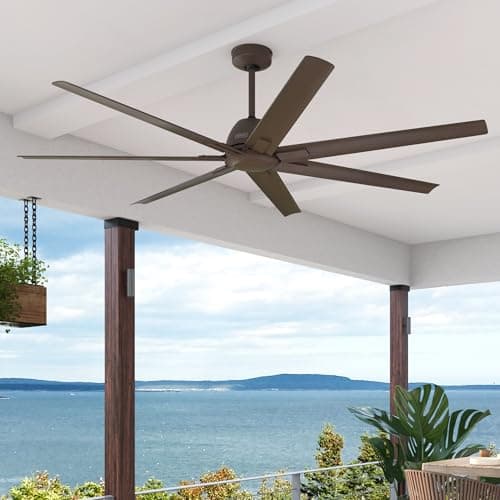 Best whole-room approach Hunter Lakeway 72" Ceiling Fan 329.1 CFM per watt across a 72-inch span, and 2.3 W on low. | A large open space where cooling every corner is not the goal | |
| 3 | 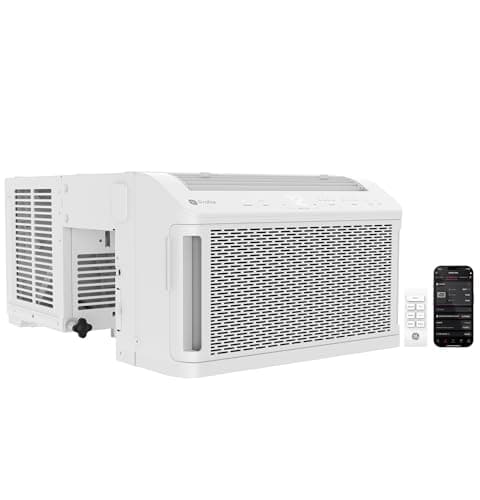 Best for the main living space GE Profile ClearView Window Air Conditioner, 8,000 BTU 375 kWh a year at CEER 16 — Most Efficient, and 47% below the federal standard. | The one room the household shares in the evening | |
| — | 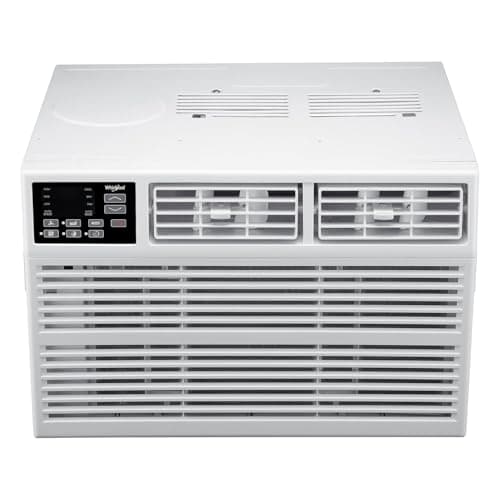 The scope mistake Whirlpool Window Air Conditioner, 24,000 BTU 1,417.3 kWh a year at CEER 12.7 — the least efficient certified unit we hold data for, and the largest. | A genuinely large single space, sized deliberately |
Most people never explicitly decide how much of their home to cool. They decide it implicitly, by buying a machine.
The data
Bigger is less efficient, not more
There is a general assumption that larger equipment is more efficient — economies of scale. In certified room air conditioners, the opposite holds across the units we hold data for.
| Unit | Capacity | CEER | kWh/yr | Season |
|---|---|---|---|---|
| Midea MAW06S1KWT | 6,000 BTU | 16.0 | 281.3 | $52 |
| GE Profile PWJV08W | 8,000 BTU | 16.0 | 375 | $69 |
| Midea MAW14V1KYWT | 14,000 BTU | 16.0 | 656.3 | $120 |
| Whirlpool WHAW241IN | 24,000 BTU | 12.7 | 1417.3 | $260 |
The efficiency leaders hold at CEER 16 up to 14,000 BTU and then fall off. The 24,000 BTU unit is the least efficient in the set as well as the largest — so scaling up costs you twice, once in capacity and again in the efficiency of every BTU of it.
Annual kWh is the figure to compare, not BTU and not the price on the box. How the specification sheet is arranged — and which numbers on it are load-bearing.
The question
How much of the house are you in?
Cooling is not storage. What you make now is gone in an hour, so cooling a room nobody enters is spending with no return whatsoever.
Which makes the real question behavioral rather than technical: how much of your home is genuinely occupied at the times it is hot?
- One person, one room at a time. Room-scale cooling, almost always. A bedroom at night and a workspace by day are two units that never run together.
- A household that gathers in the evening. Cool the shared room well, and the bedrooms only at night.
- Open-plan living where the space is one room. Then “the room” genuinely is most of the floor, and a larger unit is the honest answer.
- A house with high internal gains and poor airflow. Whole-house ventilation may beat both — when a whole-house fan is worth it.
The hierarchy
Cool the person, then the room, then the house
Each step up costs roughly an order of magnitude more to run than the one below it, and each is genuinely necessary at some point.
- The person. A ceiling fan at 2.3 W on low makes a warm room feel several degrees cooler to anyone it reaches. It changes no temperature at all, which is exactly why it costs nothing.
- The room. A certified 6,000 to 8,000 BTU unit, 281 to 375 kWh a year. It lowers real temperature in the space you occupy.
- The house. Whole-house equipment, or several room units. The running cost is a multiple, and the justification has to be that you actually occupy it.
Almost everyone should be doing step one regardless, because it is nearly free and it raises the temperature at which step two becomes necessary.
This one is not a DIY job
Central and ducted systems are a different decision from this one. If your home already has ducted cooling, the question is how to run it well rather than what to buy — and zoning, duct condition and thermostat behavior dominate.
Do not try to convert a ducted system into a room-by-room one by closing vents. That does not work the way it looks like it should, and it can damage the equipment.
Sizing and installing fixed or ducted equipment is a job for a qualified HVAC contractor, working from a proper load calculation rather than a square-footage rule of thumb.
Practical
Getting the scope right
- Count the hours, not the rooms. A room used two hours an evening does not justify the same equipment as one used all day.
- Close the door on the room you are cooling. A room unit sized for one room and asked to cool a floor will run continuously and never get there.
- Two small units usually beat one large one if the two rooms are used at different times, because you only ever run one.
- Reduce the load before scaling up. Shading and sealing lower the capacity you need in the first place.
- Check the annual kWh before the capacity. It folds efficiency and size into one number you can compare directly.
Say the unwelcome thing
Do not buy one large unit to cool rooms you are not in.
This is the most expensive mistake in home cooling, and it is a planning error rather than a product one.
Cooling cannot be stored. Every hour spent cooling an empty room is spent for nothing, and a machine sized for a whole floor spends most of its hours doing exactly that.
The certified data makes it worse: the 24,000 BTU unit runs at CEER 12.7 against 16.0 for the small ones. You buy more cooling and each unit of it costs more.
Cool where you are. 281.3 kWh a year for a bedroom, or 375 kWh for the shared room — and put a 2.3 W fan everywhere else.
In full
Every pick, and what is wrong with it
Published specifications only, each linked to the page it came from. Where a manufacturer publishes nothing, the row says so — we do not fill blanks in.
1. Best for one room
Midea Window Air Conditioner, 6,000 BTU
Midea · model MAW06S1KWT-A
281.3 kWh a year at CEER 16 — the lowest annual energy use of any certified unit we hold data for.
The whole argument of this page in one product. It cools the space you are in, and it does not spend anything on the spaces you are not.
281.3 kWh a year — roughly $52 a cooling season at 18.34¢/kWh — and CEER 16, which is 45% below the federal standard and on the Most Efficient list.
31.6 lb and no support bracket required, which makes it the one most people can install without help. Bracket requirements do not track weight the way you would expect.
Variable-speed compressor and R-32. The variable speed is why it holds a temperature rather than cycling.
What’s wrong with it
6,000 BTU is one room. It does nothing for the rest of the house, by design.
Running cost — MAW06S1KWT-A
| Annual energy use | 281.3 kWh | ENERGY STAR certified figure |
|---|---|---|
| Annual cost | $52 | 281.3 × 18.34¢/kWh |
| Per cooling month | $13 | spread over a four-month season |
The annual figure is the certified value from the ENERGY STAR Certified Room Air Conditioners dataset, which models a standard cooling season rather than your actual summer. It is more useful than a nameplate wattage here, because a variable-speed compressor spends most of its life well below nameplate.
Rate: 18.34¢/kWh, the US average residential price for June 2026 (EIA Electric Power Monthly, Table 5.3). Yours will differ — swap it in: (watts ÷ 1000) × hours × your rate.
| Cooling capacity | 6,000 BTU/h |
|---|---|
| CEER | 16 |
| Annual energy use | 281.3 kWh/yr |
| vs federal standard | 45% less energy |
| Dimensions | 12.1 H x 16.0 W x 13.3 D in |
| Weight | 31.6 lb |
| Installation | Does not straddle the windowsill |
| Support bracket | Not required |
| Compressor | Variable speed |
| Refrigerant | R-32 |
| ENERGY STAR | Certified, and on the Most Efficient list |
Every figure above is from ENERGY STAR Certified Room Air Conditioners dataset. Blanks are shown as “not published” rather than filled in.
2. Best whole-room approach
Hunter Lakeway 72" Ceiling Fan
Hunter · model 72" Lakeway
329.1 CFM per watt across a 72-inch span, and 2.3 W on low.
The scope question has a third answer that is neither room nor house: cool the people, and leave the air alone.
72 inches covers a large open-plan space from one fixture, and 2.3 W on low is small enough that running cost stops being part of the decision.
329.1 CFM per watt, certified, and rated for indoor or outdoor use — so it also works over a covered terrace.
The honest limit: a fan cools you, not the room. It is the cheapest useful thing in the house and it is not a substitute for cooling when the air is genuinely too warm.
What’s wrong with it
It does not lower the temperature at all. It only helps people it can reach.
Running cost — 72" Lakeway
| Nameplate power | 2.3 W – 31 W | manufacturer's published figure |
|---|---|---|
| Energy, 8-hour night | 0.25 kWh | 31 ÷ 1000 × 8 |
| Cost per hour | 0.6¢ | at 18.34¢/kWh |
| Cost per 8-hour night | 4.5¢ | on the highest speed |
| Cost per 30 nights | $1.36 | 7.4 kWh |
| Same month, lowest speed | 10¢ | at 2.3 W |
Rate: 18.34¢/kWh, the US average residential price for June 2026 (EIA Electric Power Monthly, Table 5.3). Yours will differ — swap it in: (watts ÷ 1000) × hours × your rate.
| Blade span | 72 in |
|---|---|
| Efficiency | 329.1 CFM per watt |
| Power, high speed | 31.0 W |
| Power, low speed | 2.3 W |
| Type | Rated for indoor and outdoor use |
| ENERGY STAR | Certified |
Every figure above is from ENERGY STAR Certified Ceiling Fans dataset. Blanks are shown as “not published” rather than filled in.
3. Best for the main living space
GE Profile ClearView Window Air Conditioner, 8,000 BTU
GE Profile · model PWJV08W
375 kWh a year at CEER 16 — Most Efficient, and 47% below the federal standard.
The middle answer, and for most households the correct one: cool the room everyone is in, at the time everyone is in it.
375 kWh a year, about $69 a season, for 8,000 BTU. That is a quarter of the whole-floor unit below for the space that is actually occupied.
CEER 16 and on the Most Efficient list. What that designation requires is a real bar, not a marketing tier.
46.2 lb and unusually shallow at 15.3 inches deep — it does not straddle the sill, so check what your window needs.
What’s wrong with it
It does not straddle the sill, so the installation depends on your window and possibly a bracket.
Running cost — PWJV08W
| Annual energy use | 375 kWh | ENERGY STAR certified figure |
|---|---|---|
| Annual cost | $69 | 375 × 18.34¢/kWh |
| Per cooling month | $17 | spread over a four-month season |
The annual figure is the certified value from the ENERGY STAR Certified Room Air Conditioners dataset, which models a standard cooling season rather than your actual summer. It is more useful than a nameplate wattage here, because a variable-speed compressor spends most of its life well below nameplate.
Rate: 18.34¢/kWh, the US average residential price for June 2026 (EIA Electric Power Monthly, Table 5.3). Yours will differ — swap it in: (watts ÷ 1000) × hours × your rate.
| Cooling capacity | 8,000 BTU/h |
|---|---|
| CEER | 16 |
| Annual energy use | 375 kWh/yr |
| vs federal standard | 47% less energy |
| Dimensions | 12.6 H x 18.6 W x 15.3 D in |
| Weight | 46.2 lb |
| Refrigerant | R-32 |
| Installation | Does not straddle the windowsill |
| Compressor | Variable speed |
| ENERGY STAR | Certified, and on the Most Efficient list |
Every figure above is from ENERGY STAR Certified Room Air Conditioners dataset. Blanks are shown as “not published” rather than filled in.
Skip this one
Whirlpool Window Air Conditioner, 24,000 BTU
Whirlpool · model WHAW-241IN
1,417.3 kWh a year at CEER 12.7 — the least efficient certified unit we hold data for, and the largest.
Not a bad machine. It is the machine people buy when they decide to cool a whole floor with one purchase, and that decision is what costs them.
1,417.3 kWh a year — about $260 a season, and five times the 6,000 BTU unit above.
CEER 12.7 is the point. It is not just bigger, it is less efficient per BTU than every smaller unit here. You pay more per unit of cooling and then buy more units of it.
115.7 lb and firmly in support-bracket territory. If you genuinely have one large space to cool, it is the right shape of product — just size it on purpose.
What’s wrong with it
Buying capacity to cool rooms nobody is in, at the worst efficiency in the certified set.
Running cost — WHAW-241IN
| Annual energy use | 1417.3 kWh | ENERGY STAR certified figure |
|---|---|---|
| Annual cost | $260 | 1417.3 × 18.34¢/kWh |
| Per cooling month | $65 | spread over a four-month season |
The annual figure is the certified value from the ENERGY STAR Certified Room Air Conditioners dataset, which models a standard cooling season rather than your actual summer. It is more useful than a nameplate wattage here, because a variable-speed compressor spends most of its life well below nameplate.
Rate: 18.34¢/kWh, the US average residential price for June 2026 (EIA Electric Power Monthly, Table 5.3). Yours will differ — swap it in: (watts ÷ 1000) × hours × your rate.
| Cooling capacity | 24,000 BTU/h |
|---|---|
| CEER | 12.7 |
| Annual energy use | 1,417.3 kWh/yr |
| vs federal standard | 35% less energy |
| Dimensions | 20.7 H x 30.0 W x 28.8 D in |
| Weight | 115.7 lb |
| Refrigerant | R-32 |
| Installation | Straddles the window; support bracket territory |
| ENERGY STAR | Certified |
Every figure above is from ENERGY STAR Certified Room Air Conditioners dataset. Blanks are shown as “not published” rather than filled in.
We are not linking a buy button for this one. If you want to look at it anyway, it is easy enough to find — but we would rather send you to something that fits your room.
Questions people actually ask
Frequently asked
Is it cheaper to cool one room or the whole house?
One room, by a wide margin. A certified 6,000 BTU unit uses 281.3 kWh a year against 1,417.3 for a 24,000 BTU unit sized at a whole floor — five times the energy, for space that is mostly unoccupied.
Are bigger air conditioners more efficient?
Not in the certified units we hold data for. CEER holds at 16.0 up to 14,000 BTU and then drops to 12.7 at 24,000 BTU. Scaling up costs you twice: more capacity, and worse efficiency per BTU of it.
When does whole-house cooling make sense?
When you genuinely occupy the whole house while it is hot — open-plan living where the space really is one room, or a household spread across several rooms simultaneously. Cooling cannot be stored, so an empty room being cooled is money spent for nothing.
Should I get two small units or one big one?
Two small ones, if the rooms are used at different times — because you only ever run one. One large one, if the space is genuinely a single open room.
Does a fan count as cooling the room?
No, and that is why it costs so little. A fan changes no temperature; it makes people it reaches feel cooler. At 2.3 W on low that is nearly free, and it raises the temperature at which you actually need an air conditioner. How fans work.
What number should I compare between units?
Annual kWh. It folds capacity and efficiency into a single figure you can compare directly, which neither BTU nor CEER does on its own. Reading a spec sheet.
Sources
Where these numbers came from
Read next
Where to go from here
Back to Guides & Calculators, or read how we pick.