Head to head
Tower fan vs pedestal fan
One of these gets air to bed height from across a room. The other tells you what it draws and how loud it is. That is the actual trade, and it is not the one most comparisons make.
By Sawyer V. · Published
The short answer
A tower fan for a bedroom — quieter, cheaper to run, more stable, and it publishes the figures (23 dBA, 2.9–19 W) that a pedestal fan does not. A pedestal fan when you need height: 38–54 inches puts airflow across a bed or at a seated person’s head from the far side of a room.
Fan & Frost earns a commission when you buy through our links, at no cost to you. It never changes a ranking, and we say so when the right answer is the cheaper unit or nothing at all. Full disclosure · How we pick.

At a glance
The picks, ranked
Tap any row to jump to the full reasoning. Prices are live from Amazon where we have them, and read “check price” where we don’t — never a number we cannot verify today.
| # | Product | Best for | Price |
|---|---|---|---|
| 1 | 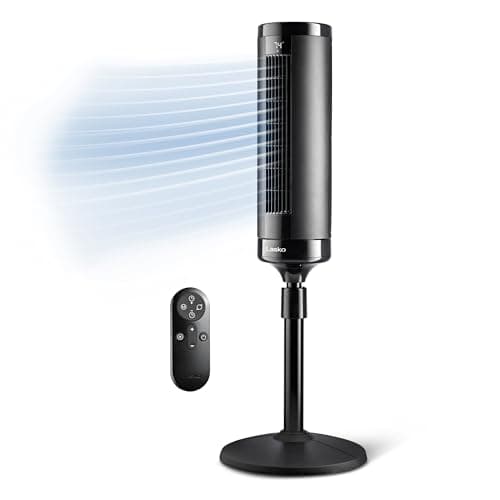 The tower pick Lasko EcoQuiet 42" DC Tower Fan 23 dBA and 2.9 W on low, twelve speeds, and a 12.8-inch square footprint. | Bedrooms, small rooms, and anywhere quiet matters | |
| 2 | 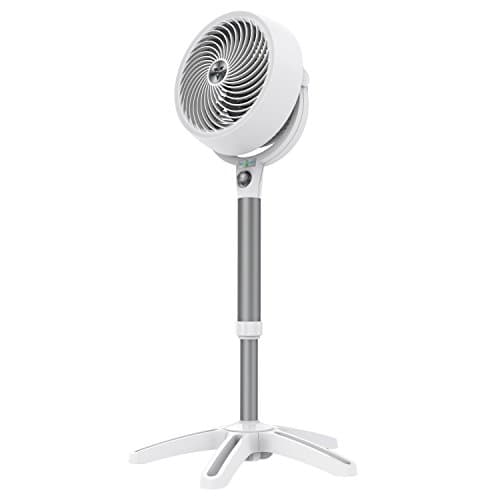 The pedestal pick Vornado 683DC Energy Smart Medium Pedestal Air Circulator A published 80 ft reach and a 5-year warranty — reach being the thing a tower fan cannot do. | Large or long rooms where air has to travel | |
| 3 | 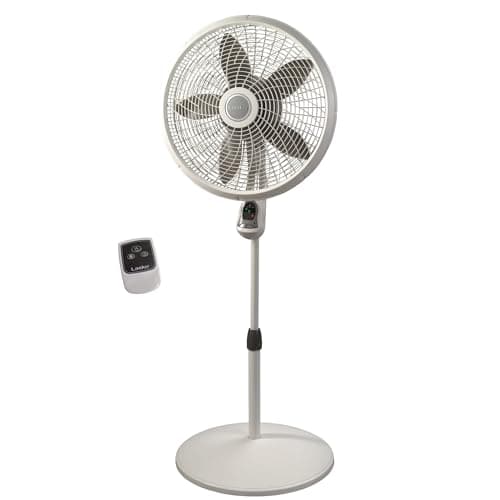 The pedestal pick for height Lasko Cyclone 18" Pedestal Fan 38 to 54.5 inches of adjustment — the widest range here, and the reason to buy a pedestal fan at all. | Aiming air across a bed | |
| 4 | 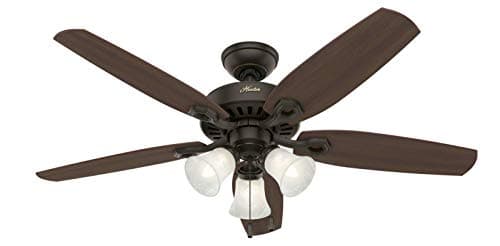 What beats both Hunter Vespucci 52" Ceiling Fan 366.7 CFM per watt certified, 1.8 W on low, and it needs no floor space at all. | A room you own with a mountable ceiling |
Most comparisons of these two settle on style and floor space. The more useful difference is that one of them tells you what you are buying and the other does not — and that turns out to matter as much as the physical distinction.
Side by side
The comparison
| Tower fan | Pedestal fan | |
|---|---|---|
| Airflow height | Roughly 12 – 40 in, a fixed column | 38 – 54 in, adjustable |
| Airflow shape | Broad soft column | Concentrated stream from a round head |
| Reach | Not published | Up to 80 ft claimed (Vornado) |
| Wattage published | Yes — 2.9 to 19 W | No, on either fan we looked at |
| Noise published | Yes — 23 / 46 dBA | No |
| Speeds | Up to 12 on a DC motor | 3 (Lasko) / variable (Vornado) |
| Footprint | About 13 in square | Wide tripod base |
| Stability | Low center of mass | Top-heavy by design |
| 30 nights on low | 13¢ | Cannot be calculated |
| Warranty | 1 – 2 years | 1 year (Lasko) / 5 years (Vornado) |
From Lasko and Vornado product pages, 2026-09-03. Costs are our arithmetic at 18.34¢/kWh.
The real difference
Height, and why it matters more than it sounds
A fan cools by moving air across skin, which speeds evaporation and strips off the warm layer sitting against you. Most of your exposed skin — face, neck, arms — is above waist height. So a fan aimed at your ankles is doing a fraction of the work of one aimed at your upper body.
A tower fan produces a column of air roughly 12 to 40 inches from the floor. Sitting on a sofa or standing, that covers you adequately. Lying on a bed at 25 inches, it is fine. Sitting at a desk, it hits your torso.
A pedestal fan at 50-plus inches can aim down across a bed from the far wall, or straight at a seated person’s head and shoulders from across a room. That is the genuine capability, and if it describes your situation, it decides the question.
If it does not describe your situation — and for most bedrooms it does not — then you are choosing a fan with no published specifications over one with several, for no benefit.
The documentation gap
What you can and cannot know
This is the part we would want to know before buying, and it is rarely mentioned.
Tower fans, from Lasko: wattage published on both models we looked at. Noise published on the DC model (23/46 dBA). CFM published on the AC model (720). Speeds, height, weight, timer and warranty all published.
Pedestal fans, from Lasko and Vornado: no wattage on either. No CFM on either. No noise figure on either. Vornado also publishes no weight and no dimensions.
The two airflow claims that do exist are in incompatible units: “1,200 feet per minute” is a velocity, “up to 80 feet” is a distance, and neither is a volume. You cannot rank them against each other, let alone against a tower fan.
For a site that computes running costs from published specifications, that is a hard limit, and we would rather say so than manufacture numbers. The fans that do publish wattages are all here.
Decide
Which to buy
Buy a tower fan if:
- It is for a bedroom, and quiet matters.
- The room is small and floor space is tight.
- There are children or pets who might knock it over.
- You want to know what it draws and how loud it is before you buy it.
- You want more than three speeds, which means a DC motor.
Buy a pedestal fan if:
- You need air at bed height from across the room, or at a seated person’s head from a distance.
- The room is long and you need reach rather than local stirring.
- You want to adjust the height for different uses.
- A 5-year warranty outweighs the missing performance data for you.
Buy neither if you own the room and the ceiling can take a fan — a certified ceiling fan on low draws 1.8 W, solves the height problem completely, and uses no floor at all. And if the room is genuinely hot rather than warm, no fan of any shape will be enough: you need something that removes heat.
In full
Every pick, and what is wrong with it
Published specifications only, each linked to the page it came from. Where a manufacturer publishes nothing, the row says so — we do not fill blanks in.
1. The tower pick
Lasko EcoQuiet 42" DC Tower Fan
Lasko · model T42710
23 dBA and 2.9 W on low, twelve speeds, and a 12.8-inch square footprint.
The case for a tower fan is that you can check it. 23 dBA on low and 46 on high; 2.9 W on low and 19 on high — all four published by Lasko. Neither pedestal fan we looked at publishes a single one of those numbers.
13¢ for a month of eight-hour nights on low at 18.34¢/kWh, and twelve speeds so you can actually sit on the setting that is just enough.
The footprint matters in a bedroom: 12.8 inches square, against a pedestal fan’s wide tripod base. And a tower fan’s mass is low and central, so it does not tip.
What’s wrong with it
Airflow comes out between roughly 12 and 40 inches from the floor, so it cannot aim across a bed from the far side of a room the way a pedestal fan can. No CFM figure published either.
Running cost — T42710
| Nameplate power | 2.9 W – 19 W | manufacturer's published figure |
|---|---|---|
| Energy, 8-hour night | 0.15 kWh | 19 ÷ 1000 × 8 |
| Cost per hour | 0.3¢ | at 18.34¢/kWh |
| Cost per 8-hour night | 2.8¢ | on the highest speed |
| Cost per 30 nights | 84¢ | 4.6 kWh |
| Same month, lowest speed | 13¢ | at 2.9 W |
Rate: 18.34¢/kWh, the US average residential price for June 2026 (EIA Electric Power Monthly, Table 5.3). Yours will differ — swap it in: (watts ÷ 1000) × hours × your rate.
| Power | 2.9 W - 19 W (0.06-0.303 A at 120 V) |
|---|---|
| Noise | 23 dBA low, 46 dBA high |
| Speeds | 12 |
| Height | 41.6 in |
| Footprint | 12.8 x 12.8 in |
| Weight | 7.8 lb |
| Timer | 8 hours |
| Air delivery (CFM) | Not published |
| Warranty | 2 years |
Every figure above is from Lasko product page, T42710. Blanks are shown as “not published” rather than filled in.
2. The pedestal pick
Vornado 683DC Energy Smart Medium Pedestal Air Circulator
Vornado · model 683DC
A published 80 ft reach and a 5-year warranty — reach being the thing a tower fan cannot do.
Vornado’s shrouded deep-pitch blade produces a focused vortex that holds together over distance rather than dissipating within a few feet. The published claim is “moves air up to 80 feet”, and in a long living room that is a real capability — air arriving at the far end with velocity left in it.
The 5-year warranty is five times what almost anything else in this category offers, and with no performance data to compare it is one of the few genuine signals available.
What you accept is not knowing what it costs to run. The documentation gap across this whole category is set out here.
What’s wrong with it
No published wattage, CFM, weight or noise figure. You are buying on a distance claim and a warranty, with no way to compute running cost.
Running cost
Vornado does not publish a wattage for the 683DC, so we cannot calculate what it costs to run. We are not going to estimate one. If Vornado publishes a nameplate figure, this block will show the arithmetic.
| Power | Not published |
|---|---|
| Airflow reach | Moves air up to 80 ft |
| Speeds | Variable-speed dial; Vornado publishes no fixed speed count |
| Motor | Brushless DC |
| Height | 32 - 38 in, adjustable |
| Air delivery (CFM) | Not published |
| Warranty | 5 years |
Every figure above is from Vornado product page, 683DC Energy Smart. Blanks are shown as “not published” rather than filled in.
3. The pedestal pick for height
Lasko Cyclone 18" Pedestal Fan
Lasko · model S18931
38 to 54.5 inches of adjustment — the widest range here, and the reason to buy a pedestal fan at all.
Up to 54.5 inches is the tallest here, and height is the entire argument for this form factor. At that setting it aims air across a mattress from the opposite wall, which no tower fan can do — a tower’s airflow column stops around 40 inches.
9 lb, so it moves between rooms easily. Three speeds, oscillating, 1-year warranty.
Same documentation caveat as the Vornado: no wattage published, so no running cost.
What’s wrong with it
No wattage, no CFM, no noise figure, and a 1-year warranty. Its published '1,200 ft/min' is a velocity, not a volume, and cannot be compared with anything.
Running cost
Lasko does not publish a wattage for the S18931, so we cannot calculate what it costs to run. We are not going to estimate one. If Lasko publishes a nameplate figure, this block will show the arithmetic.
| Power | Not published (120 V stated, no wattage) |
|---|---|
| Air velocity | Up to 1,200 ft per minute |
| Speeds | 3 |
| Height | 38 - 54.5 in, adjustable |
| Weight | 9.0 lb |
| Air delivery (CFM) | Not published |
| Warranty | 1 year |
Every figure above is from Lasko product page, S18931. Blanks are shown as “not published” rather than filled in.
4. What beats both
Hunter Vespucci 52" Ceiling Fan
Hunter · model Vespucci
366.7 CFM per watt certified, 1.8 W on low, and it needs no floor space at all.
Worth stating plainly, because this comparison is often made without it: if you own the room and the ceiling can take a fan, both options above are the wrong answer.
1.8 W on low at a certified 366.7 CFM per watt — about 7.9¢ for a month of nights. The best tower fan here costs 84¢ for the same hours on high, and neither pedestal fan will tell you what it costs.
It also solves the height problem outright by putting the airflow above everything, and it uses no floor space. The certified ranking is here.
What’s wrong with it
Permanent installation with wiring and clearance requirements, so it is not an option in most rentals and you cannot move it between rooms.
Running cost — Vespucci
| Nameplate power | 1.8 W – 13.9 W | manufacturer's published figure |
|---|---|---|
| Energy, 8-hour night | 0.11 kWh | 13.9 ÷ 1000 × 8 |
| Cost per hour | 0.3¢ | at 18.34¢/kWh |
| Cost per 8-hour night | 2.0¢ | on the highest speed |
| Cost per 30 nights | 61¢ | 3.3 kWh |
| Same month, lowest speed | 7.9¢ | at 1.8 W |
Rate: 18.34¢/kWh, the US average residential price for June 2026 (EIA Electric Power Monthly, Table 5.3). Yours will differ — swap it in: (watts ÷ 1000) × hours × your rate.
| Blade span | 52 in |
|---|---|
| Efficiency | 366.7 CFM per watt |
| Power, high speed | 13.9 W |
| Power, low speed | 1.8 W |
| Standby power | 0.8 W |
| Type | Indoor, fan only (no light kit) |
| Warranty | 3 years, components |
| ENERGY STAR | Certified |
Every figure above is from ENERGY STAR Certified Ceiling Fans dataset. Blanks are shown as “not published” rather than filled in.
Questions people actually ask
Frequently asked
Is a tower fan or a pedestal fan better for a bedroom?
A tower fan, in most bedrooms. It is quieter, has a smaller footprint, does not tip, and — unlike the pedestal fans we looked at — publishes its wattage and decibel figures. A pedestal fan wins only if you specifically need air aimed across a bed from the far side of the room.
Which moves more air, a tower fan or a pedestal fan?
There is no way to answer this from published data. Neither pedestal fan we looked at publishes a CFM figure, and only one tower fan does (720 CFM). The airflow claims that exist are in incompatible units — a velocity in feet per minute versus a distance in feet.
Are tower fans quieter than pedestal fans?
Probably, though only the tower fans publish figures to prove it. A DC tower publishes 23 dBA on low; neither pedestal fan publishes any noise rating. A tower's shrouded impeller is inherently less turbulent than an open blade, which supports the expectation.
Do pedestal fans use more electricity than tower fans?
Unknown, because neither Lasko nor Vornado publishes a wattage for its pedestal fans. Tower fans publish theirs: 2.9 to 19 W for a DC model, 37 to 49 W for an AC model. Where a manufacturer publishes nothing, we do not estimate.
How tall should a fan be for a bed?
Around 50 to 54 inches if you want to aim air across a mattress from the far side of the room, which is at the top of a typical pedestal fan's range. A tower fan's airflow column stops around 40 inches, which is fine beside the bed but not from across the room.
Is a ceiling fan better than either?
Considerably, if the room allows one. A certified ceiling fan draws 1.8 W on low at 366.7 CFM per watt — about 7.9¢ for a month of nights — solves the height problem by being above everything, and takes no floor space. The trade is permanent installation. Ceiling fans ranked.
Sources
Where these numbers came from
- Lasko EcoQuiet T42710 specifications — 2.9-19 W, 23/46 dBA, 12 speeds
- Lasko S18931 pedestal fan specifications — 38-54.5 in, no wattage
- Vornado 683DC Energy Smart pedestal air circulator — 80 ft reach, variable-speed DC motor, 5-year warranty
- ENERGY STAR Certified Ceiling Fans dataset — the comparison figures
Read next
Where to go from here
Back to Fans, or read how we pick.