Head to head
Swamp cooler vs tower fan
Eighty-six times the power for a real temperature drop that only happens where the air is dry. That is the whole trade.
By Sawyer V. · Published
The short answer
A swamp cooler genuinely lowers air temperature by evaporating water into the air stream — but only where the air is dry enough to absorb it, and it costs 220 to 250 W plus water and maintenance. A tower fan makes you feel cooler anywhere, in any humidity, on 2.9 W. In a dry climate the cooler wins on effect; everywhere else the fan wins outright.
Fan & Frost earns a commission when you buy through our links, at no cost to you. It never changes a ranking, and we say so when the right answer is the cheaper unit or nothing at all. Full disclosure · How we pick.

At a glance
The picks, ranked
Tap any row to jump to the full reasoning. Prices are live from Amazon where we have them, and read “check price” where we don’t — never a number we cannot verify today.
| # | Product | Best for | Price |
|---|---|---|---|
| 1 | 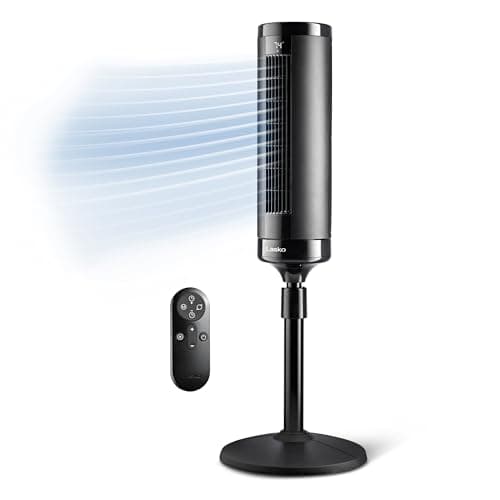 Right almost everywhere Lasko EcoQuiet 42" DC Tower Fan 2.9 W on low at 23 dBA with twelve speeds — one eighty-sixth the power of a swamp cooler, and it works in humid air. | Any climate, any room, any humidity | |
| 2 | The dry-climate case, indoors Honeywell CL25AE Indoor Evaporative Cooler 764 CFM on 235 W at 52 to 60 dBA — the quietest evaporative cooler published, and a genuine temperature drop where the air is dry. | A single room in a dry climate with a window or door open | |
| 3 | 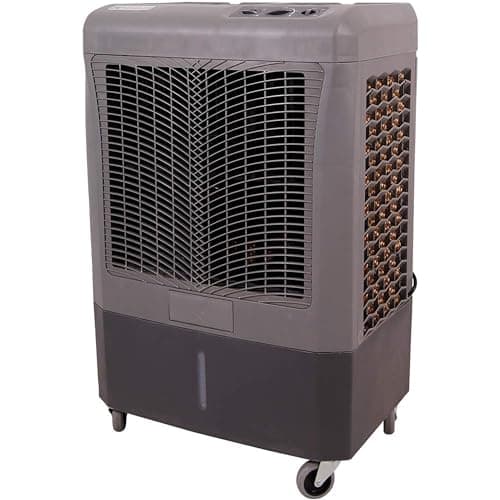 Most cooling capacity, outdoors or in a shop Hessaire MC37M Mobile Evaporative Cooler 3,100 CFM on 250 W — the best air-per-watt of any evaporative cooler, with a continuous water hookup. | A garage, workshop or patio in a dry climate | |
| — | What to buy in a humid climate Midea Window Air Conditioner, 6,000 BTU 6,000 BTU at CEER 16 and 281.3 kWh a year — it removes moisture instead of adding it, in any humidity. | Anywhere a swamp cooler will not work — which is most places |
These get compared because they occupy similar floor space and cost similar money. They work by entirely different mechanisms, and one of them has a hard climate precondition the other does not.
Mechanisms
One changes the air, one changes you
A tower fan moves air across your skin. That accelerates evaporation of sweat and convective heat loss from your body, so you feel cooler. The air temperature is unchanged — fractionally higher, in fact, since the motor adds heat.
A swamp cooler evaporates water into the air stream. Evaporation absorbs heat, and that heat comes out of the air passing through the pad. The air genuinely leaves the machine cooler than it entered.
Which sounds decisive for the cooler, and would be if evaporation happened everywhere equally. It does not.
| Swamp cooler | Tower fan | |
|---|---|---|
| Lowers air temperature | Yes, in dry air | No |
| Works in humid air | No | Yes, with reduced effect |
| Power | 220 – 250 W | 2.9 – 19 W |
| Published noise | 52 – 65 dBA | 23 – 46 dBA |
| Needs water | Yes — 6.6 to 15.9 gallons | No |
| Needs a window open | Yes | No |
| Maintenance | Tank, pump, pads, draining | Wipe the blades |
| Adds humidity | Yes, deliberately | No |
The precondition
Humidity decides it, not preference
Evaporative cooling depends on the air having spare capacity to absorb water. Relative humidity is a direct measure of how much of that capacity is already used.
In dry air the capacity is large, a lot of water evaporates, and the temperature drop is substantial. In humid air the capacity is small, almost nothing evaporates, and you get negligible cooling plus added moisture — which makes your own sweat evaporate less well.
It is the one appliance on this site that can leave a room feeling worse than doing nothing. A fan never does that.
The humidity thresholds — and check yours with a cheap hygrometer before buying, not after.
This one is not a DIY job
The water use is the cooling. This is the concept that makes the category make sense, and it cuts both ways.
The cooling you get is proportional to the water evaporated — they are the same event measured two ways. So a cooler getting through its tank quickly on a hot dry day is working well, and one whose tank barely moves is not being frugal, it is not cooling.
No manufacturer publishes a consumption rate. Tank capacity is always stated — 6.6 to 15.9 gallons across the units here — and gallons per hour is not. How to measure yours.
Evaporation also leaves every dissolved mineral behind in the pad, so in hard water the recurring cost is media rather than water.
The other costs
Maintenance is part of the comparison
A tower fan needs its blades wiped occasionally. A swamp cooler needs genuinely more:
- Refilling or plumbing. A 6.6 gallon tank on a hot dry day does not last indefinitely, which is why the larger units offer continuous hookups.
- Draining when idle. Warm standing water is the origin of essentially every cooler smell, and it needs doing whenever the machine sits for more than a day.
- Pad inspection and replacement. No manufacturer publishes an interval, so it is judged by inspection. What to look for.
- Seasonal cleaning and winterizing. Tank, pump, distributor and media, and drying it all before storage. The shutdown.
That is not a reason to avoid one in the right climate. It is a reason to be honest that the comparison is not just 250 W against 2.9 W.
Decide
Which one
Tower fan if your climate is humid, you want something quiet, you want it in a bedroom, or you want zero maintenance. That covers most people in most places.
Swamp cooler if your air is genuinely dry, the space is large or outdoors, you can leave a door or window open, and you want an actual temperature drop rather than felt cooling. A garage, workshop or patio in a dry climate is the strong case.
Both, honestly, is a reasonable answer in a dry climate: the cooler for the hot hours in the main space, a 2.9 W tower fan in the bedroom overnight where the noise and humidity would not be welcome.
Neither, if the room is genuinely too hot in humid air — that is an air conditioner question.
Say the unwelcome thing
Do not buy a swamp cooler for a bedroom.
Even in the right climate, this is the room where the format suits least, on three counts at once.
Noise. The quietest published evaporative figure is 52 to 60 dBA, against 23 for a good tower fan. In a room you sleep in that is a large difference.
Humidity. It adds moisture to a small, usually closed room, overnight, which is the opposite of comfortable for sleeping.
Standing water. Several gallons in a warm tank feeding a permanently damp pad, in a room you breathe in for eight hours — with a maintenance routine that has to be kept up.
Use one in a garage, workshop or patio. For a bedroom, a 23 dBA tower fan at 2.9 W is better on every axis that matters there.
In full
Every pick, and what is wrong with it
Published specifications only, each linked to the page it came from. Where a manufacturer publishes nothing, the row says so — we do not fill blanks in.
1. Right almost everywhere
Lasko EcoQuiet 42" DC Tower Fan
Lasko · model T42710
2.9 W on low at 23 dBA with twelve speeds — one eighty-sixth the power of a swamp cooler, and it works in humid air.
2.9 W on low is 0.4¢ for an eight-hour night, against 37¢ for a swamp cooler over the same period.
More importantly, it works regardless of humidity. Air movement over skin accelerates evaporation from you, and while that effect weakens in humid air it never fails the way a swamp cooler does.
23 dBA on low is the quietest published figure on this site, against 52 to 65 dBA for the evaporative coolers.
No water, no tank, no pads, no draining. That absence of maintenance is a real part of the comparison.
What’s wrong with it
It does not lower the air temperature at all. In a genuinely hot room it supplements rather than solves.
Running cost — T42710
| Nameplate power | 2.9 W – 19 W | manufacturer's published figure |
|---|---|---|
| Energy, 8-hour night | 0.15 kWh | 19 ÷ 1000 × 8 |
| Cost per hour | 0.3¢ | at 18.34¢/kWh |
| Cost per 8-hour night | 2.8¢ | on the highest speed |
| Cost per 30 nights | 84¢ | 4.6 kWh |
| Same month, lowest speed | 13¢ | at 2.9 W |
Rate: 18.34¢/kWh, the US average residential price for June 2026 (EIA Electric Power Monthly, Table 5.3). Yours will differ — swap it in: (watts ÷ 1000) × hours × your rate.
| Power | 2.9 W - 19 W (0.06-0.303 A at 120 V) |
|---|---|
| Noise | 23 dBA low, 46 dBA high |
| Speeds | 12 |
| Height | 41.6 in |
| Footprint | 12.8 x 12.8 in |
| Weight | 7.8 lb |
| Timer | 8 hours |
| Air delivery (CFM) | Not published |
| Warranty | 2 years |
Every figure above is from Lasko product page, T42710. Blanks are shown as “not published” rather than filled in.
2. The dry-climate case, indoors
Honeywell CL25AE Indoor Evaporative Cooler
Honeywell · model CL25AE
764 CFM on 235 W at 52 to 60 dBA — the quietest evaporative cooler published, and a genuine temperature drop where the air is dry.
The thing a fan cannot do: in dry air this lowers the temperature of the air passing through it, because evaporating water absorbs heat from that air.
52 to 60 dBA is the quietest published figure in the category, though still well above a tower fan’s 23.
235 W — about 26¢ for a six-hour session — and a 6.6 gallon tank with a 7.5 hour timer, sized for a session rather than continuous running.
The precondition is absolute: it needs an air path out of the room, or the humidity it adds saturates the space and the cooling stops. The indoor requirements.
What’s wrong with it
235 W for 764 CFM is poor air-per-watt, and it needs an open window to work at all.
Running cost — CL25AE
| Nameplate power | 235 W | manufacturer's published figure |
|---|---|---|
| Energy, 8-hour night | 1.88 kWh | 235 ÷ 1000 × 8 |
| Cost per hour | 4.3¢ | at 18.34¢/kWh |
| Cost per 8-hour night | 34¢ | on the highest speed |
| Cost per 30 nights | $10 | 56.4 kWh |
Rate: 18.34¢/kWh, the US average residential price for June 2026 (EIA Electric Power Monthly, Table 5.3). Yours will differ — swap it in: (watts ÷ 1000) × hours × your rate.
| Air delivery | 764 CFM |
|---|---|
| Power | 235 W |
| Water tank | 6.6 gallons |
| Air throw | 33 ft |
| Noise | 52-60 dBA |
| Speeds | 3, oscillating louvers |
| Timer | Up to 7.5 hours |
| Dimensions | 18.9 x 14.6 x 33.3 in |
| Weight | 25.4 lb |
| Manufacturer coverage claim | 466 sq ft |
| Warranty | 1 year |
Every figure above is from Honeywell Air Comfort product page, CL25AE. Blanks are shown as “not published” rather than filled in.
3. Most cooling capacity, outdoors or in a shop
Hessaire MC37M Mobile Evaporative Cooler
Hessaire · model MC37M
3,100 CFM on 250 W — the best air-per-watt of any evaporative cooler, with a continuous water hookup.
3,100 CFM on 250 W is a genuinely large amount of cooled air, and the format makes sense where a tower fan is simply outmatched by the space.
The 10.3 gallon tank with continuous hookup is the design that makes all-day running practical — and a float valve also holds the water level steady, which reduces the mineral concentration that scales up pumps and pads.
37¢ for an eight-hour day of electricity, plus water and pad replacement.
Worth noting what Hessaire declines to publish: no noise rating and no coverage claim. We treat the missing coverage claim as a point in their favor — the claims that do exist follow a formula.
What’s wrong with it
Hessaire publishes no noise rating and no coverage claim, and 250 W is 86 times a tower fan on low.
Running cost — MC37M
| Nameplate power | 250 W | manufacturer's published figure |
|---|---|---|
| Energy, 8-hour night | 2.00 kWh | 250 ÷ 1000 × 8 |
| Cost per hour | 4.6¢ | at 18.34¢/kWh |
| Cost per 8-hour night | 37¢ | on the highest speed |
| Cost per 30 nights | $11 | 60.0 kWh |
Rate: 18.34¢/kWh, the US average residential price for June 2026 (EIA Electric Power Monthly, Table 5.3). Yours will differ — swap it in: (watts ÷ 1000) × hours × your rate.
| Air delivery | 3,100 CFM |
|---|---|
| Power | 250 W / 2.4 A |
| Water tank | 10.3 gallons, continuous hookup capable |
| Dimensions | 24 L x 16 W x 38 H in |
| Weight | 40 lb |
| Pads | Industrial-grade cooling pads |
| Coverage claim | Not published on the product page |
Every figure above is from Hessaire product page, MC37M. Blanks are shown as “not published” rather than filled in.
Skip this one
Midea Window Air Conditioner, 6,000 BTU
Midea · model MAW06S1KWT-A
6,000 BTU at CEER 16 and 281.3 kWh a year — it removes moisture instead of adding it, in any humidity.
Listed as the alternative because a lot of people arrive at this comparison from a humid climate, where neither option is really right.
A swamp cooler adds humidity; an air conditioner removes it. In a muggy room those are opposite directions and only one improves how it feels.
281.3 kWh a year — the lowest annual figure of any certified room air conditioner — at CEER 16 and 45% below the federal standard.
What’s wrong with it
It needs a window it can sit in, and at 31.6 lb it is a two-person lift over a sill.
Running cost — MAW06S1KWT-A
| Annual energy use | 281.3 kWh | ENERGY STAR certified figure |
|---|---|---|
| Annual cost | $52 | 281.3 × 18.34¢/kWh |
| Per cooling month | $13 | spread over a four-month season |
The annual figure is the certified value from the ENERGY STAR Certified Room Air Conditioners dataset, which models a standard cooling season rather than your actual summer. It is more useful than a nameplate wattage here, because a variable-speed compressor spends most of its life well below nameplate.
Rate: 18.34¢/kWh, the US average residential price for June 2026 (EIA Electric Power Monthly, Table 5.3). Yours will differ — swap it in: (watts ÷ 1000) × hours × your rate.
| Cooling capacity | 6,000 BTU/h |
|---|---|
| CEER | 16 |
| Annual energy use | 281.3 kWh/yr |
| vs federal standard | 45% less energy |
| Dimensions | 12.1 H x 16.0 W x 13.3 D in |
| Weight | 31.6 lb |
| Installation | Does not straddle the windowsill |
| Support bracket | Not required |
| Compressor | Variable speed |
| Refrigerant | R-32 |
| ENERGY STAR | Certified, and on the Most Efficient list |
Every figure above is from ENERGY STAR Certified Room Air Conditioners dataset. Blanks are shown as “not published” rather than filled in.
We are not linking a buy button for this one. If you want to look at it anyway, it is easy enough to find — but we would rather send you to something that fits your room.
Questions people actually ask
Frequently asked
Is a swamp cooler better than a fan?
In dry air, it does something a fan cannot — it genuinely lowers the air temperature. Everywhere else a fan wins, because it works in any humidity on 2.9 watts against 220 to 250, with no water and no maintenance.
How much more power does a swamp cooler use than a tower fan?
Roughly 86 times on the low setting — 250 W against 2.9 W. Over an eight-hour session that is a meaningful difference, though both are small compared with an air conditioner at 1,300 W.
Will a swamp cooler work in my climate?
Only if the air is dry. Evaporative cooling depends on the air having spare capacity to absorb water, so in humid conditions you get negligible temperature drop plus added moisture — which makes your own sweat evaporate less well. Humidity thresholds.
Can I use a swamp cooler in a bedroom?
We would not. The quietest published figure in the category is 52 to 60 dBA against 23 for a good tower fan, it adds humidity to a small closed room overnight, and it means several gallons of standing water in a room you sleep in.
Does a swamp cooler need a window open?
Yes. It works by adding water vapor to the air, and that vapor needs somewhere to go. In a sealed room the humidity climbs, the air's capacity to absorb more falls, and the cooling effect drops toward zero.
Which is cheaper to maintain?
A tower fan, by a wide margin — occasional blade wiping against refilling or plumbing, draining when idle, pad inspection and replacement, and seasonal cleaning and winterizing for a swamp cooler.
Sources
Where these numbers came from
- Honeywell CL25AE product page — 764 CFM, 235 W, 52-60 dBA, 6.6 gal tank, 7.5 h timer
- Hessaire MC37M product page — 3,100 CFM, 250 W, 10.3 gal tank, continuous hookup
- Lasko T42710 EcoQuiet product page — 2.9-19 W, 23-46 dBA, 12 speeds
- ENERGY STAR Certified Room Air Conditioners dataset — the air conditioner comparison figures
Read next
Where to go from here
Back to Evaporative Coolers, or read how we pick.