The picks
Best rechargeable and battery-powered fans
The good cordless fans are not sold as fans. They are sold as tools, on a battery platform you may already own.
By Sawyer V. · Published
The short answer
For airflow, the Ryobi PCL813B moves 2,300 CFM on an 18V ONE+ battery or an AC adapter. For endurance, the Milwaukee M12 mounting fan runs up to 16 hours on one battery at 400 CFM. Both belong to tool platforms rather than the consumer fan aisle, and that is the point: a replaceable, shared battery outlasts a sealed one, and spares turn run time into a solved problem.
Fan & Frost earns a commission when you buy through our links, at no cost to you. It never changes a ranking, and we say so when the right answer is the cheaper unit or nothing at all. Full disclosure · How we pick.
At a glance
The picks, ranked
Tap any row to jump to the full reasoning. Prices are live from Amazon where we have them, and read “check price” where we don’t — never a number we cannot verify today.
| # | Product | Best for | Price |
|---|---|---|---|
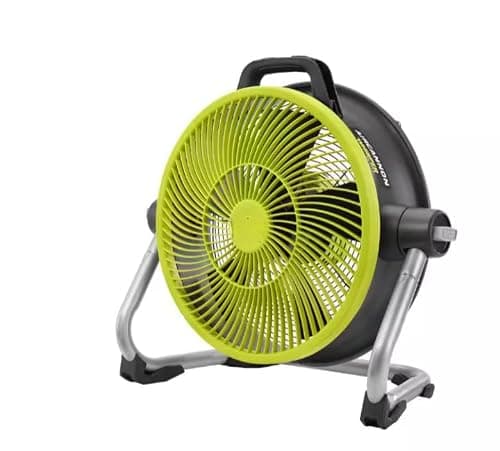
| 1 | Most airflow Ryobi ONE+ 18V Hybrid Whisper Series 14" Air Cannon Fan 2,300 CFM on high from an 18V battery, with a barrel-plug AC adapter as a second power source. | A garage, a campsite, or a room during a power cut | |
| 2 | 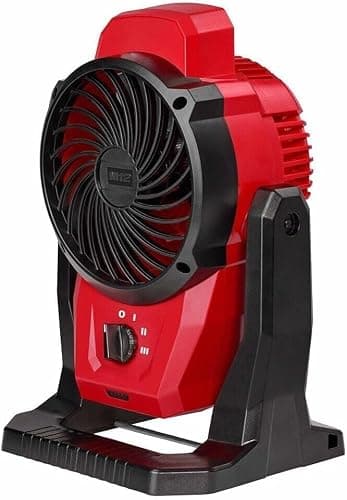 Longest run time Milwaukee M12 Mounting Fan Up to 16 hours on one M12 XC 6.0 battery at 400 CFM, and 4.41 lb with magnets and a clamp built in. | All-day personal airflow somewhere with no outlet | |
| 3 | 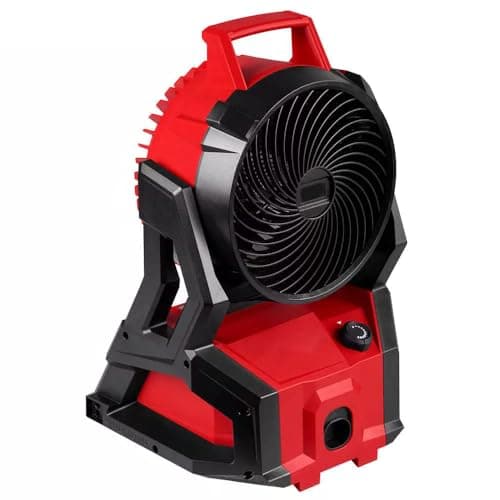 Best balance of the two Milwaukee M18 Brushless PACKOUT Fan 850 CFM with over 3 hours on high and 6.5 hours at 75% speed — the only fan here that publishes both. | Someone who wants real airflow and a published run time | |
| — | 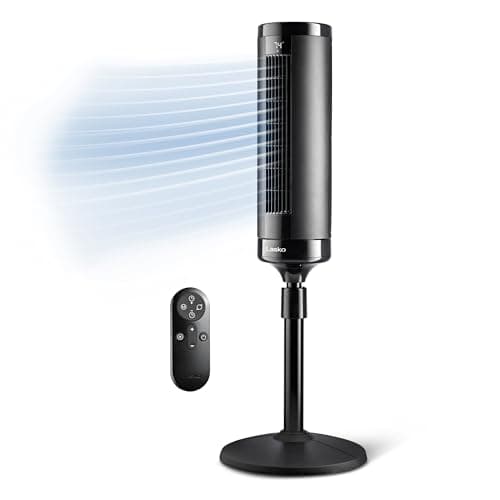 What a wall outlet buys you Lasko EcoQuiet 42" DC Tower Fan 2.9 W on low, 23 dBA, twelve speeds and no battery to manage at all. | Anywhere with power — which is most places |
Cordless fans divide sharply into two groups, and the split is not by price. It is by whether the battery is part of a platform or sealed into the product.
The buying decision
Platform batteries beat sealed batteries
The consumer aisle is full of small rechargeable fans with an internal lithium cell and a USB-C port. They are cheap and they are convenient, and they share one structural problem.
The battery is the shortest-lived part, and it is not replaceable. Lithium cells degrade with cycles regardless of how the product is treated. When the cell reaches the end of its life, the fan is finished — the motor, the housing and the electronics go in the bin with it.
A tool-platform fan inverts that. The battery is a separate, standard, replaceable item that also runs your drill. Three consequences follow:
- Run time becomes a purchasing decision rather than a fixed spec. Want twice as long? Bring a second battery. A sealed fan gives you what it gives you.
- The fan outlives its battery. Cells are replaced individually, and the platform outlasts several generations of them.
- If you already own the platform, the fan is the only purchase. Most of these are sold as bare tools for exactly this reason.
Every pick on this page is a platform fan. That is not a coincidence — it is the reason they publish run times at all, because run time is a property of the battery you choose rather than a fixed number they would rather not print.
The numbers
Published specifications
| Fan | CFM | Run time | AC option | Weight |
|---|---|---|---|---|
| Ryobi PCL813B, 18V ONE+ | 2,300 | not published | Yes, barrel plug | not published |
| Milwaukee 0818-20, M18 | 850 | 3 h high / 6.5 h at 75% | Yes, integrated plug | not published |
| Milwaukee 0820-20, M12 | 400 | up to 16 h | No | 4.41 lb |
Manufacturer product pages. Run times are quoted against a specific battery: an M18 REDLITHIUM XC5.0 and an M12 XC 6.0 respectively.
Two things that table makes obvious. There is no certification program for any of this — every figure is a manufacturer claim, and the “not published” entries are as informative as the numbers.
And run time and airflow trade against each other exactly as you would expect. 2,300 CFM with no published run time; 400 CFM with sixteen hours. There is no cordless fan that does both.
This one is not a DIY job
Run time claims are quoted against one specific battery. “Up to 16 hours” means on an M12 XC 6.0. On a compact 2.0 Ah pack it will be roughly a third of that, and nobody prints the smaller number.
When comparing platforms, compare at equal energy. Amp-hours times voltage gives you watt-hours, which is the honest basis: an 18V 4.0 Ah pack holds 72 Wh, a 12V 6.0 Ah pack holds 72 Wh. Same energy, very different marketing.
Lithium batteries do not like heat, which is an awkward property in a product you buy because it is hot. Do not leave packs in a car, a tent in full sun, or on a windowsill. Store them part-charged and indoors.
Where these belong
Four situations where cordless is the answer
- Power cuts. Summer outages happen precisely when a fan matters, and a tool battery plus a fan is a far simpler answer than a generator.
- Camping, tents and campervans. No outlet, and running a 12V system down to power a fan is worse than using a battery you already carry. More on cooling an RV.
- Garages, workshops and outbuildings. Often no convenient socket where you actually stand, and a magnet-mounted fan goes on the nearest steel surface.
- Outdoor work and events. Patios, market stalls, sports sidelines — anywhere a cord would be a trip hazard or is simply impossible.
Say the unwelcome thing
Do not buy a cordless fan for a room with a wall outlet.
The premium is real and it buys you nothing indoors. A cordless fan costs more, weighs more for the airflow it produces, needs charging, and publishes far less about itself than a mains fan does.
A good mains tower fan runs at 2.9 watts on low with a published 23 dBA noise rating and twelve speeds. No battery fan on this page publishes a noise figure at all.
Buy cordless for the four situations above, where a socket genuinely does not exist. For a bedroom, an office or a living room, the mains options are better in every measurable way.
In full
Every pick, and what is wrong with it
Published specifications only, each linked to the page it came from. Where a manufacturer publishes nothing, the row says so — we do not fill blanks in.
1. Most airflow
Ryobi ONE+ 18V Hybrid Whisper Series 14" Air Cannon Fan
Ryobi · model PCL813B
2,300 CFM on high from an 18V battery, with a barrel-plug AC adapter as a second power source.
2,300 CFM on high. For scale, the highest published airflow of any mains fan on this site is 720 CFM from a 20-inch pedestal fan. This moves roughly three times that, from a battery.
The 14-inch drum format is what makes it possible — a big slow wheel rather than a small fast one. A 225-degree pivoting head means it can be aimed anywhere including straight up.
The dual power source is the practical feature. 18V ONE+ battery or a barrel-plug AC adapter, so the same fan works on a jobsite and on a bench.
Be clear about what is missing: no published run time, no weight, no dBA. The “over 55% quieter” Whisper Series claim has no test behind it that we could find.
What’s wrong with it
Ryobi publishes no run time, no weight and no dBA figure, so three of the four things you would want to compare are missing.
Running cost
Ryobi does not publish a wattage for the PCL813B, so we cannot calculate what it costs to run. We are not going to estimate one. If Ryobi publishes a nameplate figure, this block will show the arithmetic.
| Air delivery | 2,300 CFM on high |
|---|---|
| Fan size | 14 in |
| Speeds | 3 (high, medium, low) |
| Power source | 18V ONE+ battery or barrel-plug AC adapter |
| Pivoting head | 225 degrees |
| Run time | Not published |
| Weight | Not published |
| Noise | Not published (marketed as over 55% quieter) |
| Warranty | Not published on the product page |
Every figure above is from Ryobi Tools product page, PCL813B. Blanks are shown as “not published” rather than filled in.
2. Longest run time
Milwaukee M12 Mounting Fan
Milwaukee · model 0820-20
Up to 16 hours on one M12 XC 6.0 battery at 400 CFM, and 4.41 lb with magnets and a clamp built in.
Up to 16 hours on a single M12 XC 6.0 battery. That is the figure that makes a cordless fan genuinely useful rather than a novelty: it covers a full working day, or a night, without intervention.
400 CFM and up to 14 MPH puts it in the same territory as a good clip-on fan — personal airflow aimed at a person, not a room being stirred.
The mounting is the other reason to pick it: magnets, a 2-inch spring-loaded clamp, keyholes and pass-through holes. At 4.41 lb it attaches to a shelf, a pole, a tent frame or anything ferrous.
Three speeds and a one-year warranty. No AC input, so the battery platform is not optional here.
What’s wrong with it
Battery only — no AC option at all — and 400 CFM is personal airflow, not room airflow.
Running cost
Milwaukee does not publish a wattage for the 0820-20, so we cannot calculate what it costs to run. We are not going to estimate one. If Milwaukee publishes a nameplate figure, this block will show the arithmetic.
| Air delivery | Up to 400 CFM |
|---|---|
| Air speed | Up to 14 MPH |
| Run time | Up to 16 hours on an M12 XC 6.0 battery |
| Speeds | 3 (high, medium, low) |
| Power source | M12 battery only, no AC option |
| Weight | 4.41 lb |
| Mounting | Magnets, 2 in spring-loaded clamp, keyholes, pass-through holes |
| Noise | Not published |
| Warranty | 1 year |
Every figure above is from Milwaukee Tool product page, 0820-20. Blanks are shown as “not published” rather than filled in.
3. Best balance of the two
Milwaukee M18 Brushless PACKOUT Fan
Milwaukee · model 0818-20
850 CFM with over 3 hours on high and 6.5 hours at 75% speed — the only fan here that publishes both.
The one that answers both questions. 850 CFM is serious airflow, and unlike the Ryobi it comes with published endurance: over 3 hours on high, 6.5 hours at 75% speed, on an M18 REDLITHIUM XC5.0 battery.
That 75% figure is the useful one. Dropping one notch off maximum roughly doubles the run time — the same pattern that shows up across certified ventilating fans, where lower speeds are usually the efficient ones.
An integrated AC plug takes a standard extension cord, and a 300-degree adjustable head aims it almost anywhere. PACKOUT compatibility stacks it with the rest of that system.
20.5 MPH air speed from a 7-inch blade — fast and directional rather than broad.
What’s wrong with it
Milwaukee publishes no weight and no noise rating, and an M18 battery is a significant purchase if you do not own one.
Running cost
Milwaukee does not publish a wattage for the 0818-20, so we cannot calculate what it costs to run. We are not going to estimate one. If Milwaukee publishes a nameplate figure, this block will show the arithmetic.
| Air delivery | 850 CFM |
|---|---|
| Air speed | Up to 20.5 MPH |
| Blade size | 7 in |
| Run time, high | Over 3 hours on an M18 REDLITHIUM XC5.0 battery |
| Run time, 75% speed | 6.5 hours on the same battery |
| Power source | M18 battery or integrated AC plug |
| Head rotation | 300 degrees |
| Speeds | Variable-speed dial |
| Weight | Not published |
| Noise | Not published |
| Warranty | 1 year |
Every figure above is from Milwaukee Tool product page, 0818-20. Blanks are shown as “not published” rather than filled in.
Skip this one
Lasko EcoQuiet 42" DC Tower Fan
Lasko · model T42710
2.9 W on low, 23 dBA, twelve speeds and no battery to manage at all.
Worth stating before you buy a battery fan for a room that has a socket in it.
2.9 W on low — 0.6¢ for a twelve-hour night — and 23 dBA, the quietest published figure on this site. Twelve speeds, a DC motor, and nothing to charge.
Every cordless fan on this page is louder, heavier per unit of airflow, and dependent on a battery you have to keep charged. They earn that because they work where no outlet exists.
If your actual problem is a bedroom, buy the quiet mains fan. If it is a campsite, a power cut or a jobsite, the fans above are the right category.
What’s wrong with it
It needs an outlet. That is the entire reason the fans above exist, and it is a real limitation exactly when you need one.
Running cost — T42710
| Nameplate power | 2.9 W – 19 W | manufacturer's published figure |
|---|---|---|
| Energy, 8-hour night | 0.15 kWh | 19 ÷ 1000 × 8 |
| Cost per hour | 0.3¢ | at 18.34¢/kWh |
| Cost per 8-hour night | 2.8¢ | on the highest speed |
| Cost per 30 nights | 84¢ | 4.6 kWh |
| Same month, lowest speed | 13¢ | at 2.9 W |
Rate: 18.34¢/kWh, the US average residential price for June 2026 (EIA Electric Power Monthly, Table 5.3). Yours will differ — swap it in: (watts ÷ 1000) × hours × your rate.
| Power | 2.9 W - 19 W (0.06-0.303 A at 120 V) |
|---|---|
| Noise | 23 dBA low, 46 dBA high |
| Speeds | 12 |
| Height | 41.6 in |
| Footprint | 12.8 x 12.8 in |
| Weight | 7.8 lb |
| Timer | 8 hours |
| Air delivery (CFM) | Not published |
| Warranty | 2 years |
Every figure above is from Lasko product page, T42710. Blanks are shown as “not published” rather than filled in.
We are not linking a buy button for this one. If you want to look at it anyway, it is easy enough to find — but we would rather send you to something that fits your room.
Questions people actually ask
Frequently asked
What is the best battery powered fan?
It depends which axis matters. The Ryobi PCL813B publishes the most airflow at 2,300 CFM; the Milwaukee M12 mounting fan publishes the longest run time at up to 16 hours; the Milwaukee M18 PACKOUT fan is the only one publishing both airflow (850 CFM) and run time.
Are rechargeable fans with built-in batteries worth it?
Less so than platform fans. A sealed lithium cell is the shortest-lived part of the product and cannot be replaced, so when it degrades the whole fan is finished. A tool-platform battery is replaceable, shared with other tools, and lets you extend run time by carrying a spare.
How long do battery fans run?
From about 3 hours at full airflow to 16 hours at low airflow, depending entirely on the fan and the battery. Every published figure is quoted against one specific battery — usually the largest in the range — so a compact pack will deliver substantially less.
Can battery fans also run on mains power?
Some can. The Ryobi takes a barrel-plug adapter and the Milwaukee M18 fan has an integrated AC plug for a standard extension cord. The M12 mounting fan is battery-only. Dual power is worth prioritizing if the fan will spend time in both situations.
How do I compare battery platforms fairly?
Multiply amp-hours by voltage to get watt-hours. An 18V 4.0 Ah pack and a 12V 6.0 Ah pack both hold 72 Wh — the same energy, marketed very differently. Run-time claims only compare meaningfully at equal watt-hours.
Are battery fans noisy?
Nobody publishes a figure, so there is no way to compare them. None of the three fans here carries a dBA rating, and one carries a marketing claim of being quieter with no test behind it. Mains fans in this category routinely publish dBA. Fans with published dBA figures.
Sources
Where these numbers came from
- Ryobi PCL813B product page — 2,300 CFM, 3 speeds, 225-degree pivot, barrel-plug AC adapter
- Milwaukee 0818-20 product page — 850 CFM, 20.5 MPH, 3 h high / 6.5 h at 75%, integrated AC plug
- Milwaukee 0820-20 product page — 400 CFM, 14 MPH, up to 16 h, 4.41 lb
- EIA Electric Power Monthly, Table 5.3 — electricity rate
Read next
Where to go from here
Back to Fans, or read how we pick.