Guide and picks
Ceiling fan downrod and mounting guide
A fan at the wrong height stirs air nobody is standing in. Three measurements settle it, and one of them is a safety requirement.
By Sawyer V. · Published
The short answer
Aim to put the blades 8 to 9 feet above the floor, with an absolute minimum of 7 feet, and keep blade tips at least 18 inches from any wall. As a starting point, subtract about 9 feet from your ceiling height to get the downrod length. Under about eight feet of ceiling, use a flush-mount hugger instead. In every case the fan must hang from a box listed for fan support — that part is not optional.
Fan & Frost earns a commission when you buy through our links, at no cost to you. It never changes a ranking, and we say so when the right answer is the cheaper unit or nothing at all. Full disclosure · How we pick.
At a glance
The picks, ranked
Tap any row to jump to the full reasoning. Prices are live from Amazon where we have them, and read “check price” where we don’t — never a number we cannot verify today.
| # | Product | Best for | Price |
|---|---|---|---|
| 1 | 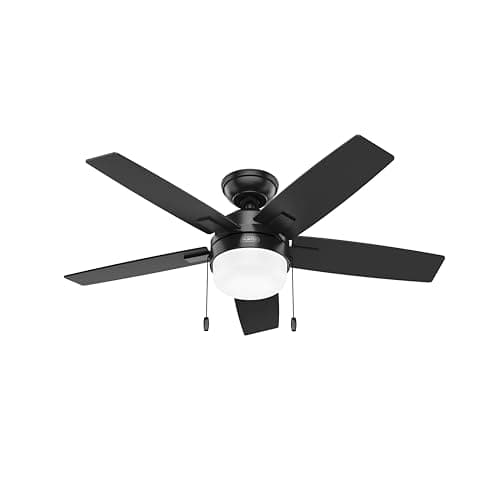 Best for a low ceiling Hunter Anisten 44" Hugger Ceiling Fan A flush-mount hugger at 295.9 CFM per watt, 12.5 W high and 1.6 W low — no downrod, no clearance problem. | Ceilings under about eight feet, where a downrod is out | |
| 2 | 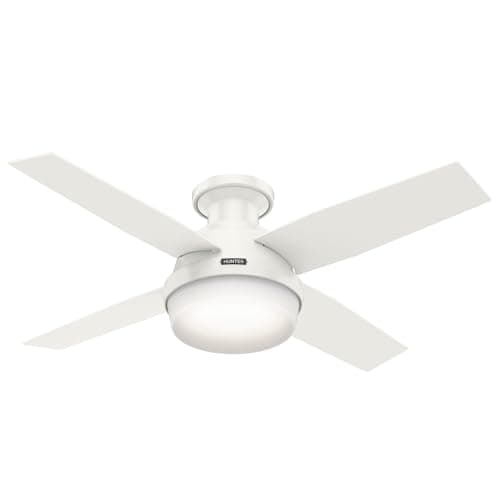 Best standard mount at a normal height Hunter Martindale 44" Ceiling Fan 304.5 CFM per watt on 10.1 W, and 1.1 W on low — the lowest certified low-speed draw we hold data for. | An eight to nine foot ceiling with a short downrod | |
| 3 | Best fan for a long downrod Aeratron AE+2 60" Ceiling Fan 483.0 CFM per watt on 16.2 W — the highest certified figure of any ceiling fan, at a span that suits a long rod. | A tall room where the fan has to come down to be useful | |
| — | 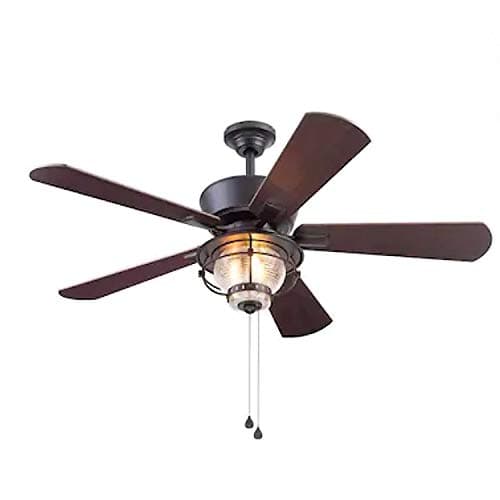 The span that demands the most from a mount Harbor Breeze Cando 84" Ceiling Fan 422.2 CFM per watt at 84 inches, and a fan this size shows every fraction of an inch of mounting error. | A large room — installed on a properly rated, properly braced box |
A ceiling fan does one job badly if it is at the wrong height: too high and its air column dissipates before it reaches anyone, too low and people walk into it. Three measurements settle the whole question.
Measurement one
Blade height above the floor
7 feet is the usual minimum, and 8 to 9 feet is where most installs aim. Below 7 feet you are into head-clearance territory; much above 9 feet and the airflow spreads and slows before it gets to seated or standing height.
That gives a simple starting point for downrod length:
| Ceiling height | Approach |
|---|---|
| Under 8 ft | Flush-mount hugger — no downrod |
| 8 ft | Shortest downrod, or flush mount |
| 9 ft | The short rod supplied with most fans |
| 10 ft | Around 12 in |
| 12 ft | Around 36 in |
| 14 ft | Around 60 in |
| Higher | Subtract ~9 ft from the ceiling height |
A starting point only. Manufacturers publish their own downrod charts and those take precedence — the fan body height counts toward the total and differs between models.
Check the manufacturer’s chart before ordering. A fan with a deep motor housing needs a shorter rod than a slim one to land the blades at the same height, and rods are frequently model-specific rather than universal.
Measurement two
Blade tip to wall
At least 18 inches from the blade tips to the nearest wall, beam or sloping ceiling. This is about airflow as much as safety — a blade sweeping close to a surface is working in disturbed air and does not perform to its rating.
The arithmetic is straightforward: fan diameter plus 36 inches gives the clear width you need to center it.
- 42-inch fan — about 78 inches of clear width
- 52-inch fan — about 88 inches
- 60-inch fan — about 96 inches
- 84-inch fan — about 120 inches
In most rooms this binds before ceiling height does. It is also the reason an oversized fan in a modest room performs worse than a correctly-sized one, quite apart from the efficiency question.
This one is not a DIY job
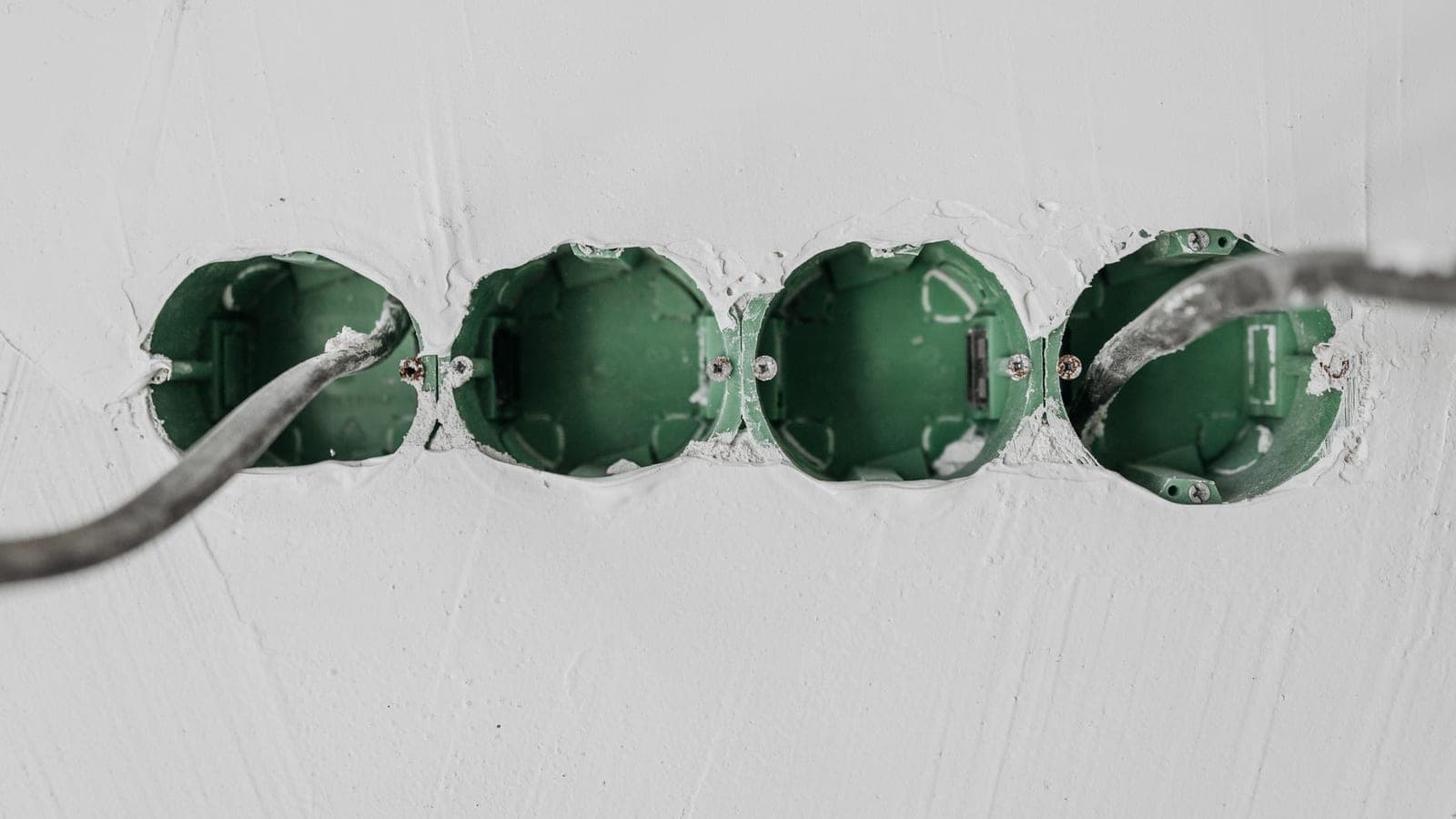
The electrical box is the safety requirement, and it is specific. A ceiling fan must hang from a box listed for fan support. A standard lighting box is designed for a static load and is not rated for the dynamic, rotating, vibrating load of a fan.
A fan-rated box is marked as such, and is either braced between joists or fixed directly to solid blocking. If you cannot confirm what is up there, establish that before anything else — and get an electrician if the answer is unclear.
Always kill the power at the breaker, not just at the wall switch, before removing a canopy.
Sloped ceilings need a compatible canopy. Most fans are rated to a maximum slope, commonly around 15 to 20 degrees. Steeper needs an angled mount kit — check the fan’s stated maximum before buying.
Flush or downrod
Which mount, and what it costs
A flush-mount or hugger fan fixes the motor tight to the ceiling. A downrod hangs it below.
Downrod is better wherever the height allows, because a fan needs clearance above the blades as well as below. Air is drawn down through the disc, and a fan pressed against the ceiling is restricted on its intake side.
The size of that penalty is measurable. Two certified 44-inch Hunters, same brand, same span, differing in mount:
- Standard mount — 304.5 CFM per watt, 10.1 W high, 1.1 W low
- Flush mount — 295.9 CFM per watt, 12.5 W high, 1.6 W low
About three percent. One comparison rather than a controlled study, and the two fans differ in more than mount type — but it does not support avoiding a hugger where the ceiling calls for one. A hugger at the right height beats a downrod fan you keep ducking under.
Also
Two things worth getting right at install
Seat the downrod properly. Fully home in the coupling, cross-pin fitted, set screws tight. A rod that is slightly out of square at the top produces a visible circle at the tips, and it is the most common cause of wobble on a new install.
Do not put a standard lighting dimmer on a fan. Fan motors and lighting dimmers are not compatible, and the result ranges from humming to motor damage. Use the control the manufacturer specifies — and on a connected fan that matters more, because the electronics live in the canopy.
Say the unwelcome thing
Do not buy a downrod based on ceiling height alone.
The subtract-nine-feet rule is a starting point for shopping, not a specification. Two things break it.
Fan body height varies. The distance from the canopy to the blade plane differs between models, sometimes by several inches, and it counts toward the total. A rod that lands one fan at 9 feet lands another at 8 foot 6.
Rods are frequently model-specific. Diameter, the coupling, and the cross-pin position differ between manufacturers, and a rod that physically fits is not necessarily the rated part.
Buy the fan first, read its own downrod chart, and order the rod the manufacturer lists for your ceiling height. It costs nothing extra and removes the guesswork entirely.
In full
Every pick, and what is wrong with it
Published specifications only, each linked to the page it came from. Where a manufacturer publishes nothing, the row says so — we do not fill blanks in.
1. Best for a low ceiling
Hunter Anisten 44" Hugger Ceiling Fan
Hunter · model 44 Anisten
A flush-mount hugger at 295.9 CFM per watt, 12.5 W high and 1.6 W low — no downrod, no clearance problem.
Under an eight-foot ceiling the arithmetic simply does not work: a downrod plus the fan body plus the 7-foot minimum leaves nothing. A hugger mounts the motor tight to the ceiling and gets you there.
295.9 CFM per watt, and 1.6 W on low — about 0.2¢ for an eight-hour night.
The efficiency penalty for flush mounting is smaller than its reputation. Against the same brand’s standard-mount 44-inch fan at 304.5 CFM per watt, this is about three percent behind — because less clearance above the blades restricts the intake side.
What’s wrong with it
12.5 W against 10.1 W for the same brand's standard-mount 44-inch fan, which is roughly what the flush mount costs.
Running cost — 44 Anisten
| Nameplate power | 1.6 W – 12.5 W | manufacturer's published figure |
|---|---|---|
| Energy, 8-hour night | 0.10 kWh | 12.5 ÷ 1000 × 8 |
| Cost per hour | 0.2¢ | at 18.34¢/kWh |
| Cost per 8-hour night | 1.8¢ | on the highest speed |
| Cost per 30 nights | 55¢ | 3.0 kWh |
| Same month, lowest speed | 7.0¢ | at 1.6 W |
Rate: 18.34¢/kWh, the US average residential price for June 2026 (EIA Electric Power Monthly, Table 5.3). Yours will differ — swap it in: (watts ÷ 1000) × hours × your rate.
| Blade span | 44 in |
|---|---|
| Efficiency | 295.9 CFM per watt |
| Power, high speed | 12.5 W |
| Power, low speed | 1.6 W |
| Standby power | 0.3 W |
| Type | Indoor hugger (flush mount), fan only |
| Warranty | 3 years, components |
| ENERGY STAR | Certified |
Every figure above is from ENERGY STAR Certified Ceiling Fans dataset. Blanks are shown as “not published” rather than filled in.
2. Best standard mount at a normal height
Hunter Martindale 44" Ceiling Fan
Hunter · model 44in Martindale
304.5 CFM per watt on 10.1 W, and 1.1 W on low — the lowest certified low-speed draw we hold data for.
At a standard nine-foot ceiling, a short downrod — often the few inches the fan ships with — puts the blades right where they should be without any calculation.
10.1 W on high, 1.1 W on low. Twelve hours on low is 0.2¢, which is the level at which the running cost stops being a consideration.
304.5 CFM per watt is the best small-fan efficiency in our certified data.
Check the wall clearance before committing: blade tips want 18 inches minimum, so a 44-inch fan needs roughly 80 inches of clear width to sit centered.
What’s wrong with it
44 inches suits a normal room, and it needs about 80 inches of clear width to sit centered with proper clearance.
Running cost — 44in Martindale
| Nameplate power | 1.1 W – 10.1 W | manufacturer's published figure |
|---|---|---|
| Energy, 8-hour night | 0.08 kWh | 10.1 ÷ 1000 × 8 |
| Cost per hour | 0.2¢ | at 18.34¢/kWh |
| Cost per 8-hour night | 1.5¢ | on the highest speed |
| Cost per 30 nights | 44¢ | 2.4 kWh |
| Same month, lowest speed | 4.8¢ | at 1.1 W |
Rate: 18.34¢/kWh, the US average residential price for June 2026 (EIA Electric Power Monthly, Table 5.3). Yours will differ — swap it in: (watts ÷ 1000) × hours × your rate.
| Blade span | 44 in |
|---|---|
| Efficiency | 304.5 CFM per watt |
| Power, high speed | 10.1 W |
| Power, low speed | 1.1 W |
| Standby power | 0.4 W |
| Type | Indoor, fan only |
| Warranty | 3 years, components |
| ENERGY STAR | Certified |
Every figure above is from ENERGY STAR Certified Ceiling Fans dataset. Blanks are shown as “not published” rather than filled in.
3. Best fan for a long downrod
Aeratron AE+2 60" Ceiling Fan
Aeratron · model AE+2WI60
483.0 CFM per watt on 16.2 W — the highest certified figure of any ceiling fan, at a span that suits a long rod.
On a twelve or fourteen-foot ceiling, the fan is going to hang on three or four feet of rod. That is worth putting a good fan on.
483.0 CFM per watt on 16.2 W is the highest figure across all 1,398 US-market certified records, and 2.9 W on low is 0.6¢ for a twelve-hour evening.
The caution is mechanical rather than electrical. A long rod puts the rotating mass a long way below its anchor, so a small angular error at the top becomes a visible circle at the tips. Diagnosing wobble.
What’s wrong with it
A long downrod amplifies any mounting error into a visible wobble, so this asks for a careful install.
Running cost — AE+2WI60
| Nameplate power | 2.9 W – 16.2 W | manufacturer's published figure |
|---|---|---|
| Energy, 8-hour night | 0.13 kWh | 16.2 ÷ 1000 × 8 |
| Cost per hour | 0.3¢ | at 18.34¢/kWh |
| Cost per 8-hour night | 2.4¢ | on the highest speed |
| Cost per 30 nights | 71¢ | 3.9 kWh |
| Same month, lowest speed | 13¢ | at 2.9 W |
Rate: 18.34¢/kWh, the US average residential price for June 2026 (EIA Electric Power Monthly, Table 5.3). Yours will differ — swap it in: (watts ÷ 1000) × hours × your rate.
| Blade span | 60 in |
|---|---|
| Efficiency | 483.0 CFM per watt |
| Power, high speed | 16.2 W |
| Power, low speed | 2.9 W |
| Type | Indoor |
| Light kit | No ENERGY STAR lamp shipped |
| Warranty | 3 years, components |
| ENERGY STAR | Certified, and on the Most Efficient list |
Every figure above is from ENERGY STAR Certified Ceiling Fans dataset. Blanks are shown as “not published” rather than filled in.
Skip this one
Harbor Breeze Cando 84" Ceiling Fan
Harbor Breeze · model 84" Cando
422.2 CFM per watt at 84 inches, and a fan this size shows every fraction of an inch of mounting error.
Listed as a caution on mounting rather than a criticism. This is the best outdoor-rated figure in the certified data.
The geometry is what demands care. A tip on an 84-inch fan sits twice as far from the axis as a tip on a 42-inch fan, so the same angular error traces twice the circle — and the mass being supported is proportionately greater.
18 inches of tip clearance means an 84-inch fan wants about 120 inches of clear width. In many rooms that is the binding constraint rather than the ceiling height.
Confirm the box, the blocking, and what is actually above the plasterboard before ordering.
What’s wrong with it
Not a fault of the fan. An 84-inch span needs a rated box, solid blocking and real clearance on all sides.
Running cost — 84" Cando
| Nameplate power | 6 W – 30.6 W | manufacturer's published figure |
|---|---|---|
| Energy, 8-hour night | 0.24 kWh | 30.6 ÷ 1000 × 8 |
| Cost per hour | 0.6¢ | at 18.34¢/kWh |
| Cost per 8-hour night | 4.5¢ | on the highest speed |
| Cost per 30 nights | $1.35 | 7.3 kWh |
| Same month, lowest speed | 26¢ | at 6 W |
Rate: 18.34¢/kWh, the US average residential price for June 2026 (EIA Electric Power Monthly, Table 5.3). Yours will differ — swap it in: (watts ÷ 1000) × hours × your rate.
| Blade span | 84 in |
|---|---|
| Efficiency | 422.2 CFM per watt |
| Power, high speed | 30.6 W |
| Power, low speed | 6.0 W |
| Type | Outdoor ceiling fan |
| ENERGY STAR | Certified |
Every figure above is from ENERGY STAR Certified Ceiling Fans dataset. Blanks are shown as “not published” rather than filled in.
We are not linking a buy button for this one. If you want to look at it anyway, it is easy enough to find — but we would rather send you to something that fits your room.
Questions people actually ask
Frequently asked
How long should a ceiling fan downrod be?
As a starting point, subtract about 9 feet from your ceiling height — a twelve-foot ceiling suggests around 36 inches. Then check the manufacturer's own chart, because the fan body height counts toward the total and differs between models.
How high should a ceiling fan be from the floor?
Blades at 8 to 9 feet is the usual target, with 7 feet as the minimum. Higher than about 9 feet and the air column spreads and slows before it reaches seated or standing height, so the room below stays still.
How much clearance does a ceiling fan need from the wall?
At least 18 inches from blade tip to the nearest wall or beam. That means fan diameter plus 36 inches of clear width to center it — 88 inches for a 52-inch fan, 120 inches for an 84-inch one.
Is a flush mount ceiling fan less efficient?
Slightly. Comparing two same-brand 44-inch fans, standard mount achieves 304.5 CFM per watt and the flush-mount hugger 295.9 — about three percent, because less clearance above the blades restricts the intake side.
What kind of electrical box does a ceiling fan need?
One listed for fan support. A standard lighting box is designed for a static load and is not rated for the dynamic, rotating load of a fan. A fan-rated box is marked as such and is either braced between joists or fixed to solid blocking.
Can I put a ceiling fan on a sloped ceiling?
Usually, but check the canopy's rated slope first — most are rated to roughly 15 to 20 degrees and steeper ceilings need an angled mount kit. Blade clearance also gets tighter where a sloped ceiling comes down toward the walls.
Sources
Where these numbers came from
Read next
Where to go from here
Back to Whole-House Airflow, or read how we pick.