The picks
The best dehumidifiers, ranked on certified efficiency
Everyone sells these on pints per day. That is a capacity figure. The efficiency figure is IEF, it is federally tested, and it separates this field far more usefully.
By Sawyer V. · Published
The short answer
Rank on IEF, the certified liters-per-kilowatt-hour figure, not on pints. Across 502 certified portable units IEF runs 1.70 to 2.24 L/kWh with a median of 2.01 — and almost every household-name brand tops out at exactly that median. The efficiency leaders are 2.24 and 2.20, both at around 45 to 49 pints a day, at 444 and 471 kWh a year.
Fan & Frost earns a commission when you buy through our links, at no cost to you. It never changes a ranking, and we say so when the right answer is the cheaper unit or nothing at all. Full disclosure · How we pick.
At a glance
The picks, ranked
Tap any row to jump to the full reasoning. Prices are live from Amazon where we have them, and read “check price” where we don’t — never a number we cannot verify today.
| # | Product | Best for | Price |
|---|---|---|---|
| 1 | Best overall Vellgoo Taurus Pro Dehumidifier, 45 pints/day 2.24 L/kWh — the highest IEF of any certified portable we hold data for, at 45 pints a day and 444 kWh a year. | A basement or large room that needs real capacity efficiently | |
| 2 | Best capacity per watt Waykar Dehumidifier, 49 pints/day 49.43 pints a day at 2.20 L/kWh and 471 kWh a year — nearly 50 pints without the usual efficiency penalty. | A wet basement where the machine will run for months | |
| 3 | 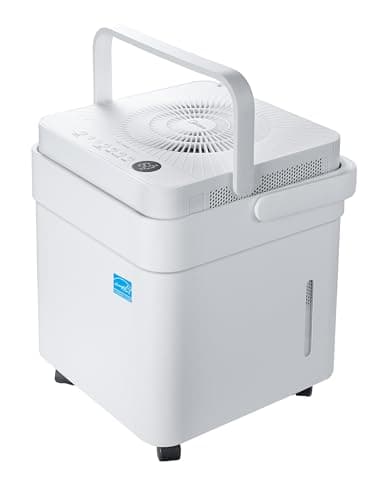 Best mainstream brand Midea Dehumidifier, 50 pints/day 2.08 L/kWh at 49.67 pints a day — the only household-name unit here that beats the 2.01 ceiling. | Buyers who want a name with a service network behind it | |
| 4 | Best small unit Vissani Dehumidifier, 27 pints/day 26.87 pints a day at 283 kWh a year — the lowest running cost of any certified unit we hold data for. | A bedroom, a bathroom or a single damp cupboard | |
| 5 | If the whole house is damp Santa Fe Whole-Home Dehumidifier, 128 pints/day 3.26 L/kWh at 127.51 pints a day — 46% more efficient than the best portable in the entire dataset. | A permanently damp basement or a whole-house humidity problem |
Dehumidifiers are one of the easier categories to rank honestly, because the useful number is published for every certified model and almost nobody uses it.
Method
What we ranked on, and what we ignored
We have not tested any of these. What we have is the ENERGY STAR Certified Dehumidifiers dataset — 526 US records, of which 502 are portable units — carrying figures produced under a federal test procedure. The four criteria, in order:
- IEF, the integrated energy factor. Liters of water removed per kilowatt-hour. This is the efficiency figure and the primary ranking.
- Annual energy use in kWh. What it actually costs, folding capacity and efficiency into one comparable number.
- Capacity in pints per day, used to place a unit in a class rather than to rank within one.
- Most Efficient designation, as a tie-breaker — with a caveat about it we cover below.
We did not rank on tank size, coverage claims in square feet, or noise. Coverage claims are marketing rather than test output, and there is no certified noise figure to rank on at all.
The finding
Almost every brand you have heard of stops at 2.01
Grouping the 502 certified portables by brand and taking each brand’s best model produces a striking pattern.
| Brand | Certified models | Best IEF | At |
|---|---|---|---|
| Vellgoo | 1 | 2.24 | 45.00 pt/day |
| Waykar | 39 | 2.20 | 49.43 pt/day |
| Midea | 47 | 2.08 | 49.67 pt/day |
| Hisense | 21 | 2.01 | 49.89 pt/day |
| TCL | 16 | 2.01 | 32.46 pt/day |
| Vissani | 13 | 2.01 | 26.87 pt/day |
| Honeywell | 8 | 2.01 | 32.46 pt/day |
| Frigidaire | 6 | 2.01 | 35.85 pt/day |
| Black+Decker | 5 | 2.01 | 36.39 pt/day |
| Whirlpool | 4 | 2.01 | 32.46 pt/day |
| GE | 3 | 2.01 | 35.34 pt/day |
| LG | 3 | 2.01 | 35.30 pt/day |
| Danby | 3 | 2.01 | 49.74 pt/day |
| hOmeLabs | 2 | 2.01 | 32.46 pt/day |
Eleven consecutive household names, all at exactly 2.01 L/kWh, across capacities from 26.87 to 49.89 pints a day. That is not eleven engineering teams independently landing on the same number. It is a small number of platforms wearing a lot of badges — the same pattern we found in room air conditioners, where 58% of certified units share every published spec with another brand.
The practical reading: if you buy on brand you will very likely get 2.01, whichever name you pick. The units above it are online-native brands competing specifically on the certified figure.
The label
Most Efficient skews small, badly
The ENERGY STAR Most Efficient designation is usually the fastest way to shortlist a category. Here it needs a caveat.
| Capacity band | Certified units | Most Efficient | Median IEF |
|---|---|---|---|
| Under 25 pt/day | 239 | 89 (37%) | 1.79 |
| 25 to 35 pt/day | 40 | 15 (38%) | 2.04 |
| 35 to 45 pt/day | 68 | 2 (3%) | 2.01 |
| 45 to 60 pt/day | 155 | 5 (3%) | 2.01 |
89 of the 111 Most Efficient portables are under 25 pints a day. In the two bands most people actually shop — 35 to 60 pints, the basement sizes — only 7 units out of 223 carry the label.
That is not the label failing. It reflects that the criteria are set against a scale where small units clear more easily. But it does mean that filtering a 50-pint search by Most Efficient leaves you five options, and that IEF has to do the work instead at the sizes that matter. How selective the label is by category.
Running cost
What these actually cost
The certified annual energy figure is the most useful number for a buyer, because it folds capacity and efficiency together. At 18.34¢/kWh:
- 27-pint unit, 283 kWh: $52 a year.
- 32-pint unit, 343 kWh: $63.
- 45-pint efficiency leader, 444 kWh: $81.
- 50-pint mainstream unit, 526 kWh: $96.
- Whole-home, 842 kWh: $154, for two and a half times the water.
Two things follow. The spread across the whole portable category is about $45 a year, which is smaller than people expect. And the figure assumes the standard test usage — a machine running continuously against a real water source in a basement will exceed it, sometimes by a lot.
This one is not a DIY job
A dehumidifier is a symptom treatment, and persistent damp is a building problem. If a basement stays wet with the machine running, the water is arriving faster than it is being removed, and the fix is drainage, grading or sealing rather than a bigger appliance.
Standing water, visible mold growth over a large area, or damp that returns within hours of emptying the tank are all reasons to get the building assessed rather than to keep shopping.
Health effects of damp and mold are a matter for a qualified professional, not a buying guide. We can tell you what these machines remove and what they cost to run; we cannot tell you what any of it means for a specific health condition.
Practical
Six things worth knowing before you buy
- Find the water source first. A dryer venting indoors, missing bathroom extraction, or laundry drying in a closed room will keep any machine running indefinitely.
- Plumb the drain if you can. A tank that fills and stops the unit is the most common reason a dehumidifier stops working. Nearly all of these accept a hose.
- Undersizing costs more than oversizing here. This is the opposite of the air conditioner rule — a dehumidifier that cannot keep up runs continuously and never reaches setpoint.
- It warms the room slightly. All the electrical energy ends up as heat, plus the latent heat released when water condenses. The room feels cooler because your sweat can evaporate again, but the thermometer does not fall.
- Check the refrigerant if it matters to you. 420 of the 502 certified portables use R-32 at GWP 675; 69 use R-290 at GWP 3, but those cluster at very small capacities.
- Ignore square-footage coverage claims. They are not test output and they are not comparable between brands. Size from the room and the dampness instead.
Say the unwelcome thing
Do not buy a dehumidifier on the pint number alone.
Pints per day is a capacity rating. It tells you whether a unit is big enough for the space, and nothing at all about whether it is any good at the job.
Two 50-pint units in this dataset differ by 9% in energy use for identical water removal — 471 kWh against 526 — which is $10 a year, every year, for a machine many households run for months.
The distinguishing figure is IEF, it is federally tested, and it is published for every certified model. Nothing on a retail listing shows it, which is precisely why it is worth looking up.
Start at the top: 2.24 L/kWh at 444 kWh a year or 2.20 at nearly 50 pints.
In full
Every pick, and what is wrong with it
Published specifications only, each linked to the page it came from. Where a manufacturer publishes nothing, the row says so — we do not fill blanks in.
1. Best overall
Vellgoo Taurus Pro Dehumidifier, 45 pints/day
Vellgoo · model TAURUS PRO-RCS50(Y)-N4-3-25
2.24 L/kWh — the highest IEF of any certified portable we hold data for, at 45 pints a day and 444 kWh a year.
The efficiency leader of the entire certified portable field, and not by a rounding error: 2.24 L/kWh against a median of 2.01 is about 11% more water removed per unit of electricity than the typical machine.
444 kWh a year — roughly $81 at 18.34¢/kWh — while removing 45.00 pints a day under the DOE test. Compare that to the 50-pint units at 515 to 526 kWh and the gap is real money over a damp season.
On the Most Efficient list, which only 5 of the 155 certified units in the 45 to 60 pint band reach. In that band the label is a genuinely selective signal.
HFC-32 refrigerant at GWP 675, in line with the rest of the field. The honest gaps: no noise rating exists in the certified data for any dehumidifier, and this is not a brand with a repair network behind it.
What’s wrong with it
It is an online-native brand with no service network, and the certified data publishes no noise figure.
Running cost — TAURUS PRO-RCS50(Y)-N4-3-25
| Annual energy use | 444 kWh | ENERGY STAR certified figure |
|---|---|---|
| Annual cost | $81 | 444 × 18.34¢/kWh |
| Per cooling month | $20 | spread over a four-month season |
The annual figure is the certified value from the ENERGY STAR Certified Dehumidifiers dataset, which models a standard cooling season rather than your actual summer. It is more useful than a nameplate wattage here, because a variable-speed compressor spends most of its life well below nameplate.
Rate: 18.34¢/kWh, the US average residential price for June 2026 (EIA Electric Power Monthly, Table 5.3). Yours will differ — swap it in: (watts ÷ 1000) × hours × your rate.
| Water removal | 45.00 pints/day (DOE Appendix X1) |
|---|---|
| Efficiency (IEF) | 2.24 L/kWh |
| Annual energy use | 444 kWh/yr |
| Refrigerant | HFC-32 (GWP 675) |
| Connected | No |
| Noise | Not published in the certified dataset |
| ENERGY STAR | Certified, and on the Most Efficient list |
Every figure above is from ENERGY STAR Certified Dehumidifiers dataset. Blanks are shown as “not published” rather than filled in.
2. Best capacity per watt
Waykar Dehumidifier, 49 pints/day
Waykar · model CTH150D
49.43 pints a day at 2.20 L/kWh and 471 kWh a year — nearly 50 pints without the usual efficiency penalty.
The pick if you want the full 50-pint class without paying the efficiency tax most of that class charges.
49.43 pints a day at 2.20 L/kWh. Every mainstream 50-pint unit in the certified set sits at 2.01, so this removes about 9% more water per kilowatt-hour than the machine most people buy.
471 kWh a year, about $86 at 18.34¢/kWh, against 515 to 530 kWh for the Midea, Frigidaire, LG, Whirlpool and Danby units at the same capacity.
Most Efficient certified, HFC-32. Waykar files 39 certified models, more than any household name in this dataset except Midea — which tells you something about who is actually competing on this figure.
What’s wrong with it
471 kWh a year is still a real running cost, and no noise figure is published.
Running cost — CTH150D
| Annual energy use | 471 kWh | ENERGY STAR certified figure |
|---|---|---|
| Annual cost | $86 | 471 × 18.34¢/kWh |
| Per cooling month | $22 | spread over a four-month season |
The annual figure is the certified value from the ENERGY STAR Certified Dehumidifiers dataset, which models a standard cooling season rather than your actual summer. It is more useful than a nameplate wattage here, because a variable-speed compressor spends most of its life well below nameplate.
Rate: 18.34¢/kWh, the US average residential price for June 2026 (EIA Electric Power Monthly, Table 5.3). Yours will differ — swap it in: (watts ÷ 1000) × hours × your rate.
| Water removal | 49.43 pints/day (DOE Appendix X1) |
|---|---|
| Efficiency (IEF) | 2.20 L/kWh |
| Annual energy use | 471 kWh/yr |
| Refrigerant | HFC-32 (GWP 675) |
| Connected | No |
| Noise | Not published in the certified dataset |
| ENERGY STAR | Certified, and on the Most Efficient list |
Every figure above is from ENERGY STAR Certified Dehumidifiers dataset. Blanks are shown as “not published” rather than filled in.
3. Best mainstream brand
Midea Dehumidifier, 50 pints/day
Midea · model MDUDMB-50AEN8-BB0F
2.08 L/kWh at 49.67 pints a day — the only household-name unit here that beats the 2.01 ceiling.
Worth knowing about because of what it says about the rest of the mainstream field. Midea is the largest brand in the certified dehumidifier dataset at 47 models, and this is its best.
2.08 L/kWh is the highest figure any household-name brand reaches here. Hisense, TCL, Honeywell, Frigidaire, GE, Vissani, Danby, LG, Whirlpool, hOmeLabs and Black+Decker all top out at exactly 2.01.
49.67 pints a day and 515 kWh a year, about $94 at 18.34¢/kWh.
It is not on the Most Efficient list, which is a fair reflection of where 2.08 sits. What you are buying over the online-native brands is distribution and support, and that is a legitimate reason to pay the difference.
What’s wrong with it
515 kWh a year is 9% more than the Waykar for the same capacity, and it is not on the Most Efficient list.
Running cost — MDUDMB-50AEN8-BB0F
| Annual energy use | 515 kWh | ENERGY STAR certified figure |
|---|---|---|
| Annual cost | $94 | 515 × 18.34¢/kWh |
| Per cooling month | $24 | spread over a four-month season |
The annual figure is the certified value from the ENERGY STAR Certified Dehumidifiers dataset, which models a standard cooling season rather than your actual summer. It is more useful than a nameplate wattage here, because a variable-speed compressor spends most of its life well below nameplate.
Rate: 18.34¢/kWh, the US average residential price for June 2026 (EIA Electric Power Monthly, Table 5.3). Yours will differ — swap it in: (watts ÷ 1000) × hours × your rate.
| Water removal | 49.67 pints/day (DOE Appendix X1) |
|---|---|
| Efficiency (IEF) | 2.08 L/kWh |
| Annual energy use | 515 kWh/yr |
| Refrigerant | HFC-32 (GWP 675) |
| Connected | No |
| Noise | Not published in the certified dataset |
| ENERGY STAR | Certified |
Every figure above is from ENERGY STAR Certified Dehumidifiers dataset. Blanks are shown as “not published” rather than filled in.
4. Best small unit
Vissani Dehumidifier, 27 pints/day
Vissani · model VAD25S1AWTS
26.87 pints a day at 283 kWh a year — the lowest running cost of any certified unit we hold data for.
Small capacity is the honest answer for a lot of rooms, and it is where the running cost genuinely falls.
283 kWh a year — about $52 at 18.34¢/kWh — against $96 for a 50-pint unit. Nearly half, for a room that only needs half.
26.87 pints a day at 2.01 L/kWh, which is exactly the category median. You are buying the right size rather than the best engineering.
The trap to avoid is the reverse of the air conditioner rule: undersizing a dehumidifier means it runs continuously and never gets there, which costs more than the bigger machine would have.
What’s wrong with it
2.01 L/kWh is exactly median, and 27 pints will not keep up with a genuinely wet basement.
Running cost — VAD25S1AWTS
| Annual energy use | 283 kWh | ENERGY STAR certified figure |
|---|---|---|
| Annual cost | $52 | 283 × 18.34¢/kWh |
| Per cooling month | $13 | spread over a four-month season |
The annual figure is the certified value from the ENERGY STAR Certified Dehumidifiers dataset, which models a standard cooling season rather than your actual summer. It is more useful than a nameplate wattage here, because a variable-speed compressor spends most of its life well below nameplate.
Rate: 18.34¢/kWh, the US average residential price for June 2026 (EIA Electric Power Monthly, Table 5.3). Yours will differ — swap it in: (watts ÷ 1000) × hours × your rate.
| Water removal | 26.87 pints/day (DOE Appendix X1) |
|---|---|
| Efficiency (IEF) | 2.01 L/kWh |
| Annual energy use | 283 kWh/yr |
| Refrigerant | HFC-32 (GWP 675) |
| Connected | No |
| Noise | Not published in the certified dataset |
| ENERGY STAR | Certified |
Every figure above is from ENERGY STAR Certified Dehumidifiers dataset. Blanks are shown as “not published” rather than filled in.
5. If the whole house is damp
Santa Fe Whole-Home Dehumidifier, 128 pints/day
Santa Fe · model 4047300
3.26 L/kWh at 127.51 pints a day — 46% more efficient than the best portable in the entire dataset.
The reason this page does not stop at portables. Whole-home dehumidifiers are a different class of machine and the efficiency gap is not marginal.
3.26 L/kWh against 2.24 for the best portable — 46% more water removed per kilowatt-hour. The whole-home median is 2.30 against the portable median of 2.01, so this is a property of the class, not one exceptional unit.
127.51 pints a day and 842 kWh a year, about $154 at 18.34¢/kWh. That is more than any portable — because it is removing two and a half times the water.
The honest caveat is scope. This is ducted or plumbed installation work, and it belongs to a contractor. When the step up is worth it.
What’s wrong with it
It is an installation, not a purchase, and 842 kWh a year is more than any portable here.
Running cost — 4047300
| Annual energy use | 842 kWh | ENERGY STAR certified figure |
|---|---|---|
| Annual cost | $154 | 842 × 18.34¢/kWh |
| Per cooling month | $39 | spread over a four-month season |
The annual figure is the certified value from the ENERGY STAR Certified Dehumidifiers dataset, which models a standard cooling season rather than your actual summer. It is more useful than a nameplate wattage here, because a variable-speed compressor spends most of its life well below nameplate.
Rate: 18.34¢/kWh, the US average residential price for June 2026 (EIA Electric Power Monthly, Table 5.3). Yours will differ — swap it in: (watts ÷ 1000) × hours × your rate.
| Water removal | 127.51 pints/day (DOE Appendix X1) |
|---|---|
| Efficiency (IEF) | 3.26 L/kWh |
| Annual energy use | 842 kWh/yr |
| Unit type | Whole-home (ducted or free-standing install) |
| Noise | Not published in the certified dataset |
| ENERGY STAR | Certified, and on the Most Efficient list |
Every figure above is from ENERGY STAR Certified Dehumidifiers dataset. Blanks are shown as “not published” rather than filled in.
Questions people actually ask
Frequently asked
What is the best dehumidifier?
On certified efficiency, the Vellgoo Taurus Pro at 2.24 L/kWh and 444 kWh a year — the highest IEF of any certified portable we hold data for. The Waykar CTH150D is close at 2.20 and gives nearly 50 pints a day. Among household-name brands, Midea's 2.08 is the only one above the 2.01 median.
What does IEF mean on a dehumidifier?
Integrated energy factor: liters of water removed per kilowatt-hour, measured under a federal test procedure. It is the efficiency figure, and unlike a coverage claim it is not something a manufacturer can write itself. Certified portables run 1.70 to 2.24, median 2.01.
Why do so many dehumidifier brands have the same efficiency?
Because a small number of platforms carry a lot of badges. Eleven household names — Hisense, TCL, Vissani, Honeywell, Frigidaire, Black+Decker, Whirlpool, GE, LG, Danby and hOmeLabs — all top out at exactly 2.01 L/kWh across capacities from 27 to 50 pints a day.
Is the ENERGY STAR Most Efficient label useful for dehumidifiers?
Less than you would hope at the sizes people buy. 89 of the 111 Most Efficient portables are under 25 pints a day; in the 35 to 60 pint range only 7 of 223 units carry it. At basement sizes you have to compare IEF directly. How selective the label is.
How much does a dehumidifier cost to run?
From about $52 a year for a 27-pint unit to $96 for a mainstream 50-pint one at 18.34¢/kWh. That assumes standard test usage — a machine fighting a real water source in a basement will exceed it.
Is a whole-home dehumidifier worth it?
If the whole house is damp, yes on efficiency grounds: whole-home units run a median 2.30 L/kWh against 2.01 for portables, and the best reaches 3.26 against 2.24. The catch is that it is ducted or plumbed installation work rather than a purchase. When to step up.
Sources
Where these numbers came from
Read next
Where to go from here
Back to Dehumidifiers, or read how we pick.