Guide and picks
Fan safety around children and pets
Most fan hazards in a home with small children are not the blades. They are the cord, the center of gravity, and where the thing is clipped.
By Sawyer V. · Published
The short answer
The blade guard is rarely the issue on a modern fan. The four things that actually cause trouble are trailing cords, tip-over, clip mounts above a child, and small fingers through a coarse guard. A ceiling fan removes all four by having nothing in the room. Failing that, choose a low center of gravity, route the cord behind furniture, and keep anything clipped away from where a child sleeps or plays.
Fan & Frost earns a commission when you buy through our links, at no cost to you. It never changes a ranking, and we say so when the right answer is the cheaper unit or nothing at all. Full disclosure · How we pick.
At a glance
The picks, ranked
Tap any row to jump to the full reasoning. Prices are live from Amazon where we have them, and read “check price” where we don’t — never a number we cannot verify today.
| # | Product | Best for | Price |
|---|---|---|---|
| 1 | 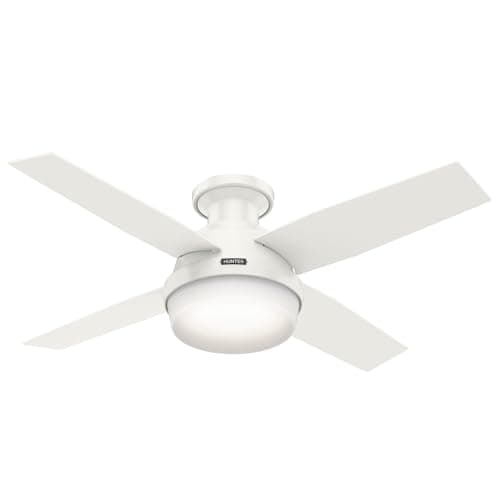 Nothing in the room at all Hunter Martindale 44" Ceiling Fan 1.1 W on low, fixed to the ceiling — no cord, no tip-over, nothing reachable. | A child's bedroom or playroom, in a home you own | |
| 2 | 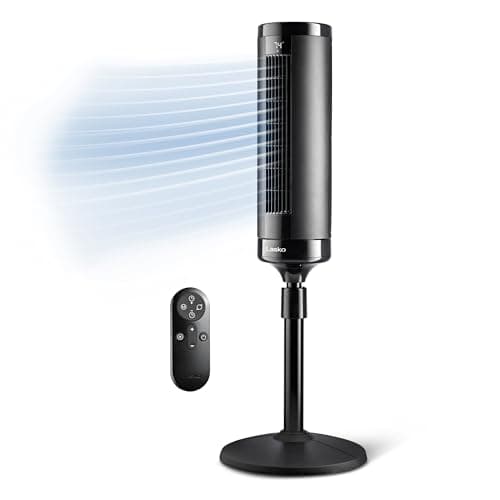 Best floor-standing shape Lasko EcoQuiet 42" DC Tower Fan A tall narrow tower with no exposed blades and a fine grille — the safest portable format for small hands. | A rental, or a room where a ceiling fan is not possible | |
| 3 | 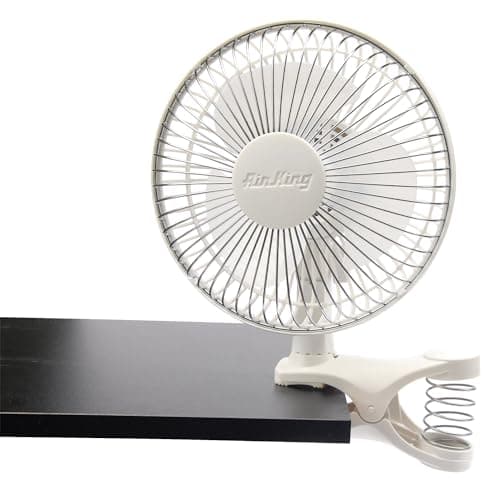 Right guard, wrong places Air King 6" Commercial Grade Clip-On Fan A metal commercial guard at 9 to 12 W, on a clip that must be placed with real care. | A desk or shelf out of reach — never above a sleeping child | |
| — | 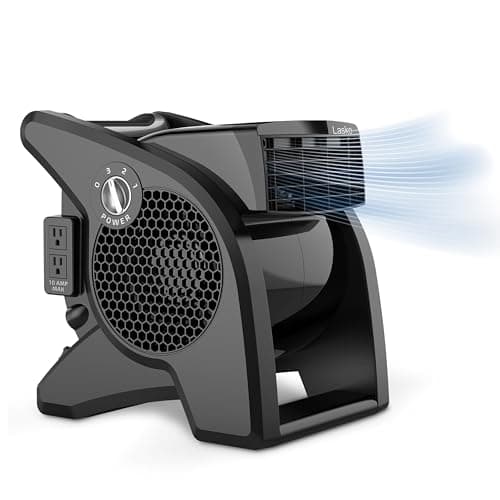 Not for a room with small children Lasko Max Performance 15" Air Mover 160 to 178 W with a coarse guard, a pivoting head and two live accessory outlets on the body. | A garage or workshop — a jobsite tool, not a domestic fan |
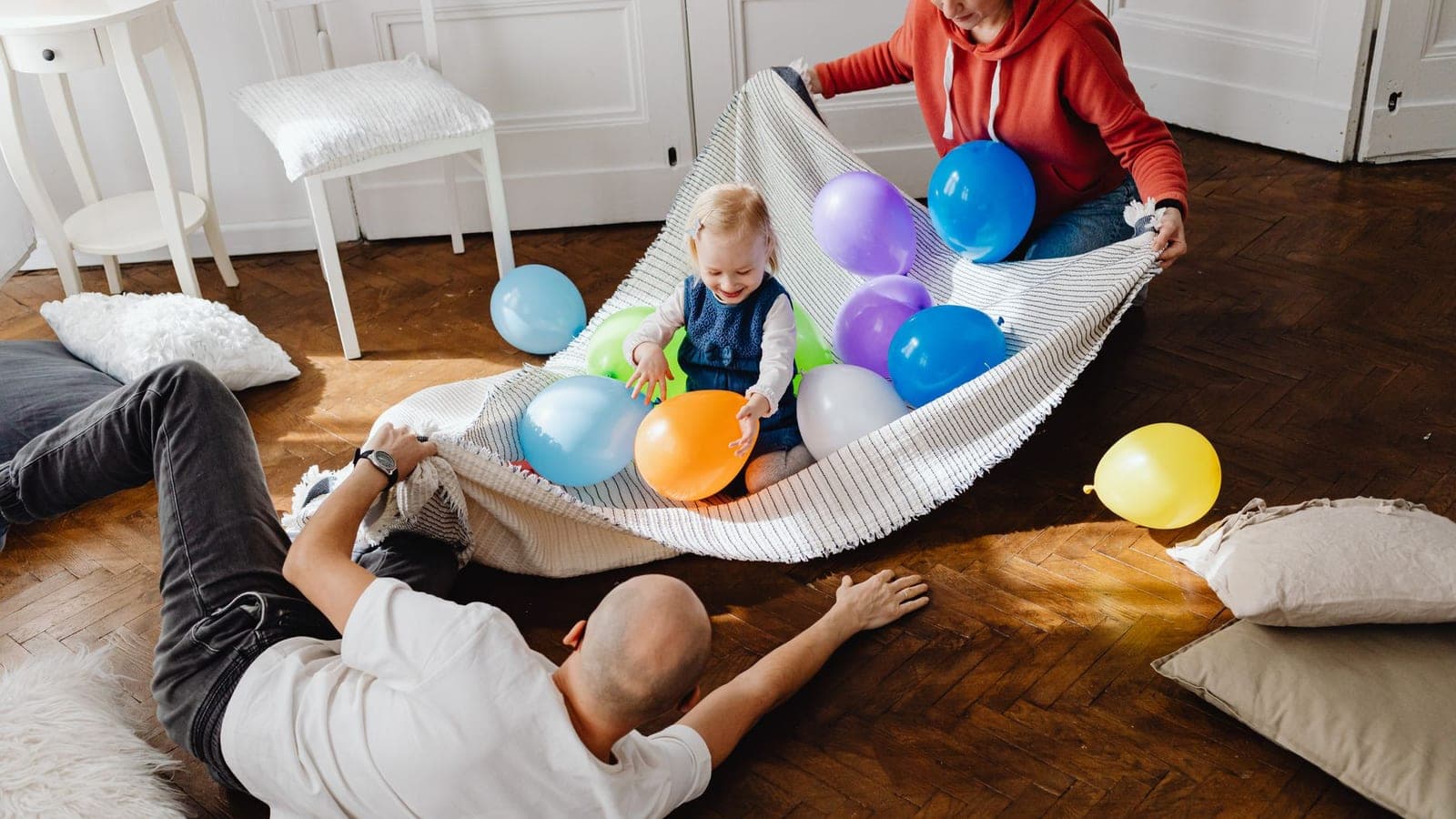
The mental image is fingers in blades, and modern guards on domestic fans handle that reasonably well. The problems that actually come up in homes are less dramatic and more common.
Ranked
Four hazards, in order of how often they matter
- The cord. A trailing lead is a trip hazard, a pull hazard that brings the fan down, and in a home with a crawling child a strangulation hazard. It is also the easiest of the four to eliminate entirely.
- Tip-over. Tall fans on small bases go over when pushed, pulled or leaned on. A tower fan is a good shape for guarding and a poor shape for stability.
- Clip and shelf mounts. Anything clipped above a sleeping or playing child can be pulled down into that space. This is the hazard people underestimate most.
- Guard spacing. Domestic fans are generally fine. Industrial and shop fans are not designed around small fingers, and older fans may predate current expectations.
By format
Which shapes avoid which problems
| Format | Cord | Tip-over | Blades |
|---|---|---|---|
| Ceiling fan | None | None | Out of reach |
| Tower fan | Yes | Tall, small base | Fine grille, enclosed |
| Box fan | Yes | Low and stable | Coarse guard, exposed |
| Pedestal fan | Yes | Tall, weighted base | Guard, at head height |
| Desk / clip fan | Yes | Small, easily moved | Guard, within reach |
| Air mover | Yes | Low but heavy | Coarse, fast |
A ceiling fan is the only format that scores well on all three, which is why it is the recommendation for a child’s room where installation is possible.
A tower fan is the best portable compromise: no exposed blades, at the cost of a tall silhouette. A box fan inverts that — stable and low, with the coarsest guard of the domestic formats.
This one is not a DIY job
Cord management is the highest-value thing you can do, and it takes five minutes.
Route the cord behind furniture, along a wall, and secure it. Not across an open floor, and not under a rug — where damage goes unseen and heat cannot escape.
Use the nearest socket so there is minimum slack. Excess cord coiled on a floor is the version children find.
Avoid extension leads in a child’s room where you can. If one is unavoidable, run it the same way and secure it the same way.
In a nursery the rules are stricter and separate: nothing on, above or within reach of a crib, and no cords near the sleep surface at all. The nursery page.
Pets
What is different with animals
Pets create a slightly different set of problems from children, and they are worth separating.
- Cords get chewed. Rabbits, rodents and young dogs in particular. This is a genuine electrical hazard rather than a trip hazard, and cord protectors or routing out of reach is the answer.
- Tails and noses find guards. A dog investigating a floor-level fan meets the guard nose-first. A fine-grille tower fan is considerably better here than a coarse-guard box fan.
- Fur clogs everything faster. A home with pets loads fan blades and motor vents far quicker, which cuts airflow and makes the motor run hotter. Clean more often than you would otherwise.
- Animals cannot move away as easily as you assume — a crated or confined pet cannot leave a draft. Aim the fan across the space rather than at a fixed position. Cooling a room for pets.
Placement
Rules that cover most of it
- Behind furniture, against a wall. Removes the cord from the floor and the fan from the traffic route in one move.
- Nothing clipped or shelved above where a child sleeps or plays. Not a fan, not anything.
- Aim across, not at. Better for comfort and it keeps the fan out of the natural line of approach.
- Check the guard fixings. A guard held by clips that have loosened is no longer a guard. This is the one blade-related check worth doing.
- Do not force an oscillating head. It strips the gearbox — and it is exactly what a curious child does.
Say the unwelcome thing
Do not buy an industrial or shop fan for a room with small children.
They are appealing on price and airflow, and they are designed around a different set of assumptions.
Guard spacing is set for a workplace, where everyone present understands what a spinning blade is. The blade behind it also turns faster than on a domestic fan of the same size.
Some carry accessory power outlets on the body, which is genuinely useful on a jobsite and puts live sockets at toddler height in a living room.
And they draw far more power — 160 to 178 W against 2.9 W for a DC tower fan on low — so the trade is not even favorable on running cost.
Keep them for the garage or workshop, and use a domestic fan indoors.
In full
Every pick, and what is wrong with it
Published specifications only, each linked to the page it came from. Where a manufacturer publishes nothing, the row says so — we do not fill blanks in.
1. Nothing in the room at all
Hunter Martindale 44" Ceiling Fan
Hunter · model 44in Martindale
1.1 W on low, fixed to the ceiling — no cord, no tip-over, nothing reachable.
The strongest safety argument for a ceiling fan has nothing to do with airflow. There is nothing in the room to pull down, trip over, unplug or climb.
All four of the hazards on this page are eliminated at once, which no floor-standing fan can claim regardless of its guard.
1.1 W on low is 0.2¢ for a twelve-hour night, so leaving it running is a non-decision.
Keep blades at least 7 feet from the floor — the mounting guide — and use a fan-rated box, which is a requirement rather than a preference.
What’s wrong with it
It is an electrical installation, so not an option in most rentals, and it cannot be aimed.
Running cost — 44in Martindale
| Nameplate power | 1.1 W – 10.1 W | manufacturer's published figure |
|---|---|---|
| Energy, 8-hour night | 0.08 kWh | 10.1 ÷ 1000 × 8 |
| Cost per hour | 0.2¢ | at 18.34¢/kWh |
| Cost per 8-hour night | 1.5¢ | on the highest speed |
| Cost per 30 nights | 44¢ | 2.4 kWh |
| Same month, lowest speed | 4.8¢ | at 1.1 W |
Rate: 18.34¢/kWh, the US average residential price for June 2026 (EIA Electric Power Monthly, Table 5.3). Yours will differ — swap it in: (watts ÷ 1000) × hours × your rate.
| Blade span | 44 in |
|---|---|
| Efficiency | 304.5 CFM per watt |
| Power, high speed | 10.1 W |
| Power, low speed | 1.1 W |
| Standby power | 0.4 W |
| Type | Indoor, fan only |
| Warranty | 3 years, components |
| ENERGY STAR | Certified |
Every figure above is from ENERGY STAR Certified Ceiling Fans dataset. Blanks are shown as “not published” rather than filled in.
2. Best floor-standing shape
Lasko EcoQuiet 42" DC Tower Fan
Lasko · model T42710
A tall narrow tower with no exposed blades and a fine grille — the safest portable format for small hands.
A tower fan has no visible blades. The impeller sits behind a fine vertical grille with openings far too small for fingers, which removes the hazard people worry about most.
2.9 W on low at 23 dBA — 0.6¢ for a twelve-hour night, and the quietest published figure on this site.
The honest weakness is geometry. 41.6 inches tall on a 12.8 inch base is a tall object with a small footprint, and 7.8 lb is not much to resist a determined toddler.
Place it against a wall or behind furniture, not free-standing in the middle of a floor.
What’s wrong with it
41.6 inches tall on a 12.8 inch footprint is tippable, and it still has a cord that needs routing.
Running cost — T42710
| Nameplate power | 2.9 W – 19 W | manufacturer's published figure |
|---|---|---|
| Energy, 8-hour night | 0.15 kWh | 19 ÷ 1000 × 8 |
| Cost per hour | 0.3¢ | at 18.34¢/kWh |
| Cost per 8-hour night | 2.8¢ | on the highest speed |
| Cost per 30 nights | 84¢ | 4.6 kWh |
| Same month, lowest speed | 13¢ | at 2.9 W |
Rate: 18.34¢/kWh, the US average residential price for June 2026 (EIA Electric Power Monthly, Table 5.3). Yours will differ — swap it in: (watts ÷ 1000) × hours × your rate.
| Power | 2.9 W - 19 W (0.06-0.303 A at 120 V) |
|---|---|
| Noise | 23 dBA low, 46 dBA high |
| Speeds | 12 |
| Height | 41.6 in |
| Footprint | 12.8 x 12.8 in |
| Weight | 7.8 lb |
| Timer | 8 hours |
| Air delivery (CFM) | Not published |
| Warranty | 2 years |
Every figure above is from Lasko product page, T42710. Blanks are shown as “not published” rather than filled in.
3. Right guard, wrong places
Air King 6" Commercial Grade Clip-On Fan
Air King · model 9145
A metal commercial guard at 9 to 12 W, on a clip that must be placed with real care.
An instructive case, because the fan itself is well built and the risk is entirely about placement.
ETL listed and OSHA compliant with a metal guard, which is a commercial specification. The guard spacing is designed for a workplace.
The problem is the mounting. A clip is an object that can be pulled down into whatever is below it, and the six-foot cord has to run from wherever it is clipped to a socket.
Clipped to a high shelf in a study, fine. Clipped to a cot rail, a changing table or a shelf above a bed, no. The nursery rules are stricter and worth reading.
What’s wrong with it
The clip and the six-foot cord are the hazard. Where you put it matters more than how it is built.
Running cost — 9145
| Nameplate power | 9 W – 12 W | manufacturer's published figure |
|---|---|---|
| Energy, 8-hour night | 0.10 kWh | 12 ÷ 1000 × 8 |
| Cost per hour | 0.2¢ | at 18.34¢/kWh |
| Cost per 8-hour night | 1.8¢ | on the highest speed |
| Cost per 30 nights | 53¢ | 2.9 kWh |
| Same month, lowest speed | 40¢ | at 9 W |
Rate: 18.34¢/kWh, the US average residential price for June 2026 (EIA Electric Power Monthly, Table 5.3). Yours will differ — swap it in: (watts ÷ 1000) × hours × your rate.
| Power | 9 W - 12 W (0.1-0.2 A at 120 V) |
|---|---|
| Air delivery | Up to 190 CFM |
| Noise | 34 dBA low, 37 dBA high |
| Speeds | 2 |
| Mounting | Spring-loaded clip, non-marking |
| Dimensions | 10.38 H x 6.25 L x 8.13 W in |
| Weight | 2.22 lb |
| Cord | 6 ft, 3-conductor |
| Listing | ETL listed, OSHA compliant |
| Warranty | 1 year |
Every figure above is from Air King product page, 9145 (via Lasko). Blanks are shown as “not published” rather than filled in.
Skip this one
Lasko Max Performance 15" Air Mover
Lasko · model U15720
160 to 178 W with a coarse guard, a pivoting head and two live accessory outlets on the body.
Listed as a skip specifically for homes with small children, and the reasons are worth naming.
The guard is coarse. Air movers prioritize airflow, so the spacing is wider than on a domestic fan and the blade is turning fast behind it.
Two 120 V accessory outlets on the body, at floor level. That is a genuinely useful jobsite feature and exactly what you do not want within reach of a toddler.
160 to 178 W — about 26¢ for an eight-hour day — on a 9.5-foot cord.
What’s wrong with it
Coarse guard spacing, high motor speed, and mains outlets at floor level. It is designed for a workplace, not a playroom.
Running cost — U15720
| Nameplate power | 160 W – 178 W | manufacturer's published figure |
|---|---|---|
| Energy, 8-hour night | 1.42 kWh | 178 ÷ 1000 × 8 |
| Cost per hour | 3.3¢ | at 18.34¢/kWh |
| Cost per 8-hour night | 26¢ | on the highest speed |
| Cost per 30 nights | $7.83 | 42.7 kWh |
| Same month, lowest speed | $7.04 | at 160 W |
Rate: 18.34¢/kWh, the US average residential price for June 2026 (EIA Electric Power Monthly, Table 5.3). Yours will differ — swap it in: (watts ÷ 1000) × hours × your rate.
| Power | 160 W - 178 W (1.35-1.53 A at 120 V) |
|---|---|
| Speeds | 3 |
| Dimensions | 14.5 H x 14.0 D x 11.5 W in |
| Weight | 12.55 lb |
| Extras | Two 120 V accessory outlets, 9.5 ft cord, pivoting head |
| Air delivery (CFM) | Not published |
| Warranty | 1 year |
Every figure above is from Lasko product page, U15720. Blanks are shown as “not published” rather than filled in.
We are not linking a buy button for this one. If you want to look at it anyway, it is easy enough to find — but we would rather send you to something that fits your room.
Questions people actually ask
Frequently asked
Are fans safe around children?
Modern domestic fan guards handle small fingers reasonably well. The problems that actually come up are trailing cords, tip-over on tall narrow fans, and anything clipped above where a child sleeps or plays.
What is the safest fan for a child's room?
A ceiling fan, because there is nothing in the room — no cord, no tip-over risk, and blades out of reach. Failing that, a tower fan has no exposed blades, though its tall narrow shape makes it tippable.
Are clip-on fans safe in a child's room?
Not above a bed or crib. A clip is an object that can be pulled down into the space below it, and the cord has to run from wherever it is clipped to a socket. On a high shelf in a study it is fine. Nursery placement rules.
How should I route a fan cord safely?
Behind furniture and along a wall, secured, using the nearest socket so there is minimum slack. Not across an open floor, and not under a rug — damage goes unseen there and heat cannot escape.
Are fans safe around pets?
Mostly, with two additions to the usual rules. Cords get chewed, so route them out of reach or protect them. And fur loads blades and motor vents far faster than dust alone, so clean the fan more often.
Should I avoid box fans with children in the house?
They have the coarsest guard of the domestic formats, but they are also the most stable — low and wide, so difficult to tip. A tower fan is the better guard and the worse shape. Placement matters more than the choice between them.
Sources
Where these numbers came from
Read next
Where to go from here
Back to Fans, or read how we pick.