The picks
The best flush-mount ceiling fans
Hugger fans pay a measurable efficiency penalty for sitting close to the ceiling. Here is exactly how large it is, and which ones do not.
By Sawyer V. · Published
The short answer
Flush-mount fans are genuinely less efficient: across 243 certified hugger and low-mount records the median is 172.3 CFM per watt against 209 for standard mounts, an 18% penalty, and the best hugger reaches 418 against 483. But the good ones close most of it — 339 CFM per watt at 16.2 W is available, and 77 huggers carry Most Efficient.
Fan & Frost earns a commission when you buy through our links, at no cost to you. It never changes a ranking, and we say so when the right answer is the cheaper unit or nothing at all. Full disclosure · How we pick.
At a glance
The picks, ranked
Tap any row to jump to the full reasoning. Prices are live from Amazon where we have them, and read “check price” where we don’t — never a number we cannot verify today.
| # | Product | Best for | Price |
|---|---|---|---|
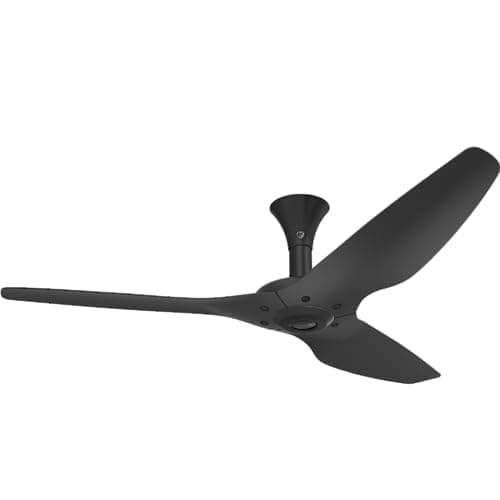
| 1 | Best overall Big Ass Fans Haiku 60" Low-Mount Ceiling Fan 339.0 CFM per watt across a 60-inch span at 16.2 W — near the top of the flush-mount field, with a 5-year warranty. | A large room with a ceiling too low for a downrod | |
| 2 | 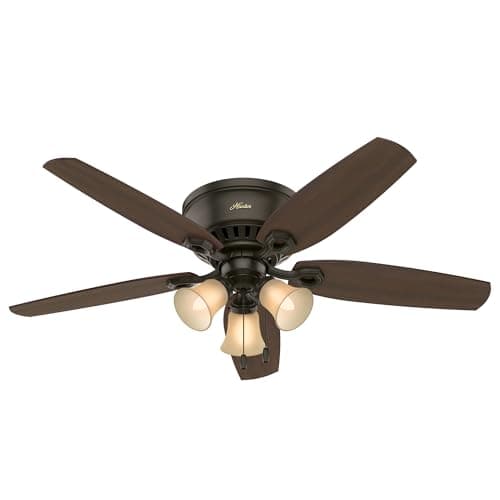 Best for a bedroom Hunter 52" Hugger Ceiling Fan 331.1 CFM per watt at 52 inches, 1.9 W on low and only 0.5 W standby. | A standard room with an 8-foot ceiling | |
| 3 | 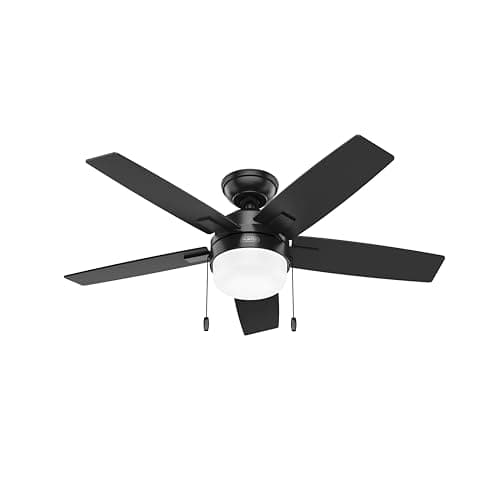 Best for a small room Hunter Anisten 44" Hugger Ceiling Fan 295.9 CFM per watt at 44 inches, 1.6 W on low and 0.3 W standby — the lowest standby here. | A small bedroom, study or a room with a sloped ceiling | |
| — | What you give up Aeratron AE+2 60" Ceiling Fan 483.0 CFM per watt at 60 inches on 16.2 W — the most efficient certified ceiling fan, and it is not a hugger. | A room with the ceiling height for a downrod |
A flush-mount fan — a hugger — mounts directly to the ceiling with no downrod. It exists for rooms where a normal fan does not fit, and it pays for that.
The finding
The hugger penalty, measured
We grouped all 1,398 certified US ceiling fan records by the dataset’s product type field, which separates hugger and low-mount designs from standard downrod ones.
| Mount type | Certified records | Median CFM/W | Best CFM/W | Most Efficient |
|---|---|---|---|---|
| Hugger and low-mount | 243 | 172.3 | 418 | 77 |
| Standard downrod | 1155 | 209.0 | 483 | — |
172.3 against 209 at the median — an 18% penalty — and 418 against 483 at the top.
There are two separate effects tangled up in that, and separating them changes the conclusion.
The physical penalty is small. Comparing two 44-inch fans from the same brand, one standard-mount and one hugger: 304.5 against 295.9 CFM per watt. That is about 3%, and it is what mounting close to the ceiling genuinely costs — the blades have less clear air above them to draw from.
The rest is product mix. Manufacturers build their efficiency flagships as downrod fans, and huggers skew toward smaller, cheaper, less sophisticated models. That is why the median gap is 18% while the like-for-like gap is 3%.
The practical consequence is encouraging: a well-chosen hugger recovers most of the difference. 339 CFM per watt is available, against a 209 standard-mount median.
When you need one
The clearance question
Flush mounting is not an aesthetic preference; it is a response to a constraint.
- Ceilings at or below 8 feet. A downrod fan needs blade clearance below the ceiling and above people, and 8 feet rarely allows both.
- Sloped and vaulted ceilings at the low end. A converted attic or a room with a knee wall frequently has one flat strip along the ridge and nothing else — which is the usual attic-room problem.
- Rooms with tall furniture or loft beds where the blade path has to stay high.
- Where a downrod would look wrong — a legitimate reason, and the 3% like-for-like penalty is a small price.
If your ceiling is 9 feet or more, use a downrod. Drop, clearance and mount type covers how to choose the length.
Standby
The number nobody looks at
Standby power is published for certified fans and almost never discussed, and it varies more than you would expect across the units here.
- 0.3 W on the 44-inch Hunter.
- 0.5 W on the 52-inch Hunter.
- 2.5 W on the 60-inch Big Ass Fans unit.
Standby is drawn all 8,760 hours of the year, not only while the fan runs. The difference between 0.3 W and 2.5 W is about 19 kWh a year — small, but it is the price of the electronics and it is worth knowing you are paying it.
Across the full certified field, connected fans average 1.74 W standby against 0.90 W for everything else — the smart-fan standby analysis.
This one is not a DIY job
Blade clearance is a safety requirement, not a preference. Manufacturers and electrical codes specify minimum heights from the floor to the blades and minimum clearance from the blade tips to walls and obstructions.
A flush mount exists to meet those in a low room. It does not remove them — check the figures for your specific model and room.
Ceiling fans must be supported by a box rated and listed for fan support. A standard lighting outlet box is not, and a fan mounted to one is a genuine hazard because of the vibration load.
If the existing box is not fan-rated, replacing it is electrical and structural work for a qualified electrician.
Practical
Choosing one
- Check the box is fan-rated before anything else. It decides whether this is a swap or a project.
- Size to the room, not to the ceiling. A 44-inch fan in a large room is worse than a 60-inch one, hugger or not.
- Look at the low-speed wattage. 1.6 to 1.9 W is what you will actually run, and it is where the running cost lives.
- Check standby if the fan has electronics. It is published, and it ranges eightfold across these three.
- Do not assume hugger means inefficient. The median is 172.3 CFM per watt and the good ones are near double that.
- Reverse it seasonally. Downdraft in summer is the only direction that cools anyone — which way and why.
Say the unwelcome thing
Do not fit a flush-mount fan just because the ceiling is a bit low.
Check the actual clearance numbers first. Plenty of rooms that feel low will take a short downrod, and a standard mount buys you access to the fans manufacturers actually optimize.
The like-for-like penalty is only about 3% — 304.5 against 295.9 CFM per watt on two matched 44-inch fans. But the median hugger sits at 172.3 against 209 for standard mounts, because the format skews toward cheaper models.
So the risk is not the mount. It is ending up in a product category where the average option is much weaker, and buying the average one.
If you genuinely need a hugger, buy a good one: 339 CFM per watt at 60 inches or 331 at 52 inches and 1.9 W on low.
In full
Every pick, and what is wrong with it
Published specifications only, each linked to the page it came from. Where a manufacturer publishes nothing, the row says so — we do not fill blanks in.
1. Best overall
Big Ass Fans Haiku 60" Low-Mount Ceiling Fan
Big Ass Fans · model MK-HK4-05240001
339.0 CFM per watt across a 60-inch span at 16.2 W — near the top of the flush-mount field, with a 5-year warranty.
The strongest combination of span and efficiency available in a low-mount fan, and it shows how much of the hugger penalty is avoidable.
339.0 CFM per watt against a hugger median of 172.3 — nearly double the typical flush-mount fan, and well above the 209 median for standard downrod fans.
16.2 W on high across a 60-inch span, which is a large room covered by a fan that draws less than a light bulb.
5-year components warranty — the longest in the certified ceiling fan set — and Most Efficient certified. The honest costs: 2.5 W standby, drawn all year, and no published low-speed figure.
What’s wrong with it
2.5 W of standby, and no low-speed figure is published for it.
Running cost — MK-HK4-05240001
| Nameplate power | 16.2 W | manufacturer's published figure |
|---|---|---|
| Energy, 8-hour night | 0.13 kWh | 16.2 ÷ 1000 × 8 |
| Cost per hour | 0.3¢ | at 18.34¢/kWh |
| Cost per 8-hour night | 2.4¢ | on the highest speed |
| Cost per 30 nights | 71¢ | 3.9 kWh |
Rate: 18.34¢/kWh, the US average residential price for June 2026 (EIA Electric Power Monthly, Table 5.3). Yours will differ — swap it in: (watts ÷ 1000) × hours × your rate.
| Blade span | 60 in |
|---|---|
| Efficiency | 339.0 CFM per watt |
| Power, high speed | 16.2 W |
| Standby power | 2.5 W |
| Type | Indoor low-mount (HSSD), fan only |
| Warranty | 5 years, components |
| ENERGY STAR | Certified, and on the Most Efficient list |
Every figure above is from ENERGY STAR Certified Ceiling Fans dataset. Blanks are shown as “not published” rather than filled in.
2. Best for a bedroom
Hunter 52" Hugger Ceiling Fan
Hunter · model 55130
331.1 CFM per watt at 52 inches, 1.9 W on low and only 0.5 W standby.
The size most rooms want, at very close to the efficiency of the larger fan above and with much better standby behavior.
1.9 W on low is 0.3¢ for an eight-hour night. That is the number that matters in a bedroom, because it is the setting you will actually leave running.
331.1 CFM per watt and 14.5 W on high across a 52-inch span, Most Efficient certified.
0.5 W standby against 2.5 W on the Big Ass Fans unit. Over a full year that difference is small in absolute terms, and it is drawn every hour whether or not the fan runs.
What’s wrong with it
331.1 is still short of the 483 the best standard-mount fan achieves.
Running cost — 55130
| Nameplate power | 1.9 W – 14.5 W | manufacturer's published figure |
|---|---|---|
| Energy, 8-hour night | 0.12 kWh | 14.5 ÷ 1000 × 8 |
| Cost per hour | 0.3¢ | at 18.34¢/kWh |
| Cost per 8-hour night | 2.1¢ | on the highest speed |
| Cost per 30 nights | 64¢ | 3.5 kWh |
| Same month, lowest speed | 8.4¢ | at 1.9 W |
Rate: 18.34¢/kWh, the US average residential price for June 2026 (EIA Electric Power Monthly, Table 5.3). Yours will differ — swap it in: (watts ÷ 1000) × hours × your rate.
| Blade span | 52 in |
|---|---|
| Efficiency | 331.1 CFM per watt |
| Power, high speed | 14.5 W |
| Power, low speed | 1.9 W |
| Standby power | 0.5 W |
| Type | Indoor hugger (flush mount), fan only |
| Warranty | 3 years, components |
| ENERGY STAR | Certified, and on the Most Efficient list |
Every figure above is from ENERGY STAR Certified Ceiling Fans dataset. Blanks are shown as “not published” rather than filled in.
3. Best for a small room
Hunter Anisten 44" Hugger Ceiling Fan
Hunter · model 44 Anisten
295.9 CFM per watt at 44 inches, 1.6 W on low and 0.3 W standby — the lowest standby here.
The right size for the rooms that most often need a hugger in the first place: small ones with ordinary or awkward ceilings.
1.6 W on low — 0.2¢ for a night — and 0.3 W standby, the lowest in this roundup.
295.9 CFM per watt and 12.5 W on high across 44 inches. Note the direct comparison available here: the same brand makes a 44-inch standard-mount fan at 304.5 CFM per watt, so the flush-mount penalty on matched fans is about 3%.
That 3% is the honest measure of what the mount itself costs, as opposed to the 18% median gap, which is mostly about which fans manufacturers choose to build in each format.
What’s wrong with it
44 inches is a small room only, and 295.9 is the lowest efficiency of the three.
Running cost — 44 Anisten
| Nameplate power | 1.6 W – 12.5 W | manufacturer's published figure |
|---|---|---|
| Energy, 8-hour night | 0.10 kWh | 12.5 ÷ 1000 × 8 |
| Cost per hour | 0.2¢ | at 18.34¢/kWh |
| Cost per 8-hour night | 1.8¢ | on the highest speed |
| Cost per 30 nights | 55¢ | 3.0 kWh |
| Same month, lowest speed | 7.0¢ | at 1.6 W |
Rate: 18.34¢/kWh, the US average residential price for June 2026 (EIA Electric Power Monthly, Table 5.3). Yours will differ — swap it in: (watts ÷ 1000) × hours × your rate.
| Blade span | 44 in |
|---|---|
| Efficiency | 295.9 CFM per watt |
| Power, high speed | 12.5 W |
| Power, low speed | 1.6 W |
| Standby power | 0.3 W |
| Type | Indoor hugger (flush mount), fan only |
| Warranty | 3 years, components |
| ENERGY STAR | Certified |
Every figure above is from ENERGY STAR Certified Ceiling Fans dataset. Blanks are shown as “not published” rather than filled in.
Skip this one
Aeratron AE+2 60" Ceiling Fan
Aeratron · model AE+2WI60
483.0 CFM per watt at 60 inches on 16.2 W — the most efficient certified ceiling fan, and it is not a hugger.
Included so the trade is explicit rather than implied.
483.0 CFM per watt is the highest of any certified ceiling fan we hold data for — 43% better than the best flush-mount unit, at the same 60-inch span and the same 16.2 W on high.
2.9 W on low and Most Efficient certified.
The reason to skip it is the reason huggers exist. A downrod fan needs blade clearance below the ceiling, and in a room with an 8-foot ceiling that either cannot be achieved safely or leaves the blades at head height.
If you have the height, take the efficiency. If you do not, the penalty above is what it costs.
What’s wrong with it
It needs the clearance a flush mount exists to avoid. If your ceiling is 8 feet, this is not your fan.
Running cost — AE+2WI60
| Nameplate power | 2.9 W – 16.2 W | manufacturer's published figure |
|---|---|---|
| Energy, 8-hour night | 0.13 kWh | 16.2 ÷ 1000 × 8 |
| Cost per hour | 0.3¢ | at 18.34¢/kWh |
| Cost per 8-hour night | 2.4¢ | on the highest speed |
| Cost per 30 nights | 71¢ | 3.9 kWh |
| Same month, lowest speed | 13¢ | at 2.9 W |
Rate: 18.34¢/kWh, the US average residential price for June 2026 (EIA Electric Power Monthly, Table 5.3). Yours will differ — swap it in: (watts ÷ 1000) × hours × your rate.
| Blade span | 60 in |
|---|---|
| Efficiency | 483.0 CFM per watt |
| Power, high speed | 16.2 W |
| Power, low speed | 2.9 W |
| Type | Indoor |
| Light kit | No ENERGY STAR lamp shipped |
| Warranty | 3 years, components |
| ENERGY STAR | Certified, and on the Most Efficient list |
Every figure above is from ENERGY STAR Certified Ceiling Fans dataset. Blanks are shown as “not published” rather than filled in.
We are not linking a buy button for this one. If you want to look at it anyway, it is easy enough to find — but we would rather send you to something that fits your room.
Questions people actually ask
Frequently asked
Are flush-mount ceiling fans less efficient?
Yes, but less than the headline suggests. Across 243 certified hugger and low-mount records the median is 172.3 CFM per watt against 209 for standard downrod fans — an 18% gap. On two matched 44-inch fans from the same brand, though, the difference is only about 3%.
Why is the median gap bigger than the like-for-like gap?
Product mix. Manufacturers build their efficiency flagships as downrod fans, and the hugger format skews toward smaller, cheaper models. The 3% is what mounting close to the ceiling actually costs; the rest is which fans get built in each format.
When should I use a flush-mount ceiling fan?
Ceilings at or below 8 feet, sloped or vaulted ceilings at the low end, and rooms with tall furniture or loft beds where the blade path must stay high. If your ceiling is 9 feet or more, use a downrod. Downrod and mounting.
What is the most efficient flush-mount ceiling fan?
339.0 CFM per watt across a 60-inch span at 16.2 W, with a 5-year warranty — roughly double the hugger median and well above the standard-mount median of 209. The best 52-inch hugger reaches 331.1 at 1.9 W on low.
How much standby power does a ceiling fan use?
It is published for certified fans and varies more than you would expect — 0.3 W, 0.5 W and 2.5 W across the three huggers here. Standby is drawn all 8,760 hours of the year, not only while the fan runs. The standby analysis.
Can I fit a ceiling fan to any ceiling box?
No. A fan must be supported by a box rated and listed for fan support — a standard lighting outlet box is not, because of the vibration load. If the existing box is not fan-rated, replacing it is work for a qualified electrician.
Sources
Where these numbers came from
Read next
Where to go from here
Back to Whole-House Airflow, or read how we pick.