The picks
The best window air conditioner brands, tested against the certified data
We grouped every certified room air conditioner by the name on the box, then checked how much that name predicts. For more than half the market, the answer is nothing at all.
By Sawyer V. · Published
The short answer
Brand predicts less than you think. Of the 485 certified room air conditioners, 282 — 58.1% — have specifications identical to a unit sold under a different brand, and 38 of the 47 brand names appear in at least one such group. The names that do mean something are Midea (100 of the 171 Most Efficient units), GE (3 of 3) and Friedrich’s Kuhl line (8 of 8). Eleven brands with six or more certified models have zero.
Fan & Frost earns a commission when you buy through our links, at no cost to you. It never changes a ranking, and we say so when the right answer is the cheaper unit or nothing at all. Full disclosure · How we pick.
At a glance
The picks, ranked
Tap any row to jump to the full reasoning. Prices are live from Amazon where we have them, and read “check price” where we don’t — never a number we cannot verify today.
| # | Product | Best for | Price |
|---|---|---|---|
| 1 | 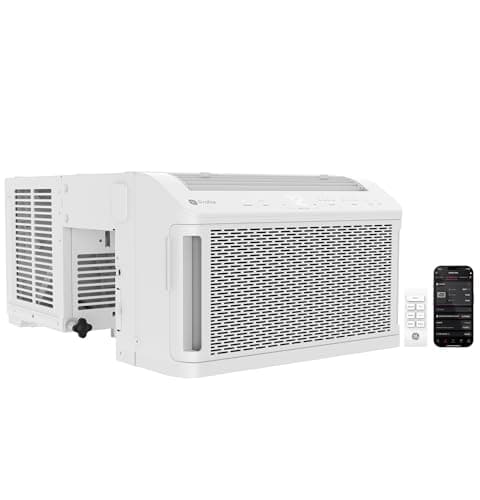 Best brand record GE Profile ClearView Window Air Conditioner, 8,000 BTU GE files three certified models and all three are Most Efficient at CEER 16 — the only brand here with a perfect record at scale. | Anyone who wants the badge and the data to agree | |
| 2 | Best brand at scale Midea Window Heat Pump Air Conditioner, 9,500 BTU Midea holds 184 of 485 certified records and 100 of the 171 Most Efficient. This is its best: CEER 17.6. | A room that also needs heating, in a window that suits a saddle unit | |
| 3 | Best premium line Friedrich Kuhl Window Air Conditioner, 12,700 BTU Friedrich's Kuhl line is 8 of 8 Most Efficient — the only sub-brand here with a perfect record. This one is CEER 16.8. | A larger room where the install can take real weight | |
| 4 | 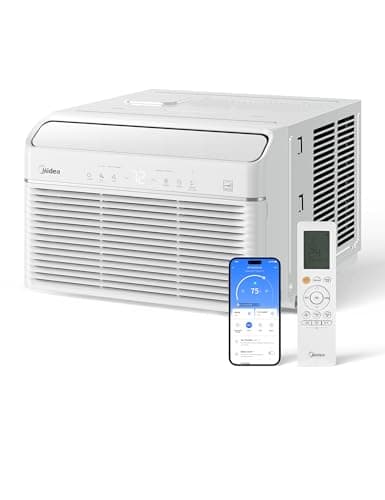 Best value brand TCL Window Air Conditioner, 12,000 BTU TCL is second only to Midea by volume, 19 of 65 Most Efficient, and this one is CEER 16 at 51.8 lb. | Getting a Most Efficient unit without a heavyweight install | |
| — | 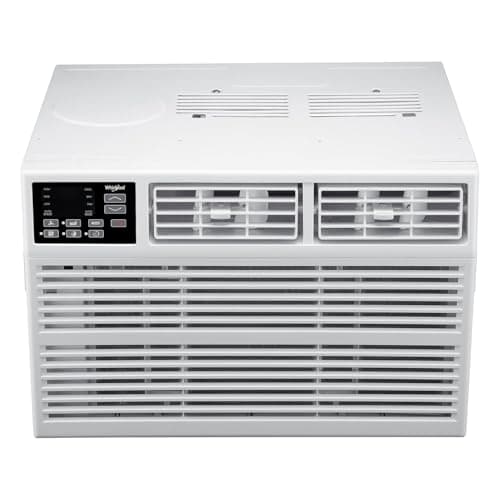 The brand that does not clear the bar Whirlpool Window Air Conditioner, 24,000 BTU Whirlpool files 6 certified models and none are Most Efficient. This one is CEER 12.7 and 1,417.3 kWh a year. | A genuinely large space, if nothing better fits the opening |
“Which brand should I buy?” is one of the most common questions in this category and one of the least useful, because the certified data says the badge is frequently the least informative thing on the box.
Method
How we judged, before naming anyone
We have not tested any of these units and we do not hold reliability data. What we have is the ENERGY STAR Certified Room Air Conditioners dataset, which records every certified model with figures the manufacturer cannot write itself. We grouped all 485 records by the brand_name field and ranked on four things:
- How many certified models the brand actually files. A brand with two models and one good one is not a track record.
- Median CEER across its range. The typical unit you get if you buy the badge blind, rather than its best.
- Best CEER. What the brand is capable of when it tries.
- Share of its range on the Most Efficient list. The strictest tier in the program — only 171 of 485 room units reach it.
We deliberately did not rank on price, warranty length or reputation. Price we cannot verify on the day, and reputation is what we are testing rather than assuming.
The finding
58.1% of certified units share a chassis with another brand
Before the rankings, the thing that changes how you should read them.
We grouped every record by an exact match on capacity, CEER, annual kWh, all three dimensions and weight, then kept only the groups spanning more than one brand name. There are 40 such groups, and they contain 282 of the 485 certified units — 58.1% of the field. 38 of the 47 brand names appear in at least one.
The largest single group is worth seeing in full:
| Group | Records | Brand names on the box |
|---|---|---|
| 8,000 BTU, CEER 15, 400 kWh, 53.1 lb | 23 | Century, Comfort Aire, Danby, Frigidaire Gallery, Honeywell, Hykolity, Keystone, Midea, Perfect aire |
| 12,000 BTU, CEER 15, 600 kWh, 56.9 lb | 16 | Century, Comfort Aire, Frigidaire Gallery, Hykolity, Keystone, Midea, Perfect aire |
| 10,000 BTU, CEER 15, 500 kWh, 54.0 lb | 13 | Century, Comfort Aire, Danby, Frigidaire Gallery, Hykolity, Keystone, Midea, Perfect aire |
| 24,000 BTU, CEER 13.3, 1,353.4 kWh, 103.0 lb | 13 | Comfort Aire, Frigidaire, Keplerx, Keystone, Midea, Perfect aire, Sea Breeze |
| 14,000 BTU, CEER 15, 700 kWh, 56.0 lb | 12 | Danby, ELEMENT, Keplerx, Keystone, Midea, Vissani |
Nine brand names, one set of numbers. These are not similar units; every published figure matches to the decimal, including the weight.
That does not make any of them a bad buy — a CEER 15 unit at 400 kWh a year is a perfectly reasonable machine. It does mean that comparing those nine on specification is comparing a machine to itself, and that whichever of them is cheapest on the day is the correct one to buy.
The table
Every brand with six or more certified models
| Brand | Models | Median CEER | Best CEER | Most Efficient |
|---|---|---|---|---|
| Kuhl (Friedrich) | 8 | 15.3 | 17.0 | 8 of 8 (100%) |
| Brothers | 9 | 14.1 | 16.0 | 8 of 9 (89%) |
| Seasons | 10 | 13.9 | 16.0 | 8 of 10 (80%) |
| Midea | 184 | 15.0 | 17.6 | 100 of 184 (54%) |
| TCL | 65 | 15.0 | 16.0 | 19 of 65 (29%) |
| LG | 12 | 15.0 | 15.5 | 3 of 12 (25%) |
| Vissani | 9 | 15.0 | 16.0 | 2 of 9 (22%) |
| Friedrich | 28 | 14.2 | 16.2 | 6 of 28 (21%) |
| Keystone | 11 | 15.0 | 15.0 | 1 of 11 (9%) |
| Hisense | 16 | 15.0 | 15.0 | 1 of 16 (6%) |
| Danby | 6 | 15.0 | 15.0 | 0 of 6 |
| DELLA | 6 | 15.0 | 15.0 | 0 of 6 |
| Frigidaire | 6 | 15.0 | 15.0 | 0 of 6 |
| Frigidaire Gallery | 9 | 15.0 | 15.0 | 0 of 9 |
| GE Profile | 9 | 15.0 | 15.7 | 0 of 9 |
| Hykolity | 6 | 15.0 | 15.0 | 0 of 6 |
| Keplerx | 6 | 15.0 | 15.0 | 0 of 6 |
| Ktaxon | 6 | 15.0 | 15.0 | 0 of 6 |
| Perfect aire | 7 | 15.0 | 15.0 | 0 of 7 |
| ROVSUN | 7 | 15.0 | 15.0 | 0 of 7 |
| Whirlpool | 6 | 14.7 | 15.0 | 0 of 6 |
Three things stand out. The highest Most Efficient rates belong to the smallest lines — Kuhl, Brothers and Seasons file eight to ten models each and certify almost all of them, because a narrow premium line is easier to keep at the top. The volume brands are mixed: Midea and TCL both have a median of CEER 15 and reach the top of the field only with specific models. And eleven brands with six or more models have none at all.
Note also how flat the median column is. Sixteen of these twenty-one brands sit at exactly CEER 15, which is what you would expect if a large part of the market is buying the same platforms.
The trap
GE files under three brand names, with opposite results
This is the single most useful thing on the page for anyone shopping by badge, because all three names appear on shelves and they perform nothing alike.
- GE — 3 models, median CEER 16, 3 of 3 Most Efficient.
- GE Profile — 9 models, median CEER 15, best 15.7, 0 of 9 Most Efficient.
- GE Appliances — 2 models, CEER 13.2, 0 of 2.
“Profile” is the premium-sounding badge, and in the certified data it is the weaker set — nine models, none of which clear the Most Efficient bar, against three plain-GE models that all do.
Sub-brands are marketing tiers, not efficiency tiers. The lesson generalizes: whenever a manufacturer runs several badges, check which one the specific model is filed under rather than assuming the fancier name is better.
The other trap
The model suffix beats the brand
Friedrich’s Kuhl range gives an unusually clean natural experiment. Nine model families appear twice in the dataset, with model numbers differing only in a trailing A or B — a revision, not a redesign.
| Family | A revision | B revision | Most Efficient |
|---|---|---|---|
| KCVS08B10 | CEER 16.0, 407.8 kWh | CEER 17.0, 383.8 kWh | both |
| KCVS12B10 | CEER 15.0, 625.0 kWh | CEER 16.2, 569.4 kWh | B only |
| KCVS12B30 | CEER 15.0, 635.0 kWh | CEER 16.8, 567.0 kWh | B only |
| KCVS16B30 | CEER 14.4, 843.8 kWh | CEER 16.0, 721.9 kWh | B only |
| KCVM14B10 | CEER 14.7, 709.2 kWh | CEER 16.2, 652.8 kWh | B only |
| KCVM18B30 | CEER 14.4, 994.8 kWh | CEER 14.6, 1,073.6 kWh | B only |
| KCVM24B30 | CEER 13.0, 1,338.5 kWh | CEER 13.9, 1,246.4 kWh | B only |
| KCVL28B30 | CEER 13.2, 1,642.0 kWh | CEER 13.8, 1,570.7 kWh | both |
| KCVL36B30 | CEER 12.2, 2,096.3 kWh | CEER 13.4, 1,847.0 kWh | B only |
The B revision is more efficient in all nine of nine families, and in seven of the nine it is the difference between clearing the Most Efficient bar and not clearing it. On KCVS12B30 that is CEER 15.0 against 16.8, and 68 kWh a year — from one letter.
Both revisions are sold. Both look like “a Friedrich Kuhl 12,700 BTU” in a listing. The efficiency difference is invisible unless you read the full model number, which is the strongest practical argument on this page for shopping by model rather than by name.
This one is not a DIY job
We hold no reliability, service or failure-rate data, and neither does the certification program. Everything above is efficiency and specification. It says nothing about whether a unit lasts eight years or three.
That is a genuine limitation of this page. If long-term durability is your priority, the things worth weighing are ones we cannot measure: warranty terms in writing, whether replacement parts are sold separately, and whether there is a service network near you.
Those favor the established names in ways the efficiency table does not, and it is a reasonable basis on which to overrule this ranking. We would rather say that than pretend a spec sheet settles it.
Installation is the other thing brand does not fix. A 110 lb unit needs a correct bracket and a sound window regardless of the badge, and that part is a job for someone competent.
What brand does tell you
The parts that are real
Having spent the page arguing the badge is weak, it is worth being fair about where it is not.
- Which platform you are getting. Midea holds 184 certified records and 100 of the Most Efficient units. If you buy almost anything in this market you are quite likely buying its engineering, whatever the sticker says.
- Whether a premium line exists. Kuhl at 8 of 8 and plain Friedrich at 6 of 28 is a real distinction, even though both are the same company.
- Distribution and availability. The nine brands in that top identical-spec group exist largely because retailers want their own label. That is genuinely useful to you — it means the same machine is available at several prices.
- Warranty and parts. Not in the dataset, and not uniform. Read the terms before you decide the cheapest identical unit is the right one.
- What it does not tell you: efficiency. That is on the model number, and the specification sheet reads the same regardless of who printed it.
In practice
How to actually shop this
- Size the room first. Capacity dominates running cost far more than brand does — work out what you need before you look at a single badge.
- Write down the full model number, including any trailing letter. That letter is worth more than the brand.
- Check it against the certified list. CEER and annual kWh are published per model. If your candidate is not on it, that is itself information.
- If two units have identical specs, buy the cheaper. There are 282 units in the field where this applies, so it comes up often.
- Then weigh the things we cannot measure — warranty, parts, service — and let those break the tie.
- Check the install before you commit. Weight, bracket requirement and whether it straddles the sill decide more about your weekend than the badge does.
Say the unwelcome thing
Do not shop for a window air conditioner by brand.
It is the most natural way to approach the category and the certified data does not support it.
282 of 485 units — 58.1% — share every published specification with a unit sold under a different name, right down to the weight in pounds. One group of 23 records carries nine different brands. In that part of the market the badge is a sticker on a shared platform, and the only rational tie-breaker is price.
Where brand does correlate with something, it frequently points the wrong way. “GE Profile” sounds like the premium tier and has 0 of 9 Most Efficient units, while plain “GE” has 3 of 3. Whirlpool, Frigidaire and Danby are household names with none.
Shop the model number. CEER 16 at 375 kWh a year, CEER 17.6 with heating or CEER 16 at 51.8 lb are all verifiable on the certified list. The name on the front is the last thing to check, not the first.
In full
Every pick, and what is wrong with it
Published specifications only, each linked to the page it came from. Where a manufacturer publishes nothing, the row says so — we do not fill blanks in.
1. Best brand record
GE Profile ClearView Window Air Conditioner, 8,000 BTU
GE Profile · model PWJV08W
GE files three certified models and all three are Most Efficient at CEER 16 — the only brand here with a perfect record at scale.
The cleanest brand record in the certified set. Under the plain GE name there are three models, and all three are on the Most Efficient list at CEER 16.
This one is 375 kWh a year, about $69 for a season at 18.34¢/kWh, and 47% below the federal standard.
46.2 lb and unusually shallow at 15.3 inches, which makes it one of the easier certified units to actually get into a window on your own.
The catch is the one this whole page is about: “GE Profile” is a different brand record with nine models and no Most Efficient units at all. The premium- sounding badge is the weaker set. More on that below.
What’s wrong with it
Three models is a narrow line, and it does not straddle the sill, so your window decides whether it fits.
Running cost — PWJV08W
| Annual energy use | 375 kWh | ENERGY STAR certified figure |
|---|---|---|
| Annual cost | $69 | 375 × 18.34¢/kWh |
| Per cooling month | $17 | spread over a four-month season |
The annual figure is the certified value from the ENERGY STAR Certified Room Air Conditioners dataset, which models a standard cooling season rather than your actual summer. It is more useful than a nameplate wattage here, because a variable-speed compressor spends most of its life well below nameplate.
Rate: 18.34¢/kWh, the US average residential price for June 2026 (EIA Electric Power Monthly, Table 5.3). Yours will differ — swap it in: (watts ÷ 1000) × hours × your rate.
| Cooling capacity | 8,000 BTU/h |
|---|---|
| CEER | 16 |
| Annual energy use | 375 kWh/yr |
| vs federal standard | 47% less energy |
| Dimensions | 12.6 H x 18.6 W x 15.3 D in |
| Weight | 46.2 lb |
| Refrigerant | R-32 |
| Installation | Does not straddle the windowsill |
| Compressor | Variable speed |
| ENERGY STAR | Certified, and on the Most Efficient list |
Every figure above is from ENERGY STAR Certified Room Air Conditioners dataset. Blanks are shown as “not published” rather than filled in.
2. Best brand at scale
Midea Window Heat Pump Air Conditioner, 9,500 BTU
Midea · model MAH09B1AGR
Midea holds 184 of 485 certified records and 100 of the 171 Most Efficient. This is its best: CEER 17.6.
Midea is not really a brand in this category so much as the manufacturer behind a large share of it — 184 of 485 certified records, and 100 of the 171 Most Efficient units.
This model is the top of the entire certified set at CEER 17.6 and 404.8 kWh a year — about $74 for a season — and it reverses to heat, so one window opening covers both seasons.
80% below the federal standard, variable-speed compressor, R-32, and no support bracket required because it straddles the sill and bears on the frame.
Be careful with the badge, though. Midea’s median CEER across 184 models is 15, and its range reaches the bottom of the field. Buying “a Midea” is not the same as buying this.
What’s wrong with it
129 lb over a saddle mount, and Midea's own range spans CEER 17.6 down to the bottom of the field.
Running cost — MAH09B1AGR
| Annual energy use | 404.8 kWh | ENERGY STAR certified figure |
|---|---|---|
| Annual cost | $74 | 404.8 × 18.34¢/kWh |
| Per cooling month | $19 | spread over a four-month season |
The annual figure is the certified value from the ENERGY STAR Certified Room Air Conditioners dataset, which models a standard cooling season rather than your actual summer. It is more useful than a nameplate wattage here, because a variable-speed compressor spends most of its life well below nameplate.
Rate: 18.34¢/kWh, the US average residential price for June 2026 (EIA Electric Power Monthly, Table 5.3). Yours will differ — swap it in: (watts ÷ 1000) × hours × your rate.
| Cooling capacity | 9,500 BTU/h |
|---|---|
| Heating mode | Yes, reverse cycle |
| CEER | 17.6 |
| Annual energy use | 404.8 kWh/yr |
| vs federal standard | 80% less energy |
| Dimensions | 20.9 H x 25.0 W x 41.2 D in |
| Weight | 129.0 lb |
| Installation | Straddles the windowsill (saddle style) |
| Support bracket | Not required |
| Compressor | Variable speed |
| Refrigerant | R-32 |
| ENERGY STAR | Certified, and on the Most Efficient list |
Every figure above is from ENERGY STAR Certified Room Air Conditioners dataset. Blanks are shown as “not published” rather than filled in.
3. Best premium line
Friedrich Kuhl Window Air Conditioner, 12,700 BTU
Friedrich · model KCVS12B30B
Friedrich's Kuhl line is 8 of 8 Most Efficient — the only sub-brand here with a perfect record. This one is CEER 16.8.
The most interesting brand story in the dataset. The certification program files Kuhl as its own brand name, separate from Friedrich — and the split is stark.
Kuhl: 8 models, 8 Most Efficient, median CEER 15.3, top CEER 17.0. Plain Friedrich: 28 models, 6 Most Efficient, median CEER 14.2. Same company, very different records.
This unit is 12,700 BTU at CEER 16.8 and 567 kWh a year, roughly $104 for a season and 54% below the federal standard.
The honest cost is the installation. 110 lb and a support bracket is required — this is not a unit to lift into a window alone. What the bracket requirement actually tracks.
What’s wrong with it
110 lb, a support bracket is required, and plain 'Friedrich' models are a much weaker set.
Running cost — KCVS12B30B
| Annual energy use | 567 kWh | ENERGY STAR certified figure |
|---|---|---|
| Annual cost | $104 | 567 × 18.34¢/kWh |
| Per cooling month | $26 | spread over a four-month season |
The annual figure is the certified value from the ENERGY STAR Certified Room Air Conditioners dataset, which models a standard cooling season rather than your actual summer. It is more useful than a nameplate wattage here, because a variable-speed compressor spends most of its life well below nameplate.
Rate: 18.34¢/kWh, the US average residential price for June 2026 (EIA Electric Power Monthly, Table 5.3). Yours will differ — swap it in: (watts ÷ 1000) × hours × your rate.
| Cooling capacity | 12,700 BTU/h |
|---|---|
| CEER | 16.8 |
| Annual energy use | 567 kWh/yr |
| vs federal standard | 54% less energy |
| Dimensions | 15.9 H x 25.9 W x 29.0 D in |
| Weight | 110.0 lb |
| Installation | Straddles the windowsill |
| Support bracket | Required |
| Compressor | Variable speed |
| Refrigerant | R-32 |
| ENERGY STAR | Certified, and on the Most Efficient list |
Every figure above is from ENERGY STAR Certified Room Air Conditioners dataset. Blanks are shown as “not published” rather than filled in.
4. Best value brand
TCL Window Air Conditioner, 12,000 BTU
TCL · model T12WV4S
TCL is second only to Midea by volume, 19 of 65 Most Efficient, and this one is CEER 16 at 51.8 lb.
TCL is the second-largest brand in the certified set with 65 models, of which 19 are Most Efficient — a 29% hit rate against Midea’s 54%.
This is the one worth having: 12,000 BTU at CEER 16 and 562.5 kWh a year, about $103 for a season, and 47% below the federal standard.
51.8 lb is the argument for it over the Kuhl above. You get the same efficiency tier at less than half the weight, and it does not straddle the sill.
The con is the brand-level one again. TCL’s median is CEER 15, so two thirds of its range is ordinary. Buy the model number, not the name.
What’s wrong with it
TCL's median CEER is 15, so most of its range is ordinary — the badge alone does not get you here.
Running cost — T12WV4S
| Annual energy use | 562.5 kWh | ENERGY STAR certified figure |
|---|---|---|
| Annual cost | $103 | 562.5 × 18.34¢/kWh |
| Per cooling month | $26 | spread over a four-month season |
The annual figure is the certified value from the ENERGY STAR Certified Room Air Conditioners dataset, which models a standard cooling season rather than your actual summer. It is more useful than a nameplate wattage here, because a variable-speed compressor spends most of its life well below nameplate.
Rate: 18.34¢/kWh, the US average residential price for June 2026 (EIA Electric Power Monthly, Table 5.3). Yours will differ — swap it in: (watts ÷ 1000) × hours × your rate.
| Cooling capacity | 12,000 BTU/h |
|---|---|
| CEER | 16 |
| Annual energy use | 562.5 kWh/yr |
| vs federal standard | 47% less energy |
| Dimensions | 15.2 H x 19.8 W x 21.5 D in |
| Weight | 51.8 lb |
| Installation | Does not straddle the windowsill |
| Compressor | Variable speed |
| Refrigerant | R-32 |
| ENERGY STAR | Certified, and on the Most Efficient list |
Every figure above is from ENERGY STAR Certified Room Air Conditioners dataset. Blanks are shown as “not published” rather than filled in.
Skip this one
Whirlpool Window Air Conditioner, 24,000 BTU
Whirlpool · model WHAW-241IN
Whirlpool files 6 certified models and none are Most Efficient. This one is CEER 12.7 and 1,417.3 kWh a year.
Included because it is the clearest illustration of the argument. A well-known name is not an efficiency signal.
Whirlpool: 6 certified models, 0 Most Efficient, median CEER 14.7. It is one of eleven brands with six or more models and none on the list — a group that also includes Frigidaire, Frigidaire Gallery, GE Profile and Danby.
This unit is 1,417.3 kWh a year at CEER 12.7 — roughly $260 for a season, and five times the smallest certified unit.
It is not junk. It is 24,000 BTU and the biggest unit here, and large capacity comes at an efficiency penalty across the board. Just size the room before you reach for it.
What’s wrong with it
It is the least efficient unit in the certified set, and it is a household-name brand, which is the point.
Running cost — WHAW-241IN
| Annual energy use | 1417.3 kWh | ENERGY STAR certified figure |
|---|---|---|
| Annual cost | $260 | 1417.3 × 18.34¢/kWh |
| Per cooling month | $65 | spread over a four-month season |
The annual figure is the certified value from the ENERGY STAR Certified Room Air Conditioners dataset, which models a standard cooling season rather than your actual summer. It is more useful than a nameplate wattage here, because a variable-speed compressor spends most of its life well below nameplate.
Rate: 18.34¢/kWh, the US average residential price for June 2026 (EIA Electric Power Monthly, Table 5.3). Yours will differ — swap it in: (watts ÷ 1000) × hours × your rate.
| Cooling capacity | 24,000 BTU/h |
|---|---|
| CEER | 12.7 |
| Annual energy use | 1,417.3 kWh/yr |
| vs federal standard | 35% less energy |
| Dimensions | 20.7 H x 30.0 W x 28.8 D in |
| Weight | 115.7 lb |
| Refrigerant | R-32 |
| Installation | Straddles the window; support bracket territory |
| ENERGY STAR | Certified |
Every figure above is from ENERGY STAR Certified Room Air Conditioners dataset. Blanks are shown as “not published” rather than filled in.
We are not linking a buy button for this one. If you want to look at it anyway, it is easy enough to find — but we would rather send you to something that fits your room.
Questions people actually ask
Frequently asked
What is the best window air conditioner brand?
By certified record, Friedrich's Kuhl line (8 of 8 Most Efficient) and plain GE (3 of 3) have the cleanest results, and Midea holds 100 of the 171 Most Efficient units across the whole field. But brand is a weak signal: 282 of 485 certified units share identical specifications with a different brand.
Are cheap air conditioner brands the same as expensive ones?
Often literally the same machine. We found 40 groups of certified units whose capacity, CEER, annual kWh, dimensions and weight all match exactly across brands — 282 units in total. The largest single group carries nine brand names on one set of numbers.
Is GE Profile better than GE?
Not in the certified data — the opposite. Plain 'GE' files three models and all three are Most Efficient at CEER 16. 'GE Profile' files nine models and none of them are, with a median of CEER 15. Sub-brands are marketing tiers, not efficiency tiers.
Which brands have no Most Efficient models at all?
Eleven brands with six or more certified models have none: Danby, DELLA, Frigidaire, Frigidaire Gallery, GE Profile, Hykolity, Keplerx, Ktaxon, Perfect aire, ROVSUN and Whirlpool. Several of those are household names. What Most Efficient requires.
Does the model number suffix matter?
More than the brand does. Across nine Friedrich and Kuhl model families that differ only in a trailing A or B, the B revision is more efficient in all nine, and in seven of them it is the difference between qualifying as Most Efficient and not. On one family that is CEER 15.0 against 16.8.
If two units have the same specs, which should I buy?
The cheaper one, then check the warranty terms. When every published figure matches to the decimal — capacity, CEER, annual kWh, all three dimensions and the weight — you are looking at the same machine with different stickers, and price is the only rational tie-breaker.
Does this ranking account for reliability?
No, and we say so plainly. Neither we nor the certification program hold reliability or failure-rate data. Everything here is efficiency and specification. Warranty terms, parts availability and a local service network are reasonable grounds to overrule it.
Sources
Where these numbers came from
- ENERGY STAR Certified Room Air Conditioners dataset — brand name, capacity, CEER, annual kWh, dimensions, weight and Most Efficient flag across all 485 certified records
- ENERGY STAR Most Efficient 2026 — criteria for the room air conditioner category
- EIA Electric Power Monthly, Table 5.3 — average residential electricity price
Read next
Where to go from here
Back to Air Conditioners, or read how we pick.