The picks
The best window fans, and the rule that makes them work
The only fan that genuinely lowers a room's temperature, and the only one with a hard precondition: the air outside has to actually be cooler than the air inside.
By Sawyer V. · Published
The short answer
The Lasko W09550 twin window fan: 22–31 W, up to 560 CFM, two independently controlled motors so you can run intake, exhaust or both at once, and an adjustable thermostat. Fits windows 24–32 inches wide. About $1.36 for a month of nights.
Fan & Frost earns a commission when you buy through our links, at no cost to you. It never changes a ranking, and we say so when the right answer is the cheaper unit or nothing at all. Full disclosure · How we pick.
At a glance
The picks, ranked
Tap any row to jump to the full reasoning. Prices are live from Amazon where we have them, and read “check price” where we don’t — never a number we cannot verify today.
| # | Product | Best for | Price |
|---|---|---|---|
| 1 | Best overall Lasko Twin Window Fan with Remote Two independent motors and a thermostat, at 31 W — the only fan here that can push air both ways through one window. | A standard sash window, 24-32 inches wide | |
| 2 | For a window that will not take a proper window fan Lasko Power Plus 20" Box Fan A 4.75-inch depth and a weather-resistant motor make a box fan a serviceable window fan when the fit is wrong. | Odd window sizes, garages, or a fan you also want to stand on the floor | |
| 3 | 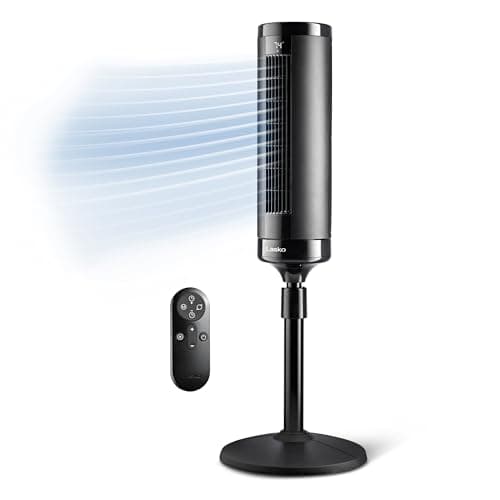 For the hours when the window rule fails Lasko EcoQuiet 42" DC Tower Fan When it is hotter outside than inside, a window fan is actively harmful and this is what you run instead. | Daytime, and any night the outside air stays warm | |
| — | 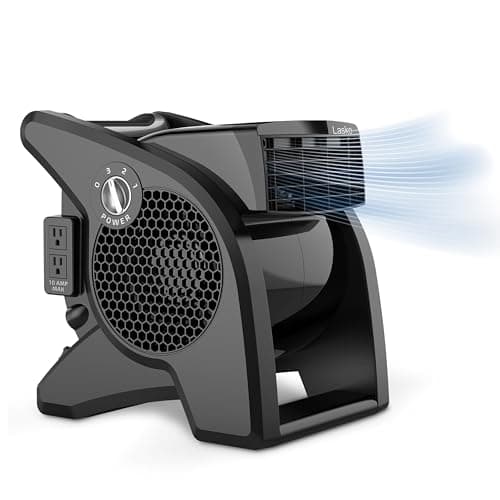 The one to skip in a window Lasko Max Performance 15" Air Mover 178 W of narrow high-velocity blast, which is exactly the wrong airflow shape for filling a window opening. | Drying a basement, not ventilating a house |
Every other fan on this site moves air around a room so that you feel cooler. A window fan is the exception: it exchanges the air in the room for air from outside, so if the outside air is cooler, the temperature of the room genuinely falls.
That makes it the highest-value fan in the house, and it comes with one hard condition.
The rule
Check the thermometer, not the feel
A window fan only helps when the outdoor temperature is actually below the indoor temperature. Run it when it is hotter outside and you are pumping heat into your house as fast as the fan can move it.
This sounds obvious and it is the single most common mistake in no-AC cooling, because evening air feels cool long before it is cool. The sun goes down, the light changes, there is a breeze — and it is still 86°F while your living room is 82°F. Opening up at that point makes things worse.
Get a cheap indoor/outdoor thermometer, or check a weather app against a room thermometer. Wait for the crossover. In a lot of climates that is 9 or 10pm rather than 7pm, and the difference between opening at the right time and the wrong time is several degrees by morning.
Direction
Which way to point it
Exhaust is almost always better than intake, and the reason is that hot air collects at the top of a house.
- Best: exhaust from the highest, hottest window, with another window open low on the opposite side of the house. The fan pulls the hottest air out and cool air is drawn in low to replace it, moving through the whole building on the way. This is the same principle as a whole-house fan at a tiny fraction of the cost.
- Good: one fan in, one out, on opposite walls. Directed cross-flow through the room.
- With a twin fan in a single window: one motor each way. This is the trick that makes twin fans worth their price in a room with only one opening.
- Weakest: blowing in, hoping air finds its way out. It works, but you are pressurizing the room rather than directing anything.
Cost
What each option costs
| Fan | Watts | Published CFM | 30 nights |
|---|---|---|---|
| Lasko W09550 twin window | 31 W | 560 | $1.36 |
| Lasko B20801 box fan | 102 W | Not published | $4.49 |
| Lasko U15720 air mover | 178 W | Not published | $7.83 |
Wattages from Lasko’s product pages; costs are our arithmetic at 18.34¢/kWh.
Compare that with a 1,300 W portable air conditioner at $57 for the same thirty nights. In a climate where the nights genuinely cool, a $1.36 window fan does a large part of the same job.
Say the unwelcome thing
Do not run a window fan while your air conditioner is on.
It happens more than you would think — a window fan in one room and an AC in another, both running overnight. The fan is pulling in outside air that the air conditioner then has to cool and dehumidify, so you are paying the compressor to undo the fan.
Pick one. If the outdoor air is cool enough for the fan, turn the air conditioner off and save the several hundred watts. If it is not, the fan should not be running.
Practical
Five things worth knowing
- Measure the window first. The W09550 fits 24–32 inches. This is the most common reason one gets returned.
- Fill the gaps. Air takes the easiest path, so whatever the fan does not seal, it will simply flow around. Extender panels on a purpose-built fan, or cut foam board around a box fan.
- Insects. A fan in an open window is an open window. Keep the screen in place where you can, and accept a small airflow penalty.
- Rain. Only use a fan with a weather-resistant motor if it stays in overnight, and angle exhaust rather than intake on the weather side.
- Security. A window held open by a fan is not locked. On a ground floor, consider a sash lock that permits partial opening.
And if you find that a window fan makes a real difference to your whole house over an hour or two, that is worth noticing: it is exactly the test for whether a whole-house fan is worth installing.
In full
Every pick, and what is wrong with it
Published specifications only, each linked to the page it came from. Where a manufacturer publishes nothing, the row says so — we do not fill blanks in.
1. Best overall
Lasko Twin Window Fan with Remote
Lasko · model W09550
Two independent motors and a thermostat, at 31 W — the only fan here that can push air both ways through one window.
Two independently controlled motors is the whole reason this exists as a category. Run both outward to exhaust hot air, both inward to pull cool air, or one each way to create a deliberate exchange through a single window — which is genuinely useful in a room with only one opening, and which no box fan can do.
Up to 560 CFM on 22–31 W. The published CFM figure matters: most portable fans publish nothing, so this is one of the few cases where you can see what you are buying. And 31 W is about $1.36 for a month of eight-hour nights at 18.34¢/kWh — less than a third of what a 20-inch box fan costs to do the same job.
The adjustable thermostat is the feature that earns its place overnight. Without it a window fan keeps pulling in outdoor air all night and you wake at 4am in a cold room. Set it and it stops once the room reaches temperature.
12.9 inches high, 24 wide, 4.9 deep, 8 lb, remote included, 1-year warranty. Measure your window before ordering: 24 to 32 inches wide, and the extender panels cover the range.
What’s wrong with it
The 24-32 inch fit range rules out narrow and very wide windows, and there is no way around it. At 8 lb it also has to be lifted in and out each season.
Running cost — W09550
| Nameplate power | 22 W – 31 W | manufacturer's published figure |
|---|---|---|
| Energy, 8-hour night | 0.25 kWh | 31 ÷ 1000 × 8 |
| Cost per hour | 0.6¢ | at 18.34¢/kWh |
| Cost per 8-hour night | 4.5¢ | on the highest speed |
| Cost per 30 nights | $1.36 | 7.4 kWh |
| Same month, lowest speed | 97¢ | at 22 W |
Rate: 18.34¢/kWh, the US average residential price for June 2026 (EIA Electric Power Monthly, Table 5.3). Yours will differ — swap it in: (watts ÷ 1000) × hours × your rate.
| Power | 22 W - 31 W at 120 V |
|---|---|
| Air delivery | Up to 560 CFM |
| Window fit | 24 - 32 in wide |
| Modes | Intake, exhaust or exchange (independent motors) |
| Thermostat | Adjustable |
| Speeds | 3 |
| Dimensions | 12.9 H x 24.0 W x 4.9 D in |
| Weight | 8.0 lb |
| Warranty | 1 year |
Every figure above is from Lasko product page, W09550. Blanks are shown as “not published” rather than filled in.
2. For a window that will not take a proper window fan
Lasko Power Plus 20" Box Fan
Lasko · model B20801
A 4.75-inch depth and a weather-resistant motor make a box fan a serviceable window fan when the fit is wrong.
If your window is 20 inches wide, or 40, a purpose-built twin window fan will not fit. A box fan will sit in almost anything.
The 4.75-inch depth is what makes it work — a sash will close down on top of it — and the weather-resistant motor means it survives sitting in an open window through a season, which an indoor fan will not. The 2-year warranty supports that.
What you lose is the seal. A twin window fan fills the opening with extender panels, so all the air it moves goes through the fan. A box fan leaves gaps around it, and a good part of your exhaust simply loops back in through the same window. You can improve this considerably with a piece of cardboard or foam board cut to fill the gaps, and it is worth ten minutes.
$4.49 a month of nights against $1.36, so use it where the fit demands it, not by default. More on box fans here.
What’s wrong with it
It does not seal the opening, so air simply flows around it and much of your exchange is lost. It also draws 73-102 W against the twin fan's 22-31, for a job the twin fan does better.
Running cost — B20801
| Nameplate power | 73 W – 102 W | manufacturer's published figure |
|---|---|---|
| Energy, 8-hour night | 0.82 kWh | 102 ÷ 1000 × 8 |
| Cost per hour | 1.9¢ | at 18.34¢/kWh |
| Cost per 8-hour night | 15¢ | on the highest speed |
| Cost per 30 nights | $4.49 | 24.5 kWh |
| Same month, lowest speed | $3.21 | at 73 W |
Rate: 18.34¢/kWh, the US average residential price for June 2026 (EIA Electric Power Monthly, Table 5.3). Yours will differ — swap it in: (watts ÷ 1000) × hours × your rate.
| Power | 73 W - 102 W (0.6-0.9 A at 120 V) |
|---|---|
| Speeds | 3 |
| Dimensions | 21.25 H x 22.5 x 4.75 in |
| Weight | 10.1 lb |
| Motor | Weather-resistant |
| Air delivery (CFM) | Not published |
| Warranty | 2 years |
Every figure above is from Lasko product page, B20801. Blanks are shown as “not published” rather than filled in.
3. For the hours when the window rule fails
Lasko EcoQuiet 42" DC Tower Fan
Lasko · model T42710
When it is hotter outside than inside, a window fan is actively harmful and this is what you run instead.
A window fan only works during the hours when the outdoor air is genuinely cooler than the indoor air. In most climates that is evening and overnight, which leaves the entire afternoon — the hottest part of the day — unaddressed.
During those hours the correct move is windows and blinds closed, and a fan on you rather than on the room. At 2.9 to 19 W and 23 dBA on low, this is the cheapest and quietest way to do that: 84¢ for a month of nights at full power.
The two together are the whole strategy in a house without air conditioning: shut everything up and run a fan on yourself by day, open up and exhaust hard once the evening air drops. The full sequence is here.
What’s wrong with it
It does not lower the room temperature at all — it only makes you feel cooler. It is a complement to a window fan, not a replacement for one.
Running cost — T42710
| Nameplate power | 2.9 W – 19 W | manufacturer's published figure |
|---|---|---|
| Energy, 8-hour night | 0.15 kWh | 19 ÷ 1000 × 8 |
| Cost per hour | 0.3¢ | at 18.34¢/kWh |
| Cost per 8-hour night | 2.8¢ | on the highest speed |
| Cost per 30 nights | 84¢ | 4.6 kWh |
| Same month, lowest speed | 13¢ | at 2.9 W |
Rate: 18.34¢/kWh, the US average residential price for June 2026 (EIA Electric Power Monthly, Table 5.3). Yours will differ — swap it in: (watts ÷ 1000) × hours × your rate.
| Power | 2.9 W - 19 W (0.06-0.303 A at 120 V) |
|---|---|
| Noise | 23 dBA low, 46 dBA high |
| Speeds | 12 |
| Height | 41.6 in |
| Footprint | 12.8 x 12.8 in |
| Weight | 7.8 lb |
| Timer | 8 hours |
| Air delivery (CFM) | Not published |
| Warranty | 2 years |
Every figure above is from Lasko product page, T42710. Blanks are shown as “not published” rather than filled in.
Skip this one
Lasko Max Performance 15" Air Mover
Lasko · model U15720
178 W of narrow high-velocity blast, which is exactly the wrong airflow shape for filling a window opening.
Air movers get suggested for window use because they clearly move a lot of air. The problem is the shape of it.
A window fan wants to move a broad, slow volume of air across the whole opening. An air mover produces a narrow, fast jet aimed at a surface. In a window, that jet punches through a small part of the opening while air loops back around it in the other direction — you get noise and very little net exchange.
160–178 W is also six times the twin window fan’s draw: $7.83 against $1.36 over a month of nights.
And it is not weather-rated for sitting in an open window. Use it for what it is — a garage tool.
What’s wrong with it
160-178 W, no published CFM, and a concentrated jet rather than a broad flow. It cannot seal a window and it is not built to sit in one.
Running cost — U15720
| Nameplate power | 160 W – 178 W | manufacturer's published figure |
|---|---|---|
| Energy, 8-hour night | 1.42 kWh | 178 ÷ 1000 × 8 |
| Cost per hour | 3.3¢ | at 18.34¢/kWh |
| Cost per 8-hour night | 26¢ | on the highest speed |
| Cost per 30 nights | $7.83 | 42.7 kWh |
| Same month, lowest speed | $7.04 | at 160 W |
Rate: 18.34¢/kWh, the US average residential price for June 2026 (EIA Electric Power Monthly, Table 5.3). Yours will differ — swap it in: (watts ÷ 1000) × hours × your rate.
| Power | 160 W - 178 W (1.35-1.53 A at 120 V) |
|---|---|
| Speeds | 3 |
| Dimensions | 14.5 H x 14.0 D x 11.5 W in |
| Weight | 12.55 lb |
| Extras | Two 120 V accessory outlets, 9.5 ft cord, pivoting head |
| Air delivery (CFM) | Not published |
| Warranty | 1 year |
Every figure above is from Lasko product page, U15720. Blanks are shown as “not published” rather than filled in.
We are not linking a buy button for this one. If you want to look at it anyway, it is easy enough to find — but we would rather send you to something that fits your room.
Questions people actually ask
Frequently asked
What is the best window fan?
The Lasko W09550 twin window fan on published specifications: 22 to 31 W, up to 560 CFM, two independently controlled motors so you can run intake and exhaust simultaneously, and an adjustable thermostat. It fits windows 24 to 32 inches wide.
Should a window fan blow in or out?
Out, from the highest and hottest window, with another window open low on the opposite side of the house for intake. Hot air collects high, so exhausting there pulls cool air in low and drags it through the whole building.
When should I run a window fan?
Only once the outdoor temperature is genuinely below your indoor temperature — check a thermometer rather than going by feel. Evening air feels cool long before it is cool, and running a window fan while it is hotter outside pumps heat into the house.
How much electricity does a window fan use?
A twin window fan draws about 22 to 31 W, which is roughly 4.5¢ for an eight-hour night and $1.36 for thirty of them at 18.34¢/kWh. A 20-inch box fan used in the same window draws 73 to 102 W.
Can I use a box fan as a window fan?
Yes, and a weather-resistant model with a slim depth works well. What you lose is the seal — a box fan leaves gaps around the opening and a good part of your exhaust loops straight back in. Cutting foam board to fill the gaps recovers most of that.
Is a window fan better than an air conditioner?
Cheaper by two orders of magnitude — about $1.36 a month against $57 for a large portable — but it can only ever bring your room toward the outdoor temperature. When the night air is cool it does much of the same job. When it is not, it cannot help at all.
Sources
Where these numbers came from
Read next
Where to go from here
Back to Fans, or read how we pick.