The picks
The best exhaust fans for a bathroom with no window
A bathroom with a window has a backup. One without has a fan, and that changes which fan you should buy.
By Sawyer V. · Published
The short answer
Buy multi-speed and run it low continuously rather than high in bursts. Across 351 certified multi-speed fans, 71.8% move air more efficiently below full speed — median gain 23.9%. The leader does 18.4 CFM per watt at its middle speed against 16.7 on high, at 0.1 sones, which is quiet enough to leave running.
Fan & Frost earns a commission when you buy through our links, at no cost to you. It never changes a ranking, and we say so when the right answer is the cheaper unit or nothing at all. Full disclosure · How we pick.
At a glance
The picks, ranked
Tap any row to jump to the full reasoning. Prices are live from Amazon where we have them, and read “check price” where we don’t — never a number we cannot verify today.
| # | Product | Best for | Price |
|---|---|---|---|
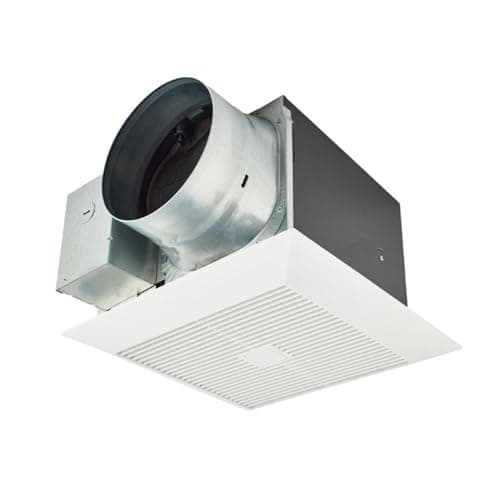
| 1 | Best overall Panasonic WhisperGreen Select FV-0511VK3 Ventilation Fan 110 CFM at 0.1 sones, and 18.4 CFM per watt at its middle speed — more efficient below full tilt, which is how you should run it. | A windowless bathroom where the fan is the only ventilation | |
| 2 | 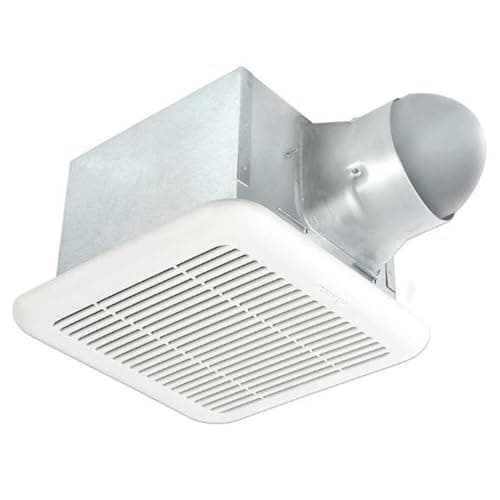 Best two-speed Delta BreezSignature SIG80-110 Ventilation Fan 0.1 sones with 15.4 CFM per watt at 80 CFM and 15.3 at 110 — field-selectable between the two. | A simpler installation with a set-and-forget low rate | |
| 3 | Most speed range Broan-NuTone PREMIUM PTE511RK Ventilation Fan 110 / 50 / 40 CFM across three speeds, from 0.1 sones — the widest turndown here. | A bathroom where you want a very low background rate | |
| — | 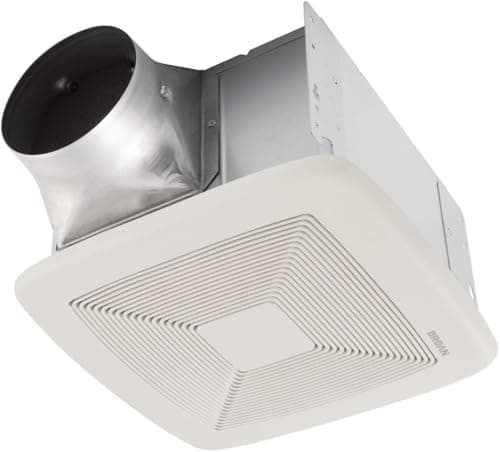 More air than this room needs Broan-NuTone Premium Ventilation Fan 154.4 CFM at 14.2 CFM per watt — but 1.4 sones is fourteen times the quietest units here. | A large bathroom or a utility room, not a small windowless one |
A bathroom with an openable window has two ways to get rid of moisture. One without has a fan, and that raises the stakes on which fan.
The difference
The fan is not a helper, it is the system
In a bathroom with a window, the extract fan handles the shower and the window handles everything the fan missed. Forget to switch it on and the room still dries out eventually.
In a windowless bathroom there is no second route. Every gram of water vapor that leaves the room does so through that duct, and anything that does not leave condenses on the coldest surface available.
Three consequences follow:
- Quiet matters more than airflow. A fan you can hear is a fan that gets switched off, and in this room that is the failure.
- Continuous beats burst. A low background rate running all day removes more total moisture than a high rate for twenty minutes.
- The duct route matters. There is no backup if it is blocked, crushed or terminating in a loft.
The finding
Most fans are more efficient below full speed
This is the analysis that makes the continuous-low strategy financially obvious rather than merely sensible.
Across 351 certified multi-speed bathroom and utility fans, 71.8% move air more efficiently below full speed. The median gain is 23.9% and the maximum we found is 81.4%.
So running a multi-speed fan on high is usually the least efficient way to use it — you get more air, and you get proportionally less air per watt.
| Fan | High | Medium | Low | Sones |
|---|---|---|---|---|
| Panasonic FV-0511VK3 | 16.7 (110 CFM) | 18.4 (80 CFM) | 14.7 (50 CFM) | 0.1 |
| Delta SIG80-110 | 15.3 (110 CFM) | 15.4 (80 CFM) | — | 0.1 |
| Broan PTE511RK | 14.5 (110 CFM) | 10.9 (50 CFM) | 9.8 (40 CFM) | 0.1 - 0.3 |
| Ortech ODD-70-1 | 16.7 (75 CFM) | single speed | — | 0.4 |
The Panasonic is the pattern: peak efficacy at the middle speed, which is exactly the setting a windowless bathroom wants to run at all day.
The Broan is the exception that proves checking matters — its efficacy falls with speed. It is still a reasonable buy for a different reason: its 40 CFM low is the gentlest continuous rate here.
The cost
Continuous running is cheaper than people assume
The instinctive objection to leaving a fan on is the bill. At these efficacies the objection does not survive the arithmetic.
A certified fan at 18.4 CFM per watt moving 80 CFM draws about 4.3 W. Running continuously that is roughly 1.9¢ a day, or about 57¢ a month at 18.34¢/kWh.
For comparison, a certified dehumidifier treating the same moisture problem runs 283 kWh a year and up, and it condenses the water back into a tank in the same room rather than removing it from the building.
Extraction at source is the cheapest moisture control available, and in a windowless bathroom it is also the only one.
The duct
The part that actually fails
A perfect fan on a bad duct moves very little air, and in this room there is nothing to compensate.
- It must terminate outdoors. A duct ending in a loft or a wall cavity moves the moisture from a room where you can see it to a structure where you cannot.
- Short and straight. Every bend and every foot of flexible duct costs airflow. The certified figures are measured at 0.25 inches of water gauge; a poor route exceeds that.
- Rigid beats flexible where the route allows, and properly stretched beats concertinaed where it does not.
- Insulate a duct running through cold space, or the moist air condenses inside it and runs back.
- Check the exterior flap opens. The same check as a dryer vent, and the same common failure.
- Match the duct size to the fan. Reducing a 6-inch outlet to 4-inch duct throttles it.
This one is not a DIY job
A windowless bathroom is a code matter, not just a comfort one. Most jurisdictions require mechanical ventilation where there is no openable window, and many specify a minimum airflow rate, a duct termination location, and sometimes continuous or humidity-controlled operation.
The requirements vary by jurisdiction and by whether the work is new, a replacement or part of a renovation. Check locally rather than relying on any general guide including this one.
Installing a fan involves ceiling work, an electrical connection and a duct route, frequently through insulated or fire-rated construction. That is a job for qualified trades.
Persistent mold in a windowless bathroom despite a working fan points at a building issue, and health effects of mold are a matter for a medical professional.
Controls
What to put on the wall
- A timer keeps the fan running after the light goes off, which is when most of the moisture is still in the room. The single most useful control.
- A humidistat runs the fan on rising humidity regardless of the light, which suits a windowless room well.
- A continuous trickle with a boost is the strongest arrangement: low all day, high while the shower runs. It is what the multi-speed finding above is built for.
- Not a plain light switch alone. Tying the fan to the light means it stops the moment the room empties, which is the moment it was most needed.
Say the unwelcome thing
Do not buy the loudest, highest-airflow fan for a windowless bathroom.
It is the intuitive move — no window, so maximize extraction — and it produces a fan nobody leaves running.
Sones are linear. A 1.4 sone fan is genuinely fourteen times as loud as a 0.1 sone one, and in a small hard-surfaced room that is the difference between background and intrusive. A fan that gets switched off is no ventilation at all, and in this room there is no backup.
The certified data also argues against running hard: 71.8% of 351 multi-speed fans are more efficient below full speed, median gain 23.9%. Low and continuous removes more total moisture than high and brief.
Buy quiet and multi-speed: 18.4 CFM per watt at 0.1 sones or 15.4 CFM per watt, field-selectable.
In full
Every pick, and what is wrong with it
Published specifications only, each linked to the page it came from. Where a manufacturer publishes nothing, the row says so — we do not fill blanks in.
1. Best overall
Panasonic WhisperGreen Select FV-0511VK3 Ventilation Fan
Panasonic · model FV-0511VK3
110 CFM at 0.1 sones, and 18.4 CFM per watt at its middle speed — more efficient below full tilt, which is how you should run it.
The best machine in the category for exactly this room, because its efficiency peak is where a windowless bathroom wants to live.
18.4 CFM per watt at 80 CFM on its middle speed, against 16.7 at 110 CFM on high. Running it continuously at the middle setting is both quieter and more efficient than cycling it hard.
0.1 sones — the floor of the measurement scale. Continuous running is only realistic if you cannot hear it, and this is the quietest tier certified.
Three or more speeds and Most Efficient certified, which only 80 of 912 certified fans reach. At this efficacy the running cost is a fraction of a cent an hour.
What’s wrong with it
It is a ducted installation, and 6-inch duct is a real route to build.
Running cost
Panasonic does not publish a wattage for the FV-0511VK3, so we cannot calculate what it costs to run. We are not going to estimate one. If Panasonic publishes a nameplate figure, this block will show the arithmetic.
| Noise | 0.1 sones |
|---|---|
| Air delivery, high | 110 CFM at 0.25 in w.g. |
| Air delivery, medium | 80 CFM |
| Air delivery, low | 50 CFM |
| Efficacy, high | 16.7 CFM per watt |
| Efficacy, medium | 18.4 CFM per watt |
| Efficacy, low | 14.7 CFM per watt |
| Duct size | 6 in diameter |
| Speeds | 3 or more |
| Lighting | None |
| Power | Not published in the certified dataset |
| ENERGY STAR | Certified, and on the Most Efficient list |
Every figure above is from ENERGY STAR Certified Ventilating Fans dataset. Blanks are shown as “not published” rather than filled in.
2. Best two-speed
Delta BreezSignature SIG80-110 Ventilation Fan
Delta · model SIG80-110
0.1 sones with 15.4 CFM per watt at 80 CFM and 15.3 at 110 — field-selectable between the two.
An unusual and useful case: this fan is almost equally efficient at both speeds, which makes the choice about airflow rather than about a trade.
15.4 CFM per watt at 80 CFM and 15.3 at 110. Most multi-speed fans give up efficiency at full tilt; this one barely does.
0.1 sones, the quietest tier, with the speed field-selectable at installation rather than switched by the user.
Most Efficient certified, 6-inch duct, no lighting. Set it at 80 CFM for a small windowless bathroom and leave it.
What’s wrong with it
Only two speeds, so less scope to tune the continuous rate.
Running cost
Delta does not publish a wattage for the SIG80-110, so we cannot calculate what it costs to run. We are not going to estimate one. If Delta publishes a nameplate figure, this block will show the arithmetic.
| Noise | 0.1 sones |
|---|---|
| Air delivery, high | 110 CFM at 0.25 in w.g. |
| Air delivery, low | 80 CFM |
| Efficacy, high | 15.3 CFM per watt |
| Efficacy, low | 15.4 CFM per watt |
| Duct size | 6 in diameter |
| Speeds | 2, field-selectable |
| Lighting | None |
| Power | Not published in the certified dataset |
| ENERGY STAR | Certified, and on the Most Efficient list |
Every figure above is from ENERGY STAR Certified Ventilating Fans dataset. Blanks are shown as “not published” rather than filled in.
3. Most speed range
Broan-NuTone PREMIUM PTE511RK Ventilation Fan
Broan-NuTone · model PTE511RK
110 / 50 / 40 CFM across three speeds, from 0.1 sones — the widest turndown here.
The counter-example to the general rule, and a useful reminder to check the figures rather than assume.
14.5 CFM per watt on high, 10.9 medium, 9.8 low. This fan gets less efficient as it slows — the opposite of the Panasonic, and against the 71.8% majority.
What it offers instead is turndown range: 40 CFM at the bottom, which is a genuine trickle rate for continuous background ventilation in a small room.
0.1 to 0.3 sones and Most Efficient certified. If your priority is the lowest possible continuous airflow rather than the best efficacy, this is the pick.
What’s wrong with it
Efficacy falls sharply at low speed: 14.5 CFM per watt on high but 9.8 on low.
Running cost
Broan-NuTone does not publish a wattage for the PTE511RK, so we cannot calculate what it costs to run. We are not going to estimate one. If Broan-NuTone publishes a nameplate figure, this block will show the arithmetic.
| Noise | 0.1 - 0.3 sones |
|---|---|
| Air delivery, high | 110 CFM at 0.25 in w.g. |
| Air delivery, medium | 50 CFM |
| Air delivery, low | 40 CFM |
| Efficacy, high | 14.5 CFM per watt |
| Efficacy, medium | 10.9 CFM per watt |
| Efficacy, low | 9.8 CFM per watt |
| Duct size | 6 in diameter |
| Speeds | 3 or more |
| Lighting | None |
| Power | Not published in the certified dataset |
| ENERGY STAR | Certified, and on the Most Efficient list |
Every figure above is from ENERGY STAR Certified Ventilating Fans dataset. Blanks are shown as “not published” rather than filled in.
Skip this one
Broan-NuTone Premium Ventilation Fan
Broan-NuTone · model PREMIUM series
154.4 CFM at 14.2 CFM per watt — but 1.4 sones is fourteen times the quietest units here.
A good fan, flagged because airflow is the wrong thing to optimize for a windowless bathroom.
1.4 sones against 0.1 for the units above. Sones are linear, so that is genuinely fourteen times the perceived loudness — why sones and decibels are not interchangeable.
A fan you can hear is a fan you switch off. In a room whose only ventilation is that fan, switching it off is the failure mode.
154.4 CFM at 14.2 CFM per watt and a single speed. In a large bathroom or a utility room with a window, the airflow earns its place.
What’s wrong with it
At 1.4 sones you will not leave it running, which defeats the strategy for this room.
Running cost
Broan-NuTone does not publish a wattage for the PREMIUM series, so we cannot calculate what it costs to run. We are not going to estimate one. If Broan-NuTone publishes a nameplate figure, this block will show the arithmetic.
| Air delivery | 154.4 CFM at 0.25 in w.g. |
|---|---|
| Efficacy | 14.2 CFM per watt |
| Noise | 1.4 sones |
| Duct size | 6 in diameter |
| Unit type | Ceiling-mounted, bathroom/utility room |
| Power | Not published in the certified dataset |
| ENERGY STAR | Certified |
Every figure above is from ENERGY STAR Certified Ventilating Fans dataset. Blanks are shown as “not published” rather than filled in.
We are not linking a buy button for this one. If you want to look at it anyway, it is easy enough to find — but we would rather send you to something that fits your room.
Questions people actually ask
Frequently asked
What size exhaust fan for a bathroom with no window?
Airflow matters less than quiet and continuous operation here. 80 to 110 CFM covers most domestic bathrooms, and a multi-speed fan run at a low continuous rate removes more total moisture than a high rate in twenty-minute bursts.
Should a windowless bathroom fan run continuously?
It is the strongest arrangement — a low trickle all day with a boost while the shower runs. The certified data supports it: 71.8% of 351 multi-speed fans are more efficient below full speed, with a median gain of 23.9%.
How much does it cost to run a bathroom fan continuously?
Very little. A certified fan at 18.4 CFM per watt moving 80 CFM draws about 4.3 W — roughly 1.9¢ a day or 57¢ a month at 18.34¢/kWh. That is cheaper than any dehumidifier treating the same moisture.
Does a windowless bathroom legally need a fan?
Most jurisdictions require mechanical ventilation where there is no openable window, and many specify a minimum airflow rate, a duct termination location and sometimes continuous or humidity-controlled operation. Requirements vary — check locally.
Why does my bathroom still get damp with the fan running?
Usually the duct. It must terminate outdoors rather than in a loft or wall cavity, be short and straight, be insulated where it passes through cold space, and have an exterior flap that actually opens. Reducing a 6-inch outlet to 4-inch duct also throttles it badly. Maintenance and airflow.
Should the fan be wired to the light switch?
Not on its own. That stops the fan the moment the room empties, which is when most of the moisture is still airborne. A timer that overruns the light, or a humidistat that responds to rising humidity, is far better in a windowless room.
Sources
Where these numbers came from
Read next
Where to go from here
Back to Whole-House Airflow, or read how we pick.