The picks
The best fans for drying laundry indoors
A fan is the cheapest half of drying washing indoors and the half people skip. It will not take a single gram of water out of your house, and it will still halve the time.
By Sawyer V. · Published
The short answer
Use the Air King 9723 box fan, stood on the floor and aimed through the airer — 2,163 CFM on 105 W, published, at 20.6 CFM per watt, and an eight-hour night on low costs 9.5¢ at 18.34¢/kWh. Understand what it does, though: a fan removes no water from the house. It strips the saturated air off the fabric so evaporation can continue, and something else — a dehumidifier or an open window — has to take the water away.
Fan & Frost earns a commission when you buy through our links, at no cost to you. It never changes a ranking, and we say so when the right answer is the cheaper unit or nothing at all. Full disclosure · How we pick.
At a glance
The picks, ranked
Tap any row to jump to the full reasoning. Prices are live from Amazon where we have them, and read “check price” where we don’t — never a number we cannot verify today.
| # | Product | Best for | Price |
|---|---|---|---|
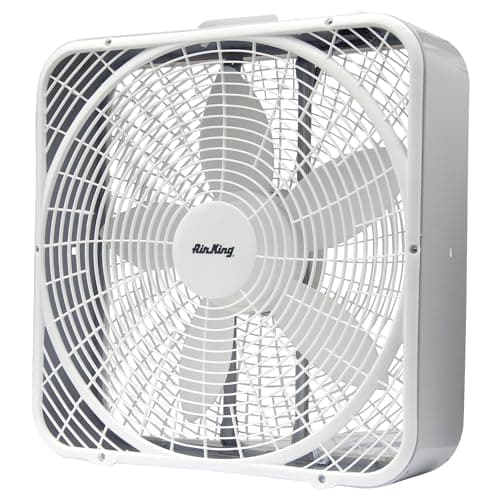
| 1 | Best overall Air King 9723 20" Commercial Grade Box Fan 2,163 / 1,900 / 1,463 CFM on 105 / 87 / 65 W, at 20.6 CFM per watt. A 20-inch square of moving air is exactly the shape of a clothes airer. | A full airer in a utility room, spare room or bathroom — a flat wall of air the width of the rack, from the only box fan with a complete published spec table | |
| 2 | 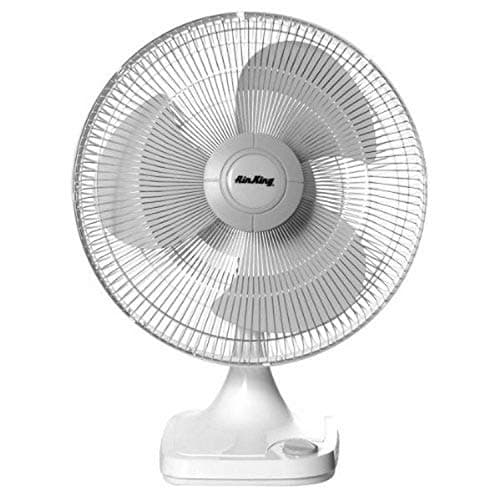 Best for a small or shared room Air King 9106 16" Commercial Grade Oscillating Table Fan 1,710 CFM on 77 W, our arithmetic 22.2 CFM per watt — a better efficiency figure than the box fan, from a head you can aim down into the rack. | An airer in a bedroom or a cramped utility room — a 16-inch oscillating head on a table or shelf, up out of the way of the wet floor | |
| 3 | 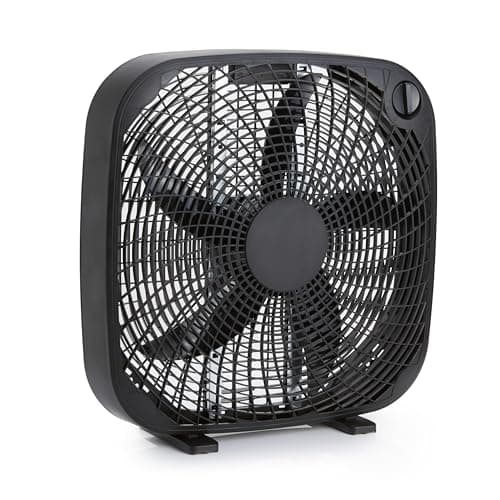 Cheapest that does the job Amazon Basics 20" 3-Speed Box Fan 67 W published, 20-inch five-blade box fan, carry handle. The same geometry as the top pick for a fraction of the money, with no airflow figure behind it. | Anyone who wants the box-fan shape and does not need to know what it moves — the lowest-cost way to get a flat wall of air at an airer | |
| — | 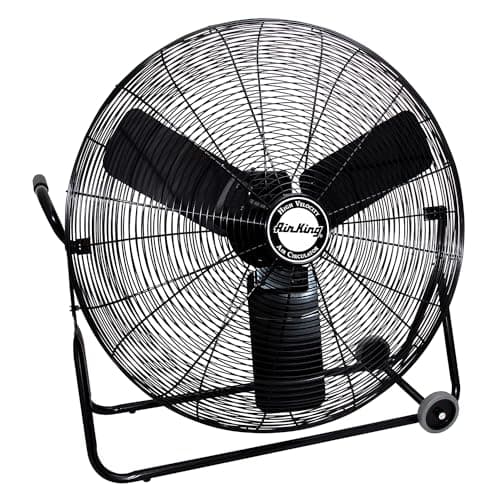 The one to skip Air King 9230 30" Industrial Grade Pivoting Drum Fan 7,400 CFM on 255 W at 75 dB. The most efficient fan in our registry at 29.0 CFM per watt, and three times too much fan for a rack of shirts. | A flooded basement or a building site, not a clothes airer — this is a water-damage air mover and the specification says so |
There is a specific reason a fan speeds up drying, and knowing it tells you where to point the fan. Wet fabric is wrapped in a thin layer of air that evaporation has already saturated. Until that layer moves, nothing more can evaporate — the clothes are at equilibrium with the millimeter of air touching them, not with the room.
A fan strips that layer away and replaces it with drier room air. That is all it does, and it is the cheapest intervention available: the fan adds no heat worth counting and removes no water at all.
Criteria
How these are judged, in order
- Published CFM, and CFM per watt. There is no mandatory airflow test for portable fans in the United States, so a published figure is a voluntary commitment. Two of these four publish one; we say so plainly for the two that do not.
- The shape of the air it makes. An airer is a flat rectangle. A fan whose output matches that rectangle does more useful work per watt than a stronger fan pointed at a corner of it, which is why a box fan beats a more powerful oscillating one here.
- Published noise. This is an overnight job indoors, so noise is a primary criterion rather than a footnote — and only one fan on this page publishes a decibel figure at all.
- Cost of a long run. Drying is hours, not minutes. We publish what eight hours and a month of nights cost at 18.34¢/kWh, from the manufacturer’s own wattage.
- Whether it will knock the washing off. Unglamorous and decisive: above a few thousand CFM at close range, light garments end up on the floor.
We have tested none of these. Every figure is the manufacturer’s own, with our arithmetic marked as ours. How we pick.
The numbers
Published airflow, and what a night costs
| Fan | CFM, low | W, low | CFM/W | 8 hours | Noise |
|---|---|---|---|---|---|
| Air King 9723 box | 1,463 | 65 | 22.5 | 9.5¢ | Not published |
| Air King 9106 table | 1,330 | 57 | 23.3 | 8.4¢ | Not published |
| Amazon Basics box | Not published | 67 | Not calculable | 9.8¢ | Not published |
| Air King 9230 drum | 4,980 | 154 | 32.3 | 23¢ | 67 dB |
Lowest-speed figures, because that is the setting to dry on. CFM and wattage are the manufacturers’ own; CFM per watt and the eight-hour cost are our arithmetic at 18.34¢/kWh. The Amazon Basics fan publishes no airflow, so no efficiency can be computed for it.
The whole column of eight-hour costs is the argument for using a fan at all. Three of the four run a full night for under fifteen cents. Nothing else you can add to an airer is that cheap.
The limit
What the fan cannot do
A fan moves the water from the clothes into the room faster. It does not move it out of the building. If the room is closed and undrained, a fan simply gets you to a saturated room sooner — at which point drying stops, because the air has nowhere left to put the moisture.
So the fan needs a partner, and there are three honest options:
- A dehumidifier in the same room. The pairing that actually works, and the one we would use. The fan does the evaporation, the dehumidifier does the removal, at about 9 cents a liter on an efficient machine. Dehumidifiers for laundry.
- An open window, in mild weather. Free and effective when the outdoor air is drier than the room, which in autumn and spring it often is. In a cold snap it costs you the heating.
- An extractor fan ducted outside. If the airer is in a bathroom or utility room with one, run it — it removes the water rather than circulating it. How long it needs to run.
What does not work is a fan in a closed cold room on its own. The EPA is direct about where that water goes: “Mold is frequently found on walls in cold corners behind furniture where condensation forms.”
This one is not a DIY job
Point it through the rack, from the end, on low. Three practical details that matter more than the choice of fan. Through the narrow end of the airer the air passes every garment in series instead of hitting the front row and spilling around it. Low speed because evaporation is limited by air exchange at the fabric rather than by wind speed, and low is quieter and cheaper. And leave gaps between garments — two shirts touching dry as one thick one.
Buying
How to choose
- Match the fan’s shape to the airer, not its CFM. A 20-inch box fan covers a standard rack. More airflow aimed at one corner is wasted.
- Buy on published noise if the room is lived in. Only the drum fan here publishes a figure, and it publishes a bad one. What fan decibel figures mean.
- Plan to run it on low. Every efficiency figure on this page is better on low than on high, and the job is hours long.
- Pair it with something that removes water. The fan is half the system; on its own in a closed room it just relocates the problem onto the windows.
Say the unwelcome thing
Do not dry laundry over a fan heater or an electric radiator to speed it up.
Heating the room lets the air carry more water, which looks like progress while the heat is on. When the room cools overnight that water comes back out of the air onto the coldest surfaces in it — the glass, the window reveals, the corner behind the wardrobe. Heat moves the problem in time rather than solving it, at several hundred watts instead of sixty.
Draping washing directly on a heater or radiator is a separate and worse idea: it blocks the airflow the appliance needs, and manufacturers prohibit it for exactly that reason.
In full
Every pick, and what is wrong with it
Published specifications only, each linked to the page it came from. Where a manufacturer publishes nothing, the row says so — we do not fill blanks in.
1. Best overall
Air King 9723 20" Commercial Grade Box Fan
Air King · model 9723
2,163 / 1,900 / 1,463 CFM on 105 / 87 / 65 W, at 20.6 CFM per watt. A 20-inch square of moving air is exactly the shape of a clothes airer.
2,163 / 1,900 / 1,463 CFM on 105 / 87 / 65 W at 1,220 / 1,075 / 855 RPM. That complete table is rare in portable fans, and our arithmetic on it gives 20.6 CFM per watt on high and 22.5 on low.
The reason a box fan specifically suits this job is geometry rather than airflow. A clothes airer is a flat rectangle about the size of a box fan’s grille, so a box fan on the floor pushes air through the whole rack instead of sweeping across one corner of it. An oscillating fan spends most of its cycle pointed somewhere else.
Low is the setting to use, and the cost is why. Eight hours at 65 W is 9.5¢; a month of eight-hour nights is $2.86. Against the roughly 9 cents a liter a dehumidifier charges, the fan is a rounding error that shortens the whole job.
1/25 HP permanently lubricated motor in a steel body, rated for dusty air and long duty cycles, which is the right specification for something you leave on all night in a damp room.
What’s wrong with it
Air King publishes no decibel figure for it, which matters if the airer shares a room with a bed. At 6.38 inches deep it is also too thick to sit in a sash window, so it cannot double as your ventilation.
Running cost — 9723
| Nameplate power | 65 W – 105 W | manufacturer's published figure |
|---|---|---|
| Energy, 8-hour night | 0.84 kWh | 105 ÷ 1000 × 8 |
| Cost per hour | 1.9¢ | at 18.34¢/kWh |
| Cost per 8-hour night | 15¢ | on the highest speed |
| Cost per 30 nights | $4.62 | 25.2 kWh |
| Same month, lowest speed | $2.86 | at 65 W |
Rate: 18.34¢/kWh, the US average residential price for June 2026 (EIA Electric Power Monthly, Table 5.3). Yours will differ — swap it in: (watts ÷ 1000) × hours × your rate.
| Air delivery | 2,163 / 1,900 / 1,463 CFM (high / medium / low) |
|---|---|
| Power | 105 / 87 / 65 W (0.94 / 0.72 / 0.56 A) |
| Efficiency | 20.6 CFM per watt on high, 22.5 on low (our arithmetic) |
| Blade speed | 1,220 / 1,075 / 855 RPM |
| Blade | 20 in |
| Speeds | 3 |
| Motor | 1/25 HP, 120 V, 1 phase |
| Dimensions | 21.38 W x 6.38 D x 22.5 H in |
| Weight | 11.4 lb |
| Oscillation | No |
| Noise | Not published |
Every figure above is from Air King commercial box fan product page, model 9723. Blanks are shown as “not published” rather than filled in.
2. Best for a small or shared room
Air King 9106 16" Commercial Grade Oscillating Table Fan
Air King · model 9106 (sold at retail as 3151G)
1,710 CFM on 77 W, our arithmetic 22.2 CFM per watt — a better efficiency figure than the box fan, from a head you can aim down into the rack.
1,710 / 1,500 / 1,330 CFM on 77 / 65 / 57 W, with blade speeds published at all three settings. 22.2 CFM per watt on high, 23.3 on low by our arithmetic — the best efficiency figure on this page.
Its advantage over the box fan is placement. At 9.2 lb and 18 inches wide it sits on a table, a shelf or a worktop and aims down through the top of the airer, which keeps it off a floor that is probably getting drips and out of the way in a small room.
An eight-hour night on low is 57 W, or 8.4¢ at 18.34¢/kWh. Over a month of nights, $2.51.
Turn the oscillation off. It is the right feature for cooling people and the wrong one for drying fabric — evaporation wants a constant stripping of the saturated layer at one place, not a visit every few seconds.
What’s wrong with it
Oscillation is a real drawback here rather than a feature: a sweeping head leaves most of the airer in still air most of the time. No decibel figure is published for it either.
Running cost — 9106 (sold at retail as 3151G)
| Nameplate power | 57 W – 77 W | manufacturer's published figure |
|---|---|---|
| Energy, 8-hour night | 0.62 kWh | 77 ÷ 1000 × 8 |
| Cost per hour | 1.4¢ | at 18.34¢/kWh |
| Cost per 8-hour night | 11¢ | on the highest speed |
| Cost per 30 nights | $3.39 | 18.5 kWh |
| Same month, lowest speed | $2.51 | at 57 W |
Rate: 18.34¢/kWh, the US average residential price for June 2026 (EIA Electric Power Monthly, Table 5.3). Yours will differ — swap it in: (watts ÷ 1000) × hours × your rate.
| Air delivery | 1,710 / 1,500 / 1,330 CFM (high / medium / low) |
|---|---|
| Power | 77 / 65 / 57 W (0.71 / 0.54 / 0.48 A) |
| Efficiency | 22.2 CFM per watt on high, 23.3 on low (our arithmetic) |
| Blade speed | 1,545 / 1,394 / 1,244 RPM |
| Blade | 16 in |
| Speeds | 3 |
| Oscillation | Yes |
| Dimensions | 18 W x 10.75 D x 24.38 H in |
| Weight | 9.2 lb |
| Noise | Not published |
Every figure above is from Air King commercial grade table fan product page, model 9106. Blanks are shown as “not published” rather than filled in.
3. Cheapest that does the job
Amazon Basics 20" 3-Speed Box Fan
Amazon Basics · model 20-inch 3-speed box fan
67 W published, 20-inch five-blade box fan, carry handle. The same geometry as the top pick for a fraction of the money, with no airflow figure behind it.
67 W published, a 20-inch five-blade box fan, 20.86 by 21.33 inches with a carry handle. Amazon is the manufacturer here, so the listing is the manufacturer’s own publication — and it publishes one number.
What is missing is everything that would let you compare it: no CFM, no blade speed, no decibel rating, and no statement of which of its three speeds the 67 W applies to. We will not estimate a CFM figure for it, and nor should a listing that quotes one.
What it does have is the right shape and a known draw. Eight hours at 67 W is 9.8¢; a month of nights is $2.95 — within pennies of the Air King on low, from a fan that costs a fraction as much to buy.
For this specific job that trade is defensible in a way it would not be for a cooling fan. You are using it as a stirrer rather than for measured air delivery, and the effect is visible in how fast the washing dries. The two box fans head to head.
What’s wrong with it
No CFM, no blade speed and no noise figure is published, so its efficiency cannot be calculated at all — the only number is the 67 W draw, and even that does not say at which speed.
Running cost — 20-inch 3-speed box fan
| Nameplate power | 67 W | manufacturer's published figure |
|---|---|---|
| Energy, 8-hour night | 0.54 kWh | 67 ÷ 1000 × 8 |
| Cost per hour | 1.2¢ | at 18.34¢/kWh |
| Cost per 8-hour night | 9.8¢ | on the highest speed |
| Cost per 30 nights | $2.95 | 16.1 kWh |
Rate: 18.34¢/kWh, the US average residential price for June 2026 (EIA Electric Power Monthly, Table 5.3). Yours will differ — swap it in: (watts ÷ 1000) × hours × your rate.
| Power | 67 W (speed not specified) |
|---|---|
| Speeds | 3 |
| Blade | 20 in, 5 blades |
| Dimensions | 20.86 W x 6.8 D x 21.33 H in |
| Handle | Carry handle |
| Air delivery (CFM) | Not published |
| Blade speed | Not published |
| Noise | Not published |
| Warranty | Not published on the listing |
Every figure above is from Amazon Basics product listing, 20-inch 3-speed box fan. Blanks are shown as “not published” rather than filled in.
Skip this one
Air King 9230 30" Industrial Grade Pivoting Drum Fan
Air King · model 9230
7,400 CFM on 255 W at 75 dB. The most efficient fan in our registry at 29.0 CFM per watt, and three times too much fan for a rack of shirts.
On paper it looks like the obvious winner. 7,400 / 6,360 / 4,980 CFM on 255 / 200 / 154 W, or 29.0 CFM per watt on high and 32.3 on low — the best efficiency figures of any fan in our registry, and it is one of the very few fans with a published decibel rating at every speed.
That rating is the problem. 75 / 71 / 67 dB. Drying laundry is an overnight job in a room inside your home, and 67 dB on the quietest setting is not a thing you sleep near or hold a conversation over.
It is also the wrong physical object. 48.3 lb, 35.5 inches tall and 33.75 wide, on a pivoting industrial frame. And at 4,980 CFM on low it does not dry a light cotton shirt so much as relocate it.
Drum fans are genuinely excellent at the job they were built for, which is drying a structure after water damage rather than drying clothes. What drum fans are properly for.
What’s wrong with it
75 dB is the loudest published figure on this site and the fan weighs 48.3 lb. Pointed at an airer it also blows lightweight washing straight onto the floor, which is a practical rather than a theoretical problem.
Running cost — 9230
| Nameplate power | 154 W – 255 W | manufacturer's published figure |
|---|---|---|
| Energy, 8-hour night | 2.04 kWh | 255 ÷ 1000 × 8 |
| Cost per hour | 4.7¢ | at 18.34¢/kWh |
| Cost per 8-hour night | 37¢ | on the highest speed |
| Cost per 30 nights | $11 | 61.2 kWh |
| Same month, lowest speed | $6.78 | at 154 W |
Rate: 18.34¢/kWh, the US average residential price for June 2026 (EIA Electric Power Monthly, Table 5.3). Yours will differ — swap it in: (watts ÷ 1000) × hours × your rate.
| Air delivery | 7,400 / 6,360 / 4,980 CFM (high / medium / low) |
|---|---|
| Power | 255 / 200 / 154 W (2.4 / 1.9 / 1.5 A) |
| Efficiency | 29.0 CFM per watt on high, 32.3 on low (our arithmetic) |
| Noise | 75 / 71 / 67 dB (high / medium / low) |
| Blade speed | 1,040 / 902 / 860 RPM |
| Blade | 30 in |
| Motor | 1/4 HP, 120 V, 1 phase, totally enclosed, ball bearing |
| Speeds | 3 |
| Head | Pivoting |
| Dimensions | 33.75 W x 12.25 D x 35.5 H in |
| Weight | 48.3 lb |
| Cord | 10 ft, 3-conductor SJT |
| Listing | ETL listed, OSHA compliant |
Every figure above is from Air King industrial grade floor fan product page, model 9230. Blanks are shown as “not published” rather than filled in.
We are not linking a buy button for this one. If you want to look at it anyway, it is easy enough to find — but we would rather send you to something that fits your room.
Questions people actually ask
Frequently asked
Does a fan help dry clothes indoors?
Yes, substantially, and for pennies. Wet fabric sits inside a thin saturated layer of air, and evaporation stalls until that layer is replaced — a fan does exactly that. It removes no water from the house, so it needs pairing with a dehumidifier, an open window or an extractor fan that does.
What is the best fan for drying clothes?
A 20-inch box fan on the floor, aimed through the airer. The Air King 9723 publishes 2,163 / 1,900 / 1,463 CFM on 105 / 87 / 65 W, which is 20.6 CFM per watt on high, and a box fan's flat square of air matches the shape of a clothes rack better than an oscillating fan does.
How much does it cost to run a fan all night to dry clothes?
About 10 cents. The Air King 9723 draws a published 65 W on low, so eight hours is roughly 10 cents at the US average electricity rate, and a month of eight-hour nights is about $2.90. A 16-inch table fan at 57 W on low is a little less again. Fan running costs.
Should the fan be on high or low for drying laundry?
Low. Evaporation is limited by how fast the saturated air at the fabric is exchanged rather than by wind speed, so the gain from high speed is small — and every fan on this page is more efficient per cubic foot on low than on high, as well as quieter and cheaper to run for a job that lasts hours.
Is a fan or a dehumidifier better for drying clothes indoors?
They do different halves of the job and the answer is both. The fan drives evaporation out of the fabric; the dehumidifier takes that water out of the room at about 9 cents a liter on an efficient unit. A fan alone in a closed room dries the clothes faster and then deposits the water on your windows. Dehumidifiers for laundry.
Can I use a drum fan or air mover to dry clothes?
You can, and we would not. The Air King 9230 publishes 7,400 CFM on 255 W — the best efficiency in our registry — but also 75 / 71 / 67 dB, and at 4,980 CFM on its lowest setting it blows light garments off the rack. Air movers are built for drying a building after water damage, not a rack of shirts. What drum fans are for.
Where should I put the fan?
On the floor or a shelf at one narrow end of the airer, blowing along its length, with oscillation switched off. Air passing through the rack end-on meets every garment in series rather than hitting the front row and spilling round the sides, and a fixed head keeps the exchange constant where a sweeping one leaves most of the load in still air. Fan placement.
Sources
Where these numbers came from
- Air King commercial box fan specifications, model 9723 — 2,163/1,900/1,463 CFM on 105/87/65 W, 1,220/1,075/855 RPM
- Air King commercial grade table fan product page, model 9106 — 1,710/1,500/1,330 CFM on 77/65/57 W
- Air King industrial grade floor fan product page, model 9230 — 7,400/6,360/4,980 CFM on 255/200/154 W, 75/71/67 dB
- Amazon Basics product listing, 20-inch 3-speed box fan — 67 W, the only figure published
- EPA, A Brief Guide to Mold, Moisture and Your Home — mold in cold corners where condensation forms; dry wet material within 24-48 hours
- EIA Electric Power Monthly, Table 5.3 — electricity rate
Read next
Where to go from here
Back to Fans, or read how we pick.