Head to head
Ceiling fan vs whole-house fan
One makes a room feel cooler while you are in it. The other makes the house cooler after the sun goes down.
By Sawyer V. · Published
The short answer
Recirculation against exchange. A certified 52-inch ceiling fan moves air within a room on 16.3 W and does not change its temperature. A whole-house fan pulls cooler outdoor air through open windows and pushes indoor air into the attic — 2,361 CFM on 73.9 W at low speed — which genuinely lowers the temperature, but only when it is cooler outside than in.
Fan & Frost earns a commission when you buy through our links, at no cost to you. It never changes a ranking, and we say so when the right answer is the cheaper unit or nothing at all. Full disclosure · How we pick.
At a glance
The picks, ranked
Tap any row to jump to the full reasoning. Prices are live from Amazon where we have them, and read “check price” where we don’t — never a number we cannot verify today.
| # | Product | Best for | Price |
|---|---|---|---|
| 1 | 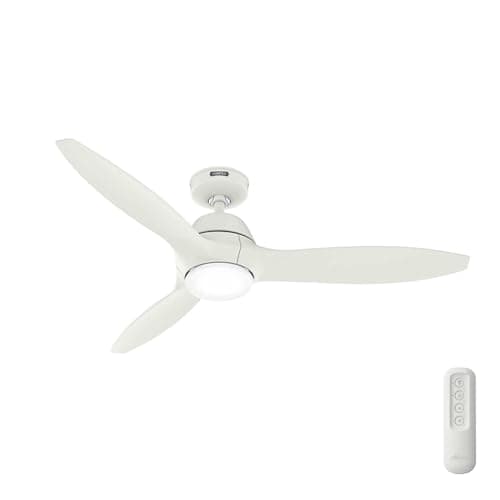 The ceiling fan case Hunter Skyway 52" Ceiling Fan with Light Kit 363.8 certified CFM per watt on 16.3 W — the cheapest comfort in the house, working whether or not outdoor air helps. | Any room with people in it, at any hour, in any weather | |
| 2 | The whole-house fan case QuietCool Stealth Pro X Whole House Fan, 4,280 CFM 4,280 CFM on high and 2,361 on 73.9 W at low — it replaces the air in the whole building rather than stirring one room. | Flushing the day's heat out of a house after sunset, in a climate with cool nights |
Different machines
Recirculation and exchange
Every cooling device in a house does one of three things: it moves air that is already inside, it exchanges inside air for outside air, or it removes heat. Ceiling fans do the first. Whole-house fans do the second. Air conditioners do the third.
| Ceiling fan | Whole-house fan | |
|---|---|---|
| What it does | Moves room air | Exchanges house air |
| Lowers temperature | No | Yes, to outdoor temperature |
| Power | 16.3 W | 73.9 W low, 408 W high |
| Airflow | About 5,900 CFM in one room | 2,361 to 4,280 CFM through the house |
| Needs open windows | No | Yes, always |
| Works in humid heat | Yes, for people | No |
| Works with the AC on | Yes | No |
| Install | Ceiling box, one room | Ceiling opening plus attic exhaust |
This one is not a DIY job
The condition
A whole-house fan needs the weather to cooperate
Because it can only deliver outdoor air, a whole-house fan is worth exactly as much as the air outside. Run it at 3 p.m. in August and you are importing heat; run it at 10 p.m. in a climate that cools off and you can drop the whole building several degrees in an hour.
- Great: dry climates and anywhere with a 20-degree day-night swing.
- Marginal: humid regions where nights stay warm and sticky — the air arriving is cooler but wetter, and the house feels worse in the morning.
- Never: with the air conditioner running. You would be exhausting the air you just paid to cool.
The ceiling fan has no such condition, which is why it is on in almost every occupied room in America and the whole-house fan is a regional machine.
Cost
Both are cheap; one is cheaper per unit of effect
At 18.34¢/kWh: the ceiling fan costs 2.4¢ a night, the whole-house fan 11¢ on low or 60¢ if you leave it on high all night, which you should not. A season of nightly low-speed running is about $9.76.
Against an air conditioner, both are rounding errors — the certified comparison is in the cheapest cooling to run, and the whole-house fan’s own running cost is worked through in what a whole-house fan costs to run.
Verdict
Most houses want both, in this order
- Ceiling fans first. Cheaper, simpler, useful in every climate and every hour. Sizing is in what size ceiling fan you need.
- A whole-house fan second, if your nights actually cool off. It is the machine that lets a house start the day cooler, and in the right climate it displaces hours of air conditioning.
- Air conditioning for the rest, because neither fan removes heat or humidity from a house that is hotter inside than out.
Say the unwelcome thing
Do not buy a whole-house fan for a humid climate with warm nights.
The machine can only give you the air outside. Where overnight lows stay in the high seventies with heavy humidity, running it pulls warm damp air through the house and leaves furnishings and drywall holding that moisture in the morning.
Check your typical overnight low and dew point before buying. Where nights genuinely cool, 2,361 CFM on 73.9 watts at low is among the cheapest real cooling available. Where they do not, 16.3 watts of ceiling fan plus air conditioning is the honest setup.
In full
Every pick, and what is wrong with it
Published specifications only, each linked to the page it came from. Where a manufacturer publishes nothing, the row says so — we do not fill blanks in.
1. The ceiling fan case
Hunter Skyway 52" Ceiling Fan with Light Kit
Hunter · model 52" Skyway (damp-rated)
363.8 certified CFM per watt on 16.3 W — the cheapest comfort in the house, working whether or not outdoor air helps.
A ceiling fan works on people, not buildings. It moves the air already in the room, which speeds evaporation from skin and reads as several degrees cooler to anyone sitting under it.
16.3 W on high at 363.8 CFM per watt makes it effectively free: 2.4¢ for an eight-hour night at 18.34¢/kWh.
Crucially, it works in weather a whole-house fan cannot touch. A humid 90-degree evening with outdoor air warmer than indoor air is exactly when the whole-house fan should stay off and the ceiling fan should be on.
What’s wrong with it
It changes no temperature, does nothing in an empty room, and cannot help a house that has stored the day's heat.
Running cost — 52" Skyway (damp-rated)
| Nameplate power | 2.1 W – 16.3 W | manufacturer's published figure |
|---|---|---|
| Energy, 8-hour night | 0.13 kWh | 16.3 ÷ 1000 × 8 |
| Cost per hour | 0.3¢ | at 18.34¢/kWh |
| Cost per 8-hour night | 2.4¢ | on the highest speed |
| Cost per 30 nights | 72¢ | 3.9 kWh |
| Same month, lowest speed | 9.2¢ | at 2.1 W |
Rate: 18.34¢/kWh, the US average residential price for June 2026 (EIA Electric Power Monthly, Table 5.3). Yours will differ — swap it in: (watts ÷ 1000) × hours × your rate.
| Blade span | 52 in |
|---|---|
| Efficiency | 363.8 CFM per watt |
| Power, high speed | 16.3 W |
| Power, low speed | 2.1 W |
| Standby power | 0.4 W |
| Type | Indoor, with light kit; damp-rated |
| Warranty | 3 years, components |
| ENERGY STAR | Certified |
Every figure above is from ENERGY STAR Certified Ceiling Fans dataset. Blanks are shown as “not published” rather than filled in.
2. The whole-house fan case
QuietCool Stealth Pro X Whole House Fan, 4,280 CFM
QuietCool · model QC STL PRO-4.8X
4,280 CFM on high and 2,361 on 73.9 W at low — it replaces the air in the whole building rather than stirring one room.
A whole-house fan is an exchange machine. Mounted in the ceiling below the attic, it pulls indoor air up and out, and an equal volume of outdoor air comes in through whatever windows you have opened.
The published figures show why low speed is the setting that matters: 2,361 CFM on 73.9 W is 31.9 CFM per watt, against 10.5 at the 4,280 CFM high setting. An overnight run on low costs 11¢.
What it buys is a house that starts the next day cooler, which is the whole game in a climate with a big day-night temperature swing. It is not air conditioning and it cannot beat outdoor conditions — that comparison is in whole-house fan versus air conditioner.
What’s wrong with it
Useless when outdoor air is warmer or more humid than indoor air, requires open windows every time it runs, and needs installing in a ceiling.
Running cost — QC STL PRO-4.8X
| Nameplate power | 73.9 W – 408 W | manufacturer's published figure |
|---|---|---|
| Energy, 8-hour night | 3.26 kWh | 408 ÷ 1000 × 8 |
| Cost per hour | 7.5¢ | at 18.34¢/kWh |
| Cost per 8-hour night | 60¢ | on the highest speed |
| Cost per 30 nights | $18 | 97.9 kWh |
| Same month, lowest speed | $3.25 | at 73.9 W |
Rate: 18.34¢/kWh, the US average residential price for June 2026 (EIA Electric Power Monthly, Table 5.3). Yours will differ — swap it in: (watts ÷ 1000) × hours × your rate.
| Air delivery, high | 4,280 CFM |
|---|---|
| Air delivery, medium | 3,500 CFM |
| Air delivery, low | 2,361 CFM |
| Power, high | 408 W |
| Power, medium | 225 W |
| Power, low | 73.9 W |
| Coverage claim | 1,427 - 2,140 sq ft |
| Motor | ECM |
| Warranty | 15 years |
| Noise | Not published as sones or dBA |
| ENERGY STAR | No program exists for whole-house fans |
Every figure above is from QuietCool Stealth Pro X specification sheet, QC STL PRO-4.8. Blanks are shown as “not published” rather than filled in.
Questions people actually ask
Frequently asked
Is a whole-house fan better than a ceiling fan?
They do different jobs. A whole-house fan exchanges the building's air for outdoor air and genuinely lowers indoor temperature when it is cooler outside. A ceiling fan recirculates one room's air and makes people feel cooler regardless of outdoor conditions.
Can a whole-house fan replace ceiling fans?
No. It runs only in the window of hours when outdoor air is cooler than indoor air, and it needs windows open. Ceiling fans cover the rest — daytime, humid evenings, and any time the air conditioner is running.
How much electricity does each use?
A certified 52-inch ceiling fan draws 16.3 watts on high. A whole-house fan draws 73.9 watts on low and 408 on high on one published unit, so an overnight run on low costs about 11 cents at the national average rate. Whole-house fan running costs.
Do you need windows open for a whole-house fan?
Always. The fan pushes indoor air into the attic and an equal volume has to enter from outside. Running it with the house shut up pulls air down chimneys and flues and moves far less air than its rating. Installing and running one.
Can you run a whole-house fan and air conditioning together?
No — they work against each other. The fan exhausts the cooled air you just paid for. Use the fan in the evening once outdoor air is cooler, then close up and run the air conditioner if the night stays warm.
Sources
Where these numbers came from
Read next
Where to go from here
Back to Whole-House Airflow, or read how we pick.