The picks
The quietest air conditioners for a bedroom
Almost nobody in this category publishes a decibel figure, which makes 'whisper quiet' impossible to check. Here is who does publish, and the physics that decides the rest.
By Sawyer V. · Published
The short answer
A U-shaped window unit is the structurally quiet answer: the sash closes through the middle of the unit, so the compressor sits outside the closed window and the glass does the acoustic work. Among portables, the Midea Duo publishes 43 dBA — the only figure here low enough to sleep beside.
Fan & Frost earns a commission when you buy through our links, at no cost to you. It never changes a ranking, and we say so when the right answer is the cheaper unit or nothing at all. Full disclosure · How we pick.

At a glance
The picks, ranked
Tap any row to jump to the full reasoning. Prices are live from Amazon where we have them, and read “check price” where we don’t — never a number we cannot verify today.
| # | Product | Best for | Price |
|---|---|---|---|
| 1 | 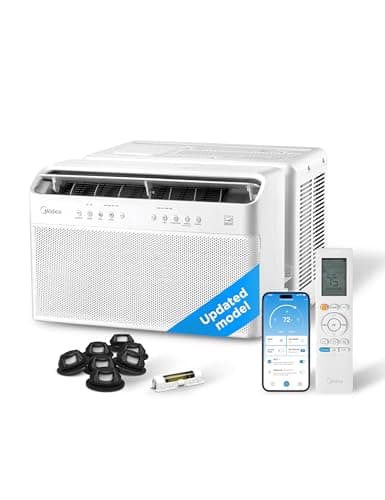 Quietest by construction Midea U-Shaped Window Air Conditioner, 8,000 BTU The U-shape puts the compressor outside a closed window, which beats any amount of sound insulation on a conventional unit. | A bedroom with a vertical sash window | |
| 2 | 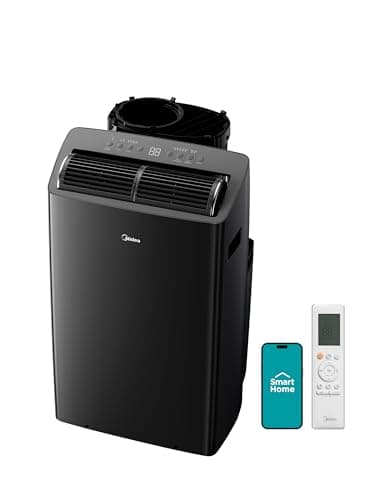 Quietest published figure Midea Duo Smart Inverter Portable Air Conditioner 43 dBA, published, which is the only number in this category low enough to be genuinely bedroom-appropriate. | A bedroom where a window unit will not fit | |
| 3 | 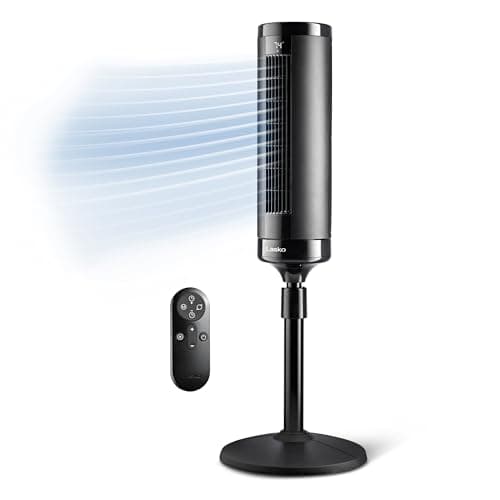 Quietest thing on this page Lasko EcoQuiet 42" DC Tower Fan 23 dBA published, at 2.9 W on its lowest speed. Nothing with a compressor comes close. | Anyone who does not strictly need refrigeration | |
| — | The one to skip for a bedroom Whynter ARC-14S Dual Hose Portable Air Conditioner Under 51 dBA on low is fine for a workspace and too much for a bedside. | A living room or office, not a room you sleep in |
Searching for a quiet air conditioner surfaces a wall of adjectives — whisper quiet, ultra silent, library quiet — and very few numbers. That is not an accident of marketing style. Most manufacturers in this category simply do not publish a decibel figure, and the ENERGY STAR certified dataset does not record one either.
What is actually published
Who gives you a number
| Unit | Type | Published noise |
|---|---|---|
| Lasko EcoQuiet T42710 | DC tower fan | 23 dBA low / 46 dBA high |
| Lasko A12107 | Table fan | 39 dBA low / 55 dBA high |
| Midea Duo MAP14S1TBL | Portable AC | 43 dBA |
| Whynter ARC-14S | Portable AC | under 51 dBA low / under 56 high |
| Honeywell CL25AE | Evaporative cooler | 52 dBA low / 60 dBA high |
| Honeywell CO60PM | Evaporative cooler | 61–65 dBA |
| All window ACs in the certified dataset | Window AC | Not published |
Every figure from the manufacturer’s own product page. The bottom row is the notable one.
Not one window air conditioner in the ENERGY STAR certified dataset carries a noise rating — the dataset records capacity, CEER, annual kWh, dimensions, weight and refrigerant, and no acoustic figure at all. So for the category that is otherwise the best-documented in home cooling, noise is the one thing you cannot look up.
That is why the top pick on this page is a construction argument rather than a decibel comparison. We would rather tell you the physics we can verify than quote a number nobody published.
Reading the numbers
What a decibel figure means in a bedroom
Decibels are logarithmic, so the gaps are larger than they look. A 10 dB increase is roughly a doubling of perceived loudness.
- Around 20–25 dBA — a quiet rural bedroom at night. The Lasko DC fan on low sits here.
- Around 40–45 dBA — a quiet library, a fridge in the next room. The Midea Duo at 43 is here, and this is about the ceiling for something you sleep next to.
- Around 50–55 dBA — quiet conversation. Fine for an office; noticeable at 2am.
- 60+ dBA — normal conversation. The large evaporative coolers are here, which is one reason they belong in a garage rather than a bedroom.
The other thing a single number hides: steady noise is much easier to sleep through than intermittent noise. A fan at a constant 40 dBA disappears within minutes. A compressor that cycles between silence and 45 dBA every twenty minutes does not, because each transition is a fresh event. This is why an inverter or variable-speed compressor is worth more for sleep than a couple of decibels on paper.
Say the unwelcome thing
Do not buy extra capacity hoping it will run less and be quieter.
The intuition is that a bigger unit will reach temperature faster and then be silent. What actually happens is that it reaches temperature faster, shuts off, warms up, and starts again — more transitions per hour, not fewer, and each one is the noise you notice.
A correctly sized unit runs for longer at lower output, which is both quieter in practice and better at dehumidifying. Size the room properly and prefer a variable-speed or inverter compressor.
Practical
Four things that make any unit quieter
- Seal the installation properly. Gaps around a window kit leak noise as well as air. The foam panels supplied are usually the weakest part; weatherstrip and tape do more for noise than most people expect.
- Check it is level. A unit that is not sitting square rattles, and rattles are far more disturbing than hum.
- Run the fan continuously rather than on auto. Steady airflow noise masks the compressor cycling underneath it. This is the single most effective free change.
- Put distance and soft furnishing between you and it. Sound falls off with distance, and a hard-walled room with no rug or curtains reflects everything.
The cheaper answer
Consider whether you need a compressor at all
A DC tower fan at 23 dBA is quieter than anything with a compressor will ever be, costs about 84¢ a month at full power against roughly $57 for a large portable, and for a warm-but-not-hot bedroom it is often the whole answer.
The quiet fan roundup is here, and the bedroom page works through the full sequence — blinds, airflow, then hardware — in order of how much each step actually does.
In full
Every pick, and what is wrong with it
Published specifications only, each linked to the page it came from. Where a manufacturer publishes nothing, the row says so — we do not fill blanks in.
1. Quietest by construction
Midea U-Shaped Window Air Conditioner, 8,000 BTU
Midea · model MAW08V1QWT-S
The U-shape puts the compressor outside a closed window, which beats any amount of sound insulation on a conventional unit.
This is a physics pick rather than a spec pick, and it is worth being explicit about that.
In a conventional window unit, the whole machine sits in the opening with the sash resting on top of it. The compressor — the loud part — is a few inches from the inside of the room, with a thin cabinet between you and it.
In a U-shaped unit, the sash closes down through the middle of the machine. The compressor and condenser end up on the outside of a closed window, with the glass and the seal between them and your bed. That is a structural acoustic advantage no amount of foam lining achieves.
The efficiency is good too: CEER 15, 400 kWh a year, about $73 at 18.34¢/kWh. And the variable speed compressor helps twice over — a modulating compressor avoids the loud thunk of cycling on and off, which is what actually wakes people up.
We cannot give you a decibel figure, because Midea does not publish one and the ENERGY STAR certified dataset does not record noise. That is a gap in what is knowable, not something we are going to fill with a guess.
What’s wrong with it
Midea publishes no dBA figure for it, so we cannot give you a number — we are recommending it on geometry, and we would rather say that than quote an adjective.
Running cost — MAW08V1QWT-S
| Annual energy use | 400 kWh | ENERGY STAR certified figure |
|---|---|---|
| Annual cost | $73 | 400 × 18.34¢/kWh |
| Per cooling month | $18 | spread over a four-month season |
The annual figure is the certified value from the ENERGY STAR Certified Room Air Conditioners dataset, which models a standard cooling season rather than your actual summer. It is more useful than a nameplate wattage here, because a variable-speed compressor spends most of its life well below nameplate.
Rate: 18.34¢/kWh, the US average residential price for June 2026 (EIA Electric Power Monthly, Table 5.3). Yours will differ — swap it in: (watts ÷ 1000) × hours × your rate.
| Cooling capacity | 8,000 BTU/h |
|---|---|
| CEER | 15 |
| Annual energy use | 400 kWh/yr |
| vs federal standard | 38% less energy |
| Dimensions | 13.5 H x 19.2 W x 22.0 D in |
| Weight | 53.2 lb |
| Refrigerant | R-32 |
| Installation | U-shape; sash closes through the middle of the unit |
| Compressor | Variable speed |
| ENERGY STAR | Certified |
Every figure above is from ENERGY STAR Certified Room Air Conditioners dataset. Blanks are shown as “not published” rather than filled in.
2. Quietest published figure
Midea Duo Smart Inverter Portable Air Conditioner
Midea · model MAP14S1TBL
43 dBA, published, which is the only number in this category low enough to be genuinely bedroom-appropriate.
43 dBA is the number, and Midea publishes it. For context, that is around the level of a quiet library or a fridge running in the next room. It is comfortably below the Whynter’s “under 51 dBA” on low and dramatically below its “under 56” on high.
The inverter compressor is doing most of the work. A fixed-speed compressor is either off or at full power, and the transition between those states is exactly the noise that wakes you. An inverter modulates continuously, so it settles into a steady low hum instead.
Be clear about the limit, though: this is a compressor in your bedroom. Even at 43 dBA it is a fundamentally noisier proposition than a machine whose compressor is outside the glass. Buy it when your window will not take a window unit — not because it is quieter, because it is not.
What’s wrong with it
The compressor is in the room with you no matter how quiet it is, and its 12,000 BTU SACC is far more than a bedroom needs — so it will cycle more than it should.
Running cost
Midea does not publish a wattage for the MAP14S1TBL, so we cannot calculate what it costs to run. We are not going to estimate one. If Midea publishes a nameplate figure, this block will show the arithmetic.
| Marketing capacity | 14,000 BTU |
|---|---|
| DOE-rated capacity | 12,000 BTU SACC |
| Hoses | Dual |
| Noise | 43 dBA |
| Speeds | 3 |
| Refrigerant | R-32 |
| Dimensions | 19.52 W x 16.73 D x 32.48 H in |
| Weight | 74.96 lb |
| Manufacturer coverage claim | 550 sq ft |
| Power | Not published (115 V stated, no wattage) |
| Warranty | 1 year |
Every figure above is from Midea product page, MAP14S1TBL. Blanks are shown as “not published” rather than filled in.
3. Quietest thing on this page
Lasko EcoQuiet 42" DC Tower Fan
Lasko · model T42710
23 dBA published, at 2.9 W on its lowest speed. Nothing with a compressor comes close.
23 dBA on low, 46 dBA on high, both published by Lasko. 23 dBA is close to the threshold of a rustling leaf, and it is roughly 20 dB below the quietest portable air conditioner here — which, because decibels are logarithmic, is not a small difference but a large one.
It also draws 2.9 W at that speed. A month of eight-hour nights on low is about 13¢.
Twelve speeds matters more than it sounds for sleeping, because it lets you find the point where the airflow is enough and the noise has not yet climbed. A three-speed fan often has nothing usable between “too little” and “too loud”.
If the room is warm rather than hot, this is the honest recommendation and it costs a fraction of everything else here. More quiet fans here.
What’s wrong with it
It does not cool the room at all — it moves air. On a genuinely hot night in a poorly insulated room, no fan will be enough regardless of how quiet it is.
Running cost — T42710
| Nameplate power | 2.9 W – 19 W | manufacturer's published figure |
|---|---|---|
| Energy, 8-hour night | 0.15 kWh | 19 ÷ 1000 × 8 |
| Cost per hour | 0.3¢ | at 18.34¢/kWh |
| Cost per 8-hour night | 2.8¢ | on the highest speed |
| Cost per 30 nights | 84¢ | 4.6 kWh |
| Same month, lowest speed | 13¢ | at 2.9 W |
Rate: 18.34¢/kWh, the US average residential price for June 2026 (EIA Electric Power Monthly, Table 5.3). Yours will differ — swap it in: (watts ÷ 1000) × hours × your rate.
| Power | 2.9 W - 19 W (0.06-0.303 A at 120 V) |
|---|---|
| Noise | 23 dBA low, 46 dBA high |
| Speeds | 12 |
| Height | 41.6 in |
| Footprint | 12.8 x 12.8 in |
| Weight | 7.8 lb |
| Timer | 8 hours |
| Air delivery (CFM) | Not published |
| Warranty | 2 years |
Every figure above is from Lasko product page, T42710. Blanks are shown as “not published” rather than filled in.
Skip this one
Whynter ARC-14S Dual Hose Portable Air Conditioner
Whynter · model ARC-14S
Under 51 dBA on low is fine for a workspace and too much for a bedside.
Credit where due: Whynter publishes noise figures at all, which most of this category does not. That makes it possible to rule the unit out for a specific application, which is what a published spec is for.
“Under 51 dBA” on low is around the level of a quiet conversation. In a living room or a home office that is unremarkable. Eight feet from a pillow it is the thing you notice at 2am.
The bigger issue for sleep is cycling. A fixed-speed compressor runs at full output until the thermostat is satisfied, then stops, then starts again — and it is the transitions that wake people, not the steady state. This unit will do that all night in a bedroom sized well below its 9,500 BTU SACC.
It remains a good machine in the right room. A bedroom is not it.
What’s wrong with it
The published figures are "under 51 dBA" low and "under 56 dBA" high — usable, but roughly 8 dB above the Midea Duo, and it is a fixed-speed compressor that cycles rather than modulating.
Running cost — ARC-14S
| Nameplate power | 1300 W | manufacturer's published figure |
|---|---|---|
| Energy, 8-hour night | 10.40 kWh | 1300 ÷ 1000 × 8 |
| Cost per hour | 24¢ | at 18.34¢/kWh |
| Cost per 8-hour night | $1.91 | on the highest speed |
| Cost per 30 nights | $57 | 312.0 kWh |
Rate: 18.34¢/kWh, the US average residential price for June 2026 (EIA Electric Power Monthly, Table 5.3). Yours will differ — swap it in: (watts ÷ 1000) × hours × your rate.
| Marketing capacity | 14,000 BTU (ASHRAE-128) |
|---|---|
| DOE-rated capacity | 9,500 BTU SACC |
| Hoses | Dual |
| Power | 1,300 W / 11.6 A at 115 V |
| Noise | Under 51 dBA low, under 56 dBA high |
| Dehumidification | 71 pints/day |
| Refrigerant | R-32 |
| Dimensions | 16 W x 19 D x 35.5 H in |
| Weight | 73 lb |
| Manufacturer coverage claim | 500 sq ft |
| Warranty | 1 year unit, 3 years compressor |
Every figure above is from Whynter product page, ARC-14S. Blanks are shown as “not published” rather than filled in.
We are not linking a buy button for this one. If you want to look at it anyway, it is easy enough to find — but we would rather send you to something that fits your room.
Questions people actually ask
Frequently asked
What is the quietest air conditioner for a bedroom?
A U-shaped window unit, because the sash closes through the middle of the machine and the compressor ends up outside a closed window. Among portables, the Midea Duo publishes 43 dBA, which is the lowest figure we found for a unit with a compressor in the room.
How many decibels is a quiet air conditioner?
Around 40 to 45 dBA is roughly the ceiling for something you sleep beside — comparable to a quiet library. Above about 50 dBA you are at quiet-conversation level, which is fine in an office and noticeable at night.
Why do window air conditioners not list a decibel rating?
Most manufacturers simply do not publish one, and the ENERGY STAR certified dataset records capacity, CEER, annual kWh, dimensions and weight but no acoustic figure. It is the one specification you cannot look up for the otherwise best-documented category in home cooling.
Are inverter air conditioners quieter?
In practice, yes, and for a reason a single decibel figure hides. A fixed-speed compressor is either off or at full power, and the transitions are what wake people. An inverter modulates continuously and settles into a steady hum, which is far easier to sleep through.
Is a portable air conditioner quieter than a window unit?
Generally no. A portable has its compressor inside the room with you by definition, while a window unit has most of its noisy hardware outside the glass. A U-shaped window unit takes that further by placing the compressor outside a fully closed window.
Does running the fan constantly make an AC quieter?
It makes it less disturbing, which is what matters for sleep. Continuous airflow noise masks the compressor cycling underneath it, so you stop noticing each start and stop. It is the most effective free change you can make.
Sources
Where these numbers came from
Read next
Where to go from here
Back to Air Conditioners, or read how we pick.