The picks
Best 8,000 BTU air conditioners
The default size for a bedroom, and the class where the certified data actually gives you something to choose on.
By Sawyer V. · Published
The short answer
The GE Profile PWJV08W leads at CEER 16 and 375 kWh a year, and at 15.3 inches deep it is also the shallowest. The Midea U-shaped MAW08V1QWT trades a point of CEER for a compressor that sits outside a closed window — the quietest architecture available. If weight decides it, the BLACK+DECKER BD08NWES at 44.1 lb is the lightest certified unit in the class.
Fan & Frost earns a commission when you buy through our links, at no cost to you. It never changes a ranking, and we say so when the right answer is the cheaper unit or nothing at all. Full disclosure · How we pick.
At a glance
The picks, ranked
Tap any row to jump to the full reasoning. Prices are live from Amazon where we have them, and read “check price” where we don’t — never a number we cannot verify today.
| # | Product | Best for | Price |
|---|---|---|---|
| 1 | 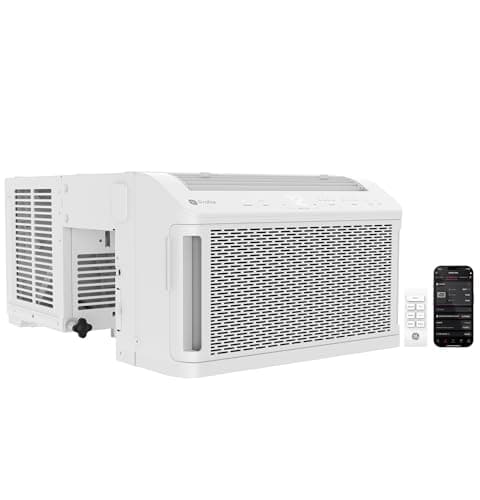 Best overall GE Profile ClearView Window Air Conditioner, 8,000 BTU CEER 16 and 375 kWh a year — the top of the class, and the shallowest at 15.3 inches. | A bedroom or office where you want the lowest running cost | |
| 2 | 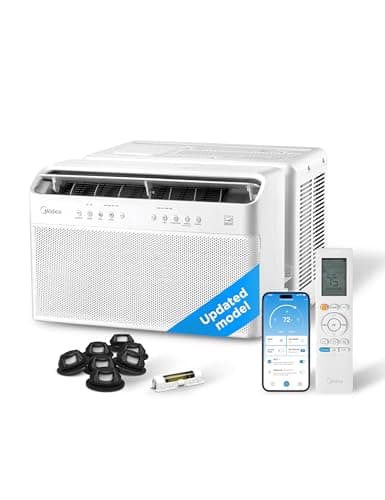 Quietest architecture Midea U-Shaped Window Air Conditioner, 8,000 BTU The sash closes through the middle of the machine, putting the compressor outside a shut window. | A bedroom where noise matters more than a point of CEER | |
| 3 | 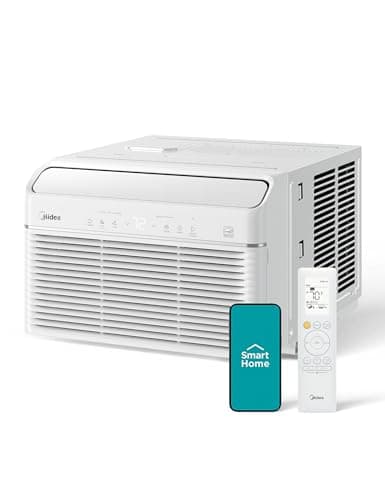 Lightest certified in the class BLACK+DECKER Window Air Conditioner, 8,000 BTU 44.1 lb at CEER 15 and 400 kWh a year — the lightest certified 8,000 BTU unit. | An upper-floor window, or installing without much help | |
| — | Check this size first Midea Window Air Conditioner, 6,000 BTU 6,000 BTU at CEER 16 and 281.3 kWh — the lowest annual consumption of any certified room unit. | A small room where 8,000 BTU would be oversized |
8,000 BTU is the most-bought room air conditioner capacity, and it is the class where the certified data gives you the most to work with — the units genuinely differ, and the differences are published.
The field
Certified 8,000 BTU units compared
| Unit | CEER | kWh/yr | Season | Weight | Depth |
|---|---|---|---|---|---|
| GE Profile PWJV08W | 16 | 375 | $69 | 46.2 lb | 15.3 in |
| Friedrich Kühl KCVS08B10A | 16 | 407.8 | $75 | not published | not published |
| Midea MAW08V1QWT (U-shape) | 15 | 400 | $73 | 53.2 lb | 22.0 in |
| BLACK+DECKER BD08NWES | 15 | 400 | $73 | 44.1 lb | 19.6 in |
| Hisense AHW0823TW1W | 15 | 400 | $73 | 44.5 lb | 18.9 in |
| Midea MAW08HV1KWT-A (heats) | 15.1 | 397.4 | $73 | 56.0 lb | 22.2 in |
ENERGY STAR Certified Room Air Conditioners dataset. All six are on the Most Efficient list. Season cost is the certified annual kWh at current average residential rates.
Three things fall out of that table.
The efficiency spread is narrow. 375 to 407.8 kWh a year across the whole class — about $6.02 per season between best and worst. Real, and not large enough to override a physical constraint.
The physical spread is wide. 44.1 to 56.0 lb, and 15.3 to 22.2 inches deep. That is a much bigger practical difference than the efficiency, and it is the one that decides whether a unit fits your window and whether you can install it.
One of them heats. The Midea MAW08HV1KWT-A is a reverse-cycle unit at essentially the same cooling figures, which makes it a genuinely different proposition for a room with electric resistance heating. More on that category.
This one is not a DIY job
In this class, let the window decide. The efficiency differences are small enough that a unit which does not fit properly will cost you more through a bad seal than you would ever save on CEER.
Measure three things before shopping. Sash opening width — the clear width between the channels. Sill depth and what is behind it — a storm window or a fixed screen stops a 22-inch unit that a 15.3-inch one clears. And who is helping you lift it.
A gap around a poorly-fitted unit lets hot outdoor air into the room continuously while it runs, and no certified figure accounts for that.
Which spec matters
Choosing between them
Lowest running cost: the GE at 375 kWh. It is also the shallowest, which makes it the easiest to fit.
Quietest: the U-shaped Midea. No certified unit publishes a noise rating — the program does not measure it — so you are choosing on architecture, and putting the compressor outside a closed window is the strongest architectural move available.
Easiest to install: the 44.1 lb BLACK+DECKER.
Needs heating too: the reverse-cycle Midea, at CEER 15.1 and 397.4 kWh.
Sizing
Is 8,000 BTU actually right?
It is the default, which means it is frequently bought for rooms above and below where it belongs.
Size from the room using the ENERGY STAR method, then apply the adjustments: more for a very sunny room, more per regular occupant beyond two, less for heavy shade, substantially more for a kitchen.
Do not round up. An oversized unit reaches temperature quickly, shuts off before the coil has removed moisture, and leaves the room cold and damp — which people respond to by lowering the setpoint, making the cycling worse.
If the answer comes out lower, the smaller classes are here. If higher, 12,000 BTU.
Say the unwelcome thing
Do not choose an 8,000 BTU unit on CEER alone.
The whole certified class sits between 375 and 407.8 kWh a year — about $6.02 a season between the best and worst.
Against that, the physical differences are large: 12 lb of weight and 7 inches of depth across the same class. A unit that is 22 inches deep when your sill clears 17 does not fit, whatever its CEER.
And a badly sealed install — because the unit is the wrong shape for the window — lets hot outdoor air in continuously, which costs more than any efficiency difference on this page.
Fit first, then noise architecture, then CEER. In this class that ordering is not a compromise; it reflects where the money actually is.
In full
Every pick, and what is wrong with it
Published specifications only, each linked to the page it came from. Where a manufacturer publishes nothing, the row says so — we do not fill blanks in.
1. Best overall
GE Profile ClearView Window Air Conditioner, 8,000 BTU
GE Profile · model PWJV08W
CEER 16 and 375 kWh a year — the top of the class, and the shallowest at 15.3 inches.
375 kWh a year, about $69 for a cooling season, at CEER 16 and 47% less energy than the federal standard. On the Most Efficient list.
15.3 inches deep is the quiet advantage. A window unit sits with part of its mass cantilevered outside the sill, and less depth means less overhang to control while you seat it — and it clears storm windows and shallow ledges that a 22-inch unit will not.
Variable-speed compressor, which modulates rather than cycling hard on and off. That matters for noise and for dehumidification, since moisture only condenses out while the compressor runs.
What’s wrong with it
46.2 lb is a two-person lift over a sill, and like any conventional unit it props the sash open for the season.
Running cost — PWJV08W
| Annual energy use | 375 kWh | ENERGY STAR certified figure |
|---|---|---|
| Annual cost | $69 | 375 × 18.34¢/kWh |
| Per cooling month | $17 | spread over a four-month season |
The annual figure is the certified value from the ENERGY STAR Certified Room Air Conditioners dataset, which models a standard cooling season rather than your actual summer. It is more useful than a nameplate wattage here, because a variable-speed compressor spends most of its life well below nameplate.
Rate: 18.34¢/kWh, the US average residential price for June 2026 (EIA Electric Power Monthly, Table 5.3). Yours will differ — swap it in: (watts ÷ 1000) × hours × your rate.
| Cooling capacity | 8,000 BTU/h |
|---|---|
| CEER | 16 |
| Annual energy use | 375 kWh/yr |
| vs federal standard | 47% less energy |
| Dimensions | 12.6 H x 18.6 W x 15.3 D in |
| Weight | 46.2 lb |
| Refrigerant | R-32 |
| Installation | Does not straddle the windowsill |
| Compressor | Variable speed |
| ENERGY STAR | Certified, and on the Most Efficient list |
Every figure above is from ENERGY STAR Certified Room Air Conditioners dataset. Blanks are shown as “not published” rather than filled in.
2. Quietest architecture
Midea U-Shaped Window Air Conditioner, 8,000 BTU
Midea · model MAW08V1QWT-S
The sash closes through the middle of the machine, putting the compressor outside a shut window.
The U-shape is the closest a window unit gets to a mini-split acoustically. The sash comes down through a channel in the machine, so the compressor and condenser end up outside a closed window with the glass between them and the room.
400 kWh a year, about $73 — roughly $4.58 more per season than the GE.
It also seals better. A conventional unit props the sash open, leaving a full-width gap that has to be foam-stripped; this lets the window genuinely shut.
53.2 lb, 22 inches deep, vertical sash windows only. The quiet case in full.
What’s wrong with it
CEER 15 and 400 kWh against 16 and 375, plus 53.2 lb and 22 inches deep — the most awkward unit here to install.
Running cost — MAW08V1QWT-S
| Annual energy use | 400 kWh | ENERGY STAR certified figure |
|---|---|---|
| Annual cost | $73 | 400 × 18.34¢/kWh |
| Per cooling month | $18 | spread over a four-month season |
The annual figure is the certified value from the ENERGY STAR Certified Room Air Conditioners dataset, which models a standard cooling season rather than your actual summer. It is more useful than a nameplate wattage here, because a variable-speed compressor spends most of its life well below nameplate.
Rate: 18.34¢/kWh, the US average residential price for June 2026 (EIA Electric Power Monthly, Table 5.3). Yours will differ — swap it in: (watts ÷ 1000) × hours × your rate.
| Cooling capacity | 8,000 BTU/h |
|---|---|
| CEER | 15 |
| Annual energy use | 400 kWh/yr |
| vs federal standard | 38% less energy |
| Dimensions | 13.5 H x 19.2 W x 22.0 D in |
| Weight | 53.2 lb |
| Refrigerant | R-32 |
| Installation | U-shape; sash closes through the middle of the unit |
| Compressor | Variable speed |
| ENERGY STAR | Certified |
Every figure above is from ENERGY STAR Certified Room Air Conditioners dataset. Blanks are shown as “not published” rather than filled in.
3. Lightest certified in the class
BLACK+DECKER Window Air Conditioner, 8,000 BTU
BLACK+DECKER · model BD08NWES
44.1 lb at CEER 15 and 400 kWh a year — the lightest certified 8,000 BTU unit.
44.1 lb. That is the number that matters on install day, and it is 9 lb lighter than the U-shaped unit above.
The difference between 44 and 53 lb sounds small and is not, because you are holding it at arm’s length over a sill while someone else brings the sash down. On an upper floor it changes the job materially.
400 kWh a year, about $73, at CEER 15 and 38% below the federal standard.
19.6 inches deep — between the GE’s 15.3 and the Midea’s 22. Check what is behind your sash before ordering.
What’s wrong with it
19.6 inches deep needs more clearance behind the sash than the GE, and CEER 15 is a point behind the leader.
Running cost — BD08NWES
| Annual energy use | 400 kWh | ENERGY STAR certified figure |
|---|---|---|
| Annual cost | $73 | 400 × 18.34¢/kWh |
| Per cooling month | $18 | spread over a four-month season |
The annual figure is the certified value from the ENERGY STAR Certified Room Air Conditioners dataset, which models a standard cooling season rather than your actual summer. It is more useful than a nameplate wattage here, because a variable-speed compressor spends most of its life well below nameplate.
Rate: 18.34¢/kWh, the US average residential price for June 2026 (EIA Electric Power Monthly, Table 5.3). Yours will differ — swap it in: (watts ÷ 1000) × hours × your rate.
| Cooling capacity | 8,000 BTU/h |
|---|---|
| CEER | 15 |
| Annual energy use | 400 kWh/yr |
| vs federal standard | 38% less energy |
| Dimensions | 13.5 H x 18.6 W x 19.6 D in |
| Weight | 44.1 lb |
| Refrigerant | R-32 |
| Installation | Does not straddle the windowsill |
| Compressor | Variable speed |
| ENERGY STAR | Certified |
Every figure above is from ENERGY STAR Certified Room Air Conditioners dataset. Blanks are shown as “not published” rather than filled in.
Skip this one
Midea Window Air Conditioner, 6,000 BTU
Midea · model MAW06S1KWT-A
6,000 BTU at CEER 16 and 281.3 kWh — the lowest annual consumption of any certified room unit.
Listed as a skip because 8,000 BTU is the default people reach for, and a fair number of rooms do not need it.
281.3 kWh a year, about $52 — roughly $17 less per season than the class leader above, at the same CEER 16.
And 31.6 lb against 44 to 53, which changes installation from a two-person job to a one-person one.
The reason to care beyond money: an oversized unit short-cycles and removes less moisture, leaving a room cold and clammy. Size from the room first.
What’s wrong with it
6,000 BTU genuinely will not hold a larger or sunnier room. This is a sizing check, not a universal downgrade.
Running cost — MAW06S1KWT-A
| Annual energy use | 281.3 kWh | ENERGY STAR certified figure |
|---|---|---|
| Annual cost | $52 | 281.3 × 18.34¢/kWh |
| Per cooling month | $13 | spread over a four-month season |
The annual figure is the certified value from the ENERGY STAR Certified Room Air Conditioners dataset, which models a standard cooling season rather than your actual summer. It is more useful than a nameplate wattage here, because a variable-speed compressor spends most of its life well below nameplate.
Rate: 18.34¢/kWh, the US average residential price for June 2026 (EIA Electric Power Monthly, Table 5.3). Yours will differ — swap it in: (watts ÷ 1000) × hours × your rate.
| Cooling capacity | 6,000 BTU/h |
|---|---|
| CEER | 16 |
| Annual energy use | 281.3 kWh/yr |
| vs federal standard | 45% less energy |
| Dimensions | 12.1 H x 16.0 W x 13.3 D in |
| Weight | 31.6 lb |
| Installation | Does not straddle the windowsill |
| Support bracket | Not required |
| Compressor | Variable speed |
| Refrigerant | R-32 |
| ENERGY STAR | Certified, and on the Most Efficient list |
Every figure above is from ENERGY STAR Certified Room Air Conditioners dataset. Blanks are shown as “not published” rather than filled in.
We are not linking a buy button for this one. If you want to look at it anyway, it is easy enough to find — but we would rather send you to something that fits your room.
Questions people actually ask
Frequently asked
What is the most efficient 8,000 BTU air conditioner?
The GE Profile PWJV08W at CEER 16 and 375 kWh a year, which is also the shallowest in the class at 15.3 inches deep. The Friedrich Kühl KCVS08B10A also reaches CEER 16, at 407.8 kWh.
What room size does 8,000 BTU cover?
It is the common default for a normal bedroom or living space, but size from the room rather than the label — then adjust upward for a very sunny room or extra occupants, and downward for heavy shade. Sizing method.
What is the lightest 8,000 BTU air conditioner?
The BLACK+DECKER BD08NWES at 44.1 lb. The heaviest certified unit in the class is 56.0 lb, and that 12 lb difference matters materially when you are holding it at arm's length over a sill.
Which 8,000 BTU air conditioner is quietest?
No certified unit publishes a noise rating — the program does not measure it. Choose on architecture instead: a U-shaped unit closes the sash through the middle of the machine, putting the compressor outside a shut window.
Is the efficiency difference between 8,000 BTU units worth chasing?
Less than the fit is. The whole certified class spans 375 to 407.8 kWh a year, while weight varies by 12 lb and depth by 7 inches. A poorly fitted unit leaks hot air continuously, which costs more than any CEER difference here.
Can you get an 8,000 BTU air conditioner that also heats?
Yes — the Midea MAW08HV1KWT-A is a reverse-cycle unit at CEER 15.1 and 397.4 kWh, essentially matching the cooling-only field. It is a strong option for a room currently using electric resistance heating. Window units with heat.
Sources
Where these numbers came from
Read next
Where to go from here
Back to Air Conditioners, or read how we pick.