Guide and picks
Do evaporative coolers work in humid climates?
No, and this is the page we would rather you read before the roundup. The mechanism is simple, the threshold is checkable, and the answer for most of the eastern US is don't.
By Sawyer V. · Published
The short answer
No. An evaporative cooler works by evaporating water into the air, which requires air dry enough to accept moisture. Below about 40% relative humidity they cool effectively; above about 60% you get air that is barely cooler and noticeably damper. Check your afternoon humidity, not your morning humidity.
Fan & Frost earns a commission when you buy through our links, at no cost to you. It never changes a ranking, and we say so when the right answer is the cheaper unit or nothing at all. Full disclosure · How we pick.
At a glance
The picks, ranked
Tap any row to jump to the full reasoning. Prices are live from Amazon where we have them, and read “check price” where we don’t — never a number we cannot verify today.
| # | Product | Best for | Price |
|---|---|---|---|
| 1 | 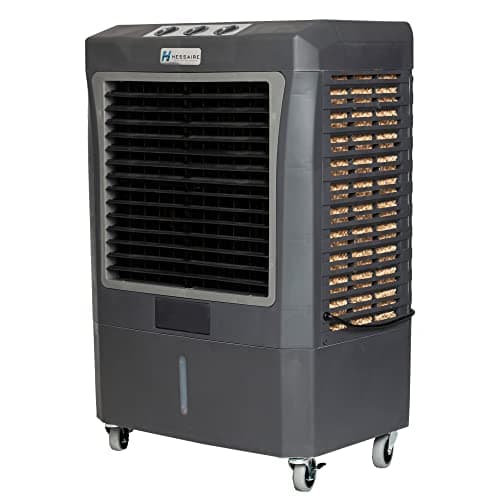 If your afternoon humidity is under 40% Hessaire MC37M Mobile Evaporative Cooler 3,100 CFM on 250 W — the best airflow per watt we found, and real cooling for a fifth of a compressor's power. | A garage, patio or workshop in the dry Southwest or interior West | |
| 2 | If it is for one dry-climate room Honeywell CL25AE Indoor Evaporative Cooler The only unit in the category quiet enough for a room at 52-60 dBA, with a 7.5-hour timer. | A single room with a window open, in genuinely dry air | |
| 3 | If your humidity is over 60% Midea U-Shaped Window Air Conditioner, 6,000 BTU An air conditioner removes humidity rather than adding it — which in a humid climate is doing as much for comfort as the temperature drop. | Most of the eastern US, where evaporative cooling cannot work | |
| — | 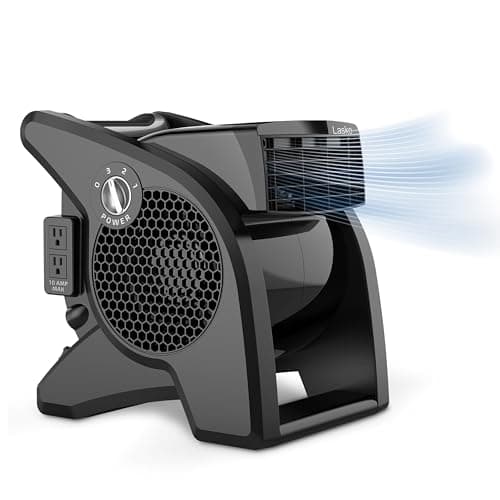 The thing not to buy on this page Lasko Max Performance 15" Air Mover A high-velocity air mover is the fallback for a humid garage, and it is not a cooler of any kind. | Nobody who came here about humidity |
This is the first question to answer about evaporative cooling, and getting it wrong is the most common expensive mistake in the category. A swamp cooler is not a cheaper air conditioner that happens to work a bit less well in humidity. In humid air it does not do the job at all.
The mechanism
Why humidity decides everything
Evaporation takes energy. When water changes from liquid to vapor it absorbs heat from its surroundings, and that heat has to come from somewhere — in this case, from the air being pulled through the wet pad. Air goes in warm and dry, comes out cooler and damper. The heat has not left the building; it has been converted into water vapor carried in the air.
This is the same reason sweating cools you, and the same reason stepping out of a pool feels cold.
The limit follows directly. Air can only hold so much water vapor, and how much it is already holding determines how much more it can absorb. Relative humidity is exactly that measure: the percentage of the maximum the air is currently carrying.
- At 15% relative humidity the air has enormous capacity for more moisture. Evaporation is rapid, a lot of heat is absorbed, and the temperature drop is substantial.
- At 50% evaporation is slower, the drop is modest, and you are adding humidity to air that is already halfway loaded.
- At 80% there is almost no capacity left. Very little water evaporates, very little heat is absorbed, and what you mostly get is a fan blowing damp air at you.
And there is a second, nastier effect at the top of that range. Your own body cools itself by evaporating sweat, using the same physics. Add moisture to already-humid air and you make it harder for your own sweat to evaporate. A swamp cooler in a humid room can genuinely make a person feel warmer while the thermometer reads a degree or two lower.
The threshold
Where the line is
| Afternoon humidity | What you get | Verdict |
|---|---|---|
| Under 30% | Substantial, obvious cooling | Excellent — this is what they are for |
| 30–40% | Clear, useful cooling | Good |
| 40–50% | Modest cooling, noticeable dampness | Marginal |
| 50–60% | Very little cooling, clearly damper air | Poor |
| Over 60% | Effectively a fan that adds humidity | Don't |
Bands describe the practical experience, not a manufacturer specification. Honeywell’s own guidance is that these units suit hot regions with humidity below 60%.
Check yours
The two-minute check
Do not use the humidity figure you remember, and do not use the one on your phone at 8am. Both will mislead you.
- Look up your local relative humidity at 3–5pm on a hot day. Any weather app shows it. The afternoon figure is the one that matters, because that is when you would be running the cooler.
- Check it across several hot days, not one. A single dry afternoon in a humid climate is not a pattern.
- Read it against the table above. Under 40%: buy one. Over 60%: do not.
Why morning humidity misleads you: relative humidity falls as air warms, even when the actual amount of water in the air has not changed at all. Warmer air can hold more, so the same water is a smaller percentage of the maximum. A humid climate can read 85% at dawn and 55% at 3pm with identical moisture content. That afternoon 55% still means the air is carrying a great deal of water — it is genuinely marginal for evaporative cooling, and the morning number would have told you it was hopeless while the afternoon number oversells it slightly.
By region
Roughly where this works
As a first filter, before you check your own numbers:
- Works well: the desert Southwest and interior West — Arizona, Nevada, New Mexico, inland California, Utah, Colorado, west Texas, eastern Oregon and Washington. Summer afternoon humidity in these areas is routinely under 25%.
- Marginal, and seasonal: the high plains and parts of the Mountain West. Often good in June and poor once monsoon moisture arrives in July and August — which is precisely when you want it most.
- Does not work: the Southeast, the Gulf Coast, the Mid-Atlantic, the Northeast, the Midwest, the Pacific Northwest west of the Cascades. Summer afternoon humidity is commonly 60–80%.
The monsoon case deserves emphasis, because it catches people in Phoenix and Tucson who bought on a dry June and found the machine useless in a humid August. If you are in a monsoon region, expect a few weeks a year where it stops working and have another plan.
Say the unwelcome thing
If you are in Houston, Atlanta, Miami or Boston, skip this category entirely.
Not “buy a bigger one”, not “buy a better brand”. No evaporative cooler works in saturated air, because the limit is the air, not the machine. A 3,100 CFM unit in 80% humidity moves more damp air than a 764 CFM unit and cools no better.
What you want instead is a window air conditioner, which removes humidity rather than adding it — and in a humid climate that dehumidification is doing at least as much for your comfort as the temperature drop.
Even in a dry climate
The second condition people miss
Dry air is necessary but not sufficient. An evaporative cooler continuously adds moisture to the space it is in, so in a closed room the humidity climbs until evaporation slows and the cooling stops. The machine effectively defeats itself over an hour or two.
It needs a route out: an open window, an open door, a garage door up. Airflow through the space rather than around it. That single requirement is why these units suit garages and patios so well, and sealed bedrooms so badly.
It is also why the phrase “ventless air conditioner” is doubly misleading when applied to these: they are not air conditioners, and they specifically need ventilation. If you found this page looking for a windowless-room solution, read this instead.
If the answer is yes
If your climate qualifies
Then this is genuinely excellent value: real cooling at roughly a fifth of the power of refrigeration. The picks, ranked on airflow per watt — including the finding that every coverage claim in the category is just CFM divided by 1.64 — are the next page to read. And the direct cost comparison against an air conditioner is here.
In full
Every pick, and what is wrong with it
Published specifications only, each linked to the page it came from. Where a manufacturer publishes nothing, the row says so — we do not fill blanks in.
1. If your afternoon humidity is under 40%
Hessaire MC37M Mobile Evaporative Cooler
Hessaire · model MC37M
3,100 CFM on 250 W — the best airflow per watt we found, and real cooling for a fifth of a compressor's power.
If you passed the test above, this is the machine. 12.4 CFM per watt, a 10.3 gallon tank that runs a working day, and about $11 for thirty eight-hour periods at 18.34¢/kWh.
Remember the second condition: it needs somewhere for the humid air to go. An open garage door or a window, not a sealed room.
What’s wrong with it
It stops working as humidity rises, and no larger unit fixes that. Hessaire also publishes no noise figure or speed count.
Running cost — MC37M
| Nameplate power | 250 W | manufacturer's published figure |
|---|---|---|
| Energy, 8-hour night | 2.00 kWh | 250 ÷ 1000 × 8 |
| Cost per hour | 4.6¢ | at 18.34¢/kWh |
| Cost per 8-hour night | 37¢ | on the highest speed |
| Cost per 30 nights | $11 | 60.0 kWh |
Rate: 18.34¢/kWh, the US average residential price for June 2026 (EIA Electric Power Monthly, Table 5.3). Yours will differ — swap it in: (watts ÷ 1000) × hours × your rate.
| Air delivery | 3,100 CFM |
|---|---|
| Power | 250 W / 2.4 A |
| Water tank | 10.3 gallons, continuous hookup capable |
| Dimensions | 24 L x 16 W x 38 H in |
| Weight | 40 lb |
| Pads | Industrial-grade cooling pads |
| Coverage claim | Not published on the product page |
Every figure above is from Hessaire product page, MC37M. Blanks are shown as “not published” rather than filled in.
2. If it is for one dry-climate room
Honeywell CL25AE Indoor Evaporative Cooler
Honeywell · model CL25AE
The only unit in the category quiet enough for a room at 52-60 dBA, with a 7.5-hour timer.
764 CFM on 235 W. Indoors, where an enclosure holds the cooled air near you, that can be enough — and the noise and timer make it liveable in a way the big outdoor units are not.
Same absolute condition applies: dry air, and a window open.
What’s wrong with it
3.3 CFM per watt against the Hessaire's 12.4 — it draws MORE power than the large outdoor units for a quarter of the airflow. The compact form factor is expensive.
Running cost — CL25AE
| Nameplate power | 235 W | manufacturer's published figure |
|---|---|---|
| Energy, 8-hour night | 1.88 kWh | 235 ÷ 1000 × 8 |
| Cost per hour | 4.3¢ | at 18.34¢/kWh |
| Cost per 8-hour night | 34¢ | on the highest speed |
| Cost per 30 nights | $10 | 56.4 kWh |
Rate: 18.34¢/kWh, the US average residential price for June 2026 (EIA Electric Power Monthly, Table 5.3). Yours will differ — swap it in: (watts ÷ 1000) × hours × your rate.
| Air delivery | 764 CFM |
|---|---|
| Power | 235 W |
| Water tank | 6.6 gallons |
| Air throw | 33 ft |
| Noise | 52-60 dBA |
| Speeds | 3, oscillating louvers |
| Timer | Up to 7.5 hours |
| Dimensions | 18.9 x 14.6 x 33.3 in |
| Weight | 25.4 lb |
| Manufacturer coverage claim | 466 sq ft |
| Warranty | 1 year |
Every figure above is from Honeywell Air Comfort product page, CL25AE. Blanks are shown as “not published” rather than filled in.
3. If your humidity is over 60%
Midea U-Shaped Window Air Conditioner, 6,000 BTU
Midea · model MAW06V1QWT
An air conditioner removes humidity rather than adding it — which in a humid climate is doing as much for comfort as the temperature drop.
If you failed the humidity test, this is the honest redirect. No evaporative cooler works in saturated air, because the limit is the air rather than the machine.
298 kWh a year, about $55 at 18.34¢/kWh for a whole season, and it dehumidifies — which is the opposite of what the category on this page does.
What’s wrong with it
Needs a vertical sash window, weighs 53.1 lb, and costs more to run than an evaporative cooler would if your climate allowed one.
Running cost — MAW06V1QWT
| Annual energy use | 298 kWh | ENERGY STAR certified figure |
|---|---|---|
| Annual cost | $55 | 298 × 18.34¢/kWh |
| Per cooling month | $14 | spread over a four-month season |
The annual figure is the certified value from the ENERGY STAR Certified Room Air Conditioners dataset, which models a standard cooling season rather than your actual summer. It is more useful than a nameplate wattage here, because a variable-speed compressor spends most of its life well below nameplate.
Rate: 18.34¢/kWh, the US average residential price for June 2026 (EIA Electric Power Monthly, Table 5.3). Yours will differ — swap it in: (watts ÷ 1000) × hours × your rate.
| Cooling capacity | 6,000 BTU/h |
|---|---|
| CEER | 15.1 |
| Annual energy use | 298 kWh/yr |
| vs federal standard | 37% less energy |
| Dimensions | 13.5 H x 19.2 W x 22.0 D in |
| Weight | 53.1 lb |
| Refrigerant | R-32 |
| Installation | U-shape; sash closes through the middle of the unit |
| Compressor | Variable speed |
| ENERGY STAR | Certified, and on the Most Efficient list |
Every figure above is from ENERGY STAR Certified Room Air Conditioners dataset. Blanks are shown as “not published” rather than filled in.
Skip this one
Lasko Max Performance 15" Air Mover
Lasko · model U15720
A high-velocity air mover is the fallback for a humid garage, and it is not a cooler of any kind.
In a humid climate this is the most effective thing available for a garage or workshop — a hard directed stream speeds evaporation of your own sweat. But it is a fan, and it belongs in the garage discussion rather than here.
$7.83 for thirty eight-hour periods, to move air. If you wanted cooling and your air is humid, the answer is refrigeration, not more airflow.
What’s wrong with it
178 W purely to move air, no published CFM, and it lowers no temperature at all. It is here so nobody mistakes it for a solution to the humidity problem.
Running cost — U15720
| Nameplate power | 160 W – 178 W | manufacturer's published figure |
|---|---|---|
| Energy, 8-hour night | 1.42 kWh | 178 ÷ 1000 × 8 |
| Cost per hour | 3.3¢ | at 18.34¢/kWh |
| Cost per 8-hour night | 26¢ | on the highest speed |
| Cost per 30 nights | $7.83 | 42.7 kWh |
| Same month, lowest speed | $7.04 | at 160 W |
Rate: 18.34¢/kWh, the US average residential price for June 2026 (EIA Electric Power Monthly, Table 5.3). Yours will differ — swap it in: (watts ÷ 1000) × hours × your rate.
| Power | 160 W - 178 W (1.35-1.53 A at 120 V) |
|---|---|
| Speeds | 3 |
| Dimensions | 14.5 H x 14.0 D x 11.5 W in |
| Weight | 12.55 lb |
| Extras | Two 120 V accessory outlets, 9.5 ft cord, pivoting head |
| Air delivery (CFM) | Not published |
| Warranty | 1 year |
Every figure above is from Lasko product page, U15720. Blanks are shown as “not published” rather than filled in.
We are not linking a buy button for this one. If you want to look at it anyway, it is easy enough to find — but we would rather send you to something that fits your room.
Questions people actually ask
Frequently asked
Do evaporative coolers work in humid climates?
No. Cooling comes from evaporating water into the air, which requires air dry enough to accept moisture. Below about 40 percent relative humidity they work well; above about 60 percent you get air that is barely cooler and clearly damper, which can feel worse than doing nothing.
Do swamp coolers work in Texas or Florida?
West Texas, yes — afternoon humidity there is often under 30 percent. East Texas, the Gulf Coast and all of Florida, no. The dividing line runs through Texas roughly around the I-35 corridor, so 'Texas' is not one answer.
What humidity is too high for an evaporative cooler?
Above about 60 percent relative humidity in the afternoon, an evaporative cooler is effectively a fan that adds moisture. Between 40 and 60 percent it is marginal. Below 40 percent it works well, and below 30 percent the cooling is substantial.
Why does my swamp cooler make the room feel muggy?
Two possible causes. Either your air is too humid for evaporative cooling to work, or the room is closed and the humidity has climbed until evaporation stopped. These units need a window or door open — in a sealed room they defeat themselves within an hour or two.
Should I check humidity in the morning or the afternoon?
The afternoon, at 3 to 5pm on a hot day. Relative humidity falls as air warms even when the water content is unchanged, so a morning reading dramatically overstates how humid the air will be when you actually want to run the cooler.
Will a bigger evaporative cooler work better in humid air?
No. The limit is the air's capacity to absorb moisture, not the machine's ability to supply it. A larger unit in humid conditions simply moves more damp air. The fix is a different category of machine, not a bigger one of the same kind.
Sources
Where these numbers came from
Read next
Where to go from here
Back to Evaporative Coolers, or read how we pick.