The picks
The best air conditioners for a garage
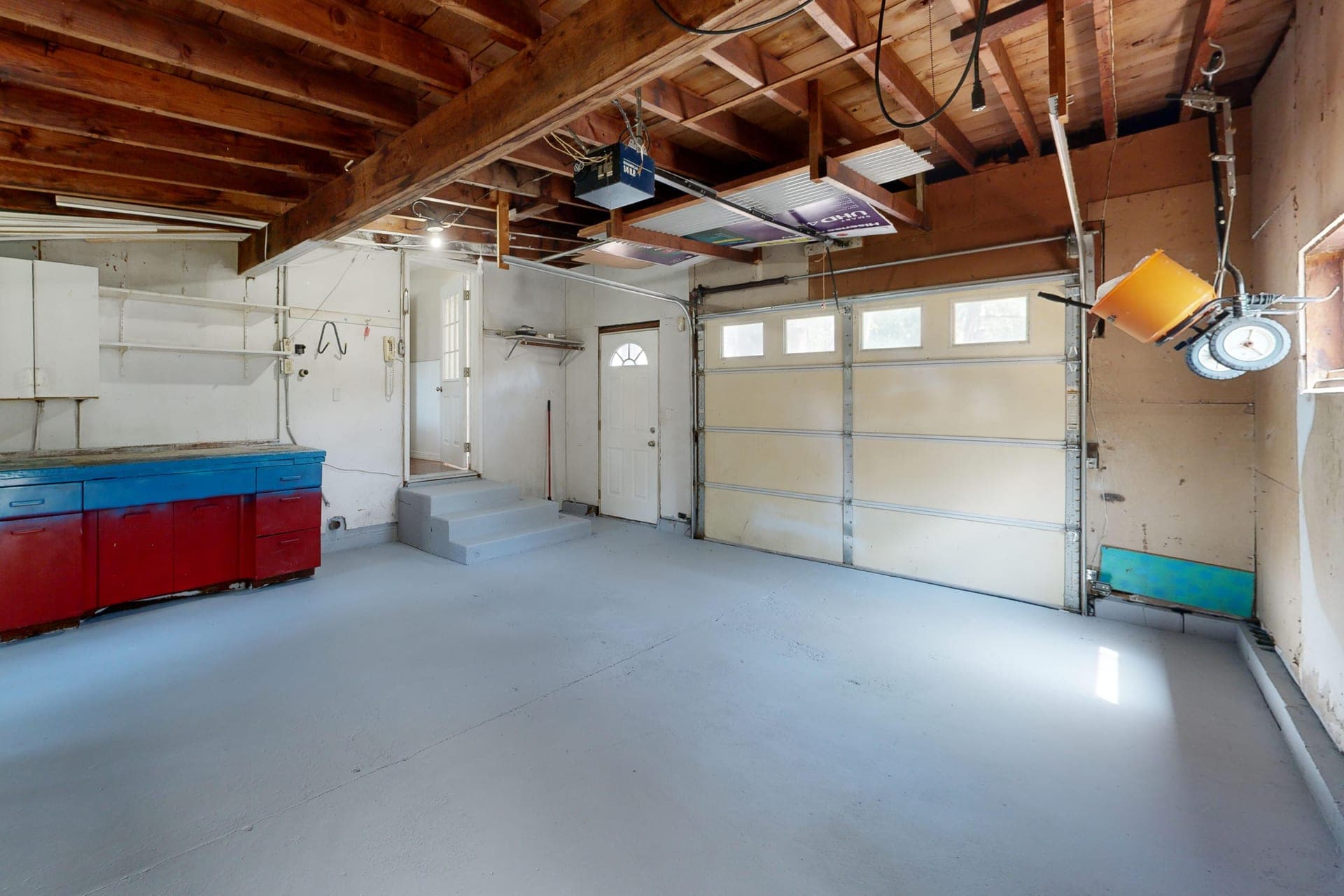
Every rule this site has about sizing assumes a sealed, insulated room. A garage is neither, which changes the answer more than the square footage does.
By Sawyer V. · Published
The short answer
Fix the envelope before you size anything. An uninsulated garage door is the largest thermal weak point in most homes, and cooling through it is money leaving the building. If the space is genuinely sealed, a through-the-wall unit at 425.5 kWh a year beats a window one because a garage rarely has a usable window. In a dry climate, 3,100 CFM on 250 W of evaporative cooling is the better trade.
Fan & Frost earns a commission when you buy through our links, at no cost to you. It never changes a ranking, and we say so when the right answer is the cheaper unit or nothing at all. Full disclosure · How we pick.
At a glance
The picks, ranked
Tap any row to jump to the full reasoning. Prices are live from Amazon where we have them, and read “check price” where we don’t — never a number we cannot verify today.
| # | Product | Best for | Price |
|---|---|---|---|
| 1 | 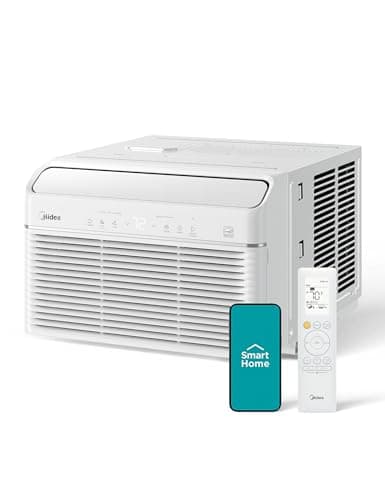 Best overall Midea Through-the-Wall Air Conditioner, 8,000 BTU 425.5 kWh a year at CEER 14.1, Most Efficient — through a wall, which is the opening a garage actually has. | A sealed, insulated garage with a wall you can put a sleeve in | |
| 2 | Best capacity that is still efficient Friedrich Kuhl Window Air Conditioner, 14,100 BTU 14,100 BTU at CEER 16.2 and 652.8 kWh a year — the most efficient large-capacity unit we hold data for. | A large or poorly insulated garage with a window opening | |
| 3 | 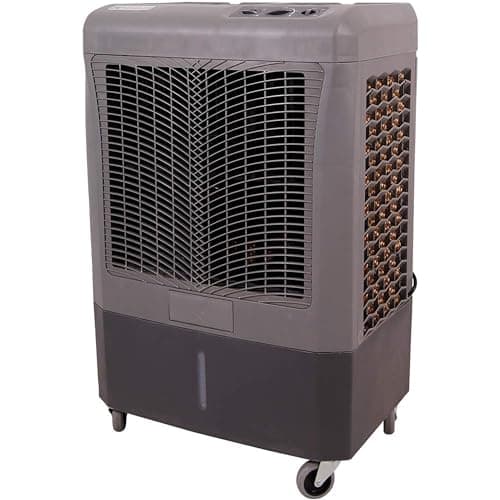 Best in a dry climate Hessaire MC37M Mobile Evaporative Cooler 3,100 CFM on 250 W with a continuous water hookup — and a garage is one of the few places evaporative cooling genuinely belongs. | A garage in a dry region, worked in with the door open | |
| 4 | 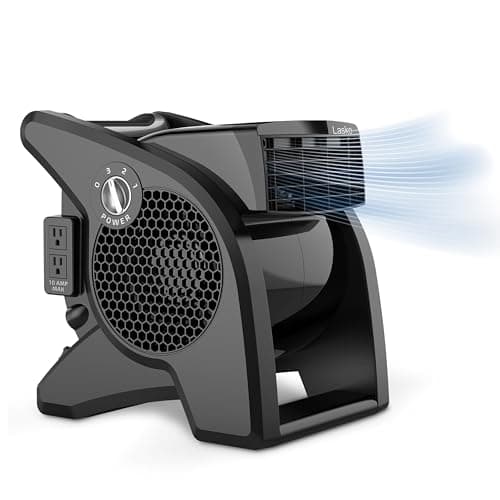 Cheapest thing that helps Lasko Max Performance 15" Air Mover 160 to 178 W of directed air with a pivoting head and two accessory outlets. | Short working sessions where you just need air moving | |
| — | 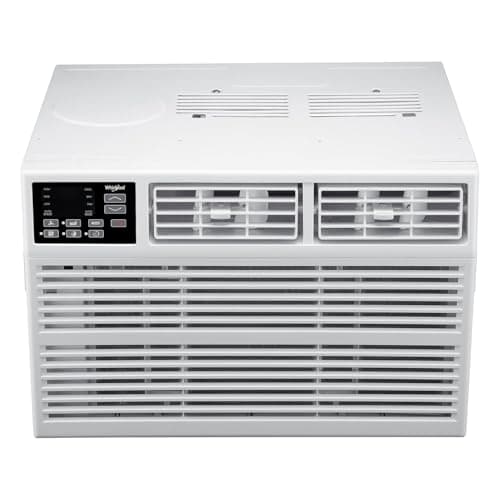 The oversizing trap Whirlpool Window Air Conditioner, 24,000 BTU 24,000 BTU at CEER 12.7 and 1,417.3 kWh a year — the least efficient certified unit, bought to beat an unsealed envelope. | A genuinely large sealed space, sized after the envelope work |
A garage breaks the assumption behind every sizing table on this site: that you are cooling a sealed, insulated room.
The problem
You are cooling a box with a door-sized hole in it
Sizing guidance works from floor area because, in a house, floor area is a reasonable proxy for how much heat gets in. In a garage it is not.
- The garage door is usually uninsulated and is the single largest exterior surface. A thin steel panel facing the sun is effectively a radiator.
- The door seals badly by design. It has to move, so it has gaps at the sides, the bottom and the top that no habitable room would tolerate.
- Walls and ceiling are frequently uninsulated too, particularly in a detached garage or one under a bonus room.
- The slab is a large thermal mass that holds yesterday’s heat and releases it slowly.
- A car that has just been driven is a very large heat source parked in the middle of the space.
The practical consequence: a garage sized by the standard table will be undersized in practice, and the correct response is to fix the envelope rather than to keep adding capacity.
Order
Do these before you buy a compressor
- Insulate the garage door. Highest impact per dollar in the entire project. It is the largest surface and usually the worst one.
- Seal the perimeter. Bottom seal, side seals, top seal. Cheap, and it turns a ventilated space into something that can hold cooling.
- Insulate the ceiling if there is living space above — which pays twice, because a room over a garage has a floor over unconditioned space.
- Let a hot car cool outside for a while before parking it in a space you are trying to condition.
- Then size the equipment, and only then. What load reduction is worth in certified terms — a capacity step is roughly $34 a year.
Which type
Why through-the-wall usually wins here
In almost every other room on this site the answer is a window unit. The garage inverts it, for practical rather than thermodynamic reasons.
| Type | Fits a garage? | Note |
|---|---|---|
| Through-the-wall | Usually | Garages have wall and no usable window |
| Window unit | Rarely | Most garage windows are small, high or fixed |
| Mini-split | Yes, at a cost | Licensed install; the premium answer |
| Portable | Poorly | Needs a vent route, and loses to a leaky envelope |
| Evaporative | Yes, if dry | Wants the door open, which a garage allows |
| Exhaust fan | Yes | Removes heat rather than making cold |
The two that get overlooked are the last two. Evaporative cooling normally fails indoors because it needs an open window; a garage already has an open door. And an exhaust fan removes accumulated heat for a fraction of a compressor’s draw, which is frequently all a workshop-hours garage needs.
This one is not a DIY job
Do not run a vehicle in an enclosed garage while a cooling system recirculates the air. Carbon monoxide is a lethal risk and no air conditioner removes it — a room air conditioner recirculates indoor air rather than exchanging it.
If the garage is attached to living space, the wall and ceiling between them is usually a fire separation required by code. Cutting through it for ducting or an opening is a building and safety matter, not a DIY one.
Cutting a new through-the-wall sleeve is structural work with a load-bearing decision and weatherproofing to get right. That belongs to a contractor.
A garage circuit is often shared with door openers and outlets. Confirm it can carry a compressor before you plan an installation.
Cost
Is refrigeration worth it for the hours you use it?
This is the question the category avoids, and it decides the purchase for most people.
- An 8,000 BTU through-wall unit: $78 for a season.
- A 14,100 BTU window unit: $120.
- A 24,000 BTU unit: $260.
- An evaporative cooler at 250 W: 18¢ per four-hour session — about $9.54 for a session every week of the year.
- An air mover at 178 W: 6.5¢ for two hours.
If you are in the garage for a few hours at weekends, the fan or the evaporative cooler wins on every measure. If it is a genuine workshop, home gym or office, refrigeration earns its place — but only after the door is insulated.
Say the unwelcome thing
Do not buy a bigger air conditioner for an uninsulated garage.
It is the standard escalation, and the certified data shows it costs twice.
An uninsulated garage door is the largest thermal weak point in most homes. Cooling harder against it does not seal it; it just moves more heat out of a box that keeps refilling.
And the biggest units are the worst ones. The 24,000 BTU unit here is CEER 12.7 against 16.2 for the 14,100 BTU unit and 16 for a small one, so you pay more per BTU as well as buying more BTU — $260 a year against $78.
Insulate and seal the door first. Then 425.5 kWh a year through the wall is usually enough — or in a dry climate, 3,100 CFM on 250 W with the door open.
In full
Every pick, and what is wrong with it
Published specifications only, each linked to the page it came from. Where a manufacturer publishes nothing, the row says so — we do not fill blanks in.
1. Best overall
Midea Through-the-Wall Air Conditioner, 8,000 BTU
Midea · model MAT08R1FWTK
425.5 kWh a year at CEER 14.1, Most Efficient — through a wall, which is the opening a garage actually has.
The format fits the building. Garages have plenty of wall and almost never a usable sash window, which reverses the usual preference for a window unit.
425.5 kWh a year, about $78 for a season at 18.34¢/kWh, at CEER 14.1 — on the Most Efficient list, because through-the-wall units are rated as their own class.
Variable-speed compressor and R-32. Variable speed matters here because a garage load swings hard with the sun on the door.
An existing sleeve is required, and cutting a new one is structural work. What that involves.
What’s wrong with it
It needs an existing sleeve, and 8,000 BTU is only enough in a garage you have properly sealed.
Running cost — MAT08R1FWTK
| Annual energy use | 425.5 kWh | ENERGY STAR certified figure |
|---|---|---|
| Annual cost | $78 | 425.5 × 18.34¢/kWh |
| Per cooling month | $20 | spread over a four-month season |
The annual figure is the certified value from the ENERGY STAR Certified Room Air Conditioners dataset, which models a standard cooling season rather than your actual summer. It is more useful than a nameplate wattage here, because a variable-speed compressor spends most of its life well below nameplate.
Rate: 18.34¢/kWh, the US average residential price for June 2026 (EIA Electric Power Monthly, Table 5.3). Yours will differ — swap it in: (watts ÷ 1000) × hours × your rate.
| Cooling capacity | 8,000 BTU/h |
|---|---|
| CEER | 14.1 |
| Annual energy use | 425.5 kWh/yr |
| Refrigerant | R-32 |
| Installation | Through the wall (existing sleeve required) |
| Compressor | Variable speed |
| ENERGY STAR | Certified, and on the Most Efficient list |
Every figure above is from ENERGY STAR Certified Room Air Conditioners dataset. Blanks are shown as “not published” rather than filled in.
2. Best capacity that is still efficient
Friedrich Kuhl Window Air Conditioner, 14,100 BTU
Friedrich · model KCVM14B10B
14,100 BTU at CEER 16.2 and 652.8 kWh a year — the most efficient large-capacity unit we hold data for.
If the garage is large, or the envelope work is only partly done, this is what real capacity looks like without the usual efficiency penalty.
CEER 16.2 at 14,100 BTU is exceptional for the size — efficiency normally falls away above 14,000 BTU, and this is where the curve is still intact.
652.8 kWh a year, about $120 at 18.34¢/kWh, and 51% below the federal standard.
70.0 lb, straddles the sill. The real obstacle is that most attached garages have a small high window or none at all, which is why the through-wall unit leads this page.
What’s wrong with it
70 lb straddling a windowsill, and most garages do not have the window for it.
Running cost — KCVM14B10B
| Annual energy use | 652.8 kWh | ENERGY STAR certified figure |
|---|---|---|
| Annual cost | $120 | 652.8 × 18.34¢/kWh |
| Per cooling month | $30 | spread over a four-month season |
The annual figure is the certified value from the ENERGY STAR Certified Room Air Conditioners dataset, which models a standard cooling season rather than your actual summer. It is more useful than a nameplate wattage here, because a variable-speed compressor spends most of its life well below nameplate.
Rate: 18.34¢/kWh, the US average residential price for June 2026 (EIA Electric Power Monthly, Table 5.3). Yours will differ — swap it in: (watts ÷ 1000) × hours × your rate.
| Cooling capacity | 14,100 BTU/h |
|---|---|
| CEER | 16.2 |
| Annual energy use | 652.8 kWh/yr |
| vs federal standard | 51% less energy |
| Dimensions | 17.9 H x 25.9 W x 29.0 D in |
| Weight | 70.0 lb |
| Refrigerant | R-32 |
| Installation | Straddles the windowsill |
| Compressor | Variable speed |
| ENERGY STAR | Certified |
Every figure above is from ENERGY STAR Certified Room Air Conditioners dataset. Blanks are shown as “not published” rather than filled in.
3. Best in a dry climate
Hessaire MC37M Mobile Evaporative Cooler
Hessaire · model MC37M
3,100 CFM on 250 W with a continuous water hookup — and a garage is one of the few places evaporative cooling genuinely belongs.
A garage is one of the two or three places on this site where we recommend evaporative cooling without hedging, and the reason is the ventilation requirement.
Evaporative coolers need a continuous supply of dry outdoor air and an opening for it to leave through. In most rooms that is a dealbreaker. In a garage you are usually working with the door open anyway.
3,100 CFM on 250 W — about 18¢ for a four-hour session — which is a very large volume of air for the power, because evaporation does the cooling rather than a compressor.
Continuous hookup capable matters: a 10.3 gallon tank will not last at this airflow. Check your climate first — above roughly 60% relative humidity this does very little.
What’s wrong with it
It needs dry air and an open door, so it is useless in a humid climate and in a sealed garage.
Running cost — MC37M
| Nameplate power | 250 W | manufacturer's published figure |
|---|---|---|
| Energy, 8-hour night | 2.00 kWh | 250 ÷ 1000 × 8 |
| Cost per hour | 4.6¢ | at 18.34¢/kWh |
| Cost per 8-hour night | 37¢ | on the highest speed |
| Cost per 30 nights | $11 | 60.0 kWh |
Rate: 18.34¢/kWh, the US average residential price for June 2026 (EIA Electric Power Monthly, Table 5.3). Yours will differ — swap it in: (watts ÷ 1000) × hours × your rate.
| Air delivery | 3,100 CFM |
|---|---|
| Power | 250 W / 2.4 A |
| Water tank | 10.3 gallons, continuous hookup capable |
| Dimensions | 24 L x 16 W x 38 H in |
| Weight | 40 lb |
| Pads | Industrial-grade cooling pads |
| Coverage claim | Not published on the product page |
Every figure above is from Hessaire product page, MC37M. Blanks are shown as “not published” rather than filled in.
4. Cheapest thing that helps
Lasko Max Performance 15" Air Mover
Lasko · model U15720
160 to 178 W of directed air with a pivoting head and two accessory outlets.
Before spending on refrigeration in a space you may use for two hours a week, this is the honest first purchase.
160 to 178 W across three speeds — about 6.5¢ for a two-hour session. Against $78 a season for the through-wall unit, the arithmetic depends entirely on how much you are in there.
The pivoting head aims air where you are working rather than at the ceiling, and the two 120 V accessory outlets and 9.5 ft cord suit a workspace with limited sockets.
12.55 lb and built as a utility air mover. The full garage cooling picture — and note that it is a burst tool, not background running.
What’s wrong with it
178 W is high for a fan, and it lowers no temperature at all.
Running cost — U15720
| Nameplate power | 160 W – 178 W | manufacturer's published figure |
|---|---|---|
| Energy, 8-hour night | 1.42 kWh | 178 ÷ 1000 × 8 |
| Cost per hour | 3.3¢ | at 18.34¢/kWh |
| Cost per 8-hour night | 26¢ | on the highest speed |
| Cost per 30 nights | $7.83 | 42.7 kWh |
| Same month, lowest speed | $7.04 | at 160 W |
Rate: 18.34¢/kWh, the US average residential price for June 2026 (EIA Electric Power Monthly, Table 5.3). Yours will differ — swap it in: (watts ÷ 1000) × hours × your rate.
| Power | 160 W - 178 W (1.35-1.53 A at 120 V) |
|---|---|
| Speeds | 3 |
| Dimensions | 14.5 H x 14.0 D x 11.5 W in |
| Weight | 12.55 lb |
| Extras | Two 120 V accessory outlets, 9.5 ft cord, pivoting head |
| Air delivery (CFM) | Not published |
| Warranty | 1 year |
Every figure above is from Lasko product page, U15720. Blanks are shown as “not published” rather than filled in.
Skip this one
Whirlpool Window Air Conditioner, 24,000 BTU
Whirlpool · model WHAW-241IN
24,000 BTU at CEER 12.7 and 1,417.3 kWh a year — the least efficient certified unit, bought to beat an unsealed envelope.
This is what happens when a garage will not cool and the response is more machine rather than a better envelope.
1,417.3 kWh a year — about $260 at 18.34¢/kWh, and five times the smallest certified unit.
CEER 12.7 is the sting. It is the least efficient unit in the certified set, so every extra BTU also costs more to produce than it would in a smaller machine.
115.7 lb and firmly bracket territory. If you genuinely have a large sealed space this is the right shape of product — just insulate the door first, because otherwise you are air-conditioning the driveway.
What’s wrong with it
Buying capacity to fight an uninsulated garage door costs five times a small unit, every year.
Running cost — WHAW-241IN
| Annual energy use | 1417.3 kWh | ENERGY STAR certified figure |
|---|---|---|
| Annual cost | $260 | 1417.3 × 18.34¢/kWh |
| Per cooling month | $65 | spread over a four-month season |
The annual figure is the certified value from the ENERGY STAR Certified Room Air Conditioners dataset, which models a standard cooling season rather than your actual summer. It is more useful than a nameplate wattage here, because a variable-speed compressor spends most of its life well below nameplate.
Rate: 18.34¢/kWh, the US average residential price for June 2026 (EIA Electric Power Monthly, Table 5.3). Yours will differ — swap it in: (watts ÷ 1000) × hours × your rate.
| Cooling capacity | 24,000 BTU/h |
|---|---|
| CEER | 12.7 |
| Annual energy use | 1,417.3 kWh/yr |
| vs federal standard | 35% less energy |
| Dimensions | 20.7 H x 30.0 W x 28.8 D in |
| Weight | 115.7 lb |
| Refrigerant | R-32 |
| Installation | Straddles the window; support bracket territory |
| ENERGY STAR | Certified |
Every figure above is from ENERGY STAR Certified Room Air Conditioners dataset. Blanks are shown as “not published” rather than filled in.
We are not linking a buy button for this one. If you want to look at it anyway, it is easy enough to find — but we would rather send you to something that fits your room.
Questions people actually ask
Frequently asked
What size air conditioner do I need for a garage?
More than the square-footage table suggests, because a garage is not a sealed insulated room — but the right move is to fix the envelope rather than size up. Insulate and seal the garage door first; it is the largest exterior surface and usually the worst one.
Can I put a window air conditioner in a garage?
Rarely, in practice. Most garages have a small high window, a fixed one, or none. That is why a through-the-wall unit is usually the better format here — a garage has plenty of wall and no usable sash. Through-the-wall units.
Is an evaporative cooler good for a garage?
In a dry climate, yes — a garage is one of the few places we recommend one without hedging. They need a continuous supply of dry air and an opening for it to leave, which a garage door provides. Above roughly 60% relative humidity they do very little. Swamp coolers for garages.
How much does it cost to cool a garage?
About $78 for a season with an 8,000 BTU through-wall unit, $120 for 14,100 BTU, or $260 for a 24,000 BTU unit at 18.34¢/kWh. An evaporative cooler is about 18¢ per four-hour session.
Is it safe to run an air conditioner in a garage with a car?
Never run a vehicle in an enclosed garage. Carbon monoxide is lethal and a room air conditioner does not remove it — it recirculates indoor air rather than exchanging it. That is a safety rule, not a comfort one.
Would an exhaust fan be enough instead?
Frequently, for a garage used a few hours at a time. An exhaust fan removes accumulated heat for a fraction of a compressor's draw, and a garage that is only occupied occasionally rarely justifies refrigeration. Garage exhaust fans.
Sources
Where these numbers came from
- ENERGY STAR Certified Room Air Conditioners dataset — capacity, CEER, annual kWh and Most Efficient flag
- Hessaire MC37M product page — 3,100 CFM, 250 W, 10.3 gal continuous hookup
- Lasko U15720 product page — 160-178 W air mover, pivoting head, accessory outlets
- EIA Electric Power Monthly, Table 5.3 — average residential electricity price
Read next
Where to go from here
Back to Air Conditioners, or read how we pick.