Guide and picks
Cooling a workshop
The room is hot, dusty and full of things you cannot put a fan next to. That combination rules out most of the usual advice.
By Sawyer V. · Published
The short answer
Deal with extraction and airflow before cooling. A workshop makes its own heat from tools and lighting, and its own airborne load from dust and fumes, so removing air beats conditioning it. In a dry climate an evaporative cooler at 3,100 CFM on 250 W is the strongest option. Choose fans that survive the environment — commercial-grade construction and wall or clip mounting to keep bench space clear.
Fan & Frost earns a commission when you buy through our links, at no cost to you. It never changes a ranking, and we say so when the right answer is the cheaper unit or nothing at all. Full disclosure · How we pick.

At a glance
The picks, ranked
Tap any row to jump to the full reasoning. Prices are live from Amazon where we have them, and read “check price” where we don’t — never a number we cannot verify today.
| # | Product | Best for | Price |
|---|---|---|---|
| 1 | 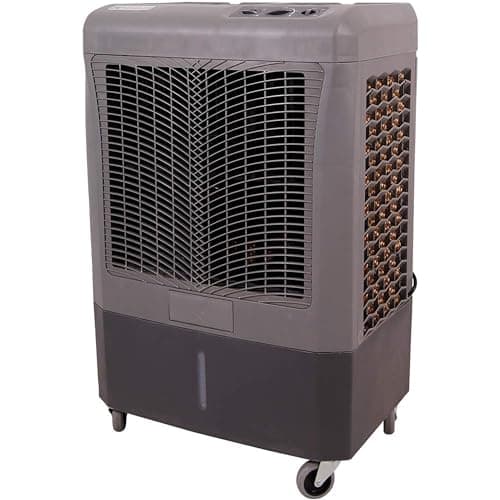 Best in a dry climate Hessaire MC37M Mobile Evaporative Cooler 3,100 CFM on 250 W with a continuous hookup — the best air-per-watt in the category, and a real temperature drop. | A workshop with the door open, where the air is genuinely dry | |
| 2 | 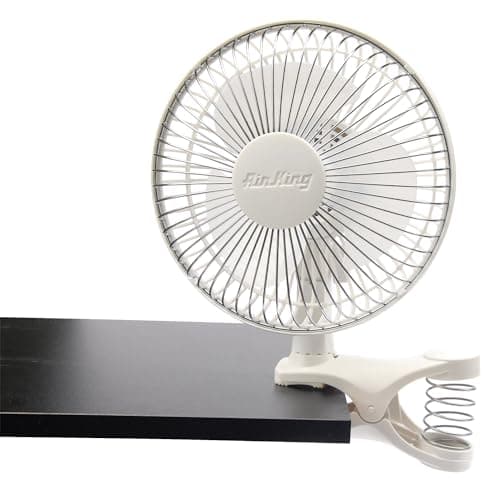 Best personal fan for a bench Air King 6" Commercial Grade Clip-On Fan ETL listed and OSHA compliant at 9 to 12 W, on a clip that mounts to a shelf edge or bench lip. | Air on you while you work, without using bench space | |
| 3 | 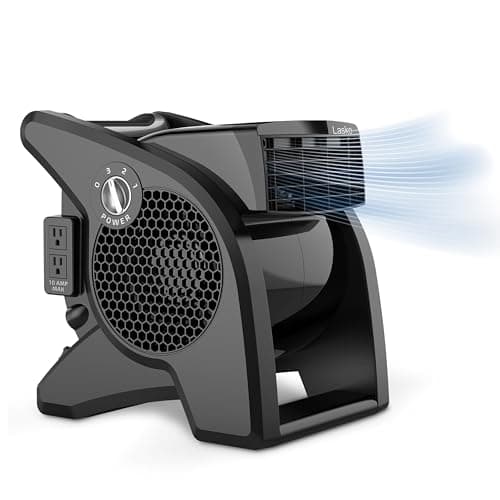 For moving air, not cooling people Lasko Max Performance 15" Air Mover 160 to 178 W with a pivoting head and two 120 V accessory outlets — a genuine shop tool. | Clearing dust and fumes, drying finishes, purging the space | |
| — | The wrong machine for this room Whynter ARC-14S Dual Hose Portable Air Conditioner 1,300 W and 9,500 BTU SACC, in a room that is usually open to outside and full of dust. | A sealed office — which a workshop is not |
A workshop is hot for reasons a house is not, and the fixes that work in a living room mostly do not apply.
Why it is hot
The room makes its own heat
Every powered tool converts most of its electrical draw into heat, and in a workshop several of them run at once. A dust extractor, a compressor and a bench light together are a substantial continuous load in a space that is usually poorly insulated to begin with.
Add the usual workshop building — a garage, an outbuilding, a shed — with thin walls, an uninsulated roof and a large door facing whichever way it faces, and the heat has nowhere to go.
Which changes the priority order. Getting air out beats conditioning air that is being continuously reheated.
First
Extraction, and why it comes before cooling
A workshop generates airborne contamination as well as heat, and the same measure addresses both.
- Heat leaves with the air. Exhaust ventilation brings the space toward outdoor temperature, which on a hot day is not cool but is a large improvement on a closed workshop.
- Dust and fumes leave too. Sanding dust, solvent vapor, welding fume — none of which a cooling appliance addresses at all.
- Humidity leaves. Which matters in a room full of steel tools.
Certified in-line duct fans reach 750 CFM at 4.6 CFM per watt, and utility ventilating fans reach 14.2 CFM per watt at lower airflow. The certified options.
Give it an intake. Pulling air from a sealed workshop creates negative pressure the fan then fights, so it moves far less than its rating. A low opening on the opposite side lets air cross the space diagonally.
This one is not a DIY job
Ventilation around fumes is a safety matter, not a comfort one. Solvent vapor, welding fume, engine exhaust and finish spraying all have specific ventilation requirements that come from the material safety data and your local code, not from a cooling site.
If the workshop is attached to a house, depressurising it can pull air the wrong way through the shared wall. And if there is any fuel-burning appliance in or near the space, make-up air sizing is professional work.
A fan aimed at a work area moves dust with it. That is fine when clearing a space and unhelpful when finishing something. Think about what is airborne before pointing anything at a bench.
Then
Airflow on the person, not the room
Once the air is moving through the space, the remaining problem is you standing in it. That is a personal airflow question, and it is cheap.
The constraint specific to a workshop is mounting. A pedestal fan on the floor is in the way, gets knocked, and sits in the dust. Two better answers:
- Clip mounting to a shelf edge, bench lip or post — no floor or bench space used, and easy to move as you move.
- Wall mounting for something permanent, aimed across the main working area from height. What supports it.
Either way, choose for the environment. A workshop is dusty, sometimes greasy, and things get knocked — commercial-grade construction with a metal guard survives it better than a plastic domestic fan.
Maintenance
Fans die faster in here
Workshop air carries far more particulate than domestic air, and it lands on the same places: blades, guards and motor vents.
Dust on blades changes their shape, so the fan moves less air per revolution while the motor works just as hard. Dust in the vents then stops the motor shedding that extra heat — and heat is what kills bearings and capacitors.
Clean workshop fans monthly, not twice a season. Blades, guard front and back, and the motor housing vents. The procedure, and why it matters most here.
The building
The free measures that outperform everything
- Insulate the door. On a sun-facing wall, a large uninsulated door is usually the biggest single heat input in the building, and an insulation kit costs a fraction of any cooling appliance.
- Insulate or shade the roof. A metal or single-skin roof in direct sun radiates heat down all afternoon.
- Work with the thermal mass. A concrete slab absorbs heat all day and releases it all evening, which is why ventilating at 9pm achieves more than ventilating at 4pm.
- Shift the schedule. The cheapest cooling in a workshop is doing the hot work in the morning.
Say the unwelcome thing
Do not buy an air conditioner for a workshop you keep open.
An air conditioner moves heat from inside a sealed space to outside it. A workshop with the door up is not a sealed space, so the machine is cooling the outdoors and losing.
Even closed, a workshop is a poor candidate. It is usually uninsulated, it generates continuous heat from tools, and its air carries a dust load that clogs an evaporator coil far faster than domestic air does.
A portable makes it worse still — it exhausts room air outdoors, so with the building already leaky it pulls hot outdoor air in through every gap, at 1,300 W.
Ventilate, insulate the door, and put airflow on yourself. In a dry climate, an evaporative cooler is the one machine that genuinely lowers the temperature in a space that has to stay open.
In full
Every pick, and what is wrong with it
Published specifications only, each linked to the page it came from. Where a manufacturer publishes nothing, the row says so — we do not fill blanks in.
1. Best in a dry climate
Hessaire MC37M Mobile Evaporative Cooler
Hessaire · model MC37M
3,100 CFM on 250 W with a continuous hookup — the best air-per-watt in the category, and a real temperature drop.
A workshop with the roller door up has the air exchange evaporative cooling requires built in, which is why this format suits the space so well.
3,100 CFM on 250 W — about 37¢ for an eight-hour day — and a 10.3 gallon tank with continuous hookup, which matters for a machine running full sessions.
Unlike a fan, this genuinely lowers the air temperature. In a hot dry workshop that is the difference between tolerable and not.
The precondition is real: check your humidity first. In damp air it adds moisture to a room full of steel tools.
What’s wrong with it
Only works in dry air, needs an air path out, and Hessaire publishes no noise rating.
Running cost — MC37M
| Nameplate power | 250 W | manufacturer's published figure |
|---|---|---|
| Energy, 8-hour night | 2.00 kWh | 250 ÷ 1000 × 8 |
| Cost per hour | 4.6¢ | at 18.34¢/kWh |
| Cost per 8-hour night | 37¢ | on the highest speed |
| Cost per 30 nights | $11 | 60.0 kWh |
Rate: 18.34¢/kWh, the US average residential price for June 2026 (EIA Electric Power Monthly, Table 5.3). Yours will differ — swap it in: (watts ÷ 1000) × hours × your rate.
| Air delivery | 3,100 CFM |
|---|---|
| Power | 250 W / 2.4 A |
| Water tank | 10.3 gallons, continuous hookup capable |
| Dimensions | 24 L x 16 W x 38 H in |
| Weight | 40 lb |
| Pads | Industrial-grade cooling pads |
| Coverage claim | Not published on the product page |
Every figure above is from Hessaire product page, MC37M. Blanks are shown as “not published” rather than filled in.
2. Best personal fan for a bench
Air King 6" Commercial Grade Clip-On Fan
Air King · model 9145
ETL listed and OSHA compliant at 9 to 12 W, on a clip that mounts to a shelf edge or bench lip.
ETL listed and OSHA compliant with a metal guard is a jobsite specification rather than a domestic one, and in a workshop that construction matters.
The spring-loaded non-marking clip is the real feature. It mounts to a shelf edge, a bench lip or a post, so it uses no bench space at all — which in a workshop is the scarcest resource.
9 to 12 W — 1.8¢ for an eight-hour day — and 34 to 37 dBA, a three-decibel spread so the sound does not change when you adjust it.
Clean it more often than you would at home. Dust and fine debris load the guard and blades far faster here.
What’s wrong with it
190 CFM is personal airflow only — it does nothing for the room, and the guard needs regular cleaning in dust.
Running cost — 9145
| Nameplate power | 9 W – 12 W | manufacturer's published figure |
|---|---|---|
| Energy, 8-hour night | 0.10 kWh | 12 ÷ 1000 × 8 |
| Cost per hour | 0.2¢ | at 18.34¢/kWh |
| Cost per 8-hour night | 1.8¢ | on the highest speed |
| Cost per 30 nights | 53¢ | 2.9 kWh |
| Same month, lowest speed | 40¢ | at 9 W |
Rate: 18.34¢/kWh, the US average residential price for June 2026 (EIA Electric Power Monthly, Table 5.3). Yours will differ — swap it in: (watts ÷ 1000) × hours × your rate.
| Power | 9 W - 12 W (0.1-0.2 A at 120 V) |
|---|---|
| Air delivery | Up to 190 CFM |
| Noise | 34 dBA low, 37 dBA high |
| Speeds | 2 |
| Mounting | Spring-loaded clip, non-marking |
| Dimensions | 10.38 H x 6.25 L x 8.13 W in |
| Weight | 2.22 lb |
| Cord | 6 ft, 3-conductor |
| Listing | ETL listed, OSHA compliant |
| Warranty | 1 year |
Every figure above is from Air King product page, 9145 (via Lasko). Blanks are shown as “not published” rather than filled in.
3. For moving air, not cooling people
Lasko Max Performance 15" Air Mover
Lasko · model U15720
160 to 178 W with a pivoting head and two 120 V accessory outlets — a genuine shop tool.
A workshop has jobs a comfort fan cannot do: pushing air out of a doorway, drying a finish, clearing a dust cloud, ventilating after solvent work.
The pivoting head aims from floor to ceiling, and the two 120 V accessory outlets mean it can sit in the middle of a run of tools without eating the only socket.
160 to 178 W — about 13¢ for a four-hour session. Velocity is expensive, and that is what you are paying for.
9.5 ft cord and 12.55 lb with a handle. Not a fan to leave running for comfort.
What’s wrong with it
178 W is the highest draw on this page, and Lasko publishes no CFM figure to set against it.
Running cost — U15720
| Nameplate power | 160 W – 178 W | manufacturer's published figure |
|---|---|---|
| Energy, 8-hour night | 1.42 kWh | 178 ÷ 1000 × 8 |
| Cost per hour | 3.3¢ | at 18.34¢/kWh |
| Cost per 8-hour night | 26¢ | on the highest speed |
| Cost per 30 nights | $7.83 | 42.7 kWh |
| Same month, lowest speed | $7.04 | at 160 W |
Rate: 18.34¢/kWh, the US average residential price for June 2026 (EIA Electric Power Monthly, Table 5.3). Yours will differ — swap it in: (watts ÷ 1000) × hours × your rate.
| Power | 160 W - 178 W (1.35-1.53 A at 120 V) |
|---|---|
| Speeds | 3 |
| Dimensions | 14.5 H x 14.0 D x 11.5 W in |
| Weight | 12.55 lb |
| Extras | Two 120 V accessory outlets, 9.5 ft cord, pivoting head |
| Air delivery (CFM) | Not published |
| Warranty | 1 year |
Every figure above is from Lasko product page, U15720. Blanks are shown as “not published” rather than filled in.
Skip this one
Whynter ARC-14S Dual Hose Portable Air Conditioner
Whynter · model ARC-14S
1,300 W and 9,500 BTU SACC, in a room that is usually open to outside and full of dust.
Portable air conditioners get bought for workshops and they suit the space badly on three counts.
They need a sealed room. A workshop with the door open — which is how most are used — gives it an infinite heat load and no chance.
The dust load is wrong. A portable pulls room air over its evaporator continuously, and workshop air carries sawdust and fine debris that clog the coil far faster than domestic dust.
1,300 W — $1.91 for an eight-hour day — and 9,500 BTU SACC from a 14,000 BTU headline.
What’s wrong with it
It needs a sealed room to work, its filter faces a dust load it was not designed for, and it exhausts room air.
Running cost — ARC-14S
| Nameplate power | 1300 W | manufacturer's published figure |
|---|---|---|
| Energy, 8-hour night | 10.40 kWh | 1300 ÷ 1000 × 8 |
| Cost per hour | 24¢ | at 18.34¢/kWh |
| Cost per 8-hour night | $1.91 | on the highest speed |
| Cost per 30 nights | $57 | 312.0 kWh |
Rate: 18.34¢/kWh, the US average residential price for June 2026 (EIA Electric Power Monthly, Table 5.3). Yours will differ — swap it in: (watts ÷ 1000) × hours × your rate.
| Marketing capacity | 14,000 BTU (ASHRAE-128) |
|---|---|
| DOE-rated capacity | 9,500 BTU SACC |
| Hoses | Dual |
| Power | 1,300 W / 11.6 A at 115 V |
| Noise | Under 51 dBA low, under 56 dBA high |
| Dehumidification | 71 pints/day |
| Refrigerant | R-32 |
| Dimensions | 16 W x 19 D x 35.5 H in |
| Weight | 73 lb |
| Manufacturer coverage claim | 500 sq ft |
| Warranty | 1 year unit, 3 years compressor |
Every figure above is from Whynter product page, ARC-14S. Blanks are shown as “not published” rather than filled in.
We are not linking a buy button for this one. If you want to look at it anyway, it is easy enough to find — but we would rather send you to something that fits your room.
Questions people actually ask
Frequently asked
What is the best way to cool a workshop?
Extraction first, because a workshop makes its own heat from tools and its own airborne load from dust and fumes. Then airflow on yourself, ideally clip- or wall-mounted to keep bench space clear. In a dry climate, an evaporative cooler genuinely lowers the temperature.
Will an air conditioner work in a workshop?
Poorly, and not at all with the door open — it moves heat out of a sealed space, and a workshop usually is not one. It is also generally uninsulated, generates continuous tool heat, and carries a dust load that clogs an evaporator coil quickly.
Do I need an intake vent for a workshop exhaust fan?
Yes. Pulling air out of a sealed workshop creates negative pressure the fan then fights, so it moves far less than its rating. A low opening on the opposite side lets air cross the space diagonally instead of short-circuiting. Exhaust fan sizing.
What kind of fan survives a workshop?
Commercial-grade construction with a metal guard rather than a plastic domestic fan, and clip or wall mounting so it is not on the floor collecting dust and getting knocked. Clean it monthly rather than twice a season.
Can I use an evaporative cooler in a workshop?
In a dry climate, yes — and it is one of the best applications, because a workshop with the door open already has the air exchange the format requires. In humid air it adds moisture to a room full of steel tools.
What free measures help most in a workshop?
Insulating the door, which on a sun-facing wall is usually the largest single heat input; insulating or shading the roof; and shifting hot work to the morning, since the slab absorbs heat all day and releases it all evening.
Sources
Where these numbers came from
- Hessaire MC37M product page — 3,100 CFM, 250 W, 10.3 gal tank, continuous hookup
- Air King 9145 product page — ETL listed, OSHA compliant, 9-12 W, 190 CFM, 34-37 dBA
- ENERGY STAR Certified Ventilating Fans dataset — in-line and utility fan CFM and efficacy
- EIA Electric Power Monthly, Table 5.3 — electricity rate
Read next
Where to go from here
Back to Room Cooling, or read how we pick.