Guide and picks
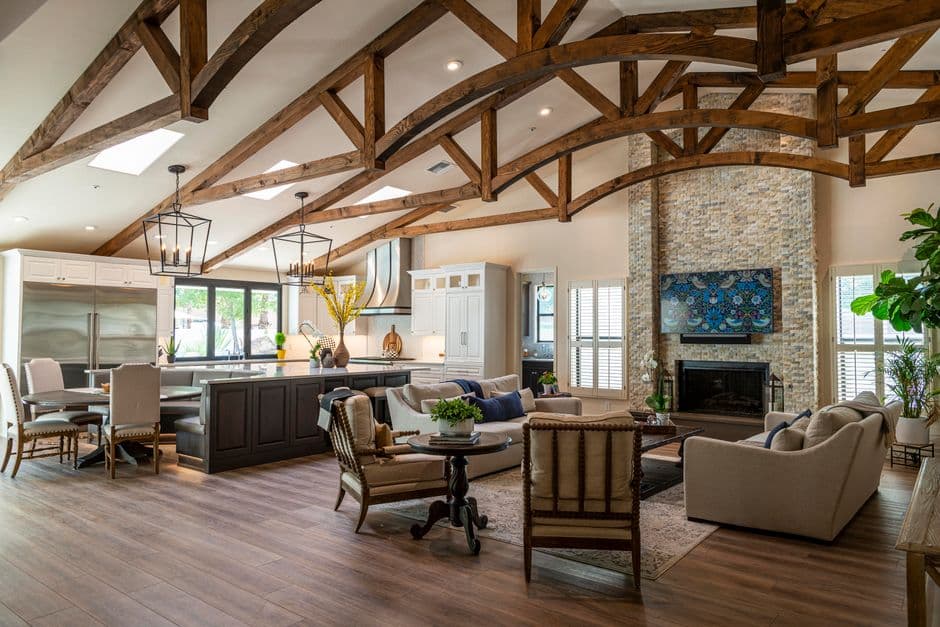
Cooling a room with a vaulted ceiling
The extra height is why the room looks good and why it never feels comfortable. Both problems come from the same cubic feet.
By Sawyer V. · Published
The short answer
Move the air before you buy more cooling. Warm air collects at the peak of a vaulted room, so the thermostat at head height reads cooler than the room actually holds and the cooling never satisfies. A long-drop ceiling fan or a circulator aimed upward mixes it back down for 2.4¢ a night. Size any air conditioner on volume, not floor area.
Fan & Frost earns a commission when you buy through our links, at no cost to you. It never changes a ranking, and we say so when the right answer is the cheaper unit or nothing at all. Full disclosure · How we pick.
At a glance
The picks, ranked
Tap any row to jump to the full reasoning. Prices are live from Amazon where we have them, and read “check price” where we don’t — never a number we cannot verify today.
| # | Product | Best for | Price |
|---|---|---|---|
| 1 | 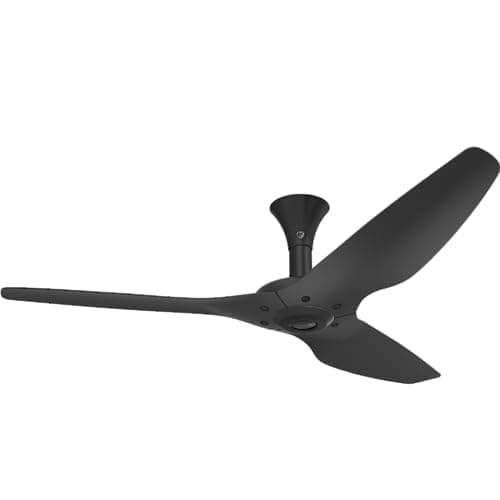 Best fan for a vaulted room Big Ass Fans Haiku 60" Low-Mount Ceiling Fan A 60-inch span built for large volumes — the diameter that actually reaches the floor from a vaulted height. | A great room or open living space with a high peak | |
| 2 | 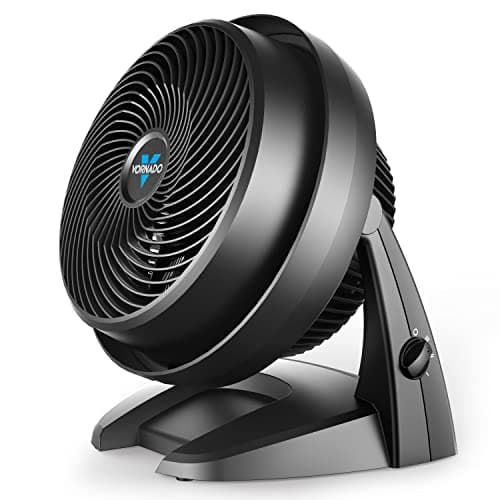 Cheapest way to break the stratification Vornado 630 Medium Air Circulator A shrouded circulator aimed at the peak — it mixes the warm layer back down without touching the ceiling. | Renting, or a vault where no ceiling fan can be fitted | |
| — | 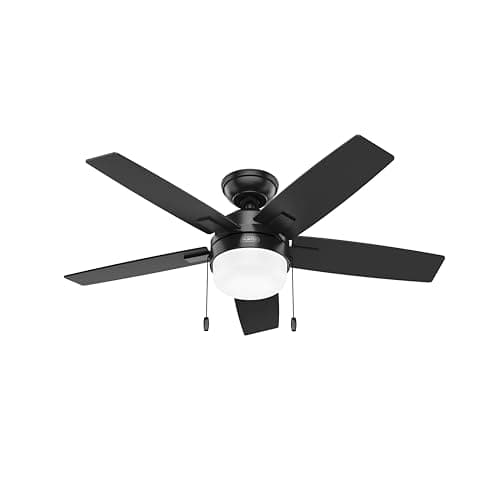 The one to skip here Hunter Anisten 44" Hugger Ceiling Fan 295.9 CFM per watt at 12.5 W in a 44-inch hugger — efficient, and far too small a span for a vaulted volume. | A low, flat ceiling — where it is genuinely good |
The problem
Warm air goes up and stays there
Warm air is less dense, so in any tall space it collects at the top. In a room with a flat 8-foot ceiling that layer is close enough to be stirred by normal movement. In a vaulted room with a 16-foot peak it can sit several degrees warmer than the air people are breathing, and nothing disturbs it.
Three consequences follow:
- The thermostat lies. Mounted at head height, it reads the cooler layer and calls for less cooling than the room needs.
- Heat leaks faster. A hot layer against the roof drives heat into the attic or through the vault, all day.
- You paid to cool air nobody uses. An air conditioner sized on volume is conditioning cubic feet above head height.
This one is not a DIY job
Sizing
Size cooling on volume, not floor area
Every BTU guideline in this category is written for an 8-foot ceiling, including the ENERGY STAR sizing table the rest of this site uses. A vaulted room with the same footprint holds far more air, and sizing from floor area alone will undersize it.
| Ceiling | Volume of a 300 sq ft room | Against an 8 ft room |
|---|---|---|
| 8 ft flat | 2,400 cu ft | Baseline |
| 10 ft flat | 3,000 cu ft | 25% more |
| Vault averaging 12 ft | 3,600 cu ft | 50% more |
| Vault averaging 14 ft | 4,200 cu ft | 75% more |
| Vault averaging 16 ft | 4,800 cu ft | Twice |
Average height, not peak height, is the figure to use: for a simple pitched vault it is roughly halfway between the wall height and the peak. Then step up a size from what the floor area alone suggested, and check the result against the BTU chart by room size.
The fix
Mixing beats capacity
- Install a large ceiling fan on a long downrod, blades 8 to 9 feet above the floor. Span matters more than speed: the certified median airflow at 60 to 72 inches is 7,443 CFM against 4,140 in the 44 to 52-inch band.
- Run it counterclockwise in summer to push air down, and reverse it in winter to bring the warm layer back down gently — both directions explained in ceiling fan direction in winter.
- Or aim a circulator at the peak where a fixture is impossible. Cheaper, portable, and effective on the same principle.
- Raise the thermostat once the air is mixed. A mixed room at 76°F is more comfortable than a stratified one at 72, and the arithmetic is in ceiling fan versus air conditioner.
The envelope
Vaults leak heat where you cannot see it
A vaulted ceiling usually means the insulation sits in the roof plane rather than on a flat attic floor, and often with less depth than a conventional attic allows. Combined with the warm layer pressing against it all afternoon, that makes the vault a significant heat path.
Two checks worth making before adding cooling capacity: whether the vault has continuous ventilation from eave to ridge, and whether any skylights are unshaded. Skylights in a vault are the single largest summer heat gain in most of these rooms, and external shading beats any amount of extra cooling — the envelope case is in window film and insulation for cooling.
Say the unwelcome thing
Do not buy a bigger air conditioner for a stratified room.
If the hot air is sitting above head height, adding capacity cools the layer you already occupy and leaves the layer above it alone, at greater expense. Worse, an oversized unit short-cycles, which removes less humidity and leaves the room cold and clammy.
Mix first, then size on volume. A 60-inch span on a long downrod is the permanent fix, and a circulator aimed at the peak is the cheap one that tells you, in an afternoon, how much of the problem was stratification.
In full
Every pick, and what is wrong with it
Published specifications only, each linked to the page it came from. Where a manufacturer publishes nothing, the row says so — we do not fill blanks in.
1. Best fan for a vaulted room
Big Ass Fans Haiku 60" Low-Mount Ceiling Fan
Big Ass Fans · model MK-HK4-05240001
A 60-inch span built for large volumes — the diameter that actually reaches the floor from a vaulted height.
In a vaulted room the fan has to push air a long way down, and span is what does that. The certified data is unambiguous about which end of the range to buy from: median airflow rises from 3,054 CFM below 36 inches to 10,286 CFM at 72 inches and up across 1,447 US records, and efficiency rises with it.
A 60-inch fan sits in the band where airflow and efficiency are both high, and it suits the width of most vaulted living rooms without crowding the walls.
Mount it so the blades sit around 8 to 9 feet above the floor regardless of how high the peak is, which on a vault means a long downrod — the arithmetic is in the downrod guide.
What’s wrong with it
A sloped ceiling needs an angled mount and a long rod, which adds cost, and a fan this size wants at least 18 inches from blade tip to anything.
Running cost — MK-HK4-05240001
| Nameplate power | 16.2 W | manufacturer's published figure |
|---|---|---|
| Energy, 8-hour night | 0.13 kWh | 16.2 ÷ 1000 × 8 |
| Cost per hour | 0.3¢ | at 18.34¢/kWh |
| Cost per 8-hour night | 2.4¢ | on the highest speed |
| Cost per 30 nights | 71¢ | 3.9 kWh |
Rate: 18.34¢/kWh, the US average residential price for June 2026 (EIA Electric Power Monthly, Table 5.3). Yours will differ — swap it in: (watts ÷ 1000) × hours × your rate.
| Blade span | 60 in |
|---|---|
| Efficiency | 339.0 CFM per watt |
| Power, high speed | 16.2 W |
| Standby power | 2.5 W |
| Type | Indoor low-mount (HSSD), fan only |
| Warranty | 5 years, components |
| ENERGY STAR | Certified, and on the Most Efficient list |
Every figure above is from ENERGY STAR Certified Ceiling Fans dataset. Blanks are shown as “not published” rather than filled in.
2. Cheapest way to break the stratification
Vornado 630 Medium Air Circulator
Vornado · model 630
A shrouded circulator aimed at the peak — it mixes the warm layer back down without touching the ceiling.
Stratification is a mixing problem, and mixing does not require a ceiling fan. A circulator on the floor pointed up at the vault throws a column into the warm layer, which drags it down and around.
This is the answer in a rented house, a room with a beamed ceiling that cannot take a fixture, or any space where the cost of an electrician decides the question. Vornado publishes neither airflow nor wattage for it, so it is bought on format and its five-year warranty rather than on numbers.
Aim it at the peak, run it on low continuously rather than high in bursts, and leave it in a corner where it is not in anyone’s way — placement principles are in where to put a fan.
What’s wrong with it
It occupies floor space, publishes no specifications, and it is a temporary-feeling fix in a room where a ceiling fan would be permanent.
Running cost
Vornado does not publish a wattage for the 630, so we cannot calculate what it costs to run. We are not going to estimate one. If Vornado publishes a nameplate figure, this block will show the arithmetic.
| Power | Not published |
|---|---|
| Airflow reach | Moves air up to 70 ft |
| Speeds | 3 |
| Air delivery (CFM) | Not published |
| Dimensions | Not published |
| Weight | Not published |
| Warranty | 5 years |
Every figure above is from Vornado product page, 630. Blanks are shown as “not published” rather than filled in.
Skip this one
Hunter Anisten 44" Hugger Ceiling Fan
Hunter · model 44 Anisten
295.9 CFM per watt at 12.5 W in a 44-inch hugger — efficient, and far too small a span for a vaulted volume.
Hugger fans mount tight to the ceiling for rooms that cannot spare the height. In a vaulted room that is precisely the wrong geometry: the fan ends up at the peak, stirring the hot layer it is supposed to be displacing and barely reaching the floor.
The specifications are good in their own context — 295.9 CFM per watt on 12.5 W — which is why this is a skip rather than a bad fan. Put it in a bedroom with an 8-foot ceiling and it is an excellent buy.
The small-room case for this format is in flush-mount ceiling fans.
What’s wrong with it
A 44-inch span mounted at a vaulted peak moves air where nobody is standing, which is the failure this page exists to prevent.
Running cost — 44 Anisten
| Nameplate power | 1.6 W – 12.5 W | manufacturer's published figure |
|---|---|---|
| Energy, 8-hour night | 0.10 kWh | 12.5 ÷ 1000 × 8 |
| Cost per hour | 0.2¢ | at 18.34¢/kWh |
| Cost per 8-hour night | 1.8¢ | on the highest speed |
| Cost per 30 nights | 55¢ | 3.0 kWh |
| Same month, lowest speed | 7.0¢ | at 1.6 W |
Rate: 18.34¢/kWh, the US average residential price for June 2026 (EIA Electric Power Monthly, Table 5.3). Yours will differ — swap it in: (watts ÷ 1000) × hours × your rate.
| Blade span | 44 in |
|---|---|
| Efficiency | 295.9 CFM per watt |
| Power, high speed | 12.5 W |
| Power, low speed | 1.6 W |
| Standby power | 0.3 W |
| Type | Indoor hugger (flush mount), fan only |
| Warranty | 3 years, components |
| ENERGY STAR | Certified |
Every figure above is from ENERGY STAR Certified Ceiling Fans dataset. Blanks are shown as “not published” rather than filled in.
We are not linking a buy button for this one. If you want to look at it anyway, it is easy enough to find — but we would rather send you to something that fits your room.
Questions people actually ask
Frequently asked
Why is a room with a vaulted ceiling always hot?
Warm air collects at the peak and stays there. The thermostat at head height reads the cooler layer below it, so cooling shuts off while the upper volume is still hot — and that hot layer keeps pushing heat through the roof.
What size ceiling fan for a vaulted ceiling?
Large, and hung so the blades sit 8 to 9 feet above the floor whatever the peak height. Certified median airflow climbs from 4,140 CFM in the 44 to 52-inch band to 7,443 at 60 to 72 inches, and efficiency rises with span too. Span by room size.
How do you size an air conditioner for a high ceiling?
On volume rather than floor area. Standard BTU tables assume 8-foot ceilings, so a 300 square foot room with a vault averaging 14 feet holds 75 percent more air and needs a step up in capacity.
Will a ceiling fan help a vaulted room in winter too?
Yes, and it is one of the few genuine winter uses for a fan. Reversed and run slowly, it brings the warm layer trapped at the peak back down without creating a draft. Winter direction.
Are skylights a problem in a vaulted room?
Usually the largest single heat gain in the room. Glass overhead takes direct sun for most of the day, and external shading or a reflective treatment does more than additional cooling capacity will.
Sources
Where these numbers came from
Read next
Where to go from here
Back to Room Cooling, or read how we pick.