The picks
Best oscillating fans
Oscillation does not add air. It divides the air you have between more of the room, which is exactly right for some rooms and wrong for others.
By Sawyer V. · Published
The short answer
For a bedroom, the Lasko EcoQuiet T42710 at 23 dBA and 2.9 W on low is the pick. For a room with several people in it, the Lasko Aria T40733 sweeps 90 degrees at 460 CFM with app scheduling. Understand the trade first: oscillation does not increase airflow, it shares the same airflow across a wider arc, so each person feels air intermittently rather than one person feeling it continuously.
Fan & Frost earns a commission when you buy through our links, at no cost to you. It never changes a ranking, and we say so when the right answer is the cheaper unit or nothing at all. Full disclosure · How we pick.
At a glance
The picks, ranked
Tap any row to jump to the full reasoning. Prices are live from Amazon where we have them, and read “check price” where we don’t — never a number we cannot verify today.
| # | Product | Best for | Price |
|---|---|---|---|
| 1 | 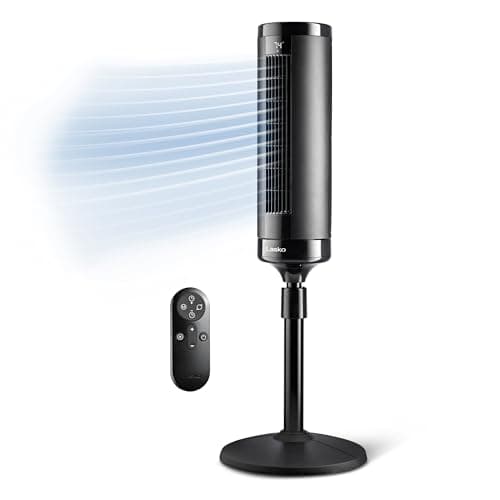 Best overall Lasko EcoQuiet 42" DC Tower Fan 23 dBA on low and 2.9 W, with twelve speeds — the quietest and cheapest oscillating fan we hold figures for. | A bedroom or quiet room where the fan runs all night | |
| 2 | Widest published sweep, with real numbers Lasko Aria 40" Smart Wi-Fi Tower Fan 90 degrees of oscillation at 460 CFM, with published wattage and dBA at both ends of its range. | A living room with several people who all want some air | |
| 3 | 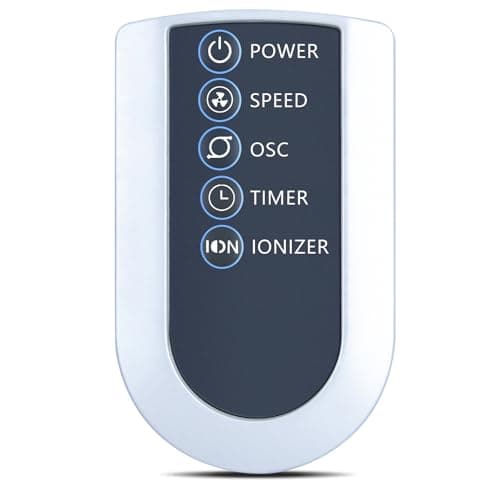 Most published airflow Lasko Wind Curve 42" Tower Fan 720 CFM published — the highest airflow figure of any oscillating fan on this site by a wide margin. | A large room where you need the air to actually arrive | |
| — | 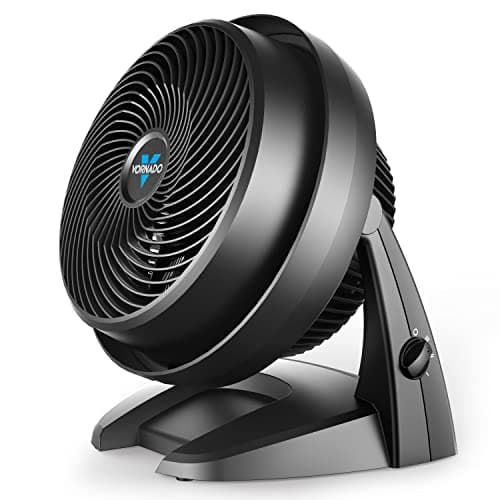 The fan that deliberately does not oscillate Vornado 630 Medium Air Circulator Vornado states it moves air up to 70 feet — a fixed, coherent column instead of a sweep. | Circulating a whole room rather than sweeping part of it |
Oscillation is treated as an obviously-good feature, ticked on a specification list beside remote control and a timer. It is actually a trade, and knowing which side of it you are on decides whether you should use the function at all.
The trade
Oscillation divides air, it does not create it
A fan moves a fixed volume of air per minute at a given speed. Turning the head does not change that volume. It changes where it goes.
Fixed, the fan delivers its full airflow continuously to one place. Oscillating across 90 degrees, that same airflow is shared across the arc, so any one position receives it for a fraction of each cycle.
This matters because of how fans actually cool you. Air moving over skin accelerates evaporative and convective heat loss — and that effect is not instantaneous. It builds while air is moving over you and decays when it stops. An intermittent breeze produces less cooling than a continuous one of the same speed, not the same amount spread out.
| Oscillating | Fixed | |
|---|---|---|
| Airflow at any one spot | Intermittent | Continuous |
| Best for | Several people, or a room being shared | One person in one place |
| Felt cooling for one person | Lower | Higher |
| Room circulation | Poor — breaks up the air column | Good, if aimed at a far wall |
| Power draw | The same either way | The same either way |
| Noise | Adds a slow mechanical sweep | Fan noise only |
Note the fifth row. Oscillation costs no extra electricity worth measuring — the sweep motor is trivial next to the fan motor. The cost is in comfort distribution, not in watts.
When to use it
Turn it on, or leave it off
Oscillate when: more than one person needs air; you move around the room; the fan would otherwise dry your eyes or your throat over a long session; or you are sitting close enough that continuous airflow is uncomfortable.
Leave it fixed when: you are the only person in the room; you sit in one place; you are genuinely hot and want maximum effect; or you are trying to circulate the room rather than cool a person — in which case aim it at the far wall and leave it there.
The last case is the one people most often get wrong. Room circulation depends on sustaining a column of air long enough for it to hit something and set up a return path. A circulator does this deliberately and does not oscillate at all. Placement matters more than the fan for this.
The numbers
Published specifications
| Fan | CFM | Watts | dBA | Speeds |
|---|---|---|---|---|
| Lasko EcoQuiet T42710 | not published | 2.9 – 19 | 23 – 46 | 12 |
| Lasko Aria T40733 | 460 | 41 – 52 | 31.5 – 48.7 | 5 |
| Lasko Cyclone 2554 | 720 | not published | not published | 3 |
| Lasko Whirlwind A12107 | not published | 18 – 32 | 39 – 55 | 3 |
| Vornado 630 (no oscillation) | not published | not published | not published | 3 |
Manufacturer product pages. There is no certification program for portable fans, so nothing here is independently tested and the gaps are as informative as the figures.
Only one fan in that table publishes all four numbers. That is the state of this category, and it is why we weight published data heavily when picking.
This one is not a DIY job
Oscillation is a mechanism, and mechanisms wear. The sweep is driven by a gearbox off the main motor, and it is the most common thing to fail on a cheap fan — usually as a click, a stall at one end of the arc, or a head that stops turning entirely.
Two things extend its life. Do not force the head by hand while it is oscillating or switched off — that is the fastest way to strip the gear. And keep the fan clean; dust loading the blades makes the motor and everything geared to it work harder.
If the sweep has already stopped, it is worth diagnosing before replacing — a seized oscillation gear does not stop the fan from working as a fixed fan.
Say the unwelcome thing
Do not pay extra for oscillation on a fan for one person.
If the fan is for a desk you sit at, a bed you sleep in, or a chair you always occupy, oscillation actively reduces what you get. The same airflow reaches you a fraction of the time.
People buy an oscillating fan, find it underwhelming, and buy a bigger one — when switching the sweep off would have solved it. The feature is genuinely useful for shared rooms and genuinely counterproductive for one person in one spot.
For a single seat, a fixed desk fan or a clip-on delivers more felt cooling for far less power — a certified clip-on runs at 9 to 12 W against 41 to 52 for a large oscillating tower.
In full
Every pick, and what is wrong with it
Published specifications only, each linked to the page it came from. Where a manufacturer publishes nothing, the row says so — we do not fill blanks in.
1. Best overall
Lasko EcoQuiet 42" DC Tower Fan
Lasko · model T42710
23 dBA on low and 2.9 W, with twelve speeds — the quietest and cheapest oscillating fan we hold figures for.
23 dBA on low. The quietest published noise figure on this site, and the reason this is the default recommendation for a room somebody sleeps in.
2.9 W at that setting — 0.4¢ for an eight-hour night. The DC motor is what makes both numbers possible; AC motors do not run efficiently or quietly at low speed.
Twelve speeds matters more with oscillation than without it. A sweeping fan reaches you intermittently, so you want the setting where each pass is just enough — and twelve increments finds that where three cannot.
41.6 inches tall on a 12.8-inch footprint, 7.8 lb, with an 8-hour timer. The gap in the data: no published CFM.
What’s wrong with it
Lasko publishes no CFM, so there is no airflow number to compare, and 19 W on high is nearly seven times its low draw.
Running cost — T42710
| Nameplate power | 2.9 W – 19 W | manufacturer's published figure |
|---|---|---|
| Energy, 8-hour night | 0.15 kWh | 19 ÷ 1000 × 8 |
| Cost per hour | 0.3¢ | at 18.34¢/kWh |
| Cost per 8-hour night | 2.8¢ | on the highest speed |
| Cost per 30 nights | 84¢ | 4.6 kWh |
| Same month, lowest speed | 13¢ | at 2.9 W |
Rate: 18.34¢/kWh, the US average residential price for June 2026 (EIA Electric Power Monthly, Table 5.3). Yours will differ — swap it in: (watts ÷ 1000) × hours × your rate.
| Power | 2.9 W - 19 W (0.06-0.303 A at 120 V) |
|---|---|
| Noise | 23 dBA low, 46 dBA high |
| Speeds | 12 |
| Height | 41.6 in |
| Footprint | 12.8 x 12.8 in |
| Weight | 7.8 lb |
| Timer | 8 hours |
| Air delivery (CFM) | Not published |
| Warranty | 2 years |
Every figure above is from Lasko product page, T42710. Blanks are shown as “not published” rather than filled in.
2. Widest published sweep, with real numbers
Lasko Aria 40" Smart Wi-Fi Tower Fan
Lasko · model T40733
90 degrees of oscillation at 460 CFM, with published wattage and dBA at both ends of its range.
The one that publishes everything. 460 CFM, 41 to 52 W, 31.5 dBA low and 48.7 dBA high, 90 degrees of oscillation. Very few fans in this category publish all four.
The 90-degree arc is the widest published figure here, and it is the right shape for a sofa: a fan in the corner sweeping a quarter-turn covers three seats without anybody being in a constant draft.
Scheduling is the underrated feature. Alexa, Google Assistant or the Aria app means it can start before you sit down, which matters more in a living room than a bedroom because you arrive rather than stay.
About 5.7¢ for a six-hour evening at full power, considerably less on low.
What’s wrong with it
48.7 dBA on high is clearly audible, and the remote is not included — you are relying on the app or a smart speaker.
Running cost — T40733
| Nameplate power | 41 W – 52 W | manufacturer's published figure |
|---|---|---|
| Energy, 8-hour night | 0.42 kWh | 52 ÷ 1000 × 8 |
| Cost per hour | 1.0¢ | at 18.34¢/kWh |
| Cost per 8-hour night | 7.6¢ | on the highest speed |
| Cost per 30 nights | $2.29 | 12.5 kWh |
| Same month, lowest speed | $1.80 | at 41 W |
Rate: 18.34¢/kWh, the US average residential price for June 2026 (EIA Electric Power Monthly, Table 5.3). Yours will differ — swap it in: (watts ÷ 1000) × hours × your rate.
| Power | 41 W - 52 W (0.3-0.44 A at 120 V) |
|---|---|
| Air delivery | 460 CFM |
| Noise | 31.5 dBA low, 48.7 dBA high |
| Speeds | 5 |
| Smart control | Aria for Home app (iOS/Android), Amazon Alexa, Google Assistant |
| Height | 39.58 in |
| Footprint | 11.2 x 11.2 in |
| Weight | 9.5 lb |
| Timer | 9 hours |
| Oscillation | 90 degrees |
| Remote | Not included |
| Warranty | 2 years |
Every figure above is from Lasko product page, T40733. Blanks are shown as “not published” rather than filled in.
3. Most published airflow
Lasko Wind Curve 42" Tower Fan
Lasko · model 2554
720 CFM published — the highest airflow figure of any oscillating fan on this site by a wide margin.
720 CFM. Set against the Aria's 460 CFM, that is over 50% more air — and airflow is what determines whether an oscillating fan still reaches you at the far end of its sweep.
This is the core problem with oscillation in a big room. The air slows and spreads as it travels, and a sweeping fan gives each position only a fraction of each cycle. Enough airflow to overcome both is the whole requirement.
The pedestal format also puts the head at seated or standing height rather than low down, which matters over furniture.
No published dBA, which is the reason this is not the bedroom pick. Full pedestal comparison.
What’s wrong with it
Lasko publishes no noise rating for it, and a pedestal takes floor space a tower does not.
Running cost — 2554
| Nameplate power | 37 W – 49 W | manufacturer's published figure |
|---|---|---|
| Energy, 8-hour night | 0.39 kWh | 49 ÷ 1000 × 8 |
| Cost per hour | 0.9¢ | at 18.34¢/kWh |
| Cost per 8-hour night | 7.2¢ | on the highest speed |
| Cost per 30 nights | $2.16 | 11.8 kWh |
| Same month, lowest speed | $1.63 | at 37 W |
Rate: 18.34¢/kWh, the US average residential price for June 2026 (EIA Electric Power Monthly, Table 5.3). Yours will differ — swap it in: (watts ÷ 1000) × hours × your rate.
| Power | 37 W - 49 W (0.4 A at 120 V) |
|---|---|
| Air delivery | 720 CFM |
| Speeds | 3 |
| Height | 42.5 in |
| Footprint | 13 x 13 in |
| Weight | 10.62 lb |
| Timer | 7.5-hour auto-off |
| Noise | Not published |
| Warranty | 1 year |
Every figure above is from Lasko product page, 2554. Blanks are shown as “not published” rather than filled in.
Skip this one
Vornado 630 Medium Air Circulator
Vornado · model 630
Vornado states it moves air up to 70 feet — a fixed, coherent column instead of a sweep.
Included as a deliberate contrast, because for a lot of rooms the right answer is not to oscillate at all.
A circulator throws a coherent column of air a long distance — Vornado states 70 feet — which hits the far wall and sets the whole room turning over. You are not aiming at people; you are stirring the volume they sit in.
Oscillation actively works against that. A sweeping head breaks the column up and never sustains flow in one direction long enough to establish circulation.
The honest gap: no published wattage, CFM, dimensions or weight. The 70-foot figure is Vornado’s own claim. A five-year warranty is unusually long for the category.
What’s wrong with it
Vornado publishes no wattage, no CFM and no dimensions, which is a real gap on a site that runs on numbers.
Running cost
Vornado does not publish a wattage for the 630, so we cannot calculate what it costs to run. We are not going to estimate one. If Vornado publishes a nameplate figure, this block will show the arithmetic.
| Power | Not published |
|---|---|
| Airflow reach | Moves air up to 70 ft |
| Speeds | 3 |
| Air delivery (CFM) | Not published |
| Dimensions | Not published |
| Weight | Not published |
| Warranty | 5 years |
Every figure above is from Vornado product page, 630. Blanks are shown as “not published” rather than filled in.
We are not linking a buy button for this one. If you want to look at it anyway, it is easy enough to find — but we would rather send you to something that fits your room.
Questions people actually ask
Frequently asked
Does oscillation make a fan cool better?
Not for one person. Oscillation shares the same airflow across a wider arc, so any one position receives it intermittently rather than continuously — and the cooling effect on skin builds while air is moving and decays when it stops. It helps when several people need air.
Does oscillating use more electricity?
Not meaningfully. The sweep is driven off the main motor through a small gearbox and its draw is trivial next to the fan itself. The cost of oscillation is in how the comfort is distributed, not in watts.
What is the quietest oscillating fan?
Of the fans with a published figure, the Lasko EcoQuiet T42710 at 23 dBA on low. Its DC motor is what makes that possible — AC motors do not run quietly or efficiently at low speed.
Should I oscillate a fan to cool a whole room?
No — aim it at the far wall and leave it fixed. Room circulation depends on sustaining a coherent column of air long enough to hit something and set up a return path, and a sweeping head breaks that column up before it can establish. Where to put a fan.
Why has my fan stopped oscillating?
Usually the oscillation gearbox, which is the most common failure on an inexpensive fan. Forcing the head by hand and running the fan with dust-loaded blades are the two things that shorten its life. A seized sweep does not stop the fan working as a fixed fan.
How wide should a fan oscillate?
Match the arc to the seating. Around 90 degrees suits a sofa from a corner position — three seats covered without anyone in a constant draft. Wider arcs spread the same airflow thinner, so each pass delivers less.
Sources
Where these numbers came from
Read next
Where to go from here
Back to Fans, or read how we pick.