The picks
The best fans for a bedroom
This is the one fan in the house that runs eight hours a night for months, which makes the low-speed figure the only one worth comparing.
By Sawyer V. · Published
The short answer
Compare the low-speed figure, because that is the setting a bedroom fan actually runs at. The certified leader draws 1.1 W on low — 0.2¢ for an eight-hour night, or about 15¢ for a whole summer of nightly use. A good tower is 2.9 W and 23 dBA. And note: ceiling fan wattage is certified, portable-fan dBA is not.
Fan & Frost earns a commission when you buy through our links, at no cost to you. It never changes a ranking, and we say so when the right answer is the cheaper unit or nothing at all. Full disclosure · How we pick.
At a glance
The picks, ranked
Tap any row to jump to the full reasoning. Prices are live from Amazon where we have them, and read “check price” where we don’t — never a number we cannot verify today.
| # | Product | Best for | Price |
|---|---|---|---|
| 1 | 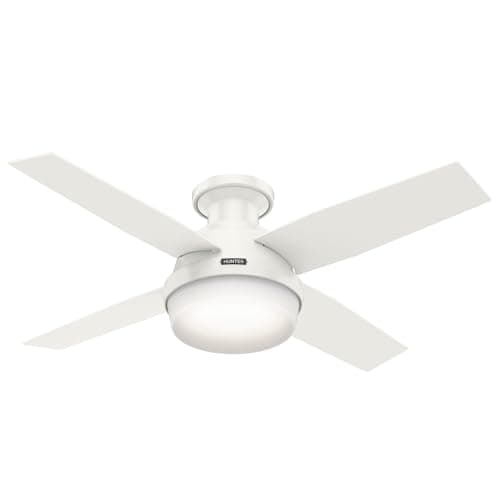 Best overall Hunter Martindale 44" Ceiling Fan 1.1 W on low — the lowest low-speed draw of any certified fan we hold data for — at 304.5 CFM per watt. | A standard bedroom with a fan-rated ceiling box | |
| 2 | 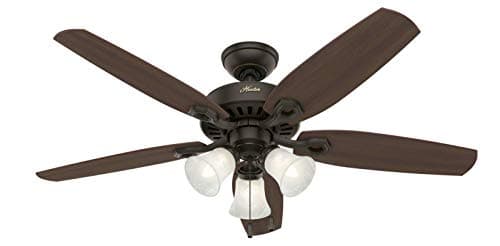 Best for a larger bedroom Hunter Vespucci 52" Ceiling Fan 366.7 CFM per watt across 52 inches at 1.8 W on low — better efficiency and more coverage. | A main bedroom, or a room where 44 inches will not reach | |
| 3 | 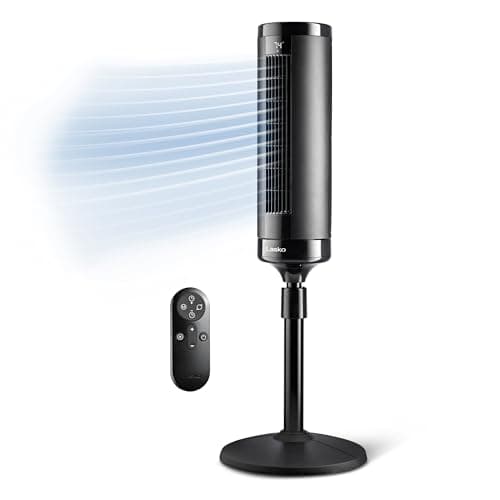 Best without an electrician Lasko EcoQuiet 42" DC Tower Fan 2.9 W on the lowest of 12 speeds, at 23 dBA — the only bedroom fan here with a published noise figure. | A rented room, or any bedroom with no fan-rated ceiling box | |
| — | The one to avoid at night Lasko Power Plus 20" Box Fan 73 W at its lowest setting — 25 times the tower fan's lowest, for a fan you sleep next to. | A garage, a workshop, or moving air in a window |
A bedroom fan is the most-used fan in the house and the one people choose most carelessly, usually on the wrong number.
Method
Why low speed is the only figure that matters
Almost every fan is marketed on its maximum: peak CFM, top speed, highest airflow. In a bedroom you will use that setting approximately never.
What you actually do is find the lowest setting that is enough and leave it there for eight hours. So we ranked on:
- Low-speed wattage, certified where the fan is a ceiling fan. This is the running cost.
- CFM per watt, certified, for how much air you get for that.
- Standby power, certified, because it is drawn all year.
- Speed granularity, because the ability to find “just enough” is worth more than peak output.
We did not rank on noise, and the reason is in the next section.
Noise
Which noise figures are real
People buy bedroom fans on quietness, and the data situation is inconsistent in a way worth understanding.
- Ceiling fans publish no noise rating at all. The certification program records CFM per watt, wattage at each speed and standby — and nothing acoustic.
- Portable fans publish uncertified dBA, when they publish anything. The 23 dBA above is Lasko’s own measurement, at a distance and setting they chose. It is useful within a brand and not comparable across brands.
- Many publish nothing. The box fan here has no dBA figure and no CFM figure.
- Bathroom fans are the exception. They are rated in tested sones, which is why that category can be ranked on quiet honestly.
The practical reading: a ceiling fan is generally quieter in a bedroom because the motor is further away and it moves a lot of air slowly. But that is a design argument rather than a measured one, and we are not going to dress it up as data. Sones, decibels and which are certified.
The cost
A whole summer, compared
Ninety nights at eight hours each, at 18.34¢/kWh. This is the number that should decide the purchase, and it almost never gets calculated.
| Fan | Watts on low | One night | Ninety nights |
|---|---|---|---|
| Hunter Martindale 44 in ceiling fan | 1.1 W | 0.2¢ | 15¢ |
| Hunter Vespucci 52 in ceiling fan | 1.8 W | 0.3¢ | 24¢ |
| Lasko EcoQuiet T42710 DC tower | 2.9 W | 0.4¢ | 38¢ |
| Lasko Wind Curve 2554 AC tower | 37 W | 5.4¢ | $4.89 |
| Lasko Power Plus B20801 box fan | 73 W | 11¢ | $9.64 |
The spread from top to bottom is $9.49 over a summer — a 66-fold difference in draw for a job that is, from your point of view, identical.
Note the AC-versus-DC tower comparison in the middle. Two 42-inch Lasko towers: 2.9 W against 37 W at their lowest settings. That is the clearest illustration of what a DC motor buys you — the full comparison.
What a fan does
And what it does not
Worth stating plainly on a bedroom page, because it changes how you place the fan.
A fan does not lower the temperature of a room. It moves air across skin, which speeds the evaporation of sweat and is worth several degrees of perceived temperature — but only to a person in the airstream. A fan running in an empty bedroom does nothing except add its own motor watts as heat.
- Aim it at the bed, not at the room. The effect is on you, so the airflow has to reach you.
- Set the ceiling fan to downdraft in summer. Updraft moves air off the ceiling and does not reach anyone — which way and why.
- It fades in humid air. If sweat cannot evaporate, moving air over it helps less — the mechanism. In a genuinely humid bedroom, a dehumidifier may be the better purchase.
- Turn it off when you leave. There is no reason to cool an empty room with something that only cools people.
This one is not a DIY job
Ceiling fans must be supported by a box rated and listed for fan support. A standard lighting outlet box is not, because of the vibration load, and a fan mounted to one is a genuine hazard.
If the existing box is not fan-rated, replacing it is electrical and structural work for a qualified electrician.
Blade clearance from the floor and from walls is specified by the manufacturer and by electrical code. In a low bedroom that may mean a flush-mount fan rather than a downrod.
With a portable fan in a bedroom, cords and tipping are the real risks rather than the blade — particularly with children or animals in the house.
Say the unwelcome thing
Do not put a box fan in your bedroom.
It is the most common bedroom fan and the worst choice available on the one measure that matters overnight.
Its lowest setting draws 73 W. A DC tower’s lowest is 2.9 W and a certified ceiling fan’s is 1.1 W. Over ninety nights that is $9.64 against 15¢ at 18.34¢/kWh.
It also publishes no CFM and no dBA, so there is nothing to evaluate it on except that wattage. Almost nobody in the box fan category publishes either figure.
If you can fit a ceiling fan, fit one: 1.1 W on low. If you cannot, 2.9 W and 12 speeds is the right portable. Save the box fan for the garage.
In full
Every pick, and what is wrong with it
Published specifications only, each linked to the page it came from. Where a manufacturer publishes nothing, the row says so — we do not fill blanks in.
1. Best overall
Hunter Martindale 44" Ceiling Fan
Hunter · model 44in Martindale
1.1 W on low — the lowest low-speed draw of any certified fan we hold data for — at 304.5 CFM per watt.
The lowest running cost available in a bedroom, by a margin that is hard to argue with.
1.1 W on low. That is 0.2¢ for an eight-hour night and roughly 15¢ for ninety nights — a whole summer. Running cost stops being a consideration at that level.
304.5 CFM per watt, certified, with 0.4 W standby, which is low even among certified fans.
44-inch span, fan only, no light kit — and the no-light-kit part is why the efficiency is where it is. What a light kit costs you. The honest limits: it needs a fan-rated box, and 44 inches is not a large room.
What’s wrong with it
44 inches suits a small to medium room, and fitting it is an electrical job.
Running cost — 44in Martindale
| Nameplate power | 1.1 W – 10.1 W | manufacturer's published figure |
|---|---|---|
| Energy, 8-hour night | 0.08 kWh | 10.1 ÷ 1000 × 8 |
| Cost per hour | 0.2¢ | at 18.34¢/kWh |
| Cost per 8-hour night | 1.5¢ | on the highest speed |
| Cost per 30 nights | 44¢ | 2.4 kWh |
| Same month, lowest speed | 4.8¢ | at 1.1 W |
Rate: 18.34¢/kWh, the US average residential price for June 2026 (EIA Electric Power Monthly, Table 5.3). Yours will differ — swap it in: (watts ÷ 1000) × hours × your rate.
| Blade span | 44 in |
|---|---|
| Efficiency | 304.5 CFM per watt |
| Power, high speed | 10.1 W |
| Power, low speed | 1.1 W |
| Standby power | 0.4 W |
| Type | Indoor, fan only |
| Warranty | 3 years, components |
| ENERGY STAR | Certified |
Every figure above is from ENERGY STAR Certified Ceiling Fans dataset. Blanks are shown as “not published” rather than filled in.
2. Best for a larger bedroom
Hunter Vespucci 52" Ceiling Fan
Hunter · model Vespucci
366.7 CFM per watt across 52 inches at 1.8 W on low — better efficiency and more coverage.
More span and better efficiency, for 0.7 W more on the setting you will use.
366.7 CFM per watt against 304.5 — a 20% improvement, and the second-highest figure of any fan we recommend for a bedroom.
1.8 W on low is 0.3¢ a night, 24¢ for a summer. The difference against the 44-inch fan over a season is a matter of cents.
52 inches reaches the corners of a main bedroom that a 44-inch fan does not. 0.8 W standby is the honest cost — double the Martindale, drawn every hour of the year whether the fan runs or not.
What’s wrong with it
0.8 W standby is double the Martindale's, drawn all year.
Running cost — Vespucci
| Nameplate power | 1.8 W – 13.9 W | manufacturer's published figure |
|---|---|---|
| Energy, 8-hour night | 0.11 kWh | 13.9 ÷ 1000 × 8 |
| Cost per hour | 0.3¢ | at 18.34¢/kWh |
| Cost per 8-hour night | 2.0¢ | on the highest speed |
| Cost per 30 nights | 61¢ | 3.3 kWh |
| Same month, lowest speed | 7.9¢ | at 1.8 W |
Rate: 18.34¢/kWh, the US average residential price for June 2026 (EIA Electric Power Monthly, Table 5.3). Yours will differ — swap it in: (watts ÷ 1000) × hours × your rate.
| Blade span | 52 in |
|---|---|
| Efficiency | 366.7 CFM per watt |
| Power, high speed | 13.9 W |
| Power, low speed | 1.8 W |
| Standby power | 0.8 W |
| Type | Indoor, fan only (no light kit) |
| Warranty | 3 years, components |
| ENERGY STAR | Certified |
Every figure above is from ENERGY STAR Certified Ceiling Fans dataset. Blanks are shown as “not published” rather than filled in.
3. Best without an electrician
Lasko EcoQuiet 42" DC Tower Fan
Lasko · model T42710
2.9 W on the lowest of 12 speeds, at 23 dBA — the only bedroom fan here with a published noise figure.
The answer when a ceiling fan is not an option, and the one product here that publishes anything about noise.
2.9 W on low — 0.4¢ a night — from a DC motor, which is why a tower fan can reach a figure this low at all. An AC tower of the same size draws 37 W at its lowest.
12 speeds matters more in a bedroom than anywhere else. Finding the setting that is just enough is the whole game, and three steps is too coarse for it.
23 dBA on low, 46 dBA on high, plus an 8-hour timer. Treat the dBA as indicative: portable fan noise figures are not certified and are not comparable between brands. Lasko publishes no CFM at all.
What’s wrong with it
23 dBA is a manufacturer measurement, not a certified one, and Lasko publishes no CFM.
Running cost — T42710
| Nameplate power | 2.9 W – 19 W | manufacturer's published figure |
|---|---|---|
| Energy, 8-hour night | 0.15 kWh | 19 ÷ 1000 × 8 |
| Cost per hour | 0.3¢ | at 18.34¢/kWh |
| Cost per 8-hour night | 2.8¢ | on the highest speed |
| Cost per 30 nights | 84¢ | 4.6 kWh |
| Same month, lowest speed | 13¢ | at 2.9 W |
Rate: 18.34¢/kWh, the US average residential price for June 2026 (EIA Electric Power Monthly, Table 5.3). Yours will differ — swap it in: (watts ÷ 1000) × hours × your rate.
| Power | 2.9 W - 19 W (0.06-0.303 A at 120 V) |
|---|---|
| Noise | 23 dBA low, 46 dBA high |
| Speeds | 12 |
| Height | 41.6 in |
| Footprint | 12.8 x 12.8 in |
| Weight | 7.8 lb |
| Timer | 8 hours |
| Air delivery (CFM) | Not published |
| Warranty | 2 years |
Every figure above is from Lasko product page, T42710. Blanks are shown as “not published” rather than filled in.
Skip this one
Lasko Power Plus 20" Box Fan
Lasko · model B20801
73 W at its lowest setting — 25 times the tower fan's lowest, for a fan you sleep next to.
Box fans are the default bedroom purchase and the worst one on every measure that matters overnight.
73 W on low. The DC tower above draws 2.9 W on low. That is a 25-fold difference for the setting you actually sleep with — 11¢ a night against 0.4¢.
Over ninety nights that is $9.64 against 38¢ at 18.34¢/kWh.
No CFM published and no dBA published. There is genuinely nothing to compare it on except the wattage, and the wattage is bad. Where a box fan does belong — and its weather-resistant motor makes it a good garage fan.
What’s wrong with it
No published CFM, no published dBA, and its quietest setting draws more than most fans' loudest.
Running cost — B20801
| Nameplate power | 73 W – 102 W | manufacturer's published figure |
|---|---|---|
| Energy, 8-hour night | 0.82 kWh | 102 ÷ 1000 × 8 |
| Cost per hour | 1.9¢ | at 18.34¢/kWh |
| Cost per 8-hour night | 15¢ | on the highest speed |
| Cost per 30 nights | $4.49 | 24.5 kWh |
| Same month, lowest speed | $3.21 | at 73 W |
Rate: 18.34¢/kWh, the US average residential price for June 2026 (EIA Electric Power Monthly, Table 5.3). Yours will differ — swap it in: (watts ÷ 1000) × hours × your rate.
| Power | 73 W - 102 W (0.6-0.9 A at 120 V) |
|---|---|
| Speeds | 3 |
| Dimensions | 21.25 H x 22.5 x 4.75 in |
| Weight | 10.1 lb |
| Motor | Weather-resistant |
| Air delivery (CFM) | Not published |
| Warranty | 2 years |
Every figure above is from Lasko product page, B20801. Blanks are shown as “not published” rather than filled in.
We are not linking a buy button for this one. If you want to look at it anyway, it is easy enough to find — but we would rather send you to something that fits your room.
Questions people actually ask
Frequently asked
What is the best fan for a bedroom?
A certified ceiling fan, if you have a fan-rated box — 1.1 W on low at 304.5 CFM per watt is about 15¢ for a whole summer of nightly use. If a ceiling fan is not an option, a DC tower at 2.9 W and 12 speeds is the best portable.
How much does it cost to run a fan all night?
From 0.2¢ for a certified ceiling fan on low to 11¢ for a box fan on its lowest setting, at 18.34¢/kWh. That is a 66-fold difference in draw for what is, from your point of view, the same job.
Which bedroom fan is quietest?
The data cannot settle it. Ceiling fans publish no noise rating at all, and portable fan dBA figures are the manufacturer's own — measured at a distance and setting they chose, and not comparable between brands. A ceiling fan is generally quieter by design, but that is an argument rather than a measurement. Which noise figures are certified.
Is a tower fan or a ceiling fan better for a bedroom?
A ceiling fan, if you can fit one — lower draw, more air moved, nothing on the floor and no cord. A DC tower is the right answer when there is no fan-rated box, when you are renting, or when you want the fan aimed at the bed specifically.
Should I leave a fan on all night?
Cost is not a reason not to — a certified ceiling fan on low is a fraction of a cent a night. Just remember a fan cools people, not rooms, so aim it at the bed and switch it off when you leave. The full answer.
Why do DC fans use so much less power?
Two 42-inch Lasko towers make the comparison directly: 2.9 W at the lowest setting on the DC model against 37 W on the AC one. DC motors are more efficient at low speed and support far more speed steps, which is exactly what a bedroom fan needs. DC vs AC motors.
Sources
Where these numbers came from
- ENERGY STAR Certified Ceiling Fans dataset — CFM per watt, high and low speed wattage, standby power
- Lasko T42710 product page — 2.9-19 W, 23/46 dBA, 12 speeds, 8-hour timer
- Lasko 2554 Wind Curve product page — 37-49 W, 3 speeds
- Lasko B20801 product page — 73-102 W, no published CFM or dBA
- EIA Electric Power Monthly, Table 5.3 — average residential electricity price
Read next
Where to go from here
Back to Fans, or read how we pick.