Guide and picks
Cooling a bathroom
You do not cool a bathroom by cooling it. You cool it by getting the water out, which is a different appliance and a different calculation.
By Sawyer V. · Published
The short answer
Extract, do not cool. A bathroom feels hot because the air is near saturation, so sweat cannot evaporate — removing the moisture fixes the sensation that cooling would not. Size the fan at roughly 1 CFM per square foot with a minimum around 50 CFM, run it during the shower and for 20 minutes after, and check the certified CFM per watt.
Fan & Frost earns a commission when you buy through our links, at no cost to you. It never changes a ranking, and we say so when the right answer is the cheaper unit or nothing at all. Full disclosure · How we pick.
At a glance
The picks, ranked
Tap any row to jump to the full reasoning. Prices are live from Amazon where we have them, and read “check price” where we don’t — never a number we cannot verify today.
| # | Product | Best for | Price |
|---|---|---|---|
| 1 | 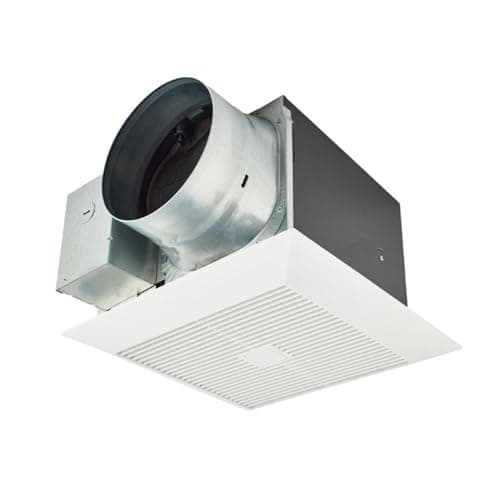 Best overall Panasonic WhisperGreen Select FV-0511VK3 Ventilation Fan 16.7 CFM per watt — the most efficient certified bathroom fan in the dataset — with selectable 50, 80 or 110 CFM from one body. | Almost any bathroom, because one unit covers several sizes | |
| 2 | 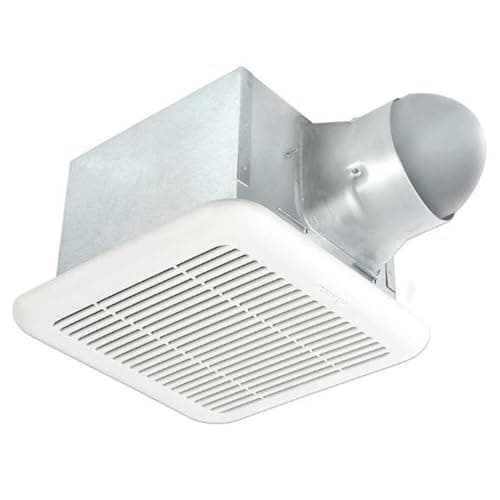 Best for a large bathroom Delta BreezSignature SIG80-110 Ventilation Fan 110 CFM on high and 80 on low at 15.3 CFM per watt — the upper end of domestic extraction, for a room where 50 CFM would never clear the air. | A bathroom over about 80 square feet, or one with a separate tub | |
| 3 | 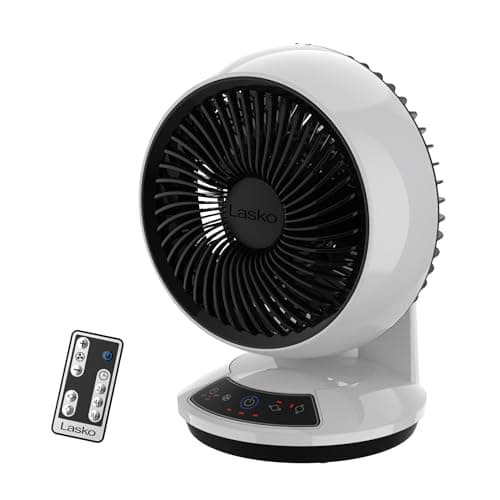 Best for the actual heat Lasko Whirlwind Tilt 12" Table Fan 18 to 32 W across three speeds with a 50 ft throw, wall-mountable so it takes no floor space at all. | Moving air on a person, in a room with no space for anything | |
| — | Comprehensively the wrong tool Whynter ARC-14S Dual Hose Portable Air Conditioner 1,300 W of refrigeration that would condense water onto every cold surface in a room already full of water. | A bedroom or office — not a bathroom |
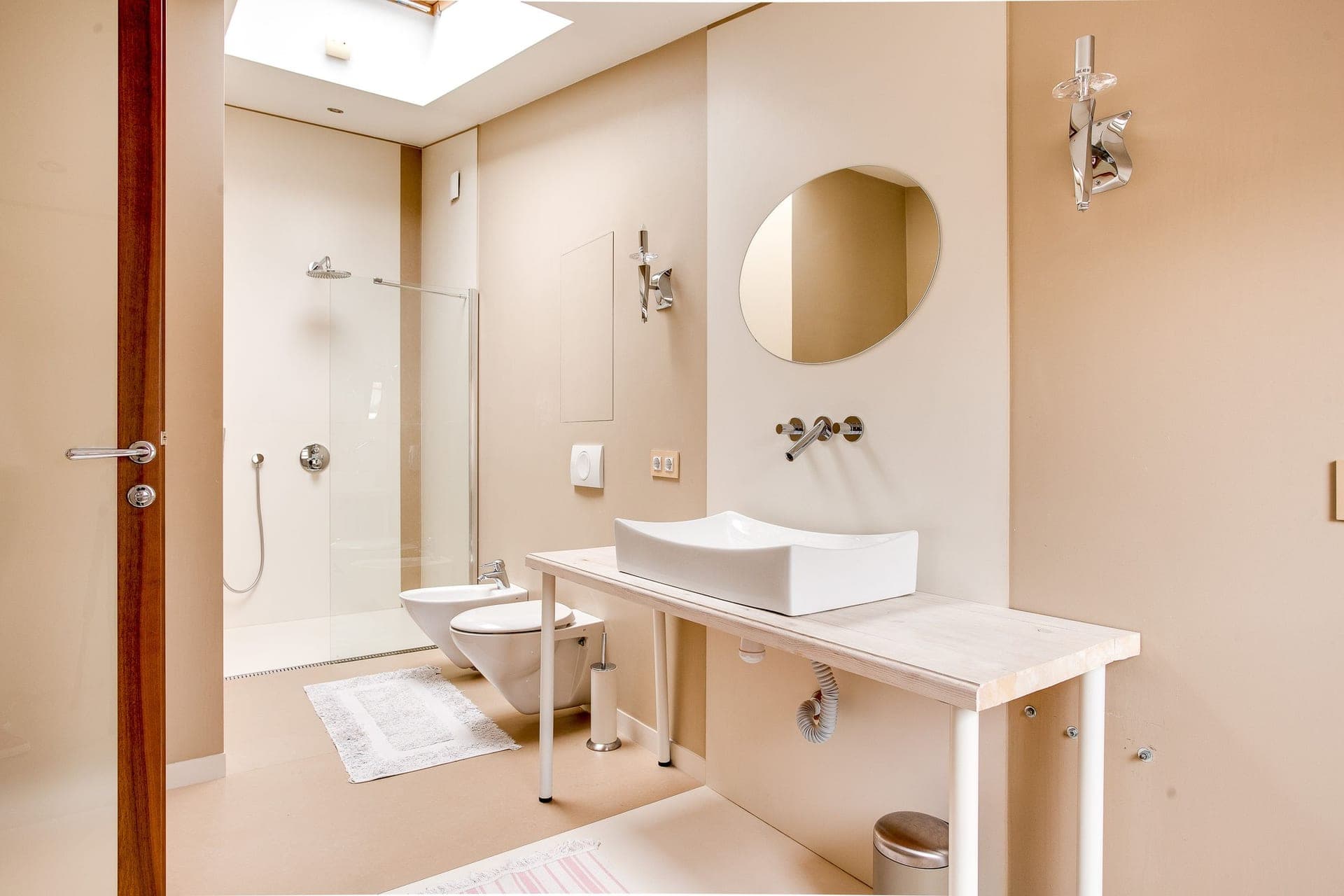
A bathroom after a shower is one of the least comfortable rooms in a house, and almost none of that is temperature. It is the only room you routinely fill with water vapor on purpose.
The mechanism
Why a wet room feels hot
Your body sheds heat by evaporating sweat. That process needs air with capacity to absorb water. A bathroom immediately after a shower is close to saturated, so there is very little capacity left and evaporation nearly stops.
The result is that the room feels considerably hotter than a thermometer says, and lowering the air temperature helps far less than you would expect — because the limiting factor was never the temperature.
There is a second reason extraction beats cooling here, and it is about the building rather than you. Moisture that is not removed condenses on the coldest surfaces — windows, tile grout, the back of a cool exterior wall — and sustained condensation is what causes mold, peeling paint and failing plaster.
Sizing
How much extraction you need
The widely used residential rule is straightforward, and unlike many cooling rules it has a real basis in air-change rates.
| Bathroom size | Extraction needed |
|---|---|
| Up to 50 sq ft | 50 CFM (the minimum) |
| 60 sq ft | 60 CFM |
| 80 sq ft | 80 CFM |
| 100 sq ft | 100 CFM |
| Over 100 sq ft | Add per fixture, or use two fans |
For context on what the market actually offers: across the 898 certified bathroom and utility fans, published airflow runs from 35 to 359 CFM with a median of 92.2. Only 56 are below 50 CFM, so the sizing rule is comfortably servable at every room size.
Two adjustments worth making. A ceiling higher than 8 feet increases the volume for the same floor area, so size up. And a fan at the end of a long or convoluted duct run delivers less than its rating — the certified CFM is measured at a standard static pressure, not at the end of thirty feet of flexible duct with three bends in it.
This one is not a DIY job
Efficiency varies far more than people expect in this category. Across the 898 certified fans, CFM per watt runs from 2.9 to 16.7 with a median of 4.7 — a spread of nearly six to one. Buying near the top of that range costs very little extra and is the single most useful spec to check, because a bathroom fan that runs twenty minutes a day for fifteen years accumulates real hours.
Noise
Sones, and why almost nothing is genuinely quiet
Bathroom fans are the one fan category with a certified noise figure. Sones are measured to a shared procedure, which makes them comparable across brands — unlike the dBA numbers on portable fans, and unlike ceiling fans, which publish no noise rating at all.
The distribution is less flattering than the marketing suggests. Of the 338 certified records that publish a sones figure:
- The median is 1.4 sones, which is audible and unremarkable.
- The range runs 0.1 to 6.8 sones — a factor of 68 between the quietest and the loudest.
- Only 7 of 338 are at or below 0.3 sones, and exactly one reaches 0.1.
Sones are also linear where decibels are logarithmic, so 1.4 sones is genuinely twice as loud as 0.7. If quiet matters — an ensuite off a bedroom, a fan you want to leave running — that 7-of-338 group is the whole shortlist, and it overlaps heavily with the efficiency leaders.
Running it
Run it after, not just during
The commonest mistake is switching the fan off as you leave. The air is at its wettest at that moment, and the surfaces are still streaming.
- Switch it on before the shower, so it is already moving air when the steam starts.
- Leave it running for about 20 minutes afterwards. This is the part that does the work. A timer switch or a humidity sensor makes it automatic and removes the decision.
- Close the door while it runs. An open door lets the fan pull dry air from the landing instead of pulling wet air from the bathroom, which sounds counterintuitive and is not — the fan extracts whatever is easiest to reach.
- Leave the shower door or curtain open afterwards, so the enclosure itself dries rather than holding water.
Note that 456 of 1,076 certified ventilating fans have two or more speeds. If yours does, the low setting is the one to leave running for the twenty-minute tail — full speed during the shower, low afterwards.
No window
If there is no window
An internal bathroom has no passive route out at all, which makes mechanical extraction the only mechanism rather than a helpful addition.
It also means make-up air has to come from the rest of the house, so the door undercut matters — a door sealed tight to the floor will starve the fan and it will move far less than its rating. Roughly three-quarters of an inch of gap under the door is the usual allowance.
Windowless bathrooms are the strongest case for a humidity-sensing fan that runs on its own judgement, because there is no backup if someone forgets — extraction for a bathroom with no window.
Still hot
If it is genuinely hot as well as wet
Some bathrooms really are hot rooms — a west-facing one with a large window, or an upstairs one under an uninsulated roof. Once extraction is sorted, the remaining options are the ordinary ones, in this order:
- Shade the window from outside if there is one. Solar gain into a small room is disproportionate — shading and film.
- Deal with the roof above it if it is a top-floor bathroom. That is usually the same job as fixing the rest of the floor — why upstairs stays hot.
- Add a small wall-mounted fan, well away from water, for the ten minutes you are in there.
- Use the extraction fan as air movement even when the room is dry. It is already installed and it already moves air.
What is rarely worth it is dedicated cooling equipment. A bathroom is occupied briefly, has no space, and has water everywhere — three reasons that an air conditioner belongs in the room next door.
Mold
The problem extraction is really solving
Comfort is the reason people search for this. Building damage is the reason it matters.
Sustained high humidity on cold surfaces produces condensation, and condensation produces mold, which is a health issue as well as a decorating one. A bathroom that is consistently extracted after use does not develop that problem; one that is not, does, regardless of how often it is cleaned.
If the damp has spread beyond the bathroom, or if the whole floor feels humid, the extraction fan is not the whole answer and a dehumidifier is doing a different job — dehumidifiers compared and what to set one to.
Say the unwelcome thing
Do not vent the fan into the attic.
It is common, it is quick, and it relocates your problem into the most expensive part of the house to repair.
A bathroom fan ducted into an unconditioned roof space delivers warm wet air onto cold framing and the underside of the roof deck, where it condenses. The result over a few winters is damp insulation, stained ceilings and rotting timber.
Duct it to outside — a wall, a soffit or a roof vent — and insulate the duct where it crosses cold space so the moisture does not condense inside the duct itself. If you are choosing a fan now, pick one near the top of the certified efficiency range: 16.7 CFM per watt, selectable 50 to 110 CFM.
In full
Every pick, and what is wrong with it
Published specifications only, each linked to the page it came from. Where a manufacturer publishes nothing, the row says so — we do not fill blanks in.
1. Best overall
Panasonic WhisperGreen Select FV-0511VK3 Ventilation Fan
Panasonic · model FV-0511VK3
16.7 CFM per watt — the most efficient certified bathroom fan in the dataset — with selectable 50, 80 or 110 CFM from one body.
Two things make this the pick: it is the efficiency maximum of the whole certified field, and the selectable airflow removes the commonest extraction mistake.
16.7 CFM per watt is the highest figure among the 898 certified bathroom and utility fans in the dataset, against a median of 4.7. That is not a marginal lead; it is more than three times the typical fan.
50, 80 or 110 CFM from one unit, set at install, which covers roughly a 50 to 110 square foot room under the standard sizing rule without having to guess in the shop.
The honest cost: it mounts in the ceiling and needs a 6-inch duct to outside. A fan that vents into the attic has simply moved your moisture problem somewhere more expensive — bathroom fans compared in full.
What’s wrong with it
It is a ceiling install with a duct run, which is a job rather than a purchase.
Running cost
Panasonic does not publish a wattage for the FV-0511VK3, so we cannot calculate what it costs to run. We are not going to estimate one. If Panasonic publishes a nameplate figure, this block will show the arithmetic.
| Noise | 0.1 sones |
|---|---|
| Air delivery, high | 110 CFM at 0.25 in w.g. |
| Air delivery, medium | 80 CFM |
| Air delivery, low | 50 CFM |
| Efficacy, high | 16.7 CFM per watt |
| Efficacy, medium | 18.4 CFM per watt |
| Efficacy, low | 14.7 CFM per watt |
| Duct size | 6 in diameter |
| Speeds | 3 or more |
| Lighting | None |
| Power | Not published in the certified dataset |
| ENERGY STAR | Certified, and on the Most Efficient list |
Every figure above is from ENERGY STAR Certified Ventilating Fans dataset. Blanks are shown as “not published” rather than filled in.
2. Best for a large bathroom
Delta BreezSignature SIG80-110 Ventilation Fan
Delta · model SIG80-110
110 CFM on high and 80 on low at 15.3 CFM per watt — the upper end of domestic extraction, for a room where 50 CFM would never clear the air.
Large bathrooms are systematically under-extracted, because the fan gets chosen by habit rather than by area.
110 CFM on high and 80 CFM on low, both certified, for a room where the standard 50 CFM builder’s fan is doing perhaps half the job it needs to.
15.3 CFM per watt through a 6-inch duct — second only to the pick above, and more than three times the certified median of 4.7.
The trade to understand: every cubic foot extracted is replaced by air pulled from elsewhere in the house, through the door gap. In summer that air is warm. Extraction is worth it anyway — but this is why you run it for twenty minutes, not all evening.
What’s wrong with it
More airflow means more make-up air pulled in from the rest of the house.
Running cost
Delta does not publish a wattage for the SIG80-110, so we cannot calculate what it costs to run. We are not going to estimate one. If Delta publishes a nameplate figure, this block will show the arithmetic.
| Noise | 0.1 sones |
|---|---|
| Air delivery, high | 110 CFM at 0.25 in w.g. |
| Air delivery, low | 80 CFM |
| Efficacy, high | 15.3 CFM per watt |
| Efficacy, low | 15.4 CFM per watt |
| Duct size | 6 in diameter |
| Speeds | 2, field-selectable |
| Lighting | None |
| Power | Not published in the certified dataset |
| ENERGY STAR | Certified, and on the Most Efficient list |
Every figure above is from ENERGY STAR Certified Ventilating Fans dataset. Blanks are shown as “not published” rather than filled in.
3. Best for the actual heat
Lasko Whirlwind Tilt 12" Table Fan
Lasko · model A12107
18 to 32 W across three speeds with a 50 ft throw, wall-mountable so it takes no floor space at all.
Once the moisture is handled, if the room is still uncomfortable, this is the sensible amount of hardware to throw at it.
18 to 32 W across three speeds — about 0.6¢ an hour on full at 18.34¢/kWh, which is genuinely negligible for the ten minutes a bathroom is occupied.
Wall-mountable, which is the practical point. A bathroom has no floor space and no worktop, and a tilting fan on a bracket solves that.
A 50 ft air throw from a 12-inch fan, so it reaches across the room from wherever you can mount it. Keep it well away from the shower and the basin — electrical safety around water is not optional here.
What’s wrong with it
It adds no extraction, so it does nothing about the moisture that is the real problem.
Running cost — A12107
| Nameplate power | 18 W – 32 W | manufacturer's published figure |
|---|---|---|
| Energy, 8-hour night | 0.26 kWh | 32 ÷ 1000 × 8 |
| Cost per hour | 0.6¢ | at 18.34¢/kWh |
| Cost per 8-hour night | 4.7¢ | on the highest speed |
| Cost per 30 nights | $1.41 | 7.7 kWh |
| Same month, lowest speed | 79¢ | at 18 W |
Rate: 18.34¢/kWh, the US average residential price for June 2026 (EIA Electric Power Monthly, Table 5.3). Yours will differ — swap it in: (watts ÷ 1000) × hours × your rate.
| Power | 18 W - 32 W (0.24-0.5 A at 120 V) |
|---|---|
| Noise | 39 dBA low, 55 dBA high |
| Air distance | 50 ft |
| Speeds | 3 |
| Dimensions | 11.19 H x 11.4 W x 6.2 D in |
| Weight | 2.78 lb |
| Mounting | Wall-mountable (hardware not included) |
| Air delivery (CFM) | Not published |
| Warranty | 1 year |
Every figure above is from Lasko product page, A12107. Blanks are shown as “not published” rather than filled in.
Skip this one
Whynter ARC-14S Dual Hose Portable Air Conditioner
Whynter · model ARC-14S
1,300 W of refrigeration that would condense water onto every cold surface in a room already full of water.
Flagged because “my bathroom is unbearable in summer” leads people here, and it is the wrong end of the problem entirely.
1,300 W and about $1.91 for eight hours at 18.34¢/kWh, to address a sensation caused by humidity rather than temperature.
It also needs a hose to a window, a drain or tank arrangement, and floor space — three things a bathroom characteristically does not have.
Most importantly, mains appliances and wet rooms do not mix. Fixed bathroom equipment is subject to electrical rules about proximity to water for good reason. Extract the moisture and the heat sensation largely goes with it — why humidity is the variable.
What’s wrong with it
There is no safe place to put a mains appliance with a water tank in a bathroom.
Running cost — ARC-14S
| Nameplate power | 1300 W | manufacturer's published figure |
|---|---|---|
| Energy, 8-hour night | 10.40 kWh | 1300 ÷ 1000 × 8 |
| Cost per hour | 24¢ | at 18.34¢/kWh |
| Cost per 8-hour night | $1.91 | on the highest speed |
| Cost per 30 nights | $57 | 312.0 kWh |
Rate: 18.34¢/kWh, the US average residential price for June 2026 (EIA Electric Power Monthly, Table 5.3). Yours will differ — swap it in: (watts ÷ 1000) × hours × your rate.
| Marketing capacity | 14,000 BTU (ASHRAE-128) |
|---|---|
| DOE-rated capacity | 9,500 BTU SACC |
| Hoses | Dual |
| Power | 1,300 W / 11.6 A at 115 V |
| Noise | Under 51 dBA low, under 56 dBA high |
| Dehumidification | 71 pints/day |
| Refrigerant | R-32 |
| Dimensions | 16 W x 19 D x 35.5 H in |
| Weight | 73 lb |
| Manufacturer coverage claim | 500 sq ft |
| Warranty | 1 year unit, 3 years compressor |
Every figure above is from Whynter product page, ARC-14S. Blanks are shown as “not published” rather than filled in.
We are not linking a buy button for this one. If you want to look at it anyway, it is easy enough to find — but we would rather send you to something that fits your room.
Questions people actually ask
Frequently asked
How do you cool down a bathroom?
Extract rather than cool. A bathroom feels hot because the air is near saturation so sweat cannot evaporate — removing the moisture fixes the sensation that cooling would not. Run the fan during the shower and for about 20 minutes afterwards.
What size extractor fan does a bathroom need?
Roughly 1 CFM per square foot of floor area, with a minimum of about 50 CFM. Size up for ceilings above 8 feet, and allow for losses in a long or convoluted duct run — certified CFM is measured at a standard static pressure, not at the end of thirty feet of flexible duct. Bathroom fans compared.
How long should I run a bathroom fan after a shower?
About 20 minutes. The air is at its wettest at the moment you leave and the surfaces are still streaming, so switching it off as you go is the commonest mistake. A timer switch or a humidity sensor removes the decision.
What is a quiet bathroom fan in sones?
Quieter than you will usually find. Of the 338 certified records publishing a sones figure the median is 1.4, the range runs 0.1 to 6.8, and only 7 are at or below 0.3 sones. Sones are linear, so 1.4 is genuinely twice as loud as 0.7.
Should the bathroom door be open or closed while the fan runs?
Closed. An open door lets the fan pull dry air from the landing instead of wet air from the bathroom — it extracts whatever is easiest to reach. Leave about three-quarters of an inch of gap under the door so it has make-up air.
Is it bad to vent a bathroom fan into the attic?
Yes. It delivers warm wet air onto cold framing and the underside of the roof deck where it condenses, producing damp insulation, stained ceilings and rotting timber over a few winters. Duct it to outside and insulate the duct across cold space.
Sources
Where these numbers came from
- ENERGY STAR Certified Ventilating Fans dataset — 1,076 US records, of which 898 publish bathroom and utility airflow; CFM per watt range and median, sones distribution across 338 records, and speed counts
- Lasko product page, A12107 — 18 to 32 W, three speeds, 50 ft air throw, wall-mountable
- Whynter ARC-14S product page — 1,300 W, used for the comparison
- EIA Electric Power Monthly, Table 5.3 — average residential electricity price
Read next
Where to go from here
Back to Room Cooling, or read how we pick.