The picks
The best large-capacity dehumidifiers
In this category, unlike cooling, the big machines are the efficient ones. That single fact changes when it is worth stepping up.
By Sawyer V. · Published
The short answer
Above about 50 pints a day, the honest answer stops being a bigger portable and becomes a whole-home unit. Whole-home dehumidifiers run a median 2.30 L/kWh against 2.01 for portables and reach 3.26 against a portable maximum of 2.24. The catch is that it is a plumbed installation rather than a purchase, at 632 to 842 kWh a year for two to three times the water.
Fan & Frost earns a commission when you buy through our links, at no cost to you. It never changes a ranking, and we say so when the right answer is the cheaper unit or nothing at all. Full disclosure · How we pick.
At a glance
The picks, ranked
Tap any row to jump to the full reasoning. Prices are live from Amazon where we have them, and read “check price” where we don’t — never a number we cannot verify today.
| # | Product | Best for | Price |
|---|---|---|---|
| 1 | Best overall Santa Fe Whole-Home Dehumidifier, 128 pints/day 3.26 L/kWh at 127.51 pints a day — the highest efficiency of any certified dehumidifier, portable or not. | A large basement or a whole-house moisture problem | |
| 2 | 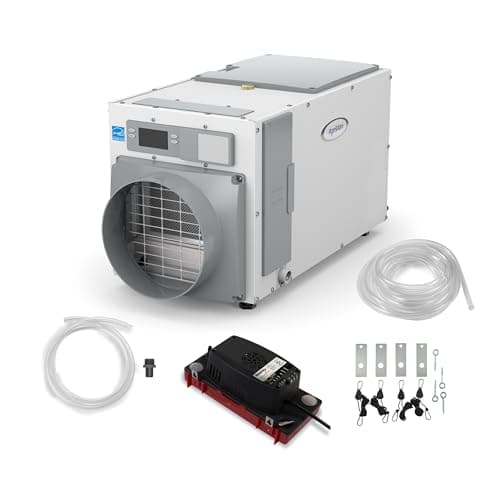 Best mid-size whole-home Aprilaire E080 Whole-Home Dehumidifier, 65 pints/day 2.35 L/kWh at 65 pints a day and 632 kWh a year — still above every portable in the dataset. | A basement that a portable cannot hold, without going to 128 pints | |
| 3 | Best portable at the top of the range Waykar Dehumidifier, 49 pints/day 49.43 pints a day at 2.20 L/kWh — the most capable portable that is still genuinely efficient. | A big room where an installation is not on the table | |
| — | 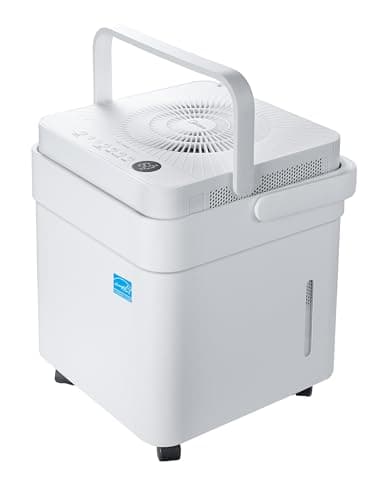 Two of these is the wrong answer Midea Dehumidifier, 50 pints/day 2.08 L/kWh at 49.67 pints a day. A good unit, and buying two is worse than buying one whole-home. | One room — not a whole-house strategy |
Most equipment on this site gets less efficient as it gets bigger. Dehumidifiers do the opposite, and it is the most useful thing to know about the category.
The inversion
Bigger is more efficient here
On our air conditioner analysis we found CEER holding flat to 14,000 BTU and then falling off a cliff at 24,000 — the largest certified unit is also the least efficient per BTU.
Dehumidifiers invert that:
| Class | Certified units | Median IEF | Best IEF | Most Efficient |
|---|---|---|---|---|
| Portable | 502 | 2.01 | 2.24 | 111 (22%) |
| Whole-home | 24 | 2.30 | 3.26 | 12 (50%) |
The median whole-home unit is 14% more efficient than the median portable, and the best is 46% ahead of the best portable. Half the whole-home field carries the Most Efficient designation against about a fifth of portables.
Some of that is physics: a bigger coil and a bigger, slower fan move air across more surface for less fan power. Some of it is that a whole-home unit is engineered as installed equipment rather than to a retail price point.
The crossover
When to stop buying portables
The whole-home class is not the right answer for most people. Here is where it becomes one.
- When a 50-pint portable runs continuously and still loses. That is the clearest signal. A machine at 100% duty that never reaches setpoint is undersized, and 50 pints is the top of portable.
- When the damp is not confined to one room. Portables treat a space. If three rooms are damp, you are either buying three machines or one installed unit.
- When nobody wants to empty a tank. A whole-home unit is plumbed by definition; a portable is plumbed only if you arrange it.
- When the noise has to leave the living space. The machine sits in a basement or plant room and is not heard.
- When the house has ducted air already. Tying into an existing air handler is far less work than creating a route from scratch.
And where it is not the answer: one damp room, a rented property, or any situation where a contractor visit is out of proportion to the problem.
Arithmetic
Two portables versus one installed unit
This is the comparison people actually face, and the numbers are clear.
| Setup | Pints/day | kWh/yr | A year |
|---|---|---|---|
| One 50-pint portable at 2.20 | 49.43 | 471 | $86 |
| Two 50-pint portables at 2.08 | 99.34 | 1030 | $189 |
| One whole-home at 2.35 | 65.00 | 632 | $116 |
| One whole-home at 3.26 | 127.51 | 842 | $154 |
Two portables give you 99 pints for 1,030 kWh. One whole-home unit gives you 128 pints for 842 kWh— 28% more water for 18% less energy, and $34 a year less at 18.34¢/kWh.
That gap does not pay for a contractor overnight. It does mean the installed unit is the cheaper machine to own from the day it is running, which is not usually true when you scale equipment up.
This one is not a DIY job
Whole-home dehumidifier installation is not a DIY job. These units require a plumbed condensate drain and, in ducted configurations, a tie-in to the air handler with correct duct sizing and control interlocks.
Getting the ducting or the control wiring wrong can leave the unit fighting the heating and cooling system, or dumping condensate somewhere it should not go.
This belongs to a qualified HVAC contractor working to local code, and the sizing should come from an assessment of the building rather than a pint number off a website.
If damp persists after installation, the water is entering faster than any machine will remove it, and the fix is drainage and sealing.
Practical
Before you commit to the step up
- Confirm the portable is genuinely losing. A unit with a full tank is not undersized, it is unplumbed. Fix the drain first and watch for a week.
- Find the source. An installed dehumidifier fighting groundwater is an expensive way to lose slowly. What to check.
- Ask about the drain route before anything else. No gravity drain means a condensate pump, and that is a different quotation.
- Decide ducted or free-standing. Free-standing in a basement is much simpler; ducted treats the whole house.
- Check the controls. A whole-home unit that fights your cooling system wastes both.
- Keep a portable for the odd room. The two are not mutually exclusive, and a small unit for a single problem space is cheap.
Say the unwelcome thing
Do not buy a second portable when the first cannot keep up.
It is the obvious move and it is the expensive one, because it scales the least efficient class of machine instead of changing class.
Two 50-pint portables remove 99 pints a day for 1,030 kWh a year. One whole-home unit removes 128 pints for 842 kWh — more water, less energy, one drain, and nothing standing in the middle of a room.
It is also worth checking, before either, that the first machine is actually undersized rather than simply sitting on a full tank. That mistake accounts for a large share of “my dehumidifier cannot keep up”.
If the load is real, step up properly: 65 pints at 2.35 L/kWh or 128 pints at 3.26.
In full
Every pick, and what is wrong with it
Published specifications only, each linked to the page it came from. Where a manufacturer publishes nothing, the row says so — we do not fill blanks in.
1. Best overall
Santa Fe Whole-Home Dehumidifier, 128 pints/day
Santa Fe · model 4047300
3.26 L/kWh at 127.51 pints a day — the highest efficiency of any certified dehumidifier, portable or not.
The efficiency ceiling of the entire certified category, and by a wide margin.
3.26 L/kWh against 2.24 for the best portable in the dataset — 46% more water removed per kilowatt-hour. There is no portable machine that approaches this.
127.51 pints a day, roughly two and a half times a 50-pint portable, at 842 kWh a year — about $154 at 18.34¢/kWh.
Most Efficient certified, one of 12 whole-home units to carry it. The honest cost is that you cannot buy this and plug it in: it needs a plumbed condensate drain and, in a ducted configuration, a tie-in to the air handler.
What’s wrong with it
842 kWh a year in absolute terms, and it is a contractor installation.
Running cost — 4047300
| Annual energy use | 842 kWh | ENERGY STAR certified figure |
|---|---|---|
| Annual cost | $154 | 842 × 18.34¢/kWh |
| Per cooling month | $39 | spread over a four-month season |
The annual figure is the certified value from the ENERGY STAR Certified Dehumidifiers dataset, which models a standard cooling season rather than your actual summer. It is more useful than a nameplate wattage here, because a variable-speed compressor spends most of its life well below nameplate.
Rate: 18.34¢/kWh, the US average residential price for June 2026 (EIA Electric Power Monthly, Table 5.3). Yours will differ — swap it in: (watts ÷ 1000) × hours × your rate.
| Water removal | 127.51 pints/day (DOE Appendix X1) |
|---|---|
| Efficiency (IEF) | 3.26 L/kWh |
| Annual energy use | 842 kWh/yr |
| Unit type | Whole-home (ducted or free-standing install) |
| Noise | Not published in the certified dataset |
| ENERGY STAR | Certified, and on the Most Efficient list |
Every figure above is from ENERGY STAR Certified Dehumidifiers dataset. Blanks are shown as “not published” rather than filled in.
2. Best mid-size whole-home
Aprilaire E080 Whole-Home Dehumidifier, 65 pints/day
Aprilaire · model E080
2.35 L/kWh at 65 pints a day and 632 kWh a year — still above every portable in the dataset.
The sensible entry point into whole-home, and the size most houses with a persistent basement problem actually need.
2.35 L/kWh beats the best portable ever certified (2.24) while removing 65.00 pints a day — 30% more capacity and better efficiency at the same time.
632 kWh a year, about $116 at 18.34¢/kWh. That is $30 a year more than an efficient 50-pint portable for 30% more water removed, which is a fair trade rather than a bargain.
Most Efficient certified. As with all of these, it is installation work — free-standing in a basement with a plumbed drain, or ducted.
What’s wrong with it
Same installation requirement, and 65 pints is a large step from a portable's 50.
Running cost — E080
| Annual energy use | 632 kWh | ENERGY STAR certified figure |
|---|---|---|
| Annual cost | $116 | 632 × 18.34¢/kWh |
| Per cooling month | $29 | spread over a four-month season |
The annual figure is the certified value from the ENERGY STAR Certified Dehumidifiers dataset, which models a standard cooling season rather than your actual summer. It is more useful than a nameplate wattage here, because a variable-speed compressor spends most of its life well below nameplate.
Rate: 18.34¢/kWh, the US average residential price for June 2026 (EIA Electric Power Monthly, Table 5.3). Yours will differ — swap it in: (watts ÷ 1000) × hours × your rate.
| Water removal | 65.00 pints/day (DOE Appendix X1) |
|---|---|
| Efficiency (IEF) | 2.35 L/kWh |
| Annual energy use | 632 kWh/yr |
| Unit type | Whole-home (ducted or free-standing install) |
| Noise | Not published in the certified dataset |
| ENERGY STAR | Certified, and on the Most Efficient list |
Every figure above is from ENERGY STAR Certified Dehumidifiers dataset. Blanks are shown as “not published” rather than filled in.
3. Best portable at the top of the range
Waykar Dehumidifier, 49 pints/day
Waykar · model CTH150D
49.43 pints a day at 2.20 L/kWh — the most capable portable that is still genuinely efficient.
Renting, or unwilling to plumb anything in? This is where the portable class runs out, and it runs out honorably.
49.43 pints a day at 2.20 L/kWh and 471 kWh a year, about $86 at 18.34¢/kWh.
Most Efficient certified — one of only 5 units in the 155-strong 45 to 60 pint band to reach it, which tells you how thin the field is at the top of portable capacity.
The structural limit: a portable has to reject its heat into the room it is drying, and its condensate has to go somewhere you can reach. Both cap how large these get.
What’s wrong with it
It is the ceiling of what a portable does, and 2.20 is well short of the whole-home class.
Running cost — CTH150D
| Annual energy use | 471 kWh | ENERGY STAR certified figure |
|---|---|---|
| Annual cost | $86 | 471 × 18.34¢/kWh |
| Per cooling month | $22 | spread over a four-month season |
The annual figure is the certified value from the ENERGY STAR Certified Dehumidifiers dataset, which models a standard cooling season rather than your actual summer. It is more useful than a nameplate wattage here, because a variable-speed compressor spends most of its life well below nameplate.
Rate: 18.34¢/kWh, the US average residential price for June 2026 (EIA Electric Power Monthly, Table 5.3). Yours will differ — swap it in: (watts ÷ 1000) × hours × your rate.
| Water removal | 49.43 pints/day (DOE Appendix X1) |
|---|---|
| Efficiency (IEF) | 2.20 L/kWh |
| Annual energy use | 471 kWh/yr |
| Refrigerant | HFC-32 (GWP 675) |
| Connected | No |
| Noise | Not published in the certified dataset |
| ENERGY STAR | Certified, and on the Most Efficient list |
Every figure above is from ENERGY STAR Certified Dehumidifiers dataset. Blanks are shown as “not published” rather than filled in.
Skip this one
Midea Dehumidifier, 50 pints/day
Midea · model MDUDMB-50AEN8-BB0F
2.08 L/kWh at 49.67 pints a day. A good unit, and buying two is worse than buying one whole-home.
Flagged for a specific mistake: when one portable cannot keep up, the intuitive fix is a second one.
Two of these is 1,030 kWh a year — about $189 at 18.34¢/kWh — for 99.34 pints a day of combined capacity.
One whole-home unit does 127.51 pints on 842 kWh. More water, less energy, one machine, one drain to plumb, nothing in the middle of the room.
The machine itself is fine — 2.08 L/kWh is the best figure any household-name brand reaches. As a single unit it earns its place. It is the pair that does not.
What’s wrong with it
Two 50-pint portables cost 1,030 kWh a year for 99 pints. One whole-home unit does 128 pints on 842.
Running cost — MDUDMB-50AEN8-BB0F
| Annual energy use | 515 kWh | ENERGY STAR certified figure |
|---|---|---|
| Annual cost | $94 | 515 × 18.34¢/kWh |
| Per cooling month | $24 | spread over a four-month season |
The annual figure is the certified value from the ENERGY STAR Certified Dehumidifiers dataset, which models a standard cooling season rather than your actual summer. It is more useful than a nameplate wattage here, because a variable-speed compressor spends most of its life well below nameplate.
Rate: 18.34¢/kWh, the US average residential price for June 2026 (EIA Electric Power Monthly, Table 5.3). Yours will differ — swap it in: (watts ÷ 1000) × hours × your rate.
| Water removal | 49.67 pints/day (DOE Appendix X1) |
|---|---|
| Efficiency (IEF) | 2.08 L/kWh |
| Annual energy use | 515 kWh/yr |
| Refrigerant | HFC-32 (GWP 675) |
| Connected | No |
| Noise | Not published in the certified dataset |
| ENERGY STAR | Certified |
Every figure above is from ENERGY STAR Certified Dehumidifiers dataset. Blanks are shown as “not published” rather than filled in.
We are not linking a buy button for this one. If you want to look at it anyway, it is easy enough to find — but we would rather send you to something that fits your room.
Questions people actually ask
Frequently asked
Are bigger dehumidifiers more efficient?
Yes, and unusually so — this category inverts the pattern for air conditioners. Whole-home units run a median 2.30 L/kWh against 2.01 for portables, and the best reaches 3.26 against a portable maximum of 2.24.
When should I get a whole-home dehumidifier?
When a 50-pint portable runs continuously and still loses, when the damp is not confined to one room, when nobody will empty a tank, or when the noise has to leave the living space. Not for one damp room, and not in a rental.
Is two portable dehumidifiers better than one large one?
No. Two 50-pint portables remove about 99 pints a day for 1,030 kWh a year. One whole-home unit removes 128 pints for 842 kWh — more water for less energy, and $34 a year cheaper at 18.34¢/kWh.
What does a whole-home dehumidifier cost to run?
632 to 842 kWh a year on the certified figures, which is $116 to $154 at 18.34¢/kWh. Higher than a portable in absolute terms, and substantially lower per unit of water removed.
Can I install a whole-home dehumidifier myself?
No. These need a plumbed condensate drain and, in ducted configurations, a tie-in to the air handler with correct duct sizing and control interlocks. It is a qualified HVAC contractor's job, working to local code.
What is the largest portable dehumidifier?
The certified portable class tops out around 50 pints a day. A portable has to reject its heat into the room it is drying and put its condensate somewhere reachable, and both cap how large these get. Every portable, ranked.
Sources
Where these numbers came from
Read next
Where to go from here
Back to Dehumidifiers, or read how we pick.