Guide and picks
The quietest box fan you can actually buy
Four brands, four marketing claims, zero published decibels. Here is the one number a manufacturer will actually stand behind, and what it tells you.
By Sawyer V. · Published
The short answer
The Air King 9723 is the quietest box fan you can verify — not because it publishes a decibel figure (no box fan does) but because it is the only one that publishes blade speed: 855 RPM on low, moving 1,463 CFM on 65 W. Blade speed is what makes fan noise. If you need an actual number before you buy, a DC tower fan publishes 23 dBA and a box fan never will.
Fan & Frost earns a commission when you buy through our links, at no cost to you. It never changes a ranking, and we say so when the right answer is the cheaper unit or nothing at all. Full disclosure · How we pick.
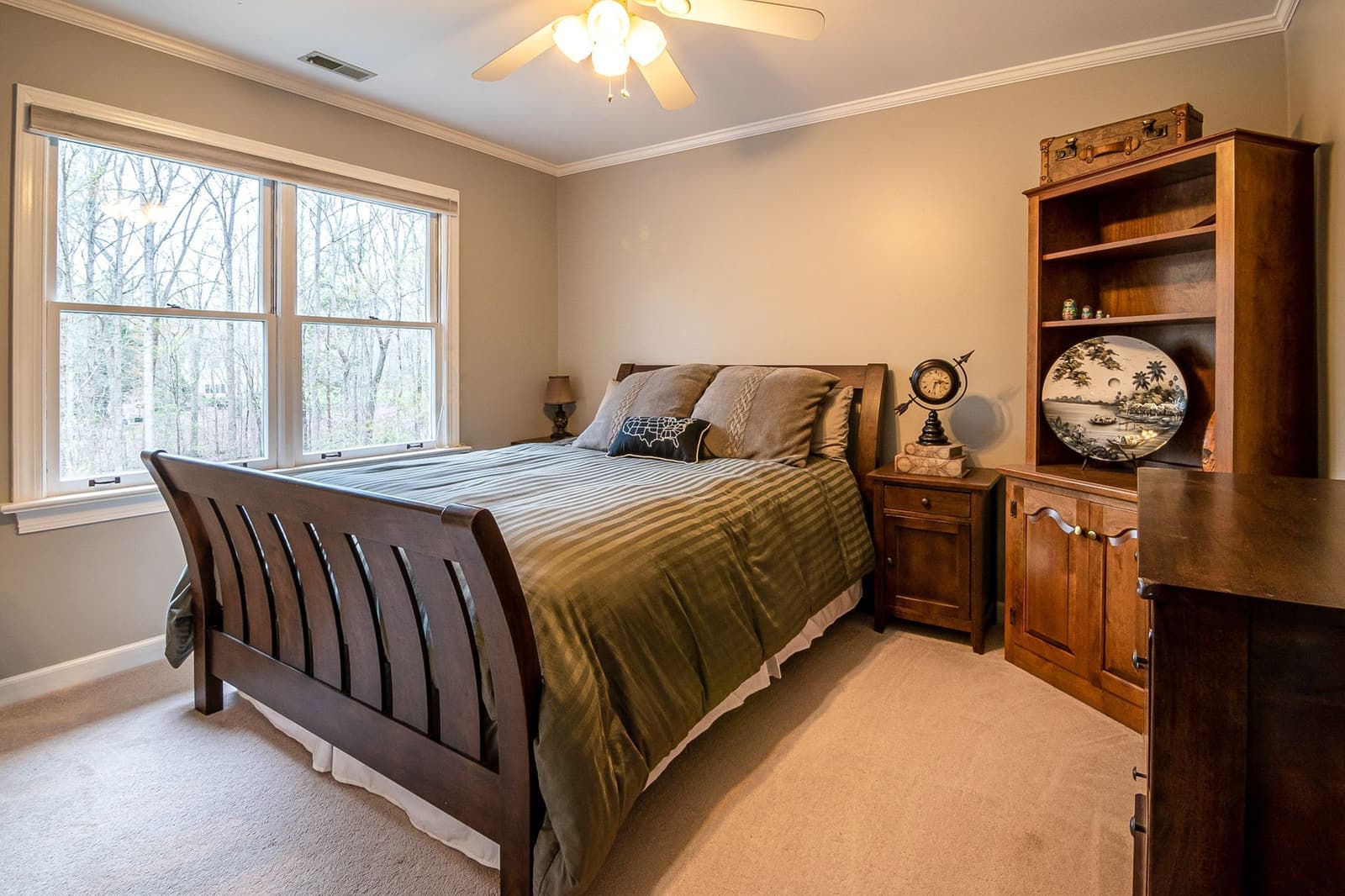
At a glance
The picks, ranked
Tap any row to jump to the full reasoning. Prices are live from Amazon where we have them, and read “check price” where we don’t — never a number we cannot verify today.
| # | Product | Best for | Price |
|---|---|---|---|
| 1 | 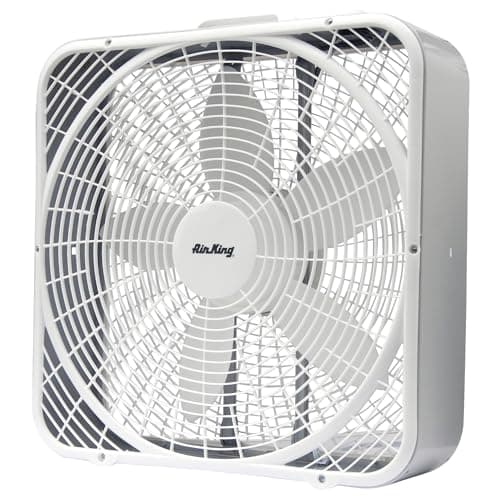 The only one with a published number Air King 9723 20" Commercial Grade Box Fan 855 RPM on low and 1,463 CFM at that speed — the only published blade speed in the box fan category, and the only quietness figure in it that can be checked. | Anyone who wants evidence rather than a claim, in a room they are awake in | |
| 2 | 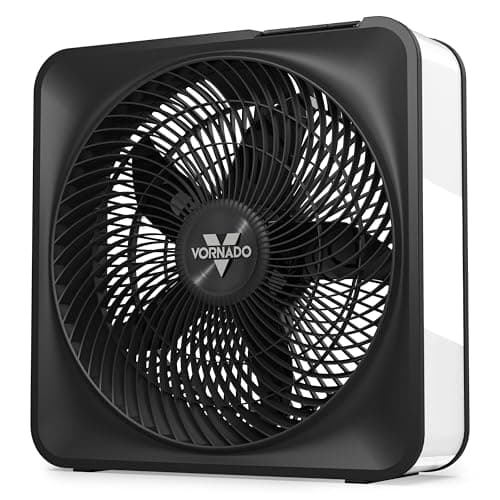 Most settings below 'low' Vornado Model 80 High-Velocity Box Fan Five speeds instead of three. A three-speed fan's low is a fixed point you either live with or you don't; this one has settings underneath it. | A room where the three-speed jump from 'too loud' to 'off' is the problem | |
| 3 | The quiet claim everyone has heard Lasko Power Plus 20" Box Fan Lasko describes its low speed as whisper-quiet and publishes 73 W to back the fact that it is doing less work. No CFM, no RPM, no dBA. | A window, where the fan is behind you and the sash is down | |
| 4 | 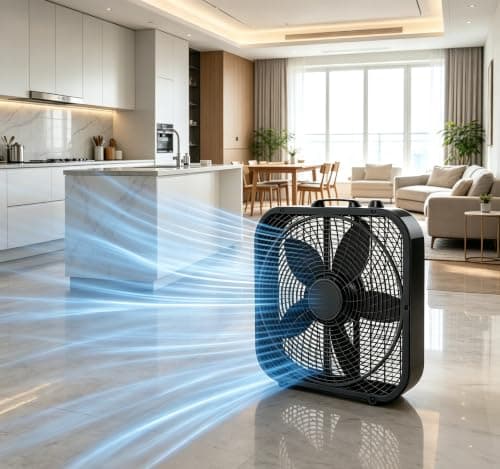 Least fan, least noise, least money Lasko B20301 20" Weather-Resistant Box Fan 7.25 lb against 11.4 for the Air King. A lighter fan has a smaller motor and a lighter blade, and it is the cheapest way into the category. | A spare room, a garage, or a fan you only run on low anyway | |
| — | 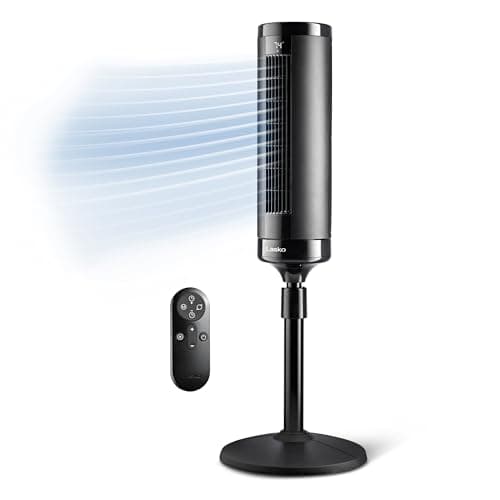 The one to buy if quiet is the actual requirement Lasko EcoQuiet 42" DC Tower Fan 23 dBA on low, published, on 2.9 W, across twelve speeds. Against an unpublished figure on 65-73 W across three speeds, this is not a comparison. | Sleeping. A box fan is the wrong format for a bedside fan |
There is no quiet box fan the way there is a quiet dishwasher, because no box fan manufacturer measures or publishes noise. Not Lasko, not Vornado, not Air King, not the house brands. Every “whisper quiet” on a box fan box is a word, not a number.
That matters more than it sounds. Air King publishes 64 / 57 / 50 dB for its 20-inch window fan and 34 / 37 dBA for its 6-inch clip-on. The same company, measuring the same way, publishes nothing for its box fan. The figures exist as a capability; they are not applied to this category.
The method
What to compare when nobody publishes decibels
Fan noise has three sources, and two of them are visible in published specifications.
- Blade speed (RPM). The dominant source. A blade tip moving faster through air makes more noise, roughly as the fifth power of tip speed. One box fan publishes RPM.
- Motor load (watts). A secondary source, and the one most people hear as a hum rather than a rush. Three of the four fans here publish watts.
- Turbulence. Grille design, blade-to-shroud clearance, and whatever the fan is standing on. Nobody publishes anything about this, and it is why two fans with identical numbers can sound different.
The numbers
Every published figure in the category, side by side
| Fan | Noise | RPM, low | Watts, low | Speeds |
|---|---|---|---|---|
| Air King 9723 | Not published | 855 | 65 W | 3 |
| Vornado Model 80 | Not published | Not published | 70 W | 5 |
| Lasko B20801 | Not published | Not published | 73 W | 3 |
| Lasko B20301 | Not published | Not published | Not published | 3 |
| Lasko EcoQuiet DC tower | 23 dBA | Not published | 2.9 W | 12 |
Every figure is the manufacturer’s own published number. Blank cells are blank because the manufacturer publishes nothing, not because we could not find it.
This one is not a DIY job
A box fan in a window is quieter in the room than the same fan on the floor, because the frame and the sash put the blade outside the room’s acoustic envelope and the exhaust noise goes out with the air. If the fan is loud where it is, move it before you replace it.
Context
How loud is a box fan, roughly
No manufacturer will say, so the honest framing is by comparison with fans that are measured. A 16-inch window fan with a similar blade and a similar motor load publishes 50 dB on low and 64 dB on high. A 20-inch box fan sits in that territory — conversation level on low, raised-voice level on high — and the specific fan you buy will land somewhere in it without anyone telling you where.
For context the other way: 23 dBA from a DC tower fan is below the background level of a quiet suburban bedroom at night. The full decibel scale for cooling hardware is here.
Say the unwelcome thing
Do not buy a box fan on a listing's CFM or dBA claim.
Retail listings for box fans routinely quote airflow figures — 2,295 CFM, 2,400 CFM — that appear nowhere on the manufacturer’s own specification page. There is no mandatory test procedure for portable fan airflow in the United States, so those numbers are not comparable between brands and frequently are not traceable to anything at all.
The same applies to decibel claims. If the figure is not on the manufacturer’s own specification sheet, treat it as copy.
Fixes
Three things that quieten the fan you already own
- Put it on something soft. Most of what people hear from a cheap box fan is frame vibration transmitted into a hard floor. A rug, a folded towel or a strip of foam under the feet removes it.
- Clean the blade. Dust builds unevenly, and an unbalanced blade makes a low rhythmic thrum that gets worse all summer. How to get into one safely.
- Move it into the window. It does more useful work there and you hear less of it.
In full
Every pick, and what is wrong with it
Published specifications only, each linked to the page it came from. Where a manufacturer publishes nothing, the row says so — we do not fill blanks in.
1. The only one with a published number
Air King 9723 20" Commercial Grade Box Fan
Air King · model 9723
855 RPM on low and 1,463 CFM at that speed — the only published blade speed in the box fan category, and the only quietness figure in it that can be checked.
Fan noise is blade speed and turbulence, in that order. A blade turning slower makes less noise, and Air King is the only box fan manufacturer that will tell you how fast its blade turns: 1,220 / 1,075 / 855 RPM across the three speeds.
What makes that figure useful rather than trivia is the airflow published next to it. On low the fan turns at 855 RPM and still moves 1,463 CFM on 65 W. That is 70 per cent of its full airflow at 70 per cent of its full blade speed — so the quiet setting is not a token setting, it is most of the fan.
For comparison, the same 20-inch blade at full tilt is 1,220 RPM for 2,163 CFM. You give up a third of the air to take a third off the blade speed, and on a fan that already moves more air than any bedroom needs, that is an easy trade.
Eight hours on low is 9.5¢ at 18.34¢/kWh, or $2.86 over a month of nights.
The honest gap: Air King publishes no decibel figure. Nobody in this category does. What they publish is the mechanism behind the noise, which is more than anyone else offers and less than a measurement.
What’s wrong with it
Air King publishes no dBA either, and this is a commercial-grade steel fan: it is heavier, costs more than a supermarket box fan, and makes no attempt to be quiet-looking.
Running cost — 9723
| Nameplate power | 65 W – 105 W | manufacturer's published figure |
|---|---|---|
| Energy, 8-hour night | 0.84 kWh | 105 ÷ 1000 × 8 |
| Cost per hour | 1.9¢ | at 18.34¢/kWh |
| Cost per 8-hour night | 15¢ | on the highest speed |
| Cost per 30 nights | $4.62 | 25.2 kWh |
| Same month, lowest speed | $2.86 | at 65 W |
Rate: 18.34¢/kWh, the US average residential price for June 2026 (EIA Electric Power Monthly, Table 5.3). Yours will differ — swap it in: (watts ÷ 1000) × hours × your rate.
| Air delivery | 2,163 / 1,900 / 1,463 CFM (high / medium / low) |
|---|---|
| Power | 105 / 87 / 65 W (0.94 / 0.72 / 0.56 A) |
| Efficiency | 20.6 CFM per watt on high, 22.5 on low (our arithmetic) |
| Blade speed | 1,220 / 1,075 / 855 RPM |
| Blade | 20 in |
| Speeds | 3 |
| Motor | 1/25 HP, 120 V, 1 phase |
| Dimensions | 21.38 W x 6.38 D x 22.5 H in |
| Weight | 11.4 lb |
| Oscillation | No |
| Noise | Not published |
Every figure above is from Air King commercial box fan product page, model 9723. Blanks are shown as “not published” rather than filled in.
2. Most settings below 'low'
Vornado Model 80 High-Velocity Box Fan
Vornado · model 80
Five speeds instead of three. A three-speed fan's low is a fixed point you either live with or you don't; this one has settings underneath it.
The complaint behind “quiet box fan” is usually not that the fan is loud at full speed. It is that low is still too loud, and on a three-speed fan there is nothing underneath it.
Five speeds is the structural fix. Two of them sit below where a conventional box fan’s low sits, which is the single most useful thing a manufacturer can do about perceived noise without changing the motor.
120 / 90 / 70 W is published across three of those five settings, and Vornado’s own listing calls the fan quiet without putting a number on it. At the published 70 W an eight-hour night is 10¢.
The blade is 16.15 inches inside a 20-inch frame, which is a deliberate choice: a smaller blade in a shrouded housing throws a tighter column of air and generates less edge turbulence than a full-width blade running close to the grille.
Five years of warranty, against two from Lasko and none published by Air King, is the other reason to look at it.
What’s wrong with it
Vornado publishes watts for only three of the five settings and no CFM at all, so you cannot work out what the two quietest settings actually deliver. It is also the most expensive fan here.
Running cost — 80
| Nameplate power | 70 W – 120 W | manufacturer's published figure |
|---|---|---|
| Energy, 8-hour night | 0.96 kWh | 120 ÷ 1000 × 8 |
| Cost per hour | 2.2¢ | at 18.34¢/kWh |
| Cost per 8-hour night | 18¢ | on the highest speed |
| Cost per 30 nights | $5.28 | 28.8 kWh |
| Same month, lowest speed | $3.08 | at 70 W |
Rate: 18.34¢/kWh, the US average residential price for June 2026 (EIA Electric Power Monthly, Table 5.3). Yours will differ — swap it in: (watts ÷ 1000) × hours × your rate.
| Power | 120 / 90 / 70 W (three of the five settings published) |
|---|---|
| Speeds | 5 |
| Blade diameter | 16.15 in |
| Supply | 120 V, 60 Hz |
| Dimensions | 19.99 W x 6.41 D x 20.19 H in |
| Weight | 12.96 lb |
| Cord | 6 ft, 2-pin polarized |
| Grille | Removable, for cleaning |
| Air delivery (CFM) | Not published |
| Noise | Not published |
| Warranty | 5 years |
Every figure above is from Vornado product page, Model 80 High-Velocity Box Fan. Blanks are shown as “not published” rather than filled in.
3. The quiet claim everyone has heard
Lasko Power Plus 20" Box Fan
Lasko · model B20801
Lasko describes its low speed as whisper-quiet and publishes 73 W to back the fact that it is doing less work. No CFM, no RPM, no dBA.
This is the fan most people mean by “box fan”, and 73 W to 102 W across three speeds is the only performance number Lasko attaches to it.
Wattage is a weak noise proxy, but it is not a useless one: a motor drawing 73 W is doing less work than a motor drawing 102 W, and less work generally means less noise. What it cannot tell you is how much of that 73 W becomes air and how much becomes sound.
The specification worth paying for here is different: a weather-resistant motor and a 4.75-inch depth, so the fan can live in an open sash window with the window closed on top of it. In a window, most of the noise goes outside with the air. That placement is the whole point of a box fan.
What’s wrong with it
Three figures matter for noise — dBA, RPM and CFM — and Lasko publishes none of them. 73 W on low is also the highest low-speed draw of any box fan here.
Running cost — B20801
| Nameplate power | 73 W – 102 W | manufacturer's published figure |
|---|---|---|
| Energy, 8-hour night | 0.82 kWh | 102 ÷ 1000 × 8 |
| Cost per hour | 1.9¢ | at 18.34¢/kWh |
| Cost per 8-hour night | 15¢ | on the highest speed |
| Cost per 30 nights | $4.49 | 24.5 kWh |
| Same month, lowest speed | $3.21 | at 73 W |
Rate: 18.34¢/kWh, the US average residential price for June 2026 (EIA Electric Power Monthly, Table 5.3). Yours will differ — swap it in: (watts ÷ 1000) × hours × your rate.
| Power | 73 W - 102 W (0.6-0.9 A at 120 V) |
|---|---|
| Speeds | 3 |
| Dimensions | 21.25 H x 22.5 x 4.75 in |
| Weight | 10.1 lb |
| Motor | Weather-resistant |
| Air delivery (CFM) | Not published |
| Warranty | 2 years |
Every figure above is from Lasko product page, B20801. Blanks are shown as “not published” rather than filled in.
4. Least fan, least noise, least money
Lasko B20301 20" Weather-Resistant Box Fan
Lasko · model B20301
7.25 lb against 11.4 for the Air King. A lighter fan has a smaller motor and a lighter blade, and it is the cheapest way into the category.
7.25 lb and 4.38 inches deep, the lightest and slimmest box fan in this set. Both of those follow from a smaller motor, and a smaller motor is a quieter motor.
Lasko quotes running cost rather than wattage — “less than 2¢ per hour”, which at 18.34¢/kWh implies something under 120 W but is not a specification you can compare with anything.
The practical catch with a light frame is that it transmits motor vibration into whatever it is standing on. On a hard floor that is audible; on a rug or a folded towel it mostly is not. The other fixes for a buzzing fan are here.
What’s wrong with it
Lasko publishes nothing at all for it — no wattage, no CFM, no RPM, no dBA. A lighter frame also buzzes more readily against a hard floor.
Running cost
Lasko does not publish a wattage for the B20301, so we cannot calculate what it costs to run. We are not going to estimate one. If Lasko publishes a nameplate figure, this block will show the arithmetic.
| Power | Not published (Lasko states "less than 2 cents per hour") |
|---|---|
| Speeds | 3 |
| Blade | 20 in |
| Motor | Weather-resistant, for indoor window use |
| Dimensions | 20.5 W x 4.38 D x 21.75 H in |
| Weight | 7.25 lb |
| Cord | 6 ft |
| Safety | Blue Plug fused plug |
| Air delivery (CFM) | Not published |
| Noise | Not published |
| Warranty | 2 years |
Every figure above is from Lasko product page, B20301. Blanks are shown as “not published” rather than filled in.
Skip this one
Lasko EcoQuiet 42" DC Tower Fan
Lasko · model T42710
23 dBA on low, published, on 2.9 W, across twelve speeds. Against an unpublished figure on 65-73 W across three speeds, this is not a comparison.
If you searched for a quiet box fan because you want to sleep, the honest answer is that you are shopping in the wrong category.
23 dBA on low, published by the manufacturer, on 2.9 W, across twelve speeds. No box fan publishes a decibel figure at all, and the quietest one we can characterise is turning a 20-inch blade at 855 RPM three feet from your head.
The running cost difference is the same shape: 13¢ for a month of eight-hour nights on low, against $2.86 for the Air King on its low setting.
A box fan earns its place in a window, in a workshop, or in a room you are awake in. For a bedside fan, the quiet formats are here.
What’s wrong with it
It is not a box fan, it does not fit a window, and it moves a fraction of the air. If you need to shift the air in a garage, this will not do it.
Running cost — T42710
| Nameplate power | 2.9 W – 19 W | manufacturer's published figure |
|---|---|---|
| Energy, 8-hour night | 0.15 kWh | 19 ÷ 1000 × 8 |
| Cost per hour | 0.3¢ | at 18.34¢/kWh |
| Cost per 8-hour night | 2.8¢ | on the highest speed |
| Cost per 30 nights | 84¢ | 4.6 kWh |
| Same month, lowest speed | 13¢ | at 2.9 W |
Rate: 18.34¢/kWh, the US average residential price for June 2026 (EIA Electric Power Monthly, Table 5.3). Yours will differ — swap it in: (watts ÷ 1000) × hours × your rate.
| Power | 2.9 W - 19 W (0.06-0.303 A at 120 V) |
|---|---|
| Noise | 23 dBA low, 46 dBA high |
| Speeds | 12 |
| Height | 41.6 in |
| Footprint | 12.8 x 12.8 in |
| Weight | 7.8 lb |
| Timer | 8 hours |
| Air delivery (CFM) | Not published |
| Warranty | 2 years |
Every figure above is from Lasko product page, T42710. Blanks are shown as “not published” rather than filled in.
We are not linking a buy button for this one. If you want to look at it anyway, it is easy enough to find — but we would rather send you to something that fits your room.
Questions people actually ask
Frequently asked
What is the quietest box fan?
No box fan manufacturer publishes a decibel figure, so there is no measured answer. The Air King 9723 is the only box fan that publishes blade speed — 855 RPM on low, moving 1,463 CFM on 65 W — and blade speed is the dominant source of fan noise, so it is the only quietness claim in the category that can be checked.
How many decibels is a box fan?
Unpublished. For reference, Air King publishes 50 dB on low and 64 dB on high for its 16-inch window fan, which uses a comparable blade and motor load, so a 20-inch box fan sits in roughly that range. No manufacturer confirms a figure for a box fan specifically.
Are box fans quieter than tower fans?
No. A DC tower fan publishes 23 dBA on low on 2.9 W across twelve speeds. A box fan turns a 20-inch blade at several hundred RPM on 65 to 73 W across three speeds and publishes no figure at all. For a bedroom the tower fan is not a close call. Box fan vs tower fan.
Why is my box fan so loud all of a sudden?
Almost always one of three things: dust has built up unevenly on the blade and unbalanced it, the frame has started vibrating against a hard floor, or a bearing is drying out. Clean the blade first and put the fan on something soft second. How to make a fan quieter.
Does a box fan get quieter on low?
Yes, and more than you would expect — noise rises very steeply with blade tip speed. On the one box fan that publishes blade speed, low is 855 RPM against 1,220 on high, a 30 per cent reduction in blade speed for only a 32 per cent reduction in airflow.
Is a five-speed box fan quieter than a three-speed one?
At its lowest setting, usually yes. A three-speed fan's low is a fixed point with nothing underneath it, while a five-speed fan has two settings below where a conventional low sits. That is the single most useful thing a manufacturer can do about perceived noise without changing the motor.
Sources
Where these numbers came from
- Air King commercial box fan specifications, model 9723 — 2,163/1,900/1,463 CFM, 1,220/1,075/855 RPM, 105/87/65 W
- Vornado Model 80 High-Velocity Box Fan — 120/90/70 W, 5 speeds, 16.15 in blade
- Lasko B20801 Power Plus box fan — 73-102 W, 0.6-0.9 A
- Lasko B20301 weather-resistant box fan — 7.25 lb, 3 speeds
- Lasko EcoQuiet T42710 DC tower fan — 23 dBA low, 2.9-19 W
- Air King 20 in whole house window fan — 64/57/50 dB published
- EIA Electric Power Monthly, Table 5.3 — electricity rate
Read next
Where to go from here
Back to Fans, or read how we pick.