Guide and picks
Cooling a home theater
Every other room lets you trade noise for airflow. This is the one room where you cannot, which changes every answer.
By Sawyer V. · Published
The short answer
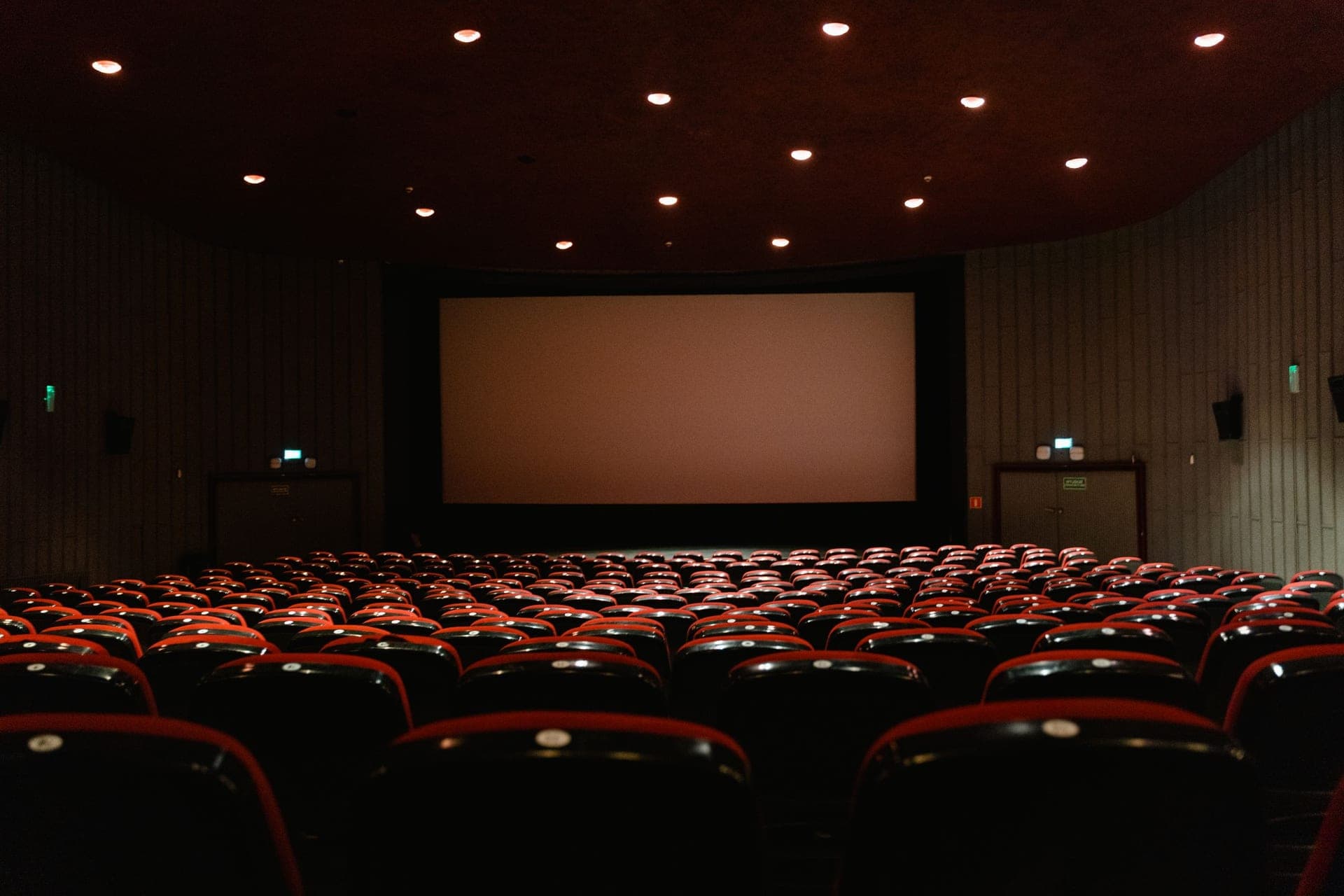
Treat it as a noise problem first. A home theater is usually sealed, dark and full of equipment, so the heat is real — but anything audible ruins the room’s purpose. The answer is continuous low-speed air movement rather than intermittent blasts: a ceiling fan at 1 to 3 W on low, a ventilated rack, and cooling that runs before and between rather than during.
Fan & Frost earns a commission when you buy through our links, at no cost to you. It never changes a ranking, and we say so when the right answer is the cheaper unit or nothing at all. Full disclosure · How we pick.
At a glance
The picks, ranked
Tap any row to jump to the full reasoning. Prices are live from Amazon where we have them, and read “check price” where we don’t — never a number we cannot verify today.
| # | Product | Best for | Price |
|---|---|---|---|
| 1 | 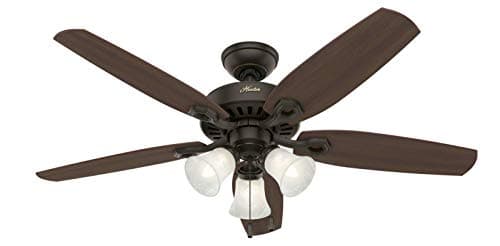 Best overall Hunter Vespucci 52" Ceiling Fan 366.7 CFM per watt with 1.8 W on low — enough air movement to matter, at a speed where blade noise is not a factor. | A media room with a normal ceiling and a fan-rated box | |
| 2 | Best for the equipment rack Fantech FG 10 EC In-Line Fan 460 CFM at 5.2 CFM per watt from an EC motor, ducted so the fan itself sits away from the listening position. | A closed cabinet or closet holding an AV receiver and sources | |
| 3 | Best actual cooling Midea Window Heat Pump Air Conditioner, 9,500 BTU CEER 17.6 and 404.8 kWh a year — the most efficient certified room unit, run before and between rather than during. | A dedicated room that genuinely runs hot, with a window | |
| — | 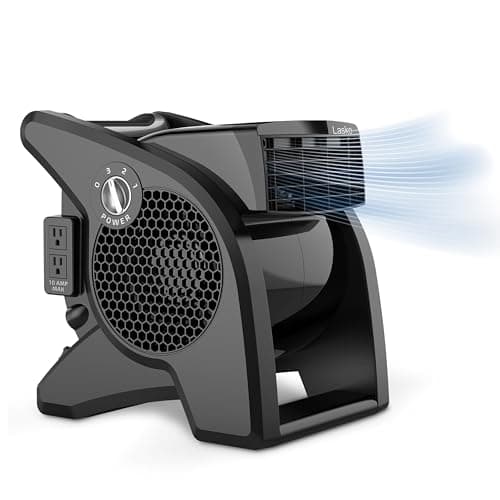 Wrong for this room Lasko Max Performance 15" Air Mover 160 to 178 W of high-velocity air movement, which is exactly the wrong instrument for a room where you need silence. | A workshop or garage — anywhere noise does not matter |
Media rooms are unusual among the rooms people ask us about, because the normal escape hatch is closed. In a bedroom, a garage or a home office you can always turn a fan up. Here, anything you can hear during a quiet scene has failed.
The load
Where the heat actually comes from
Before buying anything, work out what you are fighting. Media rooms have an unusual heat profile: relatively little from the fabric of the building, and a great deal from equipment and people.
- The projector, if you have one, is usually the single largest source and it is on for the whole session. Check its manufacturer specification for input power — whatever it draws becomes heat in the room, near enough entirely.
- The amplifier or AV receiver, particularly a class-AB power amplifier driving several channels. Much of what it draws does not become sound.
- Source equipment and games consoles, which are small individually and add up in a closed cabinet.
- The people. A seated adult is a continuous heat source, and this is a room designed to hold several of them close together.
- Very little from windows, unusually — a media room is normally blacked out, which removes the solar gain that dominates most rooms.
That profile matters because it means the load is steady and internal rather than peaking with the afternoon sun. Cooling that is sized for a sunny bedroom will behave differently here.
This one is not a DIY job
Do not guess your equipment’s heat output from its rated power output. A 100 W-per-channel amplifier does not draw 700 W at normal listening levels, and it does not put out 700 W of heat. The figure you want is the manufacturer’s stated power consumption at typical use, which most publish — and if yours does not, that absence is information too.
Strategy
Cool before and between, not during
This is the central idea and it solves most of the conflict.
A sealed, blacked-out room with a closed door is well insulated against the outdoors almost by accident. That means it holds a temperature for considerably longer than a normal room does, which in turn means the compressor does not have to run while you are watching.
- Pre-cool for 30 to 60 minutes before the session, harder than you would normally set it. Two or three degrees below target gives you headroom.
- Switch the compressor off as the film starts. A timer, an app or simply a habit.
- Leave continuous low-speed air movement running. A ceiling fan at 1 to 3 W is inaudible and keeps the room from stratifying, which is what makes a still room feel stuffy.
- Run the compressor again in the interval, or between episodes.
The equipment rack is the exception and should run continuously, because electronics do not get a break during the film — and heat soak in a closed cabinet is what shortens their life.
The rack
The cabinet is the highest-leverage fix
A closed AV cabinet with a receiver in it is a small oven. It is also the easiest thing on this page to fix well, because you are moving a small volume of air rather than conditioning a room.
In rough order of effort:
- Open the back of the cabinet. Free, and it is frequently enough on its own.
- Add a vent at the top and another at the bottom. Warm air leaves the top, cool air is drawn in at the bottom, with no fan at all. Convection is silent by definition.
- Add a small continuous fan, running slowly all the time, rather than a large one running intermittently. Continuous and slow is both quieter and better for the electronics.
- Duct it out of the room with an in-line fan, which is the proper solution and the only one that removes the heat rather than relocating it — the same principle applied to a server closet.
Noise
What you can and cannot know about noise
We have to be straight about this, because it is the specification you most want and the one least reliably published.
Ceiling fans publish no noise rating at all. The ENERGY STAR certified dataset covers airflow, wattage at each speed and standby power, and contains no sones or dBA field. Nobody has a certified noise figure for a ceiling fan, including us.
What we can use is a reliable proxy: a fan that achieves high airflow per watt can deliver useful air at a low speed, and blade noise scales sharply with tip speed. A 366.7 CFM-per-watt fan on its lowest setting is doing what a 189 CFM-per-watt fan needs a higher speed to do.
Portable fan dBA figures exist but are manufacturer-measured under conditions that vary, so they are comparable within a brand and unreliable across brands — what fan noise figures mean and the quietest fans we can evidence.
If it is a basement
Most home theaters are basements, and that changes things
If your media room is below grade, you probably have a humidity problem as well as a heat problem, and it is the more damaging of the two.
A basement stays cool, which is good for the equipment, but cool air holds less moisture before it condenses. Electronics, screens, seating and acoustic treatment all suffer in sustained high humidity, and speaker surrounds in particular do not enjoy it.
A dehumidifier is doing a different job from an air conditioner here, and in a cool basement it is usually the right machine — basement dehumidifiers and cooling a basement generally. Bear in mind it adds a little heat and its own noise, so put it on a humidistat and let it run when the room is empty.
Say the unwelcome thing
Do not put a portable air conditioner in a home theater.
It fails this room on every axis at once. A compressor and a fan in the room with you is the loudest possible arrangement, and it runs precisely when you need it not to.
It also needs a hose to a window, which a blacked-out media room usually does not have in a usable position — and on a single-hose unit that hose depressurizes the sealed room you spent money sealing.
If the room has a window, a window unit run before and between sessions is better on noise, efficiency and sealing. CEER 17.6, and it heats too — and if it has no window, that is a different problem with different answers.
In full
Every pick, and what is wrong with it
Published specifications only, each linked to the page it came from. Where a manufacturer publishes nothing, the row says so — we do not fill blanks in.
1. Best overall
Hunter Vespucci 52" Ceiling Fan
Hunter · model Vespucci
366.7 CFM per watt with 1.8 W on low — enough air movement to matter, at a speed where blade noise is not a factor.
The right shape of answer for this room: high efficiency means the fan achieves useful airflow at a speed slow enough to be inaudible under dialogue.
366.7 CFM per watt, certified, against a median of 189.2 across the 42 to 56 inch band. That gap is what buys you the ability to run it on its lowest setting.
1.8 W on low and 13.9 W on high. An eight-hour evening on low is 0.3¢ at 18.34¢/kWh.
0.8 W standby is the honest cost, drawn all 8,760 hours of the year — about $1.29 annually. In a room full of standby loads it is worth a switched circuit anyway.
What’s wrong with it
0.8 W of standby draw, which is double the quietest fans in the certified field.
Running cost — Vespucci
| Nameplate power | 1.8 W – 13.9 W | manufacturer's published figure |
|---|---|---|
| Energy, 8-hour night | 0.11 kWh | 13.9 ÷ 1000 × 8 |
| Cost per hour | 0.3¢ | at 18.34¢/kWh |
| Cost per 8-hour night | 2.0¢ | on the highest speed |
| Cost per 30 nights | 61¢ | 3.3 kWh |
| Same month, lowest speed | 7.9¢ | at 1.8 W |
Rate: 18.34¢/kWh, the US average residential price for June 2026 (EIA Electric Power Monthly, Table 5.3). Yours will differ — swap it in: (watts ÷ 1000) × hours × your rate.
| Blade span | 52 in |
|---|---|
| Efficiency | 366.7 CFM per watt |
| Power, high speed | 13.9 W |
| Power, low speed | 1.8 W |
| Standby power | 0.8 W |
| Type | Indoor, fan only (no light kit) |
| Warranty | 3 years, components |
| ENERGY STAR | Certified |
Every figure above is from ENERGY STAR Certified Ceiling Fans dataset. Blanks are shown as “not published” rather than filled in.
2. Best for the equipment rack
Fantech FG 10 EC In-Line Fan
Fantech · model FG 10 EC
460 CFM at 5.2 CFM per watt from an EC motor, ducted so the fan itself sits away from the listening position.
The single most effective intervention in most home theaters, because it removes heat at the source rather than diluting it into the room.
460 CFM at 5.2 CFM per watt, certified, with an EC motor that runs quietly at reduced speed rather than only on or off.
In-line mounting is the point. The fan sits in the duct run, remote from the cabinet and from you, so its own noise is attenuated by the duct before it reaches the room — in-line fans compared.
It is a build, not a purchase. You need a duct route, a grille and somewhere for the warm air to go. That is real work, and it is why most racks stay hot — the same problem in a server closet.
What’s wrong with it
It needs ducting and a mounting point, which is a build project rather than a purchase.
Running cost
Fantech does not publish a wattage for the FG 10 EC, so we cannot calculate what it costs to run. We are not going to estimate one. If Fantech publishes a nameplate figure, this block will show the arithmetic.
| Air delivery | 460 CFM at 0.25 in w.g. |
|---|---|
| Efficacy | 5.2 CFM per watt |
| Duct size | 10 in diameter |
| Unit type | In-line (single-port), mounted in the duct run |
| Motor | EC (electronically commutated) |
| Noise (sones) | Not published for in-line units |
| ENERGY STAR | Certified |
Every figure above is from ENERGY STAR Certified Ventilating Fans dataset. Blanks are shown as “not published” rather than filled in.
3. Best actual cooling
Midea Window Heat Pump Air Conditioner, 9,500 BTU
Midea · model MAH09B1AGR
CEER 17.6 and 404.8 kWh a year — the most efficient certified room unit, run before and between rather than during.
If air movement is not enough, the strategy is to use the compressor outside viewing time and let the room coast.
CEER 17.6 and 404.8 kWh a year — about $74 at 18.34¢/kWh, and 80% under the federal standard. It is the highest CEER of all 505 certified room air conditioners.
Pre-cool hard, then stop. A sealed media room with the door shut holds temperature well for a couple of hours, which is most of a film. A timer or an app makes that automatic.
129 lb and reverse-cycle heating included, which suits a room that is unheated the rest of the week. It straddles the sill, so no bracket is needed.
What’s wrong with it
129 lb and, like every compressor, audible when it runs.
Running cost — MAH09B1AGR
| Annual energy use | 404.8 kWh | ENERGY STAR certified figure |
|---|---|---|
| Annual cost | $74 | 404.8 × 18.34¢/kWh |
| Per cooling month | $19 | spread over a four-month season |
The annual figure is the certified value from the ENERGY STAR Certified Room Air Conditioners dataset, which models a standard cooling season rather than your actual summer. It is more useful than a nameplate wattage here, because a variable-speed compressor spends most of its life well below nameplate.
Rate: 18.34¢/kWh, the US average residential price for June 2026 (EIA Electric Power Monthly, Table 5.3). Yours will differ — swap it in: (watts ÷ 1000) × hours × your rate.
| Cooling capacity | 9,500 BTU/h |
|---|---|
| Heating mode | Yes, reverse cycle |
| CEER | 17.6 |
| Annual energy use | 404.8 kWh/yr |
| vs federal standard | 80% less energy |
| Dimensions | 20.9 H x 25.0 W x 41.2 D in |
| Weight | 129.0 lb |
| Installation | Straddles the windowsill (saddle style) |
| Support bracket | Not required |
| Compressor | Variable speed |
| Refrigerant | R-32 |
| ENERGY STAR | Certified, and on the Most Efficient list |
Every figure above is from ENERGY STAR Certified Room Air Conditioners dataset. Blanks are shown as “not published” rather than filled in.
Skip this one
Lasko Max Performance 15" Air Mover
Lasko · model U15720
160 to 178 W of high-velocity air movement, which is exactly the wrong instrument for a room where you need silence.
Flagged because the instinct when a room is hot is to buy more airflow, and in this room more airflow is the failure mode.
160 to 178 W across three speeds, with a pivoting head and two accessory outlets. A genuinely good air mover.
It is roughly a hundred times the power draw of a certified ceiling fan on low, and it makes proportionate noise. In a room built to control sound, that is not a trade you can take.
No published CFM figure, so you cannot even evaluate what the noise is buying. Excellent in a workshop, wrong here.
What’s wrong with it
It is loud by design, and Lasko publishes no CFM figure to justify the trade.
Running cost — U15720
| Nameplate power | 160 W – 178 W | manufacturer's published figure |
|---|---|---|
| Energy, 8-hour night | 1.42 kWh | 178 ÷ 1000 × 8 |
| Cost per hour | 3.3¢ | at 18.34¢/kWh |
| Cost per 8-hour night | 26¢ | on the highest speed |
| Cost per 30 nights | $7.83 | 42.7 kWh |
| Same month, lowest speed | $7.04 | at 160 W |
Rate: 18.34¢/kWh, the US average residential price for June 2026 (EIA Electric Power Monthly, Table 5.3). Yours will differ — swap it in: (watts ÷ 1000) × hours × your rate.
| Power | 160 W - 178 W (1.35-1.53 A at 120 V) |
|---|---|
| Speeds | 3 |
| Dimensions | 14.5 H x 14.0 D x 11.5 W in |
| Weight | 12.55 lb |
| Extras | Two 120 V accessory outlets, 9.5 ft cord, pivoting head |
| Air delivery (CFM) | Not published |
| Warranty | 1 year |
Every figure above is from Lasko product page, U15720. Blanks are shown as “not published” rather than filled in.
We are not linking a buy button for this one. If you want to look at it anyway, it is easy enough to find — but we would rather send you to something that fits your room.
Questions people actually ask
Frequently asked
How do you cool a home theater without noise?
Cool it before and between sessions rather than during. A sealed, blacked-out room holds temperature well, so pre-cool for 30 to 60 minutes, switch the compressor off as the film starts, and leave continuous low-speed air movement running at 1 to 3 W.
What makes a media room hot?
Equipment and people, not the building. A projector runs for the whole session, an AV receiver converts much of what it draws into heat rather than sound, and several seated adults are a continuous load. A blacked-out room has almost no solar gain, unusually.
How do I cool an AV cabinet or equipment rack?
In order of effort: open the back, add vents at top and bottom so convection does the work silently, add a small fan running continuously and slowly, or duct it out of the room with an in-line fan — which is the only option that removes the heat rather than moving it. In-line fans.
How quiet is a ceiling fan on low?
Nobody publishes a certified figure — the ENERGY STAR ceiling fan dataset has no sones or dBA field at all. The usable proxy is airflow per watt: a fan rated at 366.7 CFM per watt delivers on its lowest setting what a 189 CFM-per-watt fan needs a higher, noisier speed to match. What fan noise figures mean.
Can I use a portable air conditioner in a home cinema?
It is the worst option for this room. The compressor and fan are both inside with you, it runs when you need silence, and on a single-hose unit the hose depressurizes the sealed room. A window unit run before and between sessions is better on every axis.
My home theater is in the basement — what should I worry about?
Humidity more than heat. A basement stays cool, but cool air holds less moisture before condensing, and sustained high humidity damages electronics, seating, screens and acoustic treatment. A dehumidifier on a humidistat is usually the right machine there. Basement dehumidifiers.
Sources
Where these numbers came from
- ENERGY STAR Certified Ceiling Fans dataset — CFM per watt, low and high speed wattage, standby power; and the absence of any noise field
- ENERGY STAR Certified Ventilating Fans dataset — certified CFM and efficiency for the in-line fan cited
- ENERGY STAR Certified Room Air Conditioners dataset — CEER and annual kWh for the window heat pump cited
- Lasko product page, U15720 — 160 to 178 W, three speeds, no published CFM
- EIA Electric Power Monthly, Table 5.3 — average residential electricity price
Read next
Where to go from here
Back to Room Cooling, or read how we pick.