The picks
Best garage exhaust fans
Exhaust removes heat and fumes. It does not make you feel cooler. Get that distinction right and the choice becomes a straightforward reading of three numbers.
By Sawyer V. · Published
The short answer
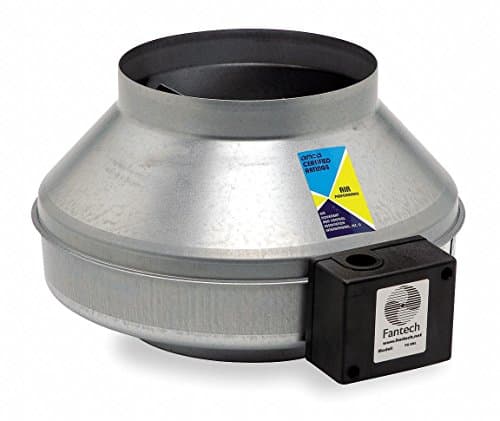
For a ducted run, the Fantech FG 8 moves 390 CFM through an 8-inch duct. For a ceiling-mounted install, the Panasonic WhisperGreen Select is 158.7 CFM at 0.7 sones — half the loudness of anything comparable — while the Broan Premium 150 gives 154.4 CFM at 14.2 CFM per watt, the best efficacy we have certified data for. None of them will make a hot garage feel cool; they remove air, they do not move it across you.
Fan & Frost earns a commission when you buy through our links, at no cost to you. It never changes a ranking, and we say so when the right answer is the cheaper unit or nothing at all. Full disclosure · How we pick.
At a glance
The picks, ranked
Tap any row to jump to the full reasoning. Prices are live from Amazon where we have them, and read “check price” where we don’t — never a number we cannot verify today.
| # | Product | Best for | Price |
|---|---|---|---|
| 1 | Most airflow Fantech FG 8 Series In-Line Fan 390 CFM through an 8-inch duct, and the motor sits in the duct run rather than on your ceiling. | A real ducted exhaust run — the fan lives in the duct, not the room | |
| 2 | 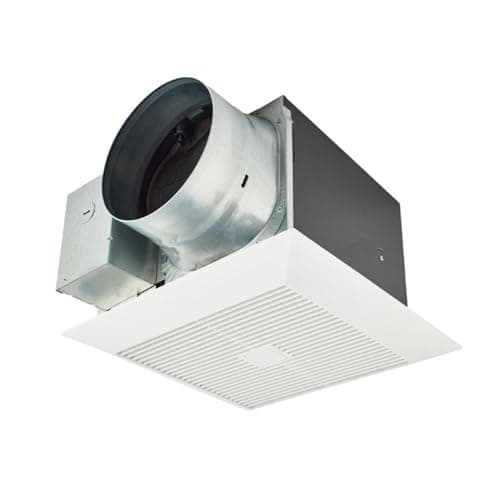 Quietest by a factor of two Panasonic WhisperGreen Select Ventilation Fan 158.7 CFM at 0.7 sones — and the sone scale is linear, so that is genuinely half the loudness of a 1.4-sone fan. | A garage attached to the house, or one you work in for hours | |
| 3 | 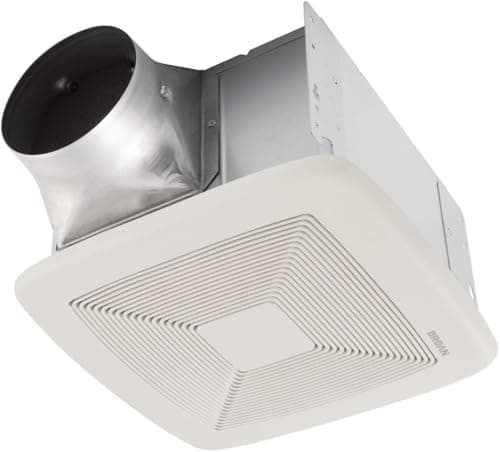 Best efficacy Broan-NuTone Premium Ventilation Fan 14.2 CFM per watt is the highest efficacy in the certified ventilating fan data we hold, at 154.4 CFM. | A detached garage where noise matters less than running cost | |
| — | 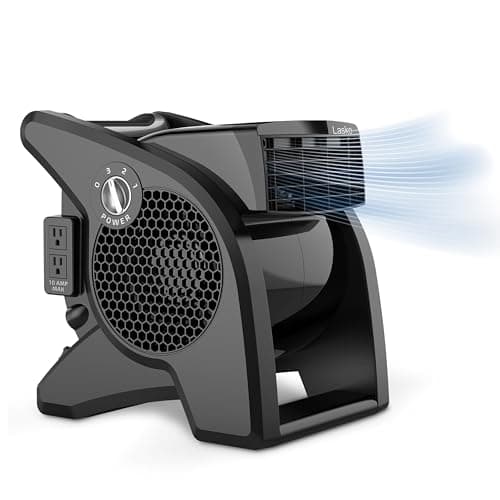 The thing people buy instead, and why it is not the same Lasko Max Performance 15" Air Mover 178 W of directional air movement with no exhaust function whatsoever, and no published CFM. | Feeling cooler while you work — which is a different problem |
A garage gets hot for reasons a fan cannot argue with: an uninsulated roof, a large uninsulated door facing the sun, a concrete slab that stores heat all day and gives it back all evening, and usually no conditioned air at all.
Exhaust ventilation addresses a specific part of that — and it is worth being precise about which part, because it is not the part most people are hoping for.
First
What exhaust actually does
It removes air. Hot air, humid air, exhaust fumes, solvent vapor, sawdust. It pulls that air out of the building and replacement air comes in through whatever openings exist.
It does not create airflow across your skin, which is what makes you feel cooler. That mechanism — moving air over the body to accelerate evaporative and convective heat loss — needs a fan pointed at you, not a fan pulling air out of a ceiling.
And it can only ever bring the garage toward the outdoor temperature. If it is 95 degrees outside, a perfect exhaust system gives you a 95-degree garage. That is a genuine improvement on a 115-degree garage. It is not cool.
So: exhaust for heat removal, fume removal and humidity. A separate fan, or an evaporative cooler, for comfort. They are two purchases solving two problems.
The numbers
The three certified options compared
| Fan | CFM | CFM/W | Sones | Duct |
|---|---|---|---|---|
| Fantech FG 8 in-line | 390 | 4.0 | Not published | 8 in |
| Panasonic WhisperGreen Select | 158.7 | 13.7 | 0.7 | 6 in |
| Broan-NuTone Premium 150 | 154.4 | 14.2 | 1.4 | 6 in |
All figures from the ENERGY STAR Certified Ventilating Fans dataset. CFM is measured at 0.25 inches of water gauge static pressure.
Three numbers, three different winners, and no overlap in who each one suits. That is unusually clean for a category.
Read this
Sones are not decibels, and the difference matters here
Ventilating fans are rated in sones rather than dBA, and the two scales behave completely differently.
The sone scale is linear against perceived loudness. Two sones sounds twice as loud as one sone. Four sones sounds four times as loud. There is no logarithm and no arithmetic to do.
Decibels are logarithmic, which is why a 3 dB difference is often dismissed as inaudible while a 10 dB difference is roughly a doubling. People carry that intuition across to sones and badly underestimate what they are reading.
So 0.7 sones against 1.4 is not a nuance. One fan is half as loud as the other, for the same airflow, through the same duct size, at essentially the same efficiency.
In an attached garage — under a bedroom, next to a living room — that is the entire decision.
This one is not a DIY job
An exhaust fan needs somewhere for the air to come from. This is the step that gets skipped, and it is why a lot of garage exhaust installations underperform their rating badly.
Pull 390 CFM out of a sealed garage and the fan is fighting the resulting negative pressure. It will move a fraction of its rated airflow and work hard doing it. Certified CFM figures assume 0.25 inches of water gauge; a sealed room presents far more than that.
Provide a deliberate intake — a low wall vent on the opposite side from the exhaust is the classic arrangement, so air crosses the space diagonally rather than short-circuiting.
If the garage is attached to the house, this is a safety matter, not just a performance one. Depressurizing a space that shares a wall with living areas can pull air the wrong way through that wall. If there is any fuel-burning appliance in or near the garage, get a professional to size the make-up air.
Sizing
How much airflow you need
Ventilation is sized on air changes per hour, and the arithmetic is simple enough to do in your head.
Take the garage volume in cubic feet — length times width times ceiling height. Divide by 60 to get the CFM for one air change per minute; multiply by the air changes per hour you want, divided by 60. Or more directly: CFM needed = (volume × air changes per hour) ÷ 60.
A two-car garage of roughly 20 by 20 feet with a 9-foot ceiling is 3,600 cubic feet. At 6 air changes per hour that is 360 CFM — which puts the 390 CFM in-line fan in range and both 6-inch ceiling fans well short of it.
Halve the garage and the picture inverts. A single-bay 12 by 20 with an 8-foot ceiling is 1,920 cubic feet, needing 192 CFM at the same rate — comfortably within the 155 to 159 CFM units if you accept a slightly lower change rate, or exactly right if you are ventilating occasionally rather than continuously.
Higher rates apply if you are running an engine, welding, spraying finish or working with solvents. Those are ventilation-for-safety numbers, and they belong to whoever supplies the material safety data, not to us.
Say the unwelcome thing
Do not buy an exhaust fan hoping the garage will feel cool.
It will not, and this is the single most common disappointment in this category. Exhaust ventilation brings a garage toward the outdoor temperature. On a 95-degree afternoon, the best possible outcome is a 95-degree garage.
What makes you feel cooler is air moving across your skin, and that takes a fan aimed at you. An air mover does that well at 178 W. An evaporative cooler in a dry climate genuinely lowers the air temperature, which exhaust never can.
Buy exhaust for heat removal, fumes and humidity. Buy something else for comfort. Attempting both with one purchase gets you neither.
Also
The cheap fixes worth doing first
Before any of this, two things cost less and often matter more.
The garage door. On a sun-facing wall it is usually the largest uninsulated surface in the building, and an insulation kit is a weekend and a fraction of a ducted fan install.
Timing. A garage is thermally massive. The slab and the walls absorb heat all afternoon and release it all evening, which is why ventilating at 4pm achieves less than ventilating at 9pm when outdoor air is finally cooler than the mass you are trying to unload. A simple timer or thermostat control is worth more than a bigger fan.
In full
Every pick, and what is wrong with it
Published specifications only, each linked to the page it came from. Where a manufacturer publishes nothing, the row says so — we do not fill blanks in.
1. Most airflow
Fantech FG 8 Series In-Line Fan
Fantech · model FG 8 Series
390 CFM through an 8-inch duct, and the motor sits in the duct run rather than on your ceiling.
390 CFM is two and a half times what either ceiling-mounted option delivers, and it is the reason to consider an in-line design for a garage rather than a bathroom fan.
The architecture is the point. An in-line fan mounts in the middle of the duct run, so the motor noise is in the duct and attenuates before it reaches the grille. There is a grille in the ceiling and nothing else.
The cost is efficiency. 4.0 CFM per watt against 14.2 for the Broan — an in-line fan is working against the full duct run, and it shows. And note what the certified dataset does not publish for in-line units: a sone rating. There is no standardized loudness figure for this class, so anyone quoting you one is quoting the manufacturer, not a test.
An 8-inch duct is a real installation. Budget for the ducting, the exterior cap and the mounting, not just the fan.
What’s wrong with it
4.0 CFM per watt is the worst efficacy of the three, and no sone rating is published for in-line fans at all.
Running cost
Fantech does not publish a wattage for the FG 8 Series, so we cannot calculate what it costs to run. We are not going to estimate one. If Fantech publishes a nameplate figure, this block will show the arithmetic.
| Air delivery | 390 CFM |
|---|---|
| Efficacy | 4.0 CFM per watt |
| Duct size | 8 in diameter |
| Unit type | In-line (single-port), mounted in the duct run |
| Noise (sones) | Not published for in-line units |
| ENERGY STAR | Certified |
Every figure above is from ENERGY STAR Certified Ventilating Fans dataset. Blanks are shown as “not published” rather than filled in.
2. Quietest by a factor of two
Panasonic WhisperGreen Select Ventilation Fan
Panasonic · model WhisperGreen Select
158.7 CFM at 0.7 sones — and the sone scale is linear, so that is genuinely half the loudness of a 1.4-sone fan.
0.7 sones. This is the number that matters and it is worth understanding why.
Unlike decibels, the sone scale is linear: two sones is twice as loud as one sone, as perceived. So 0.7 against the Broan’s 1.4 is not a marginal improvement or a fractional dB difference. It is half.
In a garage attached to a house, that is the difference between a fan you run continuously and one you switch off because it is annoying you through the wall. An exhaust fan you turn off is not doing anything.
158.7 CFM at 0.25 in w.g., and 13.7 CFM per watt — within a rounding error of the most efficient certified ventilating fan we have data for, while being half as loud.
What’s wrong with it
13.7 CFM per watt, marginally behind the Broan, and a 6-inch duct caps its airflow well below the in-line option.
Running cost
Panasonic does not publish a wattage for the WhisperGreen Select, so we cannot calculate what it costs to run. We are not going to estimate one. If Panasonic publishes a nameplate figure, this block will show the arithmetic.
| Air delivery | 158.7 CFM at 0.25 in w.g. |
|---|---|
| Efficacy | 13.7 CFM per watt |
| Noise | 0.7 sones |
| Duct size | 6 in diameter |
| Unit type | Ceiling-mounted, bathroom/utility room |
| Power | Not published in the certified dataset |
| ENERGY STAR | Certified |
Every figure above is from ENERGY STAR Certified Ventilating Fans dataset. Blanks are shown as “not published” rather than filled in.
3. Best efficacy
Broan-NuTone Premium Ventilation Fan
Broan-NuTone · model PREMIUM series
14.2 CFM per watt is the highest efficacy in the certified ventilating fan data we hold, at 154.4 CFM.
14.2 CFM per watt. The most air per watt of any certified ventilating fan in our dataset, and by a margin that is real if narrow.
Set beside the Panasonic the comparison is unusually clean, because almost everything else matches: 154.4 CFM against 158.7, both a 6-inch duct, both ceiling-mounted, both certified.
So the whole decision is 14.2 CFM/W and 1.4 sones against 13.7 CFM/W and 0.7 sones. Four percent more efficient, twice as loud. In a detached garage where nobody is listening, take the efficiency. In an attached one, do not.
Worth noting neither manufacturer publishes wattage in the certified dataset — the efficacy figure is there, the raw watts are not.
What’s wrong with it
1.4 sones is twice as loud as the Panasonic for essentially the same airflow and the same duct size.
Running cost
Broan-NuTone does not publish a wattage for the PREMIUM series, so we cannot calculate what it costs to run. We are not going to estimate one. If Broan-NuTone publishes a nameplate figure, this block will show the arithmetic.
| Air delivery | 154.4 CFM at 0.25 in w.g. |
|---|---|
| Efficacy | 14.2 CFM per watt |
| Noise | 1.4 sones |
| Duct size | 6 in diameter |
| Unit type | Ceiling-mounted, bathroom/utility room |
| Power | Not published in the certified dataset |
| ENERGY STAR | Certified |
Every figure above is from ENERGY STAR Certified Ventilating Fans dataset. Blanks are shown as “not published” rather than filled in.
Skip this one
Lasko Max Performance 15" Air Mover
Lasko · model U15720
178 W of directional air movement with no exhaust function whatsoever, and no published CFM.
This is the fan most people actually put in a garage, and it is a perfectly good product being asked to do a job it cannot do.
An air mover recirculates. It takes the hot air already in the garage and pushes it somewhere else in the garage. The heat stays, the fumes stay, and the humidity stays — you just feel a breeze while they do.
160–178 W — about 13¢ for a four-hour session — and Lasko does not publish a CFM figure, so there is nothing to compare it against.
If feeling cooler is the goal, that is legitimate and this does it well, with two accessory outlets and a pivoting head. Just do not expect it to ventilate. Our garage cooling page covers the felt-temperature side.
What’s wrong with it
Moving hot garage air around is not removing it. And 178 W is more power than all three exhaust fans above, combined, for zero air exchange.
Running cost — U15720
| Nameplate power | 160 W – 178 W | manufacturer's published figure |
|---|---|---|
| Energy, 8-hour night | 1.42 kWh | 178 ÷ 1000 × 8 |
| Cost per hour | 3.3¢ | at 18.34¢/kWh |
| Cost per 8-hour night | 26¢ | on the highest speed |
| Cost per 30 nights | $7.83 | 42.7 kWh |
| Same month, lowest speed | $7.04 | at 160 W |
Rate: 18.34¢/kWh, the US average residential price for June 2026 (EIA Electric Power Monthly, Table 5.3). Yours will differ — swap it in: (watts ÷ 1000) × hours × your rate.
| Power | 160 W - 178 W (1.35-1.53 A at 120 V) |
|---|---|
| Speeds | 3 |
| Dimensions | 14.5 H x 14.0 D x 11.5 W in |
| Weight | 12.55 lb |
| Extras | Two 120 V accessory outlets, 9.5 ft cord, pivoting head |
| Air delivery (CFM) | Not published |
| Warranty | 1 year |
Every figure above is from Lasko product page, U15720. Blanks are shown as “not published” rather than filled in.
We are not linking a buy button for this one. If you want to look at it anyway, it is easy enough to find — but we would rather send you to something that fits your room.
Questions people actually ask
Frequently asked
What size exhaust fan does a garage need?
Multiply the garage volume in cubic feet by the air changes per hour you want, then divide by 60. A 20 by 20 foot two-car garage with a 9-foot ceiling is 3,600 cubic feet, so 6 air changes per hour needs about 360 CFM.
Will an exhaust fan cool my garage?
It will bring the garage toward the outdoor temperature, which on a hot day means a 95-degree garage rather than a 115-degree one. It will not make you feel cool, because feeling cool requires air moving across your skin — a different fan pointed a different way.
What is the quietest garage exhaust fan?
Of the certified units here, the Panasonic WhisperGreen Select at 0.7 sones. Because the sone scale is linear rather than logarithmic, that is genuinely half the perceived loudness of a 1.4-sone fan moving essentially the same air.
Are sones the same as decibels?
No, and confusing them leads people to underestimate the difference. Sones are linear against perceived loudness — two sones is twice as loud as one. Decibels are logarithmic, so the intuitions you have about dB differences do not transfer.
Do I need an intake vent for a garage exhaust fan?
Yes. Pulling air out of a sealed space creates negative pressure that the fan then fights, so it moves far less than its rated airflow. A low intake vent on the opposite side lets air cross the space diagonally instead of short-circuiting.
Can I just use a box fan in the garage doorway?
It moves air, but it is not exhaust — it recirculates rather than exchanging, so heat, fumes and humidity stay in the building. It is also unfiltered, uncontrolled and, at 73 to 102 W with no published CFM, impossible to size against a ventilation requirement. Box fans, ranked.
Sources
Where these numbers came from
Read next
Where to go from here
Back to Whole-House Airflow, or read how we pick.