Guide and picks
How to install a window air conditioner
Two people, an hour, and three details that decide whether it drips inside, falls out, or quietly costs you money all summer.
By Sawyer V. · Published
The short answer
Get a second person — certified units in the 8,000 to 14,000 BTU range weigh 44.1 to 57.3 lb. Rest the unit on the sill, close the sash onto its top flange, screw the flange to the sash, then extend and screw the side curtains. Check that the unit tilts very slightly backward so condensate drains outside, and seal every remaining gap. The seal is the part people skip, and it is the part that costs money.
Fan & Frost earns a commission when you buy through our links, at no cost to you. It never changes a ranking, and we say so when the right answer is the cheaper unit or nothing at all. Full disclosure · How we pick.
At a glance
The picks, ranked
Tap any row to jump to the full reasoning. Prices are live from Amazon where we have them, and read “check price” where we don’t — never a number we cannot verify today.
| # | Product | Best for | Price |
|---|---|---|---|
| 1 | 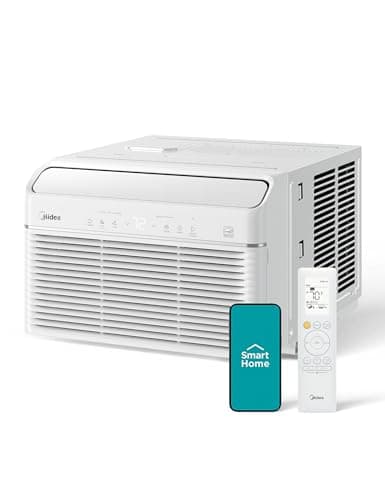 Lightest certified 8,000 BTU unit BLACK+DECKER Window Air Conditioner, 8,000 BTU 44.1 lb is the lightest certified 8,000 BTU unit here, and weight is the single biggest install variable. | Installing alone, or a second-floor window you would rather not lean out of | |
| 2 | 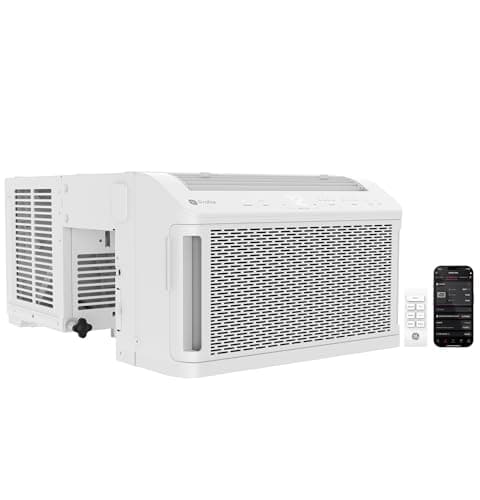 Shallowest, and the easiest to seat GE Profile ClearView Window Air Conditioner, 8,000 BTU 15.3 inches deep and 46.2 lb — the shallowest of the certified units here, with less mass hanging outside the sill line. | A shallow sill, or a window with a storm sash close behind | |
| 3 | 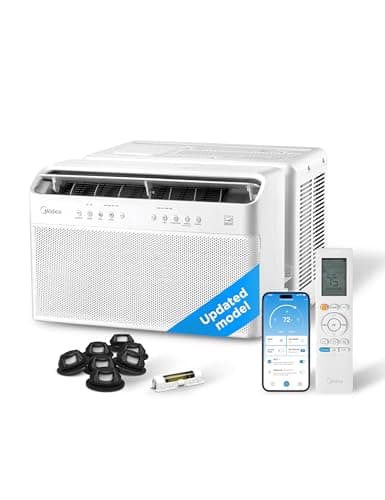 The install that works differently Midea U-Shaped Window Air Conditioner, 8,000 BTU The sash closes down through the middle of the unit rather than on top of it — a different install, and a much better result. | Anyone who wants to still open the window, or wants the compressor outside | |
| — | 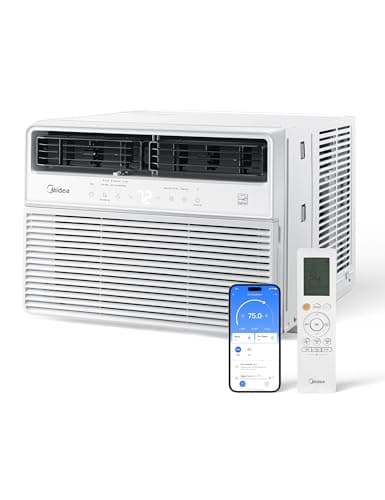 The one to think twice about installing yourself Midea Window Air Conditioner, 14,000 BTU 57.3 lb is at the top of what two people comfortably manage over a sill. | A large room — but get help, and check the sill |
A window air conditioner install has exactly three ways to go wrong: the unit falls, the water drains inward, or the gaps leak. Everything below is about those three.
Before you start
Measure, and read the weight
Two measurements decide whether the unit you are about to buy will actually go in.
- Sash opening width — measure the clear width between the window channels, not the frame outside. The unit body must be narrower; the side curtains fill the remainder.
- Sill depth and what is behind it — a storm window, a screen that does not remove, or a security grille will stop an install that the width measurement said was fine. Certified units here run from 15.3 to 22.0 inches deep.
Then read the weight, because it determines how many people you need:
| Unit | Weight | Depth |
|---|---|---|
| BLACK+DECKER BD08NWES, 8,000 BTU | 44.1 lb | 19.6 in |
| GE Profile PWJV08W, 8,000 BTU | 46.2 lb | 15.3 in |
| Midea MAW08V1QWT, 8,000 BTU | 53.2 lb | 22.0 in |
| Midea MAW12V1QWT, 12,000 BTU | 56.9 lb | 22.0 in |
| Midea MAW14V1KYWT, 14,000 BTU | 57.3 lb | 22.0 in |
Weights and depths from the ENERGY STAR Certified Room Air Conditioners dataset.
Anything over about 50 lb is a two-person install, and the second person is not there to help lift — they are there to bring the sash down while you hold the unit steady with both hands.
This one is not a DIY job
Check whether your building or city requires a support bracket. Many apartment buildings and some municipalities have a rule about securing window units. Ask your building management before you buy, not after.
Independently of any rule: a bracket is worth fitting on any above-ground-floor window. It transfers the load to the exterior wall instead of the sash and sill, and it removes the failure mode entirely.
If the window frame is rotten, cracked, or moves when you press on it, stop. That is a repair, not an install.
The install
Step by step
- Clear and clean the sill. Remove the screen if it comes out. Wipe the sill — the foam gaskets you are about to apply will not stick to grit.
- Fit the top flange and side curtains to the unit while it is still on the floor. Every fixing you can do at floor level is one you are not doing while holding 50 lb at a window.
- Apply the foam sill gasket along the sill where the unit will sit, and the adhesive foam strip to the top of the lower sash.
- Lift together and seat the unit on the sill, pushing it out until the mounting rail contacts the outside of the sill. Keep both hands on it. Do not let go to adjust anything.
- Bring the sash down onto the top flange and hold it there. This is what the second person is for. The unit is not secure until this happens.
- Screw the top flange to the sash using the screws supplied. This is the fixing that stops the sash being raised and the unit going out of the window. Do not skip it.
- Extend the side curtains to the window channels and screw them to the sash frame.
- Check the tilt — see below.
- Fit the sash lock bracket in the upper channel so the sash cannot be lifted.
- Seal every remaining gap — see below.
Detail one
The tilt: slightly back, and only slightly
A window air conditioner produces condensate continuously. That water has to end up outside, and on most units gravity is the only mechanism that puts it there.
So the unit sits with the outdoor end marginally lower than the indoor end. Set it dead level and water pools in the base pan, then eventually finds its way onto your floor.
Two important qualifications, and both come from the manual rather than from us. First, your unit specifies its own drop — and some models, including several U-shaped ones, are engineered to install level. Second, more tilt is not better. Excessive tilt loads the mounting hardware in the wrong direction and can push the unit toward sliding.
A phone level app against the top casing is entirely adequate for checking this. You are looking for a fraction of a degree, not a slope.
Detail two
The seal is where the money goes
Every step above is about the unit staying put. This one is about what it costs you.
The most efficient certified 8,000 BTU unit uses 375 kWh a year — about $69. That figure is measured under laboratory test conditions, with no air leaking around the machine. A unit installed with open gaps around the side curtains is pulling hot outdoor air into the room continuously while it runs, and no certification number accounts for that.
The gaps to close, in order of how much they leak:
- The gap between the two sashes. When the lower sash is raised, its top rail no longer meets the upper sash’s bottom rail — you have opened a full-width slot. Foam strip, cut to length, wedged in. This is the biggest single leak and the one most often ignored.
- Behind and around the side curtains. The accordion curtains block the opening but do not seal it. Foam or weatherstrip the perimeter.
- Under the unit at the sill. The foam sill gasket goes here, and it also stops the unit sliding.
- The outdoor side of the sill. Worth a look once everything is in — a gap here lets exhaust heat drift back toward the condenser intake, which hurts efficiency directly rather than through infiltration.
Do not use expanding foam anywhere in a window air conditioner install. You will not get the unit out at the end of the season without damaging the window.
Say the unwelcome thing
Do not skip the flange screws because the unit 'feels solid'.
A seated window unit does feel solid. It is heavy, it is wedged, and the sash is on top of it. That feeling is the reason people skip the two screws that fix the top flange to the sash.
What holds a window unit in is not its weight. It is the sash pressing down on the flange. The moment the sash goes up — someone tries to open the window, or the sash cords let go on an older frame — nothing is holding the unit at all, and 44 to 57 lb goes out of the window.
The screws take ninety seconds. Fit them, and fit the sash lock bracket above the sash as well.
Afterward
Once it is in
Run it and watch for water on the inside sill for the first hour. If any appears, the tilt is wrong, and it is far easier to correct now than in August.
Then leave it alone except for the filter. A blocked filter starves the evaporator of airflow, which drops capacity and raises run time — the same failure mode that dust causes in a fan, with a larger bill attached. Check it monthly through the cooling season; your manual will give the interval it wants.
And if you are still choosing, size the unit from the room before anything else. A correctly sized unit installed adequately beats an oversized one installed perfectly.
In full
Every pick, and what is wrong with it
Published specifications only, each linked to the page it came from. Where a manufacturer publishes nothing, the row says so — we do not fill blanks in.
1. Lightest certified 8,000 BTU unit
BLACK+DECKER Window Air Conditioner, 8,000 BTU
BLACK+DECKER · model BD08NWES
44.1 lb is the lightest certified 8,000 BTU unit here, and weight is the single biggest install variable.
44.1 lb. That is the number that matters on install day. Everything else about getting a window unit in is technique; the weight is what decides whether the technique is enough.
For context, the heaviest unit on this page is 57.3 lb — a 30 percent difference, and you are lifting it at arm’s length over a sill. If you are working alone, or reaching across a deep sill, start here.
400 kWh a year, about $73 for a season, from ENERGY STAR certified data.
What’s wrong with it
CEER 15 rather than 16, and 19.6 inches deep — it needs more clearance behind the sash than the shallower GE.
Running cost — BD08NWES
| Annual energy use | 400 kWh | ENERGY STAR certified figure |
|---|---|---|
| Annual cost | $73 | 400 × 18.34¢/kWh |
| Per cooling month | $18 | spread over a four-month season |
The annual figure is the certified value from the ENERGY STAR Certified Room Air Conditioners dataset, which models a standard cooling season rather than your actual summer. It is more useful than a nameplate wattage here, because a variable-speed compressor spends most of its life well below nameplate.
Rate: 18.34¢/kWh, the US average residential price for June 2026 (EIA Electric Power Monthly, Table 5.3). Yours will differ — swap it in: (watts ÷ 1000) × hours × your rate.
| Cooling capacity | 8,000 BTU/h |
|---|---|
| CEER | 15 |
| Annual energy use | 400 kWh/yr |
| vs federal standard | 38% less energy |
| Dimensions | 13.5 H x 18.6 W x 19.6 D in |
| Weight | 44.1 lb |
| Refrigerant | R-32 |
| Installation | Does not straddle the windowsill |
| Compressor | Variable speed |
| ENERGY STAR | Certified |
Every figure above is from ENERGY STAR Certified Room Air Conditioners dataset. Blanks are shown as “not published” rather than filled in.
2. Shallowest, and the easiest to seat
GE Profile ClearView Window Air Conditioner, 8,000 BTU
GE Profile · model PWJV08W
15.3 inches deep and 46.2 lb — the shallowest of the certified units here, with less mass hanging outside the sill line.
Depth matters more than people expect. A unit sits with part of its mass inboard of the sill and the rest cantilevered outside. At 15.3 inches deep against 22.0 for a U-shaped unit, this one has substantially less overhang to control while you seat it.
It also carries the highest efficiency here — CEER 16 and 375 kWh a year, about $69 — so the easiest install in this list is also the cheapest to run.
Measure your sash opening width and your sill depth before you buy anything. Full window unit comparison.
What’s wrong with it
Still 46.2 lb, and like any conventional unit it occupies the whole lower sash for the season.
Running cost — PWJV08W
| Annual energy use | 375 kWh | ENERGY STAR certified figure |
|---|---|---|
| Annual cost | $69 | 375 × 18.34¢/kWh |
| Per cooling month | $17 | spread over a four-month season |
The annual figure is the certified value from the ENERGY STAR Certified Room Air Conditioners dataset, which models a standard cooling season rather than your actual summer. It is more useful than a nameplate wattage here, because a variable-speed compressor spends most of its life well below nameplate.
Rate: 18.34¢/kWh, the US average residential price for June 2026 (EIA Electric Power Monthly, Table 5.3). Yours will differ — swap it in: (watts ÷ 1000) × hours × your rate.
| Cooling capacity | 8,000 BTU/h |
|---|---|
| CEER | 16 |
| Annual energy use | 375 kWh/yr |
| vs federal standard | 47% less energy |
| Dimensions | 12.6 H x 18.6 W x 15.3 D in |
| Weight | 46.2 lb |
| Refrigerant | R-32 |
| Installation | Does not straddle the windowsill |
| Compressor | Variable speed |
| ENERGY STAR | Certified, and on the Most Efficient list |
Every figure above is from ENERGY STAR Certified Room Air Conditioners dataset. Blanks are shown as “not published” rather than filled in.
3. The install that works differently
Midea U-Shaped Window Air Conditioner, 8,000 BTU
Midea · model MAW08V1QWT-S
The sash closes down through the middle of the unit rather than on top of it — a different install, and a much better result.
Worth understanding before you commit to the conventional method, because the U-shape changes the whole procedure.
The unit has a channel through its middle. The sash comes down into that channel rather than resting on the unit’s top flange. The compressor half ends up outside a closed window, the room half inside, and the glass runs between them.
The install is fiddlier — 53.2 lb and 22 inches deep — but you keep the ability to open the window, and the noise drops sharply. 400 kWh a year, about $73.
What’s wrong with it
53.2 lb and 22.0 inches deep, and it only works on a vertical sash window. It is the most awkward unit here to physically maneuver.
Running cost — MAW08V1QWT-S
| Annual energy use | 400 kWh | ENERGY STAR certified figure |
|---|---|---|
| Annual cost | $73 | 400 × 18.34¢/kWh |
| Per cooling month | $18 | spread over a four-month season |
The annual figure is the certified value from the ENERGY STAR Certified Room Air Conditioners dataset, which models a standard cooling season rather than your actual summer. It is more useful than a nameplate wattage here, because a variable-speed compressor spends most of its life well below nameplate.
Rate: 18.34¢/kWh, the US average residential price for June 2026 (EIA Electric Power Monthly, Table 5.3). Yours will differ — swap it in: (watts ÷ 1000) × hours × your rate.
| Cooling capacity | 8,000 BTU/h |
|---|---|
| CEER | 15 |
| Annual energy use | 400 kWh/yr |
| vs federal standard | 38% less energy |
| Dimensions | 13.5 H x 19.2 W x 22.0 D in |
| Weight | 53.2 lb |
| Refrigerant | R-32 |
| Installation | U-shape; sash closes through the middle of the unit |
| Compressor | Variable speed |
| ENERGY STAR | Certified |
Every figure above is from ENERGY STAR Certified Room Air Conditioners dataset. Blanks are shown as “not published” rather than filled in.
Skip this one
Midea Window Air Conditioner, 14,000 BTU
Midea · model MAW14V1KYWT-S
57.3 lb is at the top of what two people comfortably manage over a sill.
Nothing is wrong with this unit. It is certified, it is efficient for its class at CEER 15, and it cools a genuinely large room.
The caution is purely physical: 57.3 lb, 22 inches deep, held at arm’s length over a sill while somebody else brings the sash down. That is a two-person job with no negotiation, and on an upper floor it is worth fitting a bracket before you start.
If your room genuinely needs 14,000 BTU, compare the large-room options first — and if it does not, a lighter 8,000 BTU unit will cool it better and cost less to run.
What’s wrong with it
The heaviest unit here, 13 lb above the lightest. Not a bad machine at all — just not a first solo install.
Running cost — MAW14V1KYWT-S
| Annual energy use | 656.3 kWh | ENERGY STAR certified figure |
|---|---|---|
| Annual cost | $120 | 656.3 × 18.34¢/kWh |
| Per cooling month | $30 | spread over a four-month season |
The annual figure is the certified value from the ENERGY STAR Certified Room Air Conditioners dataset, which models a standard cooling season rather than your actual summer. It is more useful than a nameplate wattage here, because a variable-speed compressor spends most of its life well below nameplate.
Rate: 18.34¢/kWh, the US average residential price for June 2026 (EIA Electric Power Monthly, Table 5.3). Yours will differ — swap it in: (watts ÷ 1000) × hours × your rate.
| Cooling capacity | 14,000 BTU/h |
|---|---|
| CEER | 16 |
| Annual energy use | 656.3 kWh/yr |
| vs federal standard | 50% less energy |
| Dimensions | 14.7 H x 21.7 W x 19.0 D in |
| Weight | 56.9 lb |
| Refrigerant | R-32 |
| Installation | Does not straddle the windowsill |
| Compressor | Variable speed |
| ENERGY STAR | Certified |
Every figure above is from ENERGY STAR Certified Room Air Conditioners dataset. Blanks are shown as “not published” rather than filled in.
We are not linking a buy button for this one. If you want to look at it anyway, it is easy enough to find — but we would rather send you to something that fits your room.
Questions people actually ask
Frequently asked
Can one person install a window air conditioner?
For the lightest certified units — around 44 lb — it is possible but not advisable. Anything above roughly 50 lb is a firm two-person job, and the second person's role is to bring the sash down onto the flange while you hold the unit with both hands.
Which way should a window air conditioner tilt?
Very slightly backward, so the outdoor end sits marginally lower and condensate drains outside rather than pooling in the base pan. Check your manual for the exact drop it specifies — some models, including several U-shaped units, are designed to install level.
Do I need a support bracket?
Many apartment buildings and some municipalities require one, so check before you buy. Independently of any rule, a bracket is worth fitting above the ground floor because it transfers the load to the exterior wall rather than the sash and sill.
Why is my window air conditioner dripping inside?
Almost always the tilt. The unit is level or tipped slightly toward the room, so condensate pools in the base pan instead of draining outside. Re-check with a level against the top casing; a blocked drain path in the base pan is the less common cause.
What gap do people forget to seal?
The one between the two sashes. Raising the lower sash separates its top rail from the upper sash's bottom rail, opening a full-width slot above the unit. Foam strip cut to length closes it, and it is the single largest leak in a typical install.
How much does a bad seal cost?
Certified energy figures — 375 kWh a year for the most efficient 8,000 BTU unit — are measured under laboratory test conditions with no air leaking around the machine. Gaps mean the unit runs longer against continuous hot-air infiltration, so real consumption exceeds the certified figure by an amount no rating captures.
Sources
Where these numbers came from
Read next
Where to go from here
Back to Air Conditioners, or read how we pick.