The picks
The best condensate pumps
The part that fails when your air conditioner floods a floor, bought for about the price of a filter. Two incompatible designs share the name, and the cheapest mistake is buying the one with no safety switch.
By Sawyer V. · Published
The short answer
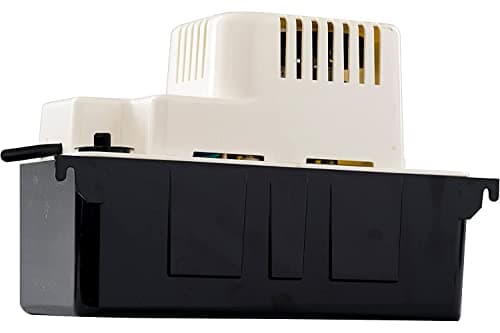
Buy the Little Giant VCMA-20ULS for anything with a tank — a furnace, an air handler, a dehumidifier — at 80 GPH at 1 foot and a 20-foot shut-off on 93 W. For a mini-split head in a bedroom, buy the Sauermann Si-30 instead: 20 dBA at 1 m and a 33-foot lift. And check the suffix before you order — Little Giant’s S means a safety switch, and the model without one currently costs more.
Fan & Frost earns a commission when you buy through our links, at no cost to you. It never changes a ranking, and we say so when the right answer is the cheaper unit or nothing at all. Full disclosure · How we pick.
At a glance
The picks, ranked
Tap any row to jump to the full reasoning. Prices are live from Amazon where we have them, and read “check price” where we don’t — never a number we cannot verify today.
| # | Product | Best for | Price |
|---|---|---|---|
| 1 | Best overall Little Giant VCMA-20ULS Condensate Removal Pump 80 GPH at 1 foot, a 20-foot shut-off head and a half-gallon tank on 93 W, with an overflow switch wired from the factory to shut the equipment down rather than just beep at you. | A dehumidifier, furnace or air handler in a basement, where the drain is above the machine and there is floor space for a tank | |
| 2 | 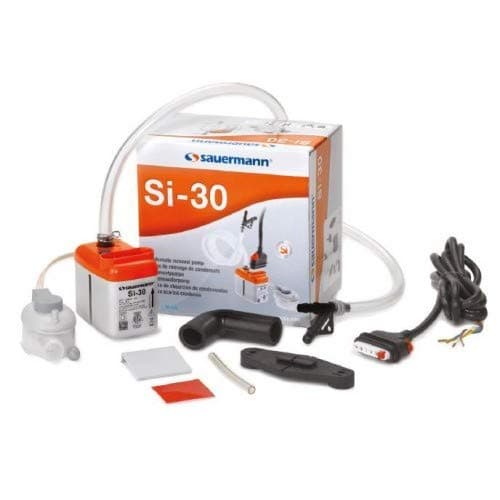 Best for a mini-split, and the only published noise figure here Sauermann Si-30 Mini Condensate Removal Pump 20 dBA measured at 1 m to EN ISO 3744, a 33-foot discharge head, and a rating for air conditioners up to 5.6 tons — in a pump body smaller than a deck of cards. | A wall-mounted mini-split head in a bedroom or office, where the pump lives in the line set and has to be inaudible | |
| 3 | 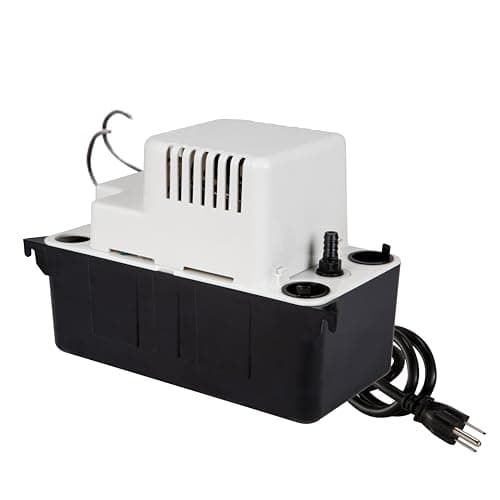 Cheapest with the switch Little Giant VCMA-15ULS Condensate Removal Pump 65 GPH at 1 foot and a 15-foot shut-off on a 1/50 hp motor, with the same overflow switch and the same half-gallon tank, for the least money on this page. | A dehumidifier or a small air handler with a short lift — the same design as the pick above, one size down | |
| — | 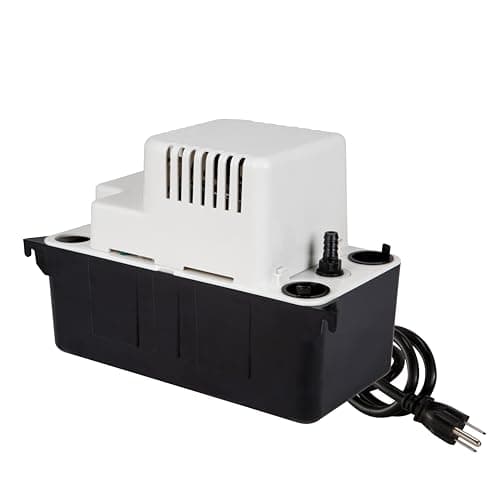 The one to skip Little Giant VCMA-15UL Condensate Removal Pump Identical to the VCMA-15ULS on every published figure — same 65 GPH, same 15-foot shut-off, same 1/50 hp, same tank — except that Little Giant's own order table lists Safety Switch: No. | Nothing. It is the same pump as the pick above with the float safety switch deleted, and at the time of writing it costs more |
A condensate pump exists for one situation: the water has to go up. Air conditioners, heat pumps and dehumidifiers all pull water out of the air, and all of them expect to hand it to gravity. When the only drain is a laundry sink across the room, a waste pipe on the floor above, or a window well at head height, gravity is not available and something has to lift it.
It is a cheap part doing a job with an expensive failure mode. The thing that goes wrong is not the air conditioner; it is twenty gallons of water on a finished floor over a weekend.
The split
Two different machines share this name
This is the single most useful thing to understand before buying, and the reason a shopping list of “condensate pumps” sorted by price is useless.
- Tank pumps are a reservoir with a float and a centrifugal motor. They sit on the floor or hang on a wall under a furnace, air handler or dehumidifier, and they move a lot of water a short distance. Little Giant’s VCMA series is the archetype.
- In-line mini-split pumps are a piston or diaphragm the size of a matchbox, hidden in the line set or behind the indoor head, with a separate sensor sitting in the drain pan. They move very little water a long way, very quietly.
The numbers show how far apart they are. The tank pump on this page moves 80 gallons an hour; the mini-split pump moves five. The mini-split pump lifts 33 feet; the tank pump stops at 20. Neither is better. Putting the quiet one under a dehumidifier is as wrong as bolting the tank one to a bedroom wall.
The data
What the makers publish
| Pump | Type | Flow at 1 ft | Max lift | Noise | Safety switch |
|---|---|---|---|---|---|
| Little Giant VCMA-20ULS | Tank | 80 GPH | 20 ft | Not published | Yes |
| Little Giant VCMA-15ULS | Tank | 65 GPH | 15 ft | Not published | Yes |
| Little Giant VCMA-15UL | Tank | 65 GPH | 15 ft | Not published | No |
| Sauermann Si-30 | In-line piston | 5 GPH | 33 ft | 20 dBA at 1 m | Yes |
Every figure is the manufacturer’s own. Little Giant flow is quoted through the check valve, which is how you will actually run it.
The finding
A flow figure without a height attached is meaningless
Retail listings sell these pumps on one number: 65 GPH, 80 GPH, 90 GPH. Little Giant publishes the whole curve, and the curve is the point.
The VCMA-20ULS moves 80 gallons an hour at one foot of lift. At five feet it is 70. At ten feet it is 48. At twenty feet — its own published shut-off height — it is zero. The headline figure describes the pump doing almost no work, and the number that matters to you is whichever one sits at your actual lift.
So size on lift first, and treat flow as a check afterwards. For a dehumidifier the flow check is close to a formality: a 50-pint machine makes roughly six gallons a day, and the smallest pump here clears that in about six minutes of running.
This one is not a DIY job
Measure to the highest point of the run, not to the drain. Lift is set by the peak of the discharge line. A hose that climbs eight feet to clear a joist and then falls to a sink four feet up is an eight-foot lift, not four. Add the climb, then buy a pump with meaningful headroom above it, because flow is already collapsing well before the published shut-off height.
The switch
What the overflow switch actually does
Every pump worth buying has two wires coming out of it that most people never connect, and they are the most important thing in the box.
Little Giant describes the function precisely: “dual function NO and NC operation (set to NO from factory for equipment shut down connection)”, with two 5-inch leads. Sauermann supplies the same idea as a normally-closed switch rated 3 A at 250 V with two safety contact wires.
Wired into the air conditioner’s low-voltage control circuit, a rising water level in a failed pump stops the machine. Unwired, the same float does nothing at all, and the first sign of a dead pump is the ceiling below it. This is the cheapest insurance in cooling and it is already in the carton.
Say the unwelcome thing
Do not buy the variant with the safety switch deleted.
Little Giant sells the same VCMA-15 pump four ways, and the suffixes are published: S adds the safety switch, T adds twenty feet of tubing. The plain VCMA-15UL, item 554401, is listed in the manufacturer’s own order table as Safety Switch: No.
It is not cheaper for the omission. At the time of writing the switchless version is the more expensive of the two — so the money buys you the removal of the part that prevents a flood. Check the last two letters before you click buy, every time.
Noise
Only one class of pump publishes a decibel figure
Sauermann publishes 20 dBA at 1 m to EN ISO 3744. That is a complete claim: a level, a distance and a test standard.
Little Giant publishes no noise figure at all for the VCMA series — not on the product pages, and not in the spec sheet PDF, which is otherwise thorough enough to list the impeller material and the check-valve plastic. That absence is itself useful information: a tank pump with a centrifugal motor and a float is not a quiet object, and nobody is claiming otherwise.
Which is why the two classes land where they do. A pump in a basement next to a furnace can be audible. A pump serving the head in a bedroom cannot, and that is worth paying several times the price for. What a decibel figure means in a room.
Upkeep
The pump is the part that fails, and why
Condensate is not clean water. It has run across a cold coil that collects dust, and it arrives in the tank as a warm, dark, permanently damp reservoir — which is an excellent place to grow biofilm. The slime is what kills these pumps: it fouls the float so it stops rising, or it blocks the check valve so the discharge line drains back after every cycle.
So treat it as a serviceable part rather than an appliance. Once a year, before the cooling season, unplug it, lift the tank off, and wash it out. Little Giant publishes the tank, cover, float arm, switch holder and switch as individually ordered replacement parts, which tells you how the manufacturer expects the thing to be treated.
Two details worth knowing while you have it apart. The discharge check valve is a wear item in its own right — Little Giant sells check valves separately from the pump. And the maximum water temperature is 140 F, which matters if you are tempted to serve a condensing furnace and an air conditioner from the same pump: that is within spec for these pumps, but it is the kind of limit worth checking rather than assuming.
None of this is optional maintenance in the way that cleaning a fan blade is. A pump that fails quietly is the one scenario this entire product category exists to prevent, which is also why the safety switch above is worth wiring in even on a pump you intend to service. The same logic for the machine upstream of it.
Scope
What is not ranked here, and why
Three more pumps are sold into this category and are worth naming. DiversiTech’s ClearVue Mini CVMINI and the Asurity ULTRACP-22 are both purchasable, but diversitech.com is rendered entirely in JavaScript and returned no readable specification text, so neither can be specced from its maker and neither is ranked.
Aspen’s Silent+ Mini Orange is the Sauermann’s direct rival and claims “sound levels as low as 16 dB(A)”, a 35 L/h flow, a 10 m head, a rating to 40 kW and a three-year warranty on Aspen’s own FP3430 page. We have left it off the list for two honest reasons: the US listings do not print that model number, and the 16 dB(A) claim carries an asterisk whose footnote we could not read — so unlike the Sauermann figure, there is no published distance or test standard attached to it. A lower number without those is not comparable with a higher one that has them.
In full
Every pick, and what is wrong with it
Published specifications only, each linked to the page it came from. Where a manufacturer publishes nothing, the row says so — we do not fill blanks in.
1. Best overall
Little Giant VCMA-20ULS Condensate Removal Pump
Little Giant · model VCMA-20ULS (554425)
80 GPH at 1 foot, a 20-foot shut-off head and a half-gallon tank on 93 W, with an overflow switch wired from the factory to shut the equipment down rather than just beep at you.
80 GPH at 1 foot, 70 at 5, 48 at 10, zero at 20. That is Little Giant’s own published curve, and the note under it matters as much as the numbers: “GPH is through check valve”, so this is flow you will actually get rather than a bench figure measured with the valve removed.
The 20-foot maximum shut-off is the number that decides whether this pump fits your house. Measure from the pump to the highest point the discharge line reaches — not to the drain, to the peak of the run — and stay well inside it, because flow collapses as you approach shut-off.
The overflow switch is the reason to buy this part number. Little Giant ships it with “dual function NO and NC operation (set to NO from factory for equipment shut down connection)” and two 5-inch lead wires. In plain terms: wire those two leads into the air conditioner’s control circuit and a failed pump stops the machine making water, instead of letting it keep producing condensate onto your floor.
93 W at 115 V, which sounds like a lot next to a fan until you remember it runs in bursts of a few seconds when the float rises. An hour of actual pump running across a humid day costs 1.7¢ at 18.34¢/kWh; the duty cycle, not the wattage, is the reason nobody worries about it.
The rest is sensible hardware: a half-gallon ABS tank with wall mount tabs, three 1-1/8 inch inlets so the hose can come in from whichever side suits, a 3/8 inch barbed discharge with the check valve built in, a thermally protected fan-cooled motor, 140 F maximum water temperature, a 6-foot grounded cord, CSA certification and a one-year warranty.
What’s wrong with it
Little Giant publishes no noise figure for it anywhere — not on the series page and not in the spec sheet — and a centrifugal motor in an open basement is audible when it cycles. Tubing is not included at this part number; you want the ULST for that. And the headline 80 GPH is measured at one foot of lift: at ten feet it is 48, and at twenty it is zero.
Running cost — VCMA-20ULS (554425)
| Nameplate power | 93 W | manufacturer's published figure |
|---|---|---|
| Energy, 8-hour night | 0.74 kWh | 93 ÷ 1000 × 8 |
| Cost per hour | 1.7¢ | at 18.34¢/kWh |
| Cost per 8-hour night | 14¢ | on the highest speed |
| Cost per 30 nights | $4.09 | 22.3 kWh |
Rate: 18.34¢/kWh, the US average residential price for June 2026 (EIA Electric Power Monthly, Table 5.3). Yours will differ — swap it in: (watts ÷ 1000) × hours × your rate.
| Flow | 80 GPH at 1 ft; 70 at 5 ft, 48 at 10 ft, 0 at 20 ft (through the check valve) |
|---|---|
| Maximum shut-off | 20 ft (6.1 m) at 115 V |
| Motor | 1/30 hp, vertical centrifugal, thermally protected and fan cooled |
| Power | 115 V, 60 Hz, 1.5 A, 93 W |
| Tank | 1/2 gallon |
| Safety switch | Overflow detection switch, dual NO/NC, factory-set to NO for equipment shutdown |
| Discharge | 3/8 in OD barbed, built-in check valve |
| Inlets | Three 1-1/8 in openings, two capped |
| Max water temperature | 140 F |
| Cord | 6 ft, 3-conductor, grounded 3-prong |
| Tubing included | No (the ULST variant includes 20 ft) |
| Weight | 5 lb |
| Noise | Not published — no dBA figure appears on the page or the spec sheet |
| Listing | CSA certified to US and Canada standards |
| Warranty | 1 year |
Every figure above is from Little Giant VCMA-20 series spec sheet 995125 (09/24) — flow at head, 20 ft shut-off, 93 W, 1/2-gallon tank, overflow detection switch wiring, CSA, 1-year warranty. Blanks are shown as “not published” rather than filled in.
2. Best for a mini-split, and the only published noise figure here
Sauermann Si-30 Mini Condensate Removal Pump
Sauermann · model Si-30, 120 V
20 dBA measured at 1 m to EN ISO 3744, a 33-foot discharge head, and a rating for air conditioners up to 5.6 tons — in a pump body smaller than a deck of cards.
This is the other machine entirely. Instead of a tank on the floor, a piston pump the size of a matchbox — 2-5/8 by 1-3/4 by 2-3/8 inches — hides in the line set with a separate detection unit in the indoor head’s drain pan.
20 dBA at 1 m, measured to EN ISO 3744. That is the figure to care about and the reason to pay for this class, and note what makes it usable: Sauermann publishes the distance and the test standard. A decibel number without those two things cannot be compared with anything.
33 feet (10 m) of discharge head, against 20 for the Little Giant, plus 10 feet of suction head so the pump does not have to sit at the lowest point. That is the trade this class makes: far less water, much further up.
It is rated for air conditioners up to 5.6 tons — 67,000 BTU/h, which covers essentially any single room head and most multi-zone indoor units. The mini-splits this is sized for.
The safety contact is here too, as a normally-closed switch rated 3 A at 250 V with two wires supplied, and an anti-siphon device is included rather than sold separately. The duty cycle is published as well — 50 percent, three seconds on and three off — which is the honest way to describe a pump that never runs continuously.
What’s wrong with it
5 gph of flow, which is a sixteenth of the Little Giant's, so it is the wrong machine for a dehumidifier or a furnace. It is roughly two and a half times the price. Sauermann publishes no wattage and no warranty length on the product page, and it is a three-part install — pump, detection unit and tubing — rather than a box you set on the floor.
Running cost
Sauermann does not publish a wattage for the Si-30, 120 V, so we cannot calculate what it costs to run. We are not going to estimate one. If Sauermann publishes a nameplate figure, this block will show the arithmetic.
| Noise | 20 dBA at 1 m (3.3 ft), measured to EN ISO 3744 |
|---|---|
| Flow | 5 gph (19 L/h) maximum |
| Maximum discharge head | 33 ft (10 m) |
| Maximum suction head | 10 ft (3 m) |
| Rated for | Air conditioners up to 5.6 tons (67,000 BTU/h, 20 kW) |
| Pump type | Piston, with a separate detection unit |
| Duty cycle | 50% — 3 seconds on, 3 seconds off |
| Safety switch | NC, 3 A resistive at 250 V; two safety contact wires supplied |
| Anti-siphon | Included |
| Tube | 1/4 in internal diameter clear PVC, 3 ft 3 in, with a pre-fitted drain safe device |
| Pump body | 2-5/8 x 1-3/4 x 2-3/8 in (66 x 43.5 x 60 mm) |
| Power | Not published |
| Warranty | Not published on the product page |
Every figure above is from Sauermann Si-30 US product page — 20 dBA at 1 m to EN ISO 3744, 5 gph, 33 ft discharge head, 5.6 ton rating, piston technology, NC safety switch. Blanks are shown as “not published” rather than filled in.
3. Cheapest with the switch
Little Giant VCMA-15ULS Condensate Removal Pump
Little Giant · model VCMA-15ULS (554405)
65 GPH at 1 foot and a 15-foot shut-off on a 1/50 hp motor, with the same overflow switch and the same half-gallon tank, for the least money on this page.
65 GPH at 1 foot, 50 at 5, 25 at 10, zero at 20, with a 15-foot maximum shut-off from a 1/50 hp motor drawing 1 A. The tank, the check valve, the barbed discharge and the safety switch are all the same as the larger pump.
For a dehumidifier this is usually the right size, and the reason is arithmetic rather than caution. A 50-pint machine removes about six gallons a day at its rated conditions. Six gallons spread over 24 hours against 65 gallons an hour of capacity means the pump runs for seconds at a time. Draining a dehumidifier continuously covers the rest of that setup.
Buy this one only if the lift is short. The gap to the VCMA-20ULS is five feet of head and 32 watts, and the price difference between them is small enough that the larger pump is the safer default whenever you are unsure of the run.
What’s wrong with it
Five feet less lift than the VCMA-20ULS for a few dollars less, which is a bad trade if your run is anywhere near the limit. Little Giant publishes no wattage, no noise figure and no warranty length on the series page, and tubing is not included.
Running cost
Little Giant does not publish a wattage for the VCMA-15ULS (554405), so we cannot calculate what it costs to run. We are not going to estimate one. If Little Giant publishes a nameplate figure, this block will show the arithmetic.
| Flow | 65 GPH at 1 ft; 50 at 5 ft, 25 at 10 ft, 0 at 20 ft (through the check valve) |
|---|---|
| Maximum shut-off | 15 ft (4.6 m) |
| Motor | 1/50 hp |
| Power | 115 V, 60 Hz, 1 A |
| Tank | 1/2 gallon |
| Safety switch | Yes — Little Giant's order table lists the switch as the S suffix |
| Discharge | 3/8 in OD barbed, built-in check valve |
| Tubing included | No |
| Noise | Not published |
| Listing | CSA certified to US and Canada standards |
| Warranty | Not published on the series page |
Every figure above is from Little Giant VCMA-15 series page — 1/50 hp, 115 V 1 A, 65 GPH at 1 ft, 15 ft shut-off, 1/2-gallon tank, and the order table showing which variants carry the safety switch. Blanks are shown as “not published” rather than filled in.
Skip this one
Little Giant VCMA-15UL Condensate Removal Pump
Little Giant · model VCMA-15UL (554401)
Identical to the VCMA-15ULS on every published figure — same 65 GPH, same 15-foot shut-off, same 1/50 hp, same tank — except that Little Giant's own order table lists Safety Switch: No.
Little Giant’s suffix convention is published plainly on the series page: S means a safety switch, T means tubing included. The VCMA-15UL is item 554401 and its row reads Safety Switch: No. The retail listing is honest about it too — the words “no safety switch” are in the product title.
Every other published number is identical to the VCMA-15ULS: 65 GPH at a foot, 15-foot shut-off, 1/50 hp, 115 V at 1 A, half-gallon tank, 3/8 inch barbed discharge with a check valve, neither one shipping tubing. There is no performance reason to choose it.
And it is the more expensive of the two. That is not a typo and it is not a sale artifact we are reading wrong — both prices on this page come from the same live feed at the same moment, and the pump without the switch has been the dearer one every time we have looked. You would be paying a premium to delete the component that protects your floor.
There is one legitimate buyer for a switchless pump: an installer wiring an external float switch of their own into the same circuit. If that is not you, buy the S.
What’s wrong with it
Without the switch there is nothing to stop the air conditioner when the pump fails. The failure mode of this product category is water on a floor, and this is the variant that removes the part that prevents it.
Running cost
Little Giant does not publish a wattage for the VCMA-15UL (554401), so we cannot calculate what it costs to run. We are not going to estimate one. If Little Giant publishes a nameplate figure, this block will show the arithmetic.
| Flow | 65 GPH at 1 ft; 50 at 5 ft, 25 at 10 ft, 0 at 20 ft (through the check valve) |
|---|---|
| Maximum shut-off | 15 ft (4.6 m) |
| Motor | 1/50 hp |
| Power | 115 V, 60 Hz, 1 A |
| Tank | 1/2 gallon |
| Safety switch | NONE. Little Giant's order table lists Safety Switch: No, and the retail listing says so in its own title |
| Discharge | 3/8 in OD barbed, built-in check valve |
| Tubing included | No |
| Noise | Not published |
| Listing | CSA certified to US and Canada standards |
| Warranty | Not published on the series page |
Every figure above is from Little Giant VCMA-15 series page — 1/50 hp, 115 V 1 A, 65 GPH at 1 ft, 15 ft shut-off, 1/2-gallon tank, and the order table showing which variants carry the safety switch. Blanks are shown as “not published” rather than filled in.
We are not linking a buy button for this one. If you want to look at it anyway, it is easy enough to find — but we would rather send you to something that fits your room.
Questions people actually ask
Frequently asked
What is the best condensate pump?
For a dehumidifier, furnace or air handler, the Little Giant VCMA-20ULS: 80 GPH at one foot of lift, a 20-foot maximum shut-off, a half-gallon tank and 93 W, with an overflow switch wired from the factory to shut the equipment down. For a mini-split head in a room where noise matters, the Sauermann Si-30 instead, at 20 dBA measured at 1 m and a 33-foot lift.
What does the S mean in VCMA-15ULS?
A safety switch. Little Giant publishes the convention on its own series page: S adds the float overflow switch and T adds twenty feet of discharge tubing. The plain VCMA-15UL, item 554401, is listed as Safety Switch: No — and at the time of writing it costs more than the VCMA-15ULS that includes one.
How high can a condensate pump lift water?
It depends on the class. The Little Giant VCMA-20ULS publishes a 20-foot maximum shut-off at 115 V, the VCMA-15 series 15 feet, and the Sauermann Si-30 a 33-foot discharge head. Measure to the highest point the line reaches rather than to the drain, and buy with headroom, because flow falls away long before the shut-off height.
Why does flow drop as the pump lifts higher?
Because a pump works against the weight of the water column above it. Little Giant publishes the whole curve for the VCMA-20: 80 GPH at one foot, 70 at five, 48 at ten and zero at twenty. The headline number on a retail listing is always the one-foot figure, which describes the pump doing almost no lifting.
Do I need a condensate pump for a dehumidifier?
Only if the drain is higher than the machine. If there is a floor drain or a sump below it, a gravity hose is simpler and has nothing to fail. If the only outlet is a laundry sink or a pipe on the floor above, you need either a dehumidifier with a built-in pump or an external one beside it. Dehumidifiers with the pump built in.
Are condensate pumps noisy?
The tank type is not quiet and its makers do not claim otherwise — Little Giant publishes no decibel figure for the VCMA series anywhere, including the spec sheet. The in-line mini-split pumps are the ones that publish: Sauermann states 20 dBA at 1 m measured to EN ISO 3744 for the Si-30. If the pump is going in a bedroom, that difference is the whole reason the second class exists.
How much electricity does a condensate pump use?
Very little, because of the duty cycle rather than the wattage. The Little Giant VCMA-20ULS draws 93 W at 115 V but only while the float is up, which is a few seconds at a time. Sauermann publishes a 50 percent duty cycle for the Si-30 — three seconds on, three seconds off — and no wattage at all.
Sources
Where these numbers came from
- Little Giant VCMA-20 series spec sheet 995125 (09/24) — 80/70/48/0 GPH at 1/5/10/20 ft, 20 ft shut-off, 1/30 hp, 115 V 1.5 A 93 W, 1/2-gallon tank, overflow detection switch dual NO/NC set to NO for equipment shutdown, CSA, 1-year warranty, 5 lb
- Little Giant VCMA-15 series page — 65/50/25/0 GPH at 1/5/10/20 ft, 15 ft shut-off, 1/50 hp, 115 V 1 A, and the order table listing Safety Switch Yes/No and Tubing Included Yes/No per item number
- Sauermann Si-30 US product page — 20 dBA at 1 m to EN ISO 3744, 5 gph max flow, 33 ft discharge head, 10 ft suction head, 5.6 ton rating, piston technology, NC safety switch 3 A at 250 V, 50 percent duty cycle
- Aspen Silent+ Mini Orange FP3430 product page — the 16 dB(A) claim, 35 L/h flow, 10 m head, 40 kW rating and 36-month warranty referenced in the scope section
- EIA Electric Power Monthly, Table 5.3 — average residential electricity rate
Read next
Where to go from here
Back to Air Conditioners, or read how we pick.