Guide and picks
Casement and sliding window air conditioners
If your windows crank outward or slide sideways, the entire certified market is closed to you. That is not an exaggeration — we counted.
By Sawyer V. · Published
The short answer
None of the 485 certified room air conditioners is recorded as casement-capable. Not one. If your windows crank outward or slide horizontally, a conventional window unit will not fit, and the ENERGY STAR efficiency data simply does not cover your situation. Your realistic options are a portable unit vented through the opening, a through-the-wall unit, a mini-split, or a purpose-built vertical unit sold outside the certified program.
Fan & Frost earns a commission when you buy through our links, at no cost to you. It never changes a ranking, and we say so when the right answer is the cheaper unit or nothing at all. Full disclosure · How we pick.

At a glance
The picks, ranked
Tap any row to jump to the full reasoning. Prices are live from Amazon where we have them, and read “check price” where we don’t — never a number we cannot verify today.
| # | Product | Best for | Price |
|---|---|---|---|
| 1 | Best if you can put a hole in the wall Friedrich Through-the-Wall Air Conditioner, 10,100 BTU 10,100 BTU at CEER 14.2 and 533.5 kWh a year, on the Most Efficient list — and it leaves the window alone entirely. | A room you own, where the window is unusable and the wall is not | |
| 2 | Lightest permanent option Midea Through-the-Wall Air Conditioner, 10,000 BTU 10,000 BTU at CEER 14.1 and 531.9 kWh, on the Most Efficient list — at 56.2 lb, half the Friedrich's weight. | An existing sleeve where the old unit was heavy and awkward | |
| 3 | 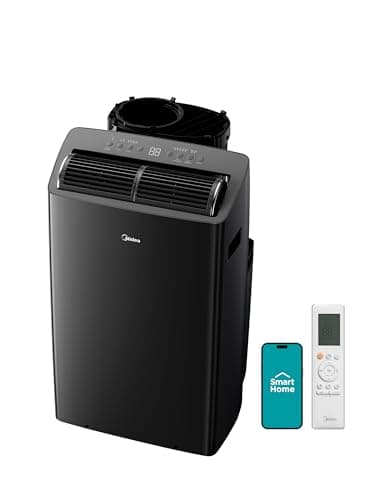 Best if the wall is not an option Midea Duo Smart Inverter Portable Air Conditioner 12,000 BTU SACC from a 14,000 BTU headline — a 14.3% haircut, the smallest we found across seven published units. | A rental with casement windows, where nothing permanent is allowed | |
| — | 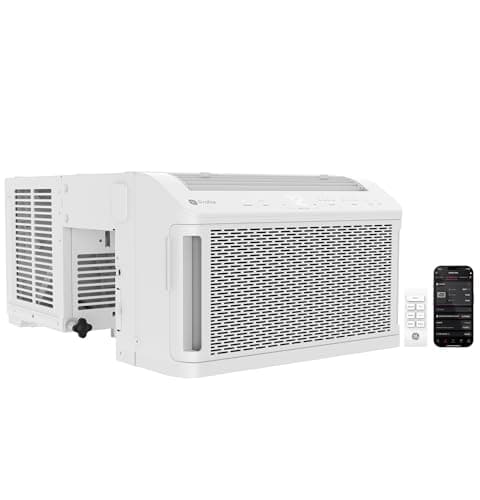 What a casement window costs you GE Profile ClearView Window Air Conditioner, 8,000 BTU CEER 16 and 375 kWh a year, and completely unusable in a casement or sliding window. | A double-hung window — which is exactly what you do not have |
Casement windows crank outward on a hinge. Sliding and awning windows move horizontally or tilt. None of them produce the tall, narrow, sash- closing-downward opening that a window air conditioner is built around.
That is a well-known inconvenience. What is less well known is how complete the exclusion is.
What we found
Zero of 485
The ENERGY STAR Certified Room Air Conditioners dataset carries a field called casement_window, recording whether a unit is designed for that installation.
We pulled every record. All 485 read “None”.
| Field | Across 485 certified units |
|---|---|
| Casement-capable | 0 — every record reads “None” |
| Window units | 438 |
| Through-the-wall units | 47 |
| Variable-speed compressor | 485 — the entire field |
| R-32 refrigerant | 485 — the entire field |
ENERGY STAR Certified Room Air Conditioners dataset, all 485 records.
Two honest readings of that, and the difference matters.
It does not prove no casement unit exists. Vertical window air conditioners are sold — tall, narrow units designed for casement and slider openings. What it proves is that none of them is in the certified program.
The consequence is the same either way: if you have casement windows, there is no independently verified efficiency figure available to you for a window-mounted unit. No CEER, no certified annual kWh, no Most Efficient list. Every claim you can find is the manufacturer’s own.
On a site that ranks on certified data, we are not going to pretend otherwise or pick a vertical unit on marketing copy. The honest advice is to look at the formats where data exists.
Options
Four routes, ranked by what you give up
| Option | Certified data? | Permanent? | Renter-friendly? |
|---|---|---|---|
| Through-the-wall unit | Yes — CEER 14.1–14.2 here | Yes | No |
| Mini-split | Yes — SEER2 to 35.1 | Yes | No |
| Portable, vented through the opening | No program exists | No | Usually |
| Vertical casement unit | No — none are certified | Seasonal | Usually |
If you own the building, the through-the-wall route is the strongest. It has certified data, it is permanent, it leaves the casement working, and at 56.2 lb the lighter units are manageable once a sleeve exists.
If you own it and the budget allows, a mini-split is the efficiency answer — certified SEER2 to 35.1 and EER2 to 19.1 — at the cost of licensed installation that usually exceeds the equipment price.
If you rent, a portable vented through the casement opening is realistically the only option, and the section below is about doing that part properly.
This one is not a DIY job
Venting a portable through a casement or slider. The hose kit that ships with a portable is made for a double-hung sash. It will not fit your window, and improvising is where most of the performance goes.
For a casement, you need a rigid panel cut to the crank-open aperture with a port for the duct. Acrylic, polycarbonate or plywood, cut to shape, sealed at the edges, with the duct collar fitted through it.
For a horizontal slider, the standard vertical extension kits are usually the answer — the same panel principle turned ninety degrees.
The seal is not cosmetic. A portable exhausts room air outdoors, so the room goes slightly negative and pulls outdoor air back in through every gap. Gaps around an improvised panel are the largest of those, and they attack the machine’s effectiveness directly.
Insulate the exhaust duct while you are at it. It is full of hot air and it runs through the room you are cooling.
Sizing
Size the portable for real, not for the box
Portables are the most likely outcome for a casement room, and they are the category where the marketing number is furthest from the truth.
Across the units we have checked, the gap between the ASHRAE marketing BTU and the DOE-rated SACC figure runs from 14.3% to 50%. Two units both sold as “14,000 BTU” rate at 12,000 and 9,500 SACC respectively.
Size on SACC and nothing else. If a listing gives only an ASHRAE figure, you do not know what you are buying. The full explanation of what SACC subtracts, and the sizing method once you have the right number.
Say the unwelcome thing
Do not buy a standard window unit and try to make it fit.
It comes up because standard units are cheaper, more efficient and available in every capacity. Improvising a frame to hold one in a casement opening is a genuinely bad idea.
A window unit is held in by the sash pressing down on its top flange, with the frame carrying the load. Remove that and you have 44 to 140 lb supported by whatever you built, on a window that was never designed to carry it, frequently above ground level.
The mechanism also depends on the sash sealing against the unit. A casement cannot do that, so the assembly leaks continuously — which means outdoor air infiltrating past the machine while it runs, undoing much of the efficiency you chose it for.
If the wall can take a sleeve, use a through-the-wall unit. If it cannot, use a portable and seal the opening properly.
In full
Every pick, and what is wrong with it
Published specifications only, each linked to the page it came from. Where a manufacturer publishes nothing, the row says so — we do not fill blanks in.
1. Best if you can put a hole in the wall
Friedrich Through-the-Wall Air Conditioner, 10,100 BTU
Friedrich · model WCVT10B10B
10,100 BTU at CEER 14.2 and 533.5 kWh a year, on the Most Efficient list — and it leaves the window alone entirely.
The best outcome available to most casement owners, because it stops trying to use the window at all.
533.5 kWh a year, about $98 for a season, and it is on the ENERGY STAR Most Efficient list. Once installed it is permanent — nothing to remove in October, and the casement still opens.
CEER 14.2 is honestly below the best window units, because the closed sleeve restricts condenser airflow. You are paying a few points of efficiency for a format that actually fits your building.
110 lb and an existing sleeve required. Cutting a new opening is licensed contractor work. Full through-the-wall comparison.
What’s wrong with it
It needs an existing wall sleeve, or licensed work to create one. CEER 14.2 is below what a good window unit manages.
Running cost — WCVT10B10B
| Annual energy use | 533.5 kWh | ENERGY STAR certified figure |
|---|---|---|
| Annual cost | $98 | 533.5 × 18.34¢/kWh |
| Per cooling month | $24 | spread over a four-month season |
The annual figure is the certified value from the ENERGY STAR Certified Room Air Conditioners dataset, which models a standard cooling season rather than your actual summer. It is more useful than a nameplate wattage here, because a variable-speed compressor spends most of its life well below nameplate.
Rate: 18.34¢/kWh, the US average residential price for June 2026 (EIA Electric Power Monthly, Table 5.3). Yours will differ — swap it in: (watts ÷ 1000) × hours × your rate.
| Cooling capacity | 10,100 BTU/h |
|---|---|
| CEER | 14.2 |
| Annual energy use | 533.5 kWh/yr |
| Weight | 110.0 lb |
| Refrigerant | R-32 |
| Installation | Through the wall (existing sleeve required) |
| Compressor | Variable speed |
| ENERGY STAR | Certified, and on the Most Efficient list |
Every figure above is from ENERGY STAR Certified Room Air Conditioners dataset. Blanks are shown as “not published” rather than filled in.
2. Lightest permanent option
Midea Through-the-Wall Air Conditioner, 10,000 BTU
Midea · model MAT10R1FWTK
10,000 BTU at CEER 14.1 and 531.9 kWh, on the Most Efficient list — at 56.2 lb, half the Friedrich's weight.
56.2 lb against 110. If a sleeve already exists in your wall, this is the same job as the Friedrich at half the mass, which changes it from a two-strong-people problem to an ordinary one.
531.9 kWh a year — about $98 — is marginally better than the Friedrich despite the slightly lower CEER, because it is a fractionally smaller machine.
Also on the Most Efficient list, also R-32, also variable-speed. Between these two the decision is weight and sleeve fit rather than performance.
What’s wrong with it
Still needs an existing sleeve, and CEER 14.1 carries the same airflow penalty as any through-the-wall unit.
Running cost — MAT10R1FWTK
| Annual energy use | 531.9 kWh | ENERGY STAR certified figure |
|---|---|---|
| Annual cost | $98 | 531.9 × 18.34¢/kWh |
| Per cooling month | $24 | spread over a four-month season |
The annual figure is the certified value from the ENERGY STAR Certified Room Air Conditioners dataset, which models a standard cooling season rather than your actual summer. It is more useful than a nameplate wattage here, because a variable-speed compressor spends most of its life well below nameplate.
Rate: 18.34¢/kWh, the US average residential price for June 2026 (EIA Electric Power Monthly, Table 5.3). Yours will differ — swap it in: (watts ÷ 1000) × hours × your rate.
| Cooling capacity | 10,000 BTU/h |
|---|---|
| CEER | 14.1 |
| Annual energy use | 531.9 kWh/yr |
| Weight | 56.2 lb |
| Refrigerant | R-32 |
| Installation | Through the wall (existing sleeve required) |
| Compressor | Variable speed |
| ENERGY STAR | Certified, and on the Most Efficient list |
Every figure above is from ENERGY STAR Certified Room Air Conditioners dataset. Blanks are shown as “not published” rather than filled in.
3. Best if the wall is not an option
Midea Duo Smart Inverter Portable Air Conditioner
Midea · model MAP14S1TBL
12,000 BTU SACC from a 14,000 BTU headline — a 14.3% haircut, the smallest we found across seven published units.
A portable air conditioner is the standard casement answer, because it vents through a flexible duct that can be sealed into almost any opening shape.
If you are going this route, capacity honesty matters. 14,000 BTU marketing, 12,000 BTU SACC is a 14.3% haircut — against 32.1% for a comparable competitor, and 50% for a single-hose unit. Why that varies so much.
43 dBA is the lowest published noise figure of any portable we hold data for, which matters when the compressor is in the room.
The gap: no published wattage, so no running cost can be calculated. And no ENERGY STAR program covers portables at all.
What’s wrong with it
Midea publishes no wattage, and a portable puts the whole refrigeration system including the compressor inside the room with you.
Running cost
Midea does not publish a wattage for the MAP14S1TBL, so we cannot calculate what it costs to run. We are not going to estimate one. If Midea publishes a nameplate figure, this block will show the arithmetic.
| Marketing capacity | 14,000 BTU |
|---|---|
| DOE-rated capacity | 12,000 BTU SACC |
| Hoses | Dual |
| Noise | 43 dBA |
| Speeds | 3 |
| Refrigerant | R-32 |
| Dimensions | 19.52 W x 16.73 D x 32.48 H in |
| Weight | 74.96 lb |
| Manufacturer coverage claim | 550 sq ft |
| Power | Not published (115 V stated, no wattage) |
| Warranty | 1 year |
Every figure above is from Midea product page, MAP14S1TBL. Blanks are shown as “not published” rather than filled in.
Skip this one
GE Profile ClearView Window Air Conditioner, 8,000 BTU
GE Profile · model PWJV08W
CEER 16 and 375 kWh a year, and completely unusable in a casement or sliding window.
Included so the trade is visible in numbers rather than in the abstract.
CEER 16 and 375 kWh a year, about $69 for a season. That is the standard a double-hung window gets you.
Against it: a through-the-wall unit at CEER 14.2 and 533.5 kWh, or a portable at no certified efficiency figure at all.
So a casement window costs roughly $29 a season in running cost against the conventional option, at similar capacity — plus the installation difference. That is the real price of the window type, and it is worth knowing before you start.
What’s wrong with it
It is here as a benchmark, not a recommendation. Nothing in this shape fits a crank-out or side-sliding opening.
Running cost — PWJV08W
| Annual energy use | 375 kWh | ENERGY STAR certified figure |
|---|---|---|
| Annual cost | $69 | 375 × 18.34¢/kWh |
| Per cooling month | $17 | spread over a four-month season |
The annual figure is the certified value from the ENERGY STAR Certified Room Air Conditioners dataset, which models a standard cooling season rather than your actual summer. It is more useful than a nameplate wattage here, because a variable-speed compressor spends most of its life well below nameplate.
Rate: 18.34¢/kWh, the US average residential price for June 2026 (EIA Electric Power Monthly, Table 5.3). Yours will differ — swap it in: (watts ÷ 1000) × hours × your rate.
| Cooling capacity | 8,000 BTU/h |
|---|---|
| CEER | 16 |
| Annual energy use | 375 kWh/yr |
| vs federal standard | 47% less energy |
| Dimensions | 12.6 H x 18.6 W x 15.3 D in |
| Weight | 46.2 lb |
| Refrigerant | R-32 |
| Installation | Does not straddle the windowsill |
| Compressor | Variable speed |
| ENERGY STAR | Certified, and on the Most Efficient list |
Every figure above is from ENERGY STAR Certified Room Air Conditioners dataset. Blanks are shown as “not published” rather than filled in.
We are not linking a buy button for this one. If you want to look at it anyway, it is easy enough to find — but we would rather send you to something that fits your room.
Questions people actually ask
Frequently asked
Are there air conditioners for casement windows?
Vertical units designed for casement and slider openings are sold, but none of them appears in the ENERGY STAR certified program — all 485 certified room air conditioners record casement capability as “None”. So no independently verified efficiency figure exists for that format.
What is the best air conditioner for a sliding window?
If you own the building, a through-the-wall unit — it has certified data, it is permanent, and it leaves the window working. If you rent, a portable vented through a purpose-cut panel is realistically the only option.
Can I put a regular window air conditioner in a casement window?
No, and improvising a frame is unsafe. A window unit is held in by the sash pressing on its top flange with the frame carrying 44 to 140 lb — a casement cannot do that, and it cannot seal against the unit either, so the assembly leaks continuously.
How do you vent a portable air conditioner through a casement window?
With a rigid panel cut to the crank-open aperture — acrylic, polycarbonate or plywood — sealed at the edges with the duct collar fitted through it. The kit supplied with the unit is made for a double-hung sash and will not fit.
Does a casement window cost me efficiency?
Yes, measurably. A good double-hung window unit reaches CEER 16 and 375 kWh a year; the through-the-wall alternative runs CEER 14.1 to 14.2 and around 532 kWh, and a portable has no certified figure at all. That difference is the price of the window type.
Why does the seal matter so much on a portable?
A portable exhausts room air outdoors, so the room goes slightly negative and pulls hot outdoor air back in through every gap to replace it. Gaps around an improvised vent panel are the biggest of those, and they work directly against the machine. Single vs dual hose.
Sources
Where these numbers came from
Read next
Where to go from here
Back to Air Conditioners, or read how we pick.