Head to head
Dehumidifier vs air purifier
People buy these interchangeably for the same complaint, and only one of them addresses it.
By Sawyer V. · Published
The short answer
Match the machine to the molecule. A dehumidifier removes water — a certified compact unit takes out 20.16 pints a day at 249 kWh a year — which is what fixes damp, musty smells and condensation. An air purifier removes particles on 40 W, which is what helps allergies and smoke. Damp air with no particles does not need a filter; dusty dry air does not need drying.
Fan & Frost earns a commission when you buy through our links, at no cost to you. It never changes a ranking, and we say so when the right answer is the cheaper unit or nothing at all. Full disclosure · How we pick.

At a glance
The picks, ranked
Tap any row to jump to the full reasoning. Prices are live from Amazon where we have them, and read “check price” where we don’t — never a number we cannot verify today.
| # | Product | Best for | Price |
|---|---|---|---|
| 1 | 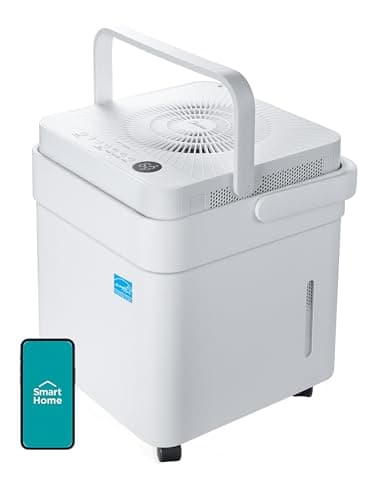 The dehumidifier case Midea Dehumidifier, 20 pints/day 20.16 pints a day on the federal test at 1.70 L/kWh and 249 certified kWh a year — it takes water out of the air and nothing else. | Condensation, musty smells, damp walls or anything that feels clammy | |
| 2 | 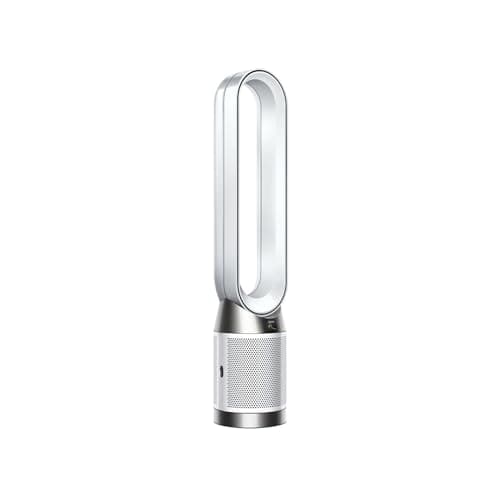 The air purifier case Dyson Purifier Cool TP07 HEPA and activated carbon filtration on 40 W maximum, in a machine that also works as a bladeless fan. | Pollen, dust, smoke, and anyone whose symptoms are respiratory |
Diagnosis
Which problem do you actually have?
The two machines get confused because several complaints sound alike. This table separates them by the evidence in the room.
| What you notice | Buy |
|---|---|
| Condensation on windows or cold walls | Dehumidifier |
| Musty smell in a basement or closet | Dehumidifier |
| Clothes and towels never fully dry | Dehumidifier |
| Mold spots on walls, grout or stored items | Dehumidifier, plus the leak |
| Sneezing, itchy eyes in pollen season | Air purifier |
| Wildfire smoke or cooking smoke | Air purifier |
| Pet dander with a pet in the house | Air purifier |
| Air feels heavy and the room smells stale | Ventilation first, then either |
This one is not a DIY job
The overlap
Where people think they overlap, and why they do not
Mold and dust mites. Both thrive above roughly 60% relative humidity, so a dehumidifier reduces the source of two common allergens. A purifier captures spores already airborne but does nothing about the damp producing them. In a damp house with allergies, the dehumidifier is the first purchase and the purifier is the second.
Smells. A musty smell is damp; a cooking or smoke smell is particles and gases. The first is a dehumidifier job, the second a carbon-filter job, and treating either with the wrong machine wastes both money and time.
“Stuffy” air. Usually neither — it is a ventilation problem, fixed by exchanging indoor air for outdoor air. That is what a window fan or an extract fan is for.
Running cost
Certified against published
The dehumidifier has a federal rating; the purifier has a manufacturer figure. That asymmetry is worth knowing:
- Dehumidifier: 249 kWh a year certified, about $46 at 18.34¢/kWh. Larger 50-pint units are certified nearer 512 kWh, or $94.
- Purifier: 40 W maximum, so 18¢ a day at full tilt, plus filters, which are the real running cost over a few years.
The dehumidifier also adds its heat to the room, which is a real consideration in summer and explains why it is not a cooling appliance — the point made in dehumidifier versus air conditioner.
Both
When two machines are the right answer
A damp basement with an allergy sufferer in the house genuinely needs both, and the order matters: dry the space first, because a room held near 50% relative humidity produces far fewer of the allergens the purifier is being asked to catch. Set the dehumidifier to a target rather than running it flat out, as in what to set a dehumidifier to, and put the purifier in the occupied room rather than next to the dehumidifier.
Say the unwelcome thing
Do not buy an air purifier for a damp room.
It is the most common mismatch in this pair, usually because the complaint is a smell and a purifier is marketed for smells. Filtering the air of a room at 70% relative humidity does not reduce the humidity, does not stop the condensation, and does not remove the cause of the musty smell.
Measure first with a hygrometer. If it reads above 60%, a certified 20-pint dehumidifier is the machine that changes something. If it reads 45% and you are sneezing, HEPA and carbon filtration is.
In full
Every pick, and what is wrong with it
Published specifications only, each linked to the page it came from. Where a manufacturer publishes nothing, the row says so — we do not fill blanks in.
1. The dehumidifier case
Midea Dehumidifier, 20 pints/day
Midea · model MAD20S1QWT
20.16 pints a day on the federal test at 1.70 L/kWh and 249 certified kWh a year — it takes water out of the air and nothing else.
A dehumidifier is a small refrigeration system that chills a coil below the dew point so water condenses on it and drains away. Everything it does well follows from that: it lowers relative humidity, and lowering relative humidity is what stops mold, condensation and the smell that comes with them.
Certified at 20.16 pints a day, an integrated energy factor of 1.70 L/kWh and 249 kWh a year — about $46 of electricity annually at 18.34¢/kWh. Those are federal figures from the ENERGY STAR dataset, not manufacturer claims.
It does not filter. Air passes over a coil and a coarse dust screen, which is not a particle-removal device in any meaningful sense. If your complaint is pollen or smoke, this machine will not touch it.
What’s wrong with it
It adds heat to the room, it needs emptying or plumbing, and it does nothing at all for particles, pollen, smoke or odors that are not damp-related.
Running cost — MAD20S1QWT
| Annual energy use | 249 kWh | ENERGY STAR certified figure |
|---|---|---|
| Annual cost | $46 | 249 × 18.34¢/kWh |
| Per cooling month | $11 | spread over a four-month season |
The annual figure is the certified value from the ENERGY STAR Certified Dehumidifiers dataset, which models a standard cooling season rather than your actual summer. It is more useful than a nameplate wattage here, because a variable-speed compressor spends most of its life well below nameplate.
Rate: 18.34¢/kWh, the US average residential price for June 2026 (EIA Electric Power Monthly, Table 5.3). Yours will differ — swap it in: (watts ÷ 1000) × hours × your rate.
| Water removal | 20.16 pints/day (DOE Appendix X1) |
|---|---|
| Efficiency (IEF) | 1.70 L/kWh |
| Annual energy use | 249 kWh/yr |
| Refrigerant | HFC-32 (GWP 675) |
| Connected | No |
| Noise | Not published in the certified dataset |
| ENERGY STAR | Certified |
Every figure above is from ENERGY STAR Certified Dehumidifiers dataset. Blanks are shown as “not published” rather than filled in.
2. The air purifier case
Dyson Purifier Cool TP07
Dyson · model TP07
HEPA and activated carbon filtration on 40 W maximum, in a machine that also works as a bladeless fan.
A purifier moves room air through a filter and returns it. The HEPA element captures fine particles — pollen, dust, smoke — and the activated carbon stage targets gases and odors. Nothing about that changes the humidity of the room by any useful amount.
40 W maximum input power and under 0.5 W on standby, so running it continuously is cheap: 18¢ a day at 18.34¢/kWh at full power, and less in practice because it modulates.
This particular model doubles as a fan, which is why it appears in bladeless fans and fans for allergy sufferers. For a room where the complaint is symptoms rather than damp, that combination is the useful one.
What’s wrong with it
Filters are a recurring cost, it does nothing for damp, and no purifier reduces humidity — running one in a damp room changes nothing you can measure.
Running cost — TP07
| Nameplate power | 40 W | manufacturer's published figure |
|---|---|---|
| Energy, 8-hour night | 0.32 kWh | 40 ÷ 1000 × 8 |
| Cost per hour | 0.7¢ | at 18.34¢/kWh |
| Cost per 8-hour night | 5.9¢ | on the highest speed |
| Cost per 30 nights | $1.76 | 9.6 kWh |
Rate: 18.34¢/kWh, the US average residential price for June 2026 (EIA Electric Power Monthly, Table 5.3). Yours will differ — swap it in: (watts ÷ 1000) × hours × your rate.
| Maximum input power | 40 W |
|---|---|
| Standby power | Under 0.5 W |
| Air delivery (CFM) | Not published — Dyson states airflow in gallons per second, which is not comparable to a CFM figure |
| Noise (dBA) | Not published |
| Dimensions | Not published on the accessible spec sheet |
| Weight | Not published on the accessible spec sheet |
| Filter | HEPA and activated carbon (purifier function) |
Every figure above is from Dyson Purifier Cool TP07 technical specification (dyson.com). Blanks are shown as “not published” rather than filled in.
Questions people actually ask
Frequently asked
Does a dehumidifier purify the air?
No. It condenses water out of the air on a cold coil and passes it over a coarse dust screen, which is not particle filtration. It reduces mold and dust mite growth by lowering humidity, which is an indirect and slower effect.
Does an air purifier reduce humidity?
No, by any amount you could measure. A purifier moves air through a filter and returns it to the room at the same moisture content. Nothing in it condenses or adsorbs water.
Which should I buy first for a damp basement with allergies?
The dehumidifier. Holding the space near 50 percent relative humidity suppresses mold and dust mites at the source, which reduces what a purifier would otherwise be catching. Add the purifier afterwards, in the occupied room. Basement dehumidifiers.
Do dehumidifiers help with allergies?
Indirectly and genuinely: dust mites and mold both need humidity above roughly 60 percent, so holding a room below that reduces two major indoor allergens. It does nothing for pollen blown in through a window, which is a filter's job.
Which costs more to run, a dehumidifier or an air purifier?
The dehumidifier, by a wide margin. A certified compact unit uses 249 kWh a year and a 50-pint model around 512, against 40 watts maximum for the purifier compared here — though filters add a recurring cost the dehumidifier does not have. Dehumidifier running costs.
Sources
Where these numbers came from
- ENERGY STAR Certified Dehumidifiers dataset — 20.16 pints/day per DOE Appendix X1, IEF 1.70 L/kWh and 249 kWh/yr for the compact unit compared here
- Dyson Purifier Cool TP07 technical specification — 40 W maximum input power, under 0.5 W standby, HEPA and activated carbon filtration
- EIA Electric Power Monthly, Table 5.3 — average residential electricity price
Read next
Where to go from here
Back to Dehumidifiers, or read how we pick.