The picks
The best window fans for casement and sliding windows
The whole category is built for one window type, and it is not the one you have. Here is what that leaves you.
By Sawyer V. · Published
The short answer
Measure the height of your opening, not the width. Every window fan we can source specs for needs an opening 26.5 to 38 inches wide and 22 to 26.25 inches high — double-hung geometry. A horizontal slider or a crank-out casement gives you a tall, narrow opening instead. If yours is under about 22 inches high, no window fan on the market fits it and you mount a fan in front of the opening instead.
Fan & Frost earns a commission when you buy through our links, at no cost to you. It never changes a ranking, and we say so when the right answer is the cheaper unit or nothing at all. Full disclosure · How we pick.
At a glance
The picks, ranked
Tap any row to jump to the full reasoning. Prices are live from Amazon where we have them, and read “check price” where we don’t — never a number we cannot verify today.
| # | Product | Best for | Price |
|---|---|---|---|
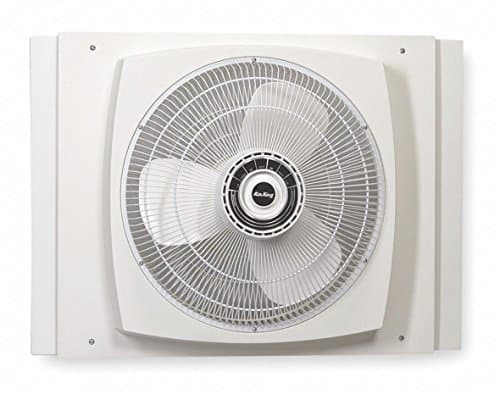
| 1 | Best overall Air King 16" Whole House Window Fan 2,470 CFM on 90 W at 27.4 CFM per watt — the most efficient window fan we can source specs for, at 15 lb and only 8.25 inches deep. | A slider or awkward opening that is at least 22 inches high | |
| 2 | Best for a narrow opening Lasko Twin Window Fan with Remote Fits from 24 inches wide — the narrowest requirement here — with twin reversible motors, a thermostat and a remote, on 22 to 31 W. | A slider that opens to 24 inches, where control matters more than airflow | |
| 3 | Best when nothing fits the frame Lasko Power Plus 20" Box Fan 73 to 102 W with a weather-resistant motor — the fan you stand in front of the opening when the frame will not take anything. | A crank-out casement, or any opening under 22 inches high | |
| — | 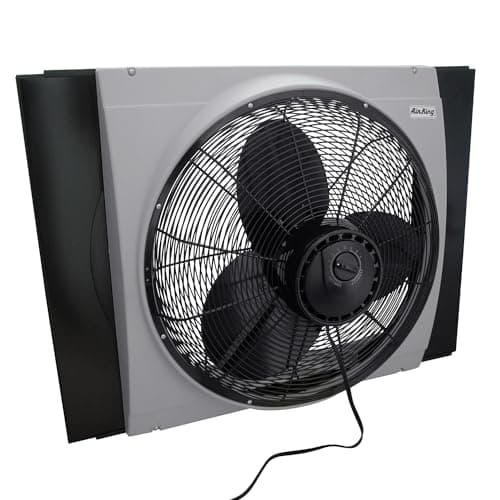 The one that will not fit Air King 20" Whole House Window Fan 3,560 CFM and the biggest airflow here, needing 26.25 inches of height and weighing 36.6 lb. It is the wrong shape for this problem. | A large double-hung window — not the window you came here with |
There is a specific frustration behind this search. You have read that a window fan is the only fan that genuinely lowers a room’s temperature, you have gone to buy one, and every single model assumes a window that slides up and down. Yours slides sideways, or cranks outward, and nothing in the aisle acknowledges that.
The frustration is justified. The category really is built for one window type, and the specifications say so plainly once you line them up.
The finding
Every window fan wants a wide, short opening
Here are the published fit requirements for every window fan we could source manufacturer specifications for.
| Fan | Width needed | Height needed | Airflow | Weight |
|---|---|---|---|---|
| Air King 9155, 16 in | 26.5 – 34.5 in | 22 in | 2,470 CFM | 15.0 lb |
| Air King 9166F, 20 in | 27 – 38 in | 26.25 in | 3,560 CFM | 36.6 lb |
| Lasko W09550 twin | 24 – 32 in | Not published | 560 CFM | 8.0 lb |
Read the two middle columns together. The category wants roughly 24 to 38 inches of width and 22 to 26 inches of height. That is the shape of a double-hung window with the lower sash raised: wide, and not very tall.
A horizontal slider gives you the opposite. Slide one pane behind the other and the opening is the full height of the window — often 40 inches or more — and only half the width. A fan sized to span 26 inches of width has nothing to grip and a two-foot gap above it.
A crank-out casement is worse again, because the sash swings outward into the space the fan would occupy. There is no arrangement in which the window closes onto a fan sitting in the frame.
This one is not a DIY job
Measure the height of your opening before anything else. If it is under about 22 inches you are out of the category entirely, whatever the width says, and you should skip to the in-front-of-the-opening approach below. Almost every returned window fan we can find a reason for is a height problem, not a width one.
Criteria
What we ranked on
The usual window fan criteria — airflow, reversibility, thermostat — are secondary here, because they only matter on a fan that physically fits. In order:
- Minimum height required. The binding constraint. A fan that needs 22 inches works in openings that a 26.25-inch fan cannot touch.
- Minimum width required. Secondary, but decisive on a narrow slider where only half the window opens.
- Weight. An awkward opening usually means the fan is supported in a way the frame was not designed for. 15 lb and 36.6 lb are different propositions.
- Depth. If the sash has to pass the fan, depth decides whether it can.
- Efficiency, in CFM per watt. Our arithmetic on published airflow and wattage, because nobody certifies window fans.
- Reversibility and control, which matter more on a single awkward opening than on a pair of normal ones.
The surprise
The smaller fan is the more efficient one
This runs against the intuition the rest of this site has built, so it is worth spelling out.
| Fan | High | Low |
|---|---|---|
| Air King 9155, 16 in blade | 27.4 CFM/W | 26.2 CFM/W |
| Air King 9166F, 20 in blade | 20.9 CFM/W | 21.8 CFM/W |
| Lasko W09550 twin | 18.1 CFM/W | Not computable |
On ceiling fans the opposite holds: span raises the floor on efficiency, and median CFM per watt climbs from 189.2 in the bedroom-size band to 306.0 at the largest spans. A big ceiling fan turning slowly beats a small one turning fast.
A window fan is a different machine. It is an axial fan pushing against the resistance of a window opening and a grille, not a large blade moving freely in open air, so the geometry that rewards a 60-inch ceiling fan does not apply. Here the 16-inch blade is 31% more efficient than the 20-inch one on high, and it weighs 15 lb instead of 36.6.
Note also how far below a ceiling fan all of these sit. The best window fan here is 27.4 CFM per watt; a certified ceiling fan reaches 483.0. They are not doing the same job — a window fan exchanges air and genuinely lowers room temperature, where a ceiling fan only moves the air already present — but if all you want is to feel cooler, the ceiling fan is an order of magnitude cheaper to run.
Storm Guard
The feature that makes an awkward window workable
Both Air King models publish a feature called Storm Guard, and on a non-standard window it does more than it does on a normal one.
On a conventional install the sash comes down onto the top of the fan and the accordion panels fill the rest. Storm Guard changes the arrangement so the window can close behind the fan — for weather, or to secure the house.
That matters on an awkward opening because it decouples the fan from the sash. You are no longer asking a sideways-sliding pane to close onto a fan body it was never going to meet. It is also the answer to the security objection that comes with any window fan: an opening with a fan in it cannot normally be locked.
Both units ship with mounting hardware, which is worth knowing because an awkward opening frequently needs the fan fixed rather than simply rested.
If nothing fits
The in-front-of-the-opening approach
For a crank-out casement, and for any slider under about 22 inches high, this is the honest answer rather than a fallback.
- Put a fan on a table or the floor facing out, close to the opening. It exhausts room air through the gap.
- Open a second window somewhere else, ideally on the shaded side, for the replacement air to come in through.
- Close the doors in between that you do not want involved, so the air takes the route you want.
- Block what you can around the opening with a board or a cut panel, so air is not simply circling back in beside the fan.
It is cruder than a fitted fan and it works, because the mechanism is the same: you are exchanging indoor air for cooler outdoor air. The efficiency loss is in recirculation around the fan, not in the principle — the full method, with the direction that people get backwards.
One hard precondition applies to every arrangement on this page, fitted or not: the outdoor air has to actually be cooler than the indoor air. Run any of this at two in the afternoon and you are importing heat with a 90 W fan — the night purge, and when it stops working.
Casement, specifically
Why a casement is a harder problem than a slider
The two window types get lumped together in search queries and they are not the same difficulty.
A horizontal slider is geometrically awkward but solvable. The opening is tall and narrow, the sash moves within the frame plane, and a fan that needs only 22 inches of height has a real chance — particularly with Storm Guard letting the pane pass behind it. Measure and you may be fine.
A crank-out casement is a different shape of problem. The sash swings out of the frame plane entirely, so there is no closed position that accommodates a fan in the opening. The frame also usually carries the crank mechanism and a screen on the inside face, both of which occupy the depth a fan needs.
For a casement, plan on the in-front approach from the start, or on a purpose-made insert panel. The same geometry is why casement rooms are difficult for air conditioners too, and the AC market at least makes a narrow vertical unit for it — casement and sliding window air conditioners. The fan market does not.
Nothing is certified
No window fan carries a certified figure
Worth stating clearly, because it changes how much weight to put on every number above.
There is no ENERGY STAR program for window fans. Ceiling fans have one, with certified CFM per watt on 1,439 US records. Bathroom and ventilating fans have one, with certified airflow and sones. Room air conditioners have one. Window fans have none.
So every airflow, wattage and fit figure on this page is a manufacturer claim, taken from the manufacturer’s own product page, and the CFM-per-watt column is our arithmetic on those claims. They are not measured to a shared procedure and they are not comparable across brands with any confidence.
One practical consequence: the noise figures. Only one fan here publishes any — 64 / 57 / 50 dB on the 20-inch Air King — and it is not measured to the standard that makes bathroom fan sones comparable. Treat it as indicative of that one model and nothing more — what fan noise figures actually mean.
Measuring
What to measure before you order
- Opening height, with the window fully open. Not the glass, not the frame — the clear gap. This is the number that decides everything.
- Opening width, with the window fully open. On a slider this is usually about half the total window width.
- Frame depth on the inside face, and whether a screen, a crank handle or a lock sits in it.
- Which way the sash travels, and whether it can pass behind a fan body or has to stop against it.
- What the sill will carry. 36.6 lb held sideways in a frame is a different load from 15 lb resting on a sill.
Say the unwelcome thing
Do not buy a window fan on its CFM number.
On a standard double-hung window, sorting by airflow is reasonable. On a slider or a casement it selects for exactly the wrong thing: the highest-CFM fan here is also the tallest, the heaviest and the least efficient per watt.
3,560 CFM sounds decisive and 26.25 inches of required height is what you will actually be defeated by. The 16-inch model moves 2,470 CFM, needs 22 inches, weighs 15 lb rather than 36.6, and is 31% more efficient on high.
Measure the clear opening first, filter to what fits, and only then look at airflow. 22 inches of height and 27.4 CFM per watt is where that process lands for most awkward windows — and if the answer is that nothing fits, that is a real answer, not a failure to shop hard enough.
In full
Every pick, and what is wrong with it
Published specifications only, each linked to the page it came from. Where a manufacturer publishes nothing, the row says so — we do not fill blanks in.
1. Best overall
Air King 16" Whole House Window Fan
Air King · model 9155
2,470 CFM on 90 W at 27.4 CFM per watt — the most efficient window fan we can source specs for, at 15 lb and only 8.25 inches deep.
The best combination of the three things that matter in an awkward opening: it needs the least height, it is the lightest by a long way, and it is the shallowest.
22 inches of height is the lowest requirement in the category. That is the number that decides whether anything fits at all, and this fan asks for less of it than any alternative we could verify.
2,470 / 1,700 / 1,360 CFM on 90 / 65 / 52 W. Our arithmetic on those published figures gives 27.4 CFM per watt on high and 26.2 on low. Eight hours on low is about 7.6¢ at 18.34¢/kWh.
15.0 lb and 8.25 inches deep, with Storm Guard — the window can close behind the fan rather than resting on top of it, which is the mechanism that makes a non-standard opening workable at all. Mounting hardware is included.
The honest gaps: it still wants 26.5 inches of width, so a genuinely narrow slider defeats it, and no noise figure is published for this model, which we flag rather than fill in.
What’s wrong with it
It still needs 26.5 inches of width, and Air King publishes no noise figure for it.
Running cost — 9155
| Nameplate power | 52 W – 90 W | manufacturer's published figure |
|---|---|---|
| Energy, 8-hour night | 0.72 kWh | 90 ÷ 1000 × 8 |
| Cost per hour | 1.7¢ | at 18.34¢/kWh |
| Cost per 8-hour night | 13¢ | on the highest speed |
| Cost per 30 nights | $3.96 | 21.6 kWh |
| Same month, lowest speed | $2.29 | at 52 W |
Rate: 18.34¢/kWh, the US average residential price for June 2026 (EIA Electric Power Monthly, Table 5.3). Yours will differ — swap it in: (watts ÷ 1000) × hours × your rate.
| Air delivery | 2,470 / 1,700 / 1,360 CFM (high / medium / low) |
|---|---|
| Power | 90 / 65 / 52 W (0.8 / 0.6 / 0.5 A) |
| Efficiency | 27.4 CFM per watt on high, 26.2 on low (our arithmetic) |
| Blade | 16 in |
| Speeds | 3 |
| Window required | 26.5 - 34.5 in wide x 22 in high |
| Dimensions | 26.5 W x 8.25 D x 22 H in |
| Weight | 15.0 lb |
| Storm Guard | Window can close behind the fan |
| Mounting | Hardware included |
| Noise | Not published |
| ENERGY STAR | No program exists for window fans |
Every figure above is from Air King whole house window fan product page, models 9155 and 9166F. Blanks are shown as “not published” rather than filled in.
2. Best for a narrow opening
Lasko Twin Window Fan with Remote
Lasko · model W09550
Fits from 24 inches wide — the narrowest requirement here — with twin reversible motors, a thermostat and a remote, on 22 to 31 W.
Two inches of width does not sound like a meaningful difference until your opening is 25 inches, at which point it is the whole decision.
24 to 32 inches wide is the narrowest fit we can source, and the accordion panels close the gap either side.
Two independently reversible motors — intake, exhaust, or one of each for a genuine air exchange through a single opening. On an awkward window where you only get one opening, that matters more than it does on a double-hung pair.
Up to 560 CFM on 22 to 31 W, with an adjustable thermostat and a remote. Eight hours on high is about 4.5¢ at 18.34¢/kWh. The remote earns its place here specifically: a fan in an awkward window is usually behind furniture or a blind.
560 CFM against 2,470 is the honest cost, and Lasko publishes no minimum height, so you are measuring the fan body (12.9 inches tall) rather than following a stated requirement.
What’s wrong with it
Up to 560 CFM is a fraction of the Air King units, and Lasko publishes no height requirement at all.
Running cost — W09550
| Nameplate power | 22 W – 31 W | manufacturer's published figure |
|---|---|---|
| Energy, 8-hour night | 0.25 kWh | 31 ÷ 1000 × 8 |
| Cost per hour | 0.6¢ | at 18.34¢/kWh |
| Cost per 8-hour night | 4.5¢ | on the highest speed |
| Cost per 30 nights | $1.36 | 7.4 kWh |
| Same month, lowest speed | 97¢ | at 22 W |
Rate: 18.34¢/kWh, the US average residential price for June 2026 (EIA Electric Power Monthly, Table 5.3). Yours will differ — swap it in: (watts ÷ 1000) × hours × your rate.
| Power | 22 W - 31 W at 120 V |
|---|---|
| Air delivery | Up to 560 CFM |
| Window fit | 24 - 32 in wide |
| Modes | Intake, exhaust or exchange (independent motors) |
| Thermostat | Adjustable |
| Speeds | 3 |
| Dimensions | 12.9 H x 24.0 W x 4.9 D in |
| Weight | 8.0 lb |
| Warranty | 1 year |
Every figure above is from Lasko product page, W09550. Blanks are shown as “not published” rather than filled in.
3. Best when nothing fits the frame
Lasko Power Plus 20" Box Fan
Lasko · model B20801
73 to 102 W with a weather-resistant motor — the fan you stand in front of the opening when the frame will not take anything.
For a true crank-out casement this is not a compromise, it is the answer. The sash swings outward, so nothing can sit in the frame and let the window close.
A weather-resistant motor is the spec that matters, because a fan working an open window is partly outdoors — rain blows in and condensation forms.
73 W on low and 102 W on high, three speeds. Eight hours on high is about 15¢ at 18.34¢/kWh.
It seals nothing. Set on a table facing out, it exhausts the room through the opening, and replacement air comes in wherever you open a second window. That is a cruder arrangement than a fitted fan and it still works — the exhaust setup, explained properly.
No published CFM, and at 22.5 inches wide it will not fit inside a narrow opening either. You are placing it, not mounting it.
What’s wrong with it
It seals nothing, and Lasko publishes no CFM figure for it at all.
Running cost — B20801
| Nameplate power | 73 W – 102 W | manufacturer's published figure |
|---|---|---|
| Energy, 8-hour night | 0.82 kWh | 102 ÷ 1000 × 8 |
| Cost per hour | 1.9¢ | at 18.34¢/kWh |
| Cost per 8-hour night | 15¢ | on the highest speed |
| Cost per 30 nights | $4.49 | 24.5 kWh |
| Same month, lowest speed | $3.21 | at 73 W |
Rate: 18.34¢/kWh, the US average residential price for June 2026 (EIA Electric Power Monthly, Table 5.3). Yours will differ — swap it in: (watts ÷ 1000) × hours × your rate.
| Power | 73 W - 102 W (0.6-0.9 A at 120 V) |
|---|---|
| Speeds | 3 |
| Dimensions | 21.25 H x 22.5 x 4.75 in |
| Weight | 10.1 lb |
| Motor | Weather-resistant |
| Air delivery (CFM) | Not published |
| Warranty | 2 years |
Every figure above is from Lasko product page, B20801. Blanks are shown as “not published” rather than filled in.
Skip this one
Air King 20" Whole House Window Fan
Air King · model 9166F
3,560 CFM and the biggest airflow here, needing 26.25 inches of height and weighing 36.6 lb. It is the wrong shape for this problem.
Flagged because it is the fan people reach for when they sort by airflow, and airflow is not the constraint on an awkward window.
26.25 inches of required height against 22 for the pick at the top. Four inches is the difference between fitting a slider and not fitting it, and almost no slider gives you 26.
36.6 lb against 15.0 — two and a half times the weight, hanging in a window frame that was not designed to carry a fan sideways.
It is also the less efficient fan. 3,560 CFM on 170 W is 20.9 CFM per watt; the 16-inch model manages 27.4. Bigger is worse here on efficiency as well as on fit.
It publishes 64 / 57 / 50 dB, which is the only noise figure in this whole comparison, and it is a genuinely strong fan in the window it was designed for — the standard double-hung roundup.
What’s wrong with it
It is also less efficient than the smaller fan at every speed, which is the opposite of what buyers assume.
Running cost — 9166F
| Nameplate power | 115 W – 170 W | manufacturer's published figure |
|---|---|---|
| Energy, 8-hour night | 1.36 kWh | 170 ÷ 1000 × 8 |
| Cost per hour | 3.1¢ | at 18.34¢/kWh |
| Cost per 8-hour night | 25¢ | on the highest speed |
| Cost per 30 nights | $7.48 | 40.8 kWh |
| Same month, lowest speed | $5.06 | at 115 W |
Rate: 18.34¢/kWh, the US average residential price for June 2026 (EIA Electric Power Monthly, Table 5.3). Yours will differ — swap it in: (watts ÷ 1000) × hours × your rate.
| Air delivery | 3,560 / 3,120 / 2,510 CFM (high / medium / low) |
|---|---|
| Power | 170 / 145 / 115 W (1.4 / 1.2 / 1.0 A) |
| Efficiency | 20.9 CFM per watt on high, 21.8 on low (our arithmetic) |
| Noise | 64 / 57 / 50 dB (high / medium / low) |
| Blade | 20 in |
| Speeds | 3 |
| Window required | 27 - 38 in wide x 26.25 in high |
| Dimensions | 26.75 W x 11.25 D x 26.25 H in |
| Weight | 36.6 lb |
| Storm Guard | Window can close behind the fan |
| Mounting | Hardware included |
| ENERGY STAR | No program exists for window fans |
Every figure above is from Air King whole house window fan product page, models 9155 and 9166F. Blanks are shown as “not published” rather than filled in.
We are not linking a buy button for this one. If you want to look at it anyway, it is easy enough to find — but we would rather send you to something that fits your room.
Questions people actually ask
Frequently asked
Is there a window fan that fits a casement window?
Not in the conventional sense. A crank-out casement sash swings out of the frame plane, so there is no closed position that accommodates a fan in the opening, and the crank and screen usually occupy the depth a fan needs. Plan on a fan placed in front of the opening instead.
What size window does a window fan need?
Roughly 24 to 38 inches wide and 22 to 26.25 inches high across every model we can source manufacturer specs for — double-hung geometry. The height requirement is the one that defeats sliders, because a slider opening is tall and narrow rather than wide and short.
Can you put a window fan in a sliding window sideways?
Sometimes, if the opening is at least about 22 inches high and 26 inches wide. Measure the clear gap with the window fully open — on a horizontal slider that is usually about half the total window width, which is what rules most of them out.
What is Storm Guard on a window fan?
A design that lets the window close behind the fan rather than resting on top of it, for weather or to secure the house. On an awkward opening it matters more than on a normal one, because it decouples the fan from a sash that was never going to meet it.
Is a bigger window fan better?
Not here. The 20-inch model moves more air but needs 26.25 inches of height against 22, weighs 36.6 lb against 15.0, and is less efficient — 20.9 CFM per watt against 27.4. That is the opposite of ceiling fans, where larger spans are more efficient. Where bigger does win.
Are window fans ENERGY STAR certified?
No. There is no ENERGY STAR program for window fans, unlike ceiling fans, ventilating fans and room air conditioners. Every airflow and wattage figure is a manufacturer claim from their own product page, and the CFM-per-watt figures here are our arithmetic on those claims.
Sources
Where these numbers came from
- Air King whole house window fan product page — models 9155 and 9166F: CFM, watts and amps at each speed, blade size, required window size, dimensions, weight, Storm Guard and mounting hardware; 64/57/50 dB published for the 9166F only
- Lasko product page, W09550 — up to 560 CFM, 22 to 31 W, 24 to 32 in window fit, twin reversible motors, adjustable thermostat, remote, 8.0 lb
- Lasko product page, B20801 — 73 to 102 W, three speeds, weather-resistant motor, 22.5 in wide, no published CFM
- ENERGY STAR Certified Ceiling Fans dataset — used only for the contrast: certified CFM per watt by span band across 1,439 US records
- EIA Electric Power Monthly, Table 5.3 — average residential electricity price
Read next
Where to go from here
Back to Fans, or read how we pick.