Head to head
Single hose vs dual hose portable air conditioners
The mechanism genuinely favors two hoses. The published data shows hose count is a much weaker predictor of real capacity than anyone claims.
By Sawyer V. · Published
The short answer
A single-hose unit exhausts room air outdoors, so the room goes slightly negative and pulls hot outdoor air in through every gap to replace it. A dual-hose unit draws its condenser air from outside instead, avoiding that. Dual is better in principle — but published SACC figures show the capacity haircut ranging from 14 percent to 50 percent, with dual-hose units at both 14 and 42 percent. Read the SACC number, not the hose count.
Fan & Frost earns a commission when you buy through our links, at no cost to you. It never changes a ranking, and we say so when the right answer is the cheaper unit or nothing at all. Full disclosure · How we pick.
At a glance
The picks, ranked
Tap any row to jump to the full reasoning. Prices are live from Amazon where we have them, and read “check price” where we don’t — never a number we cannot verify today.
| # | Product | Best for | Price |
|---|---|---|---|
| 1 | 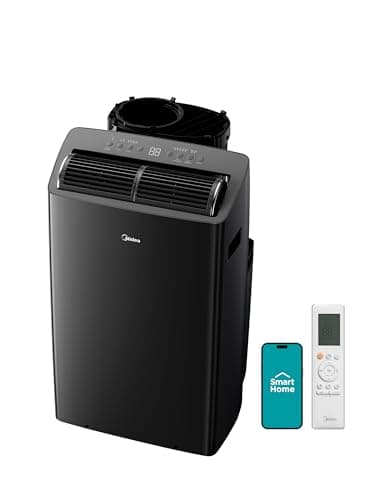 Smallest published capacity haircut Midea Duo Smart Inverter Portable Air Conditioner 14,000 BTU marketing, 12,000 BTU SACC — a 14.3 percent haircut, the smallest we found across seven published units. | Anyone who wants the marketing number to mean something | |
| 2 | The dual-hose unit that publishes its wattage Whynter ARC-14S Dual Hose Portable Air Conditioner 1,300 W published, 9,500 BTU SACC from a 14,000 BTU headline — honest numbers, unflattering ones. | Someone who wants to know what it actually costs to run | |
| 3 | 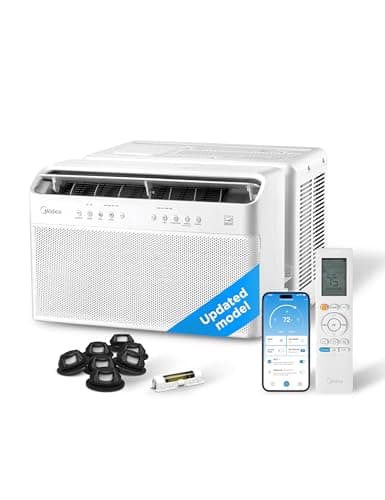 The answer to the question behind the question Midea U-Shaped Window Air Conditioner, 8,000 BTU 8,000 BTU with no SACC haircut at all, CEER 15, 400 kWh a year — because window units do not have this problem. | Anyone whose window can actually take a unit | |
| — | 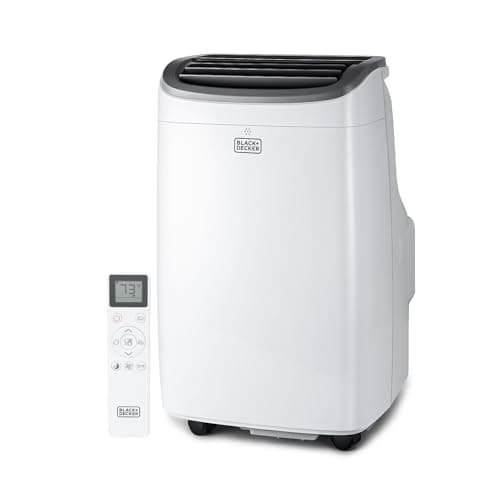 What single-hose looks like in the data BLACK+DECKER BPACT08WT Portable Air Conditioner The manufacturer publishes 4,000 BTU against an 8,000 BTU ASHRAE figure. That is a 50 percent gap, stated on their own page. | Illustrating the problem — we are not recommending it |
The mechanism is genuinely straightforward, and it does favor two hoses. What is not straightforward is how much difference it makes in practice, and the published data is more interesting than the conventional advice.
Mechanism
Why one hose costs you capacity
Every air conditioner has to reject heat somewhere. It pulls heat out of the room air at the evaporator and dumps it into a stream of air at the condenser, and that stream has to go outside.
A single-hose portable uses room air for that job. It draws air from the room, runs it across the hot condenser, and blows it out of the window through the hose.
Which means it is continuously exhausting your room to the outdoors. The room goes very slightly negative, and air comes back in to replace it — under doors, around windows, through every gap in the building envelope. That replacement air is hot outdoor air, and the unit now has to cool it too.
A dual-hose portable draws condenser air from outside through a second duct, uses it to reject heat, and sends it straight back out. Room air is not used for cooling the condenser, so there is no net exhaust and no infiltration.
That is a real advantage and the physics is not in dispute. The question is how much of it survives into the certified test results.
The data
Seven units, and the haircut is all over the place
The DOE’s SACC test procedure exists precisely to capture this. It measures cooling capacity with duct heat and infiltration accounted for, which is why the SACC figure always comes in below the older ASHRAE marketing number.
So the size of the gap is a measure of how much a unit loses to the problem this page is about. Here is every published pair we could find.
| Unit | Hoses | Marketing | SACC | Haircut |
|---|---|---|---|---|
| Midea Duo MAP14S1TBL | Dual | 14,000 | 12,000 | 14.3% |
| Whynter ARC-1230WN | Dual | 14,000 | 12,000 | 14.3% |
| Midea MAP10DV1XWT | Dual | 13,000 | 10,000 | 23.1% |
| Whynter ARC-148MHP | Dual | 14,000 | 10,000 | 28.6% |
| Whynter ARC-14S | Dual | 14,000 | 9,500 | 32.1% |
| Whynter ARC-126MD | Dual | 12,000 | 7,700 | 35.8% |
| Whynter ARC-122DS | Dual | 12,000 | 7,000 | 41.7% |
| BLACK+DECKER BPACT08WT | Single | 8,000 ASHRAE | 4,000 | 50.0% |
Marketing and SACC figures as published by each manufacturer. The BLACK+DECKER figure is the pair stated on its own product page. All percentages are our calculation.
Every dual-hose unit in that table, and the haircut ranges from 14.3 percent to 41.7 percent. Two hoses did not deliver a consistent result. The best dual-hose unit keeps 86 percent of its headline capacity; the worst keeps 58 percent.
The single-hose unit is worst at 50 percent, which is consistent with the mechanism. But it sits only 8 points below a dual-hose Whynter, and it is one data point — single-hose manufacturers largely do not publish SACC pairs, which is itself informative.
The conclusion we would draw: hose count sets the direction, but it is a poor predictor of magnitude. Two units with identical hose counts and identical headline BTU can differ by 2,500 BTU of real capacity. There is no substitute for reading the SACC figure itself.
This one is not a DIY job
How to read a portable air conditioner listing.
Find the SACC figure. It is the DOE-rated capacity and the only one you can compare across products. If a listing gives only an ASHRAE or “marketing” BTU number, you do not know what you are buying.
Distrust retailer capacity claims. For the BLACK+DECKER model on this page, three retailers quote three different SACC figures — 3,950, 4,000 and 5,300 — for one model number. Go to the manufacturer.
Check whether wattage is published at all. Two of the units here do not publish one, which makes running cost impossible to calculate and efficiency impossible to compare.
Remember there is no certification program. ENERGY STAR certifies room air conditioners, ceiling fans and ventilating fans. It does not certify portable air conditioners, so nothing here is independently verified.
Practical
What the second hose costs you
Dual-hose is not a free upgrade, and the trade-offs are worth knowing before you decide the debate on principle.
- Two ducts through the window. A wider window kit, a bigger gap to seal, and two insulated ducts crossing the room instead of one. Hose-in-hose designs mitigate this by nesting the intake inside the exhaust.
- More to seal, and the seal matters more. The whole benefit of two hoses is avoiding infiltration. A badly sealed two-duct window kit reintroduces exactly the problem you paid to avoid.
- Both ducts radiate heat into the room. The exhaust duct is hot and it is inside your room. Insulating it is one of the few genuinely worthwhile things you can do to a portable, and it applies to both configurations.
- Fewer models to choose from. Single-hose dominates the market, so the dual-hose field is smaller.
Say the unwelcome thing
Do not buy a portable air conditioner if a window unit will fit.
Everything on this page is about managing a disadvantage that window units simply do not have. A window unit puts the condenser outside the building, so there is no exhaust duct, no infiltration, and no gap between the marketing capacity and the rated capacity.
The certified numbers make the case without any editorializing. The best 8,000 BTU window unit uses 375 kWh a year. The portable on this page with a published wattage draws 1,300 W whenever it runs.
And window units are covered by ENERGY STAR, so their figures are independently verified. Portables are not certified at all.
Buy a portable when the window genuinely cannot take a unit — a casement window, a building rule, a room with no exterior window. Those cases are real and we cover them. Otherwise, the full comparison is here.
Conclusion
What to actually do
Prefer dual-hose, on the mechanism. Not using room air to cool the condenser is genuinely better, and nothing in the data contradicts it.
But choose on the SACC figure, not the hose count. A dual-hose unit at 41.7 percent haircut is worse than a dual-hose unit at 14.3 percent by 5,000 BTU, and no amount of reasoning about hoses would have told you that.
Insist on published numbers. Manufacturers who publish SACC, wattage and dBA are giving you something to evaluate.
The full explanation of what SACC measures and why it differs is the companion to this page.
In full
Every pick, and what is wrong with it
Published specifications only, each linked to the page it came from. Where a manufacturer publishes nothing, the row says so — we do not fill blanks in.
1. Smallest published capacity haircut
Midea Duo Smart Inverter Portable Air Conditioner
Midea · model MAP14S1TBL
14,000 BTU marketing, 12,000 BTU SACC — a 14.3 percent haircut, the smallest we found across seven published units.
14,000 BTU marketing, 12,000 BTU SACC. That is a 14.3 percent gap between the number on the box and the number the DOE test procedure produces — the smallest in our set by a wide margin.
For comparison, the Whynter ARC-14S is also dual-hose, also sold as 14,000 BTU, and rates 9,500 BTU SACC — a 32.1 percent haircut. Same hose count, same headline figure, and 2,500 BTU of real difference.
43 dBA is the lowest published noise figure of any portable air conditioner we have data for, and a hose-in-hose design means one duct through the window rather than two.
The gap in the data: no published wattage. Midea states 115 V and nothing else, so we cannot give you a running cost or compare its efficiency with anything.
What’s wrong with it
Midea does not publish a wattage figure at all, so there is no way to calculate what it costs to run.
Running cost
Midea does not publish a wattage for the MAP14S1TBL, so we cannot calculate what it costs to run. We are not going to estimate one. If Midea publishes a nameplate figure, this block will show the arithmetic.
| Marketing capacity | 14,000 BTU |
|---|---|
| DOE-rated capacity | 12,000 BTU SACC |
| Hoses | Dual |
| Noise | 43 dBA |
| Speeds | 3 |
| Refrigerant | R-32 |
| Dimensions | 19.52 W x 16.73 D x 32.48 H in |
| Weight | 74.96 lb |
| Manufacturer coverage claim | 550 sq ft |
| Power | Not published (115 V stated, no wattage) |
| Warranty | 1 year |
Every figure above is from Midea product page, MAP14S1TBL. Blanks are shown as “not published” rather than filled in.
2. The dual-hose unit that publishes its wattage
Whynter ARC-14S Dual Hose Portable Air Conditioner
Whynter · model ARC-14S
1,300 W published, 9,500 BTU SACC from a 14,000 BTU headline — honest numbers, unflattering ones.
Dual-hose, and a 32.1 percent capacity haircut anyway. If two hoses guaranteed a small gap, this unit would not exist.
What earns it a place is that Whynter publishes the numbers other manufacturers do not: 1,300 W and 11.6 A at 115 V — about $1.91 for an eight-hour day — plus a 71 pints per day dehumidification rate and a three-year compressor warranty.
That transparency is worth something. A unit with a published wattage can be compared; one without cannot be evaluated at all.
Under 51 dBA on low. Full portable comparison.
What’s wrong with it
A 32.1 percent haircut is more than double the best dual-hose unit here, which is the whole point of this page.
Running cost — ARC-14S
| Nameplate power | 1300 W | manufacturer's published figure |
|---|---|---|
| Energy, 8-hour night | 10.40 kWh | 1300 ÷ 1000 × 8 |
| Cost per hour | 24¢ | at 18.34¢/kWh |
| Cost per 8-hour night | $1.91 | on the highest speed |
| Cost per 30 nights | $57 | 312.0 kWh |
Rate: 18.34¢/kWh, the US average residential price for June 2026 (EIA Electric Power Monthly, Table 5.3). Yours will differ — swap it in: (watts ÷ 1000) × hours × your rate.
| Marketing capacity | 14,000 BTU (ASHRAE-128) |
|---|---|
| DOE-rated capacity | 9,500 BTU SACC |
| Hoses | Dual |
| Power | 1,300 W / 11.6 A at 115 V |
| Noise | Under 51 dBA low, under 56 dBA high |
| Dehumidification | 71 pints/day |
| Refrigerant | R-32 |
| Dimensions | 16 W x 19 D x 35.5 H in |
| Weight | 73 lb |
| Manufacturer coverage claim | 500 sq ft |
| Warranty | 1 year unit, 3 years compressor |
Every figure above is from Whynter product page, ARC-14S. Blanks are shown as “not published” rather than filled in.
3. The answer to the question behind the question
Midea U-Shaped Window Air Conditioner, 8,000 BTU
Midea · model MAW08V1QWT-S
8,000 BTU with no SACC haircut at all, CEER 15, 400 kWh a year — because window units do not have this problem.
Worth stating plainly: the entire single-versus-dual debate exists because portable air conditioners are inefficient by design. A window unit has no exhaust hose, no infiltration penalty and no SACC-versus-marketing gap.
400 kWh a year from certified data, against 1,300 W for a portable running whenever it is on. And the U-shape puts the compressor outside a closed window, which no portable can do.
Room air conditioners are covered by ENERGY STAR; portables are not certified at all. So a window unit gives you an independently verified efficiency figure, and a portable gives you a manufacturer’s claim.
If your window takes a unit, this comparison is not one you need to have.
What’s wrong with it
53.2 lb, a two-person install, and it occupies the window for the season. A portable does not.
Running cost — MAW08V1QWT-S
| Annual energy use | 400 kWh | ENERGY STAR certified figure |
|---|---|---|
| Annual cost | $73 | 400 × 18.34¢/kWh |
| Per cooling month | $18 | spread over a four-month season |
The annual figure is the certified value from the ENERGY STAR Certified Room Air Conditioners dataset, which models a standard cooling season rather than your actual summer. It is more useful than a nameplate wattage here, because a variable-speed compressor spends most of its life well below nameplate.
Rate: 18.34¢/kWh, the US average residential price for June 2026 (EIA Electric Power Monthly, Table 5.3). Yours will differ — swap it in: (watts ÷ 1000) × hours × your rate.
| Cooling capacity | 8,000 BTU/h |
|---|---|
| CEER | 15 |
| Annual energy use | 400 kWh/yr |
| vs federal standard | 38% less energy |
| Dimensions | 13.5 H x 19.2 W x 22.0 D in |
| Weight | 53.2 lb |
| Refrigerant | R-32 |
| Installation | U-shape; sash closes through the middle of the unit |
| Compressor | Variable speed |
| ENERGY STAR | Certified |
Every figure above is from ENERGY STAR Certified Room Air Conditioners dataset. Blanks are shown as “not published” rather than filled in.
Skip this one
BLACK+DECKER BPACT08WT Portable Air Conditioner
BLACK+DECKER · model BPACT08WT
The manufacturer publishes 4,000 BTU against an 8,000 BTU ASHRAE figure. That is a 50 percent gap, stated on their own page.
Included as evidence, not as a recommendation. BLACK+DECKER’s own product page states “4,000 BTU (8,000 BTU ASHRAE)”. That is a 50 percent gap between the two test standards, on the manufacturer’s own listing — the largest in our set.
It gets worse when you leave the manufacturer’s site. For this single model number, retailer listings quote 3,950, 4,000 and 5,300 BTU SACC. Three figures, one product.
The manufacturer publishes no wattage, no noise figure and no coverage claim. What it does publish is R-410A refrigerant, 52.9 lb, and a five-year compressor warranty.
This is the strongest argument on the page for reading the SACC number specifically, and for treating retailer capacity claims as marketing.
What’s wrong with it
No published wattage, no noise rating, no coverage claim — and three different retailers quote three different SACC figures for the same model number.
Running cost
BLACK+DECKER does not publish a wattage for the BPACT08WT, so we cannot calculate what it costs to run. We are not going to estimate one. If BLACK+DECKER publishes a nameplate figure, this block will show the arithmetic.
| Manufacturer capacity | 4,000 BTU (8,000 BTU ASHRAE) |
|---|---|
| Hoses | Single |
| Refrigerant | R-410A |
| Dimensions | 15.3 W x 14.0 D x 25.0 H in |
| Weight | 52.9 lb |
| Power | Not published by the manufacturer |
| Noise | Not published |
| Coverage claim | Not published by the manufacturer |
| Warranty | 1 year parts and labor, 5 years compressor |
Every figure above is from BLACK+DECKER product page, BPACT08WT. Blanks are shown as “not published” rather than filled in.
We are not linking a buy button for this one. If you want to look at it anyway, it is easy enough to find — but we would rather send you to something that fits your room.
Questions people actually ask
Frequently asked
Is a dual hose portable air conditioner better?
On mechanism, yes — it draws condenser air from outside instead of exhausting room air, so the room does not go negative and pull hot outdoor air in through gaps. But published SACC data shows dual-hose units with capacity haircuts anywhere from 14.3 to 41.7 percent, so hose count predicts direction rather than magnitude.
How much capacity does a single hose portable AC lose?
The one unit in our set whose manufacturer publishes both figures states 4,000 BTU against an 8,000 BTU ASHRAE rating — a 50 percent gap. That is the largest we found, though it is a single data point, and most single-hose makers do not publish the pair at all.
What is SACC and why is it lower than the BTU on the box?
SACC is the DOE-rated Seasonally Adjusted Cooling Capacity. It accounts for heat radiating off the exhaust duct and for the outdoor air that infiltrates to replace exhausted room air — neither of which the older ASHRAE marketing figure captures. BTU vs SACC explained.
Are portable air conditioners ENERGY STAR certified?
No. ENERGY STAR certifies room air conditioners, ceiling fans and ventilating fans, but there is no program for portable air conditioners. Every efficiency figure you see for one is a manufacturer claim, not an independently verified test result.
Why do retailers list different BTU numbers for the same portable AC?
Because ASHRAE and SACC are different test standards and listings mix them. For one BLACK+DECKER model we found three retailers quoting 3,950, 4,000 and 5,300 BTU SACC for a single model number. Go to the manufacturer's own page.
Should I insulate the exhaust hose?
Yes, and it is one of the few genuinely worthwhile modifications. The exhaust duct is full of hot air and it runs through the room you are trying to cool, so every foot of it radiates heat back into the space. This applies to single and dual hose units alike.
Sources
Where these numbers came from
- Whynter ARC-14S product page — 14,000 BTU / 9,500 BTU SACC, dual hose, 1,300 W
- Whynter ARC-1230WN product page — 14,000 BTU / 12,000 BTU SACC, dual hose
- Whynter ARC-122DS product page — 12,000 BTU / 7,000 BTU SACC, dual hose
- Whynter ARC-126MD product page — 12,000 BTU / 7,700 BTU SACC, dual hose
- Whynter ARC-148MHP product page — 14,000 BTU / 10,000 BTU SACC, dual hose
- Midea MAP10DV1XWT product page — 13,000 BTU / 10,000 BTU SACC, hose-in-hose, 1,560 W
- BLACK+DECKER BPACT08WT product page — 4,000 BTU (8,000 BTU ASHRAE), R-410A, 52.9 lb
- ENERGY STAR Certified Room Air Conditioners dataset — CEER and annual kWh for the window unit comparison
Read next
Where to go from here
Back to Guides & Calculators, or read how we pick.