Guide
Do evaporative coolers work outdoors?
This is the setting the machine was designed for. The limit outdoors is not humidity building up — it is how far the cooled air travels before it mixes away.
By Sawyer V. · Published
The short answer
Yes — outdoors is the best case for one. The failure mode indoors is moisture accumulating in a closed room until evaporation slows. Outside, the moist air disperses continuously, so the machine keeps delivering its full temperature drop all afternoon. The limit instead is reach: cooled air mixes with ambient within a few yards, so it cools people, not places.
Fan & Frost earns a commission when you buy through our links, at no cost to you. It never changes a ranking, and we say so when the right answer is the cheaper unit or nothing at all. Full disclosure · How we pick.
Why it is easier
Outdoors removes the failure mode
An evaporative cooler cools air by evaporating water into it, which means it adds as much moisture as it removes heat — about 8.3 pounds of water vapor per gallon. Indoors, that vapor has nowhere to go. Relative humidity climbs, the driving force for evaporation shrinks, and the temperature drop fades over the session.
Outdoors there is effectively infinite air. The vapor disperses as fast as the machine produces it, ambient humidity is unchanged by anything you do, and the cooler delivers the same drop in hour four as in hour one. Everything written about ventilation requirements for indoor use exists because outdoors is the baseline the technology assumes.
This one is not a DIY job
The real limit
Reach, not capacity
In a room, the cooled air is contained and the whole volume eventually drops in temperature. In open air it does not: the cooled stream mixes with ambient air and warms back up as it travels, so the useful effect is confined to the cone of moving air.
That changes how you size the machine. Airflow is the specification that matters outdoors, because airflow sets how far the cooled air carries before it mixes away:
- 764 CFM (a small indoor unit) is a personal-space machine. Outdoors it cools whoever is directly in front of it.
- 2,697 to 3,100 CFM covers a seating area — a patio table, a group of chairs, a workshop bay with the door open.
- 5,300 CFM and up is what a large deck, a tent or an event space needs, and is also where noise becomes a real consideration.
Because the coverage claims manufacturers print are square-foot numbers derived indoors, treat them as optimistic outdoors. Our product page for this setting is evaporative coolers for a patio.
Layout
Three arrangements that waste the machine
- Aimed across open ground. Air thrown into an open yard mixes away before it reaches anyone. Point it at where people actually sit, from no more than a few yards.
- Fighting the breeze. A natural breeze of a few miles an hour will overwhelm the cooled stream. Place the machine upwind so the breeze carries its output toward the seating rather than away.
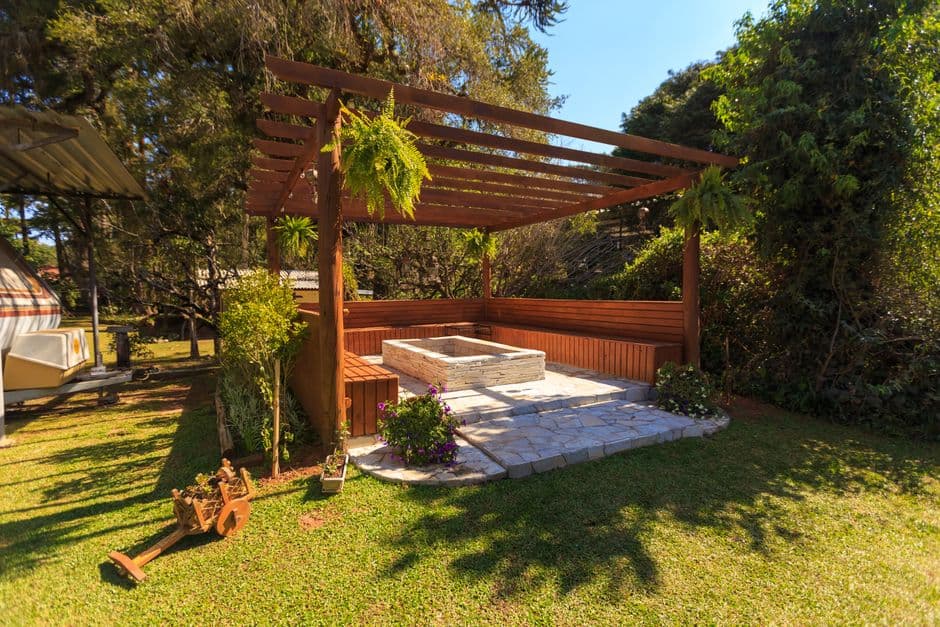
- Under a fully enclosed roof with walls. A screened porch with the panels closed behaves like a room: moisture builds and performance fades. Partly open structures — a pergola, a gazebo, a carport, a garage with the door up — are fine.
The general placement principle, which applies to fans and coolers alike, is in where to put a fan.
Practicalities
Water, power and weather
- Use the hose fitting. Outdoor machines run harder than indoor ones and empty a tank faster. A continuous-fill connection with a float valve turns refilling from a chore into a non-event; machines like the Hessaire MC37M publish it as a feature.
- Budget the electricity honestly. Published draws in this category are 220 to 430 W, so an evening on a 250 W machine costs about 23¢ at 18.34¢/kWh. The full arithmetic is in what one costs to run.
- Use an outdoor-rated circuit. A GFCI-protected outdoor receptacle, not a cord run out through a window. The machine holds ten gallons of water and stands on a wet surface.
- Drain it if it will freeze. Standing water in a reservoir and a pump is how these crack over winter; winterizing takes twenty minutes and saves the machine.
- Keep it out of sustained rain. Outdoor-rated means splash and weather resistant, not submersible. Dust and pollen also load the pads faster outdoors, which shortens their service life.
Versus misting
Evaporative cooler or misting fan?
Both use evaporation, and outdoors they are genuine alternatives.
- A misting fan sprays droplets into moving air and relies on them evaporating before they land. It is lighter, cheaper, and needs only a hose — but in humid air the droplets do not fully evaporate and you get wet furniture instead of cool air.
- An evaporative cooler evaporates through a saturated pad and delivers dry-feeling cooled air rather than droplets. It costs more, holds water, and behaves predictably.
In dry climates the cooler is the better machine and the misting fan is the cheaper one. In humid climates neither works well, and the honest answer is shade plus air movement — the case made in cooling a patio. The misting options themselves are in misting fans, ranked.
Say the unwelcome thing
Do not buy one for a humid-climate porch.
Outdoors fixes the moisture-accumulation problem and does nothing for the underlying climate limit. On a Gulf Coast afternoon at 75% relative humidity, the available evaporative cooling is a degree or two, and what you will notice instead is the dampness.
Check your afternoon humidity before you check the model numbers. Below about 50% this category is excellent value outdoors and 2,697 CFM on 220 watts will cool a seating area properly. Above it, spend the money on shade and a big fan.
Questions people actually ask
Frequently asked
Do evaporative coolers work on a patio?
Yes, and better than in a closed room, because the moisture they add disperses instead of accumulating. The catch is reach: cooled air mixes with ambient air within a few yards, so aim the machine at where people sit rather than at the space generally.
How far does the cool air from a swamp cooler travel outdoors?
Only as far as the airflow carries it before mixing, which is why outdoor use is sized on CFM rather than square feet. A 2,700 to 3,100 CFM machine covers a seating area; a 764 CFM one cools whoever is directly in front of it.
Can you leave an evaporative cooler outside?
Under cover, on a GFCI-protected outdoor circuit, yes. They are weather resistant rather than weatherproof, so keep them out of sustained rain, expect pads to load faster with outdoor dust, and drain the reservoir before freezing weather. Winterizing one.
Is a misting fan or an evaporative cooler better outside?
In dry air the cooler is more effective and more predictable; the misting fan is cheaper and lighter. In humid air neither delivers much, and the misting fan additionally leaves droplets on furniture because they do not fully evaporate. Misting fans, ranked.
Does an evaporative cooler work in a garage with the door open?
That is close to ideal — an open door provides the air exchange these machines need, and the space is usually dry. A closed garage behaves like a sealed room, with humidity climbing until the cooling effect fades. Garage-sized machines.
Sources
Where these numbers came from
- Honeywell product page, CO60PM — 2,697 CFM, 220 W, indoor/outdoor rated evaporative cooler with published coverage claim
- Hessaire product page, MC37M — 3,100 CFM, 250 W, 10.3 gallon tank with continuous hose hookup
- Honeywell — portable evaporative air cooler guidance, including the humidity ceiling for effective operation
- EIA Electric Power Monthly, Table 5.3 — average residential electricity price
Read next
Where to go from here
Back to Evaporative Coolers, or read how we pick.