Head to head
Gable fan vs roof-mount attic fan
Same job, same airflow figures, completely different day of work — and one of them puts a permanent penetration in your roof.
By Sawyer V. · Published
The short answer
Take the gable fan if you have a gable vent to put it behind. It bolts to existing framing, makes no new roof penetration, and is serviceable from inside the attic. A roof-mount fan only makes sense on a hip roof or any house with no usable gable end, because installing one means cutting through the deck and shingles and relying on flashing forever.
Fan & Frost earns a commission when you buy through our links, at no cost to you. It never changes a ranking, and we say so when the right answer is the cheaper unit or nothing at all. Full disclosure · How we pick.

At a glance
The picks, ranked
Tap any row to jump to the full reasoning. Prices are live from Amazon where we have them, and read “check price” where we don’t — never a number we cannot verify today.
| # | Product | Best for | Price |
|---|---|---|---|
| 1 | 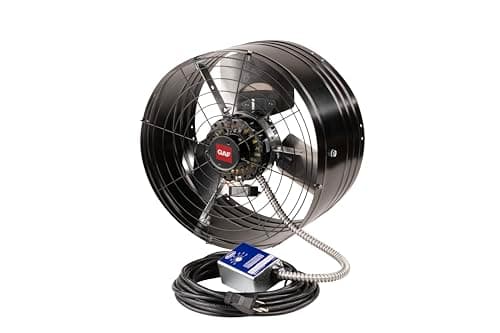 The gable case Maxx Air Premium 1,600 CFM Gable-Mount Power Attic Ventilator 1,600 CFM mounted behind an existing vent — no roof penetration, no flashing, and everything reachable from inside the attic. | Any house with a gable vent at the peak of an end wall | |
| 2 | 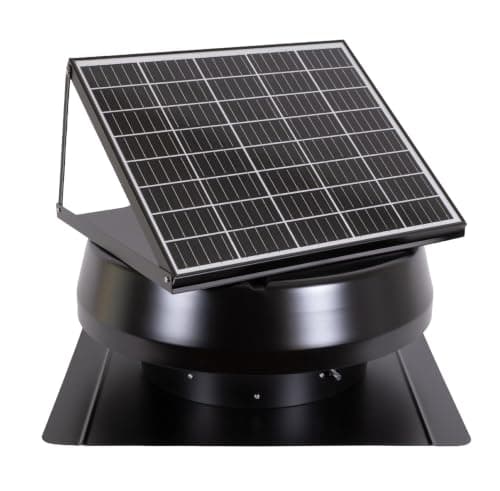 The roof-mount case iLIVING 14" Solar Roof Attic Exhaust Fan 1,150 CFM from a roof-mounted solar unit — no wiring, no running cost, and a hole in your roof for the life of the house. | A hip roof, or any house where there is no gable end to work with |
Side by side
The differences that are not airflow
Both styles are sold at similar capacities — roughly 800 to 1,600 CFM for residential units — and both are controlled by a thermostat, sometimes with a humidistat. The decision is almost entirely about the building.
| Gable mount | Roof mount | |
|---|---|---|
| Roof penetration | None | Yes, permanent |
| Needs | An existing gable vent | Deck cut, curb, flashing |
| Install location | Inside the attic | On the roof |
| Servicing | From inside, on a ladder | On the roof |
| Suits | Gable and gambrel roofs | Hip roofs, complex roof lines |
| Leak risk | None added | Real, and permanent |
| Re-roofing | Unaffected | Must be worked around |
| Intake required | 0.48 sq in per CFM | 0.48 sq in per CFM |
This one is not a DIY job
Position
Where each one draws from
A gable fan exhausts from one end of the attic, so air crosses the attic horizontally from the soffits to that end. A roof-mount fan near the ridge exhausts from the top, so air rises to it from the eaves on both sides. In a simple rectangular attic, the roof-mount pattern is slightly more even; in a long attic, a gable fan at one end may leave the far end underserved.
Neither difference is large enough to justify cutting a hole in a roof that has a perfectly good gable vent. If the attic is long, the better answer is two gable fans or one fan plus improved passive venting at the far end.
Noise and nuisance
What each one sounds like from inside
Attic ventilators sit above bedrooms and run on hot afternoons and evenings, so noise is a real consideration and the published data is poor. One gable unit in our catalog is filed at 0 sones in the certified dataset, which is a placeholder rather than a measurement; another publishes nothing at all.
Structurally, a gable fan is bolted to framing that connects to the house, so it can transmit vibration into the structure. A roof-mount fan is on the deck, further from living space, but directly above the ceiling it may be annoying at the same distance. Rubber isolation at the mounting points helps either one, and the general approach is the same as quieting any fan: speed and isolation first.
The bigger question
Whether to power the attic at all
Both of these solve the same problem in the same imperfect way. A powered attic ventilator lowers attic temperature, but it does it by moving large volumes of air through a space that is connected to your house in ways nobody documented when it was built.
The alternatives worth weighing first:
- Passive ventilation, improved. Clear soffit vents, baffles where insulation blocks the eaves, and a continuous ridge vent cost nothing to run and never depressurize anything.
- Insulation and air sealing at the ceiling plane. This is the fix that reduces the heat reaching your rooms rather than the heat in the attic.
- A whole-house fan, which takes air from inside the house deliberately and exhausts it through the attic, rather than pulling it there by accident. The comparison is in attic fan versus whole-house fan.
Say the unwelcome thing
Do not cut a roof for a fan when you have a gable vent.
A roof penetration is forever. It has to be flashed correctly, it has to be worked around at every re-roof, and it is a leak path in exactly the location where a leak is most expensive to trace.
If there is a gable vent at the peak of an end wall, use it. A 1,600 CFM gable ventilator does the same job as a roof unit of the same rating with none of the roof risk. Keep the roof-mount option for hip roofs, where there is no alternative — the full field is here.
In full
Every pick, and what is wrong with it
Published specifications only, each linked to the page it came from. Where a manufacturer publishes nothing, the row says so — we do not fill blanks in.
1. The gable case
Maxx Air Premium 1,600 CFM Gable-Mount Power Attic Ventilator
Maxx Air · model CX1600 BLU
1,600 CFM mounted behind an existing vent — no roof penetration, no flashing, and everything reachable from inside the attic.
A gable-mounted ventilator sits on the inside face of an existing gable vent and exhausts through it. Everything about that is easier: no shingles are cut, no flashing is installed, and nothing new penetrates the weather surface of the roof.
It is also serviceable. A motor replacement, a thermostat swap or a shutter that stops opening are all attic jobs on a ladder rather than roof jobs on a harness. Over a fan’s life that difference matters more than the purchase price.
At 1,600 CFM this one needs 768 square inches of net free intake to move its rating, by the 0.48-per-CFM rule manufacturers publish. That requirement is identical for either mounting style and it is where most installations fall down — intake versus exhaust is the page to read before buying either.
What’s wrong with it
Needs an existing gable vent of adequate size, and on a hip roof there is usually no gable end to use at all.
Running cost
Maxx Air does not publish a wattage for the CX1600 BLU, so we cannot calculate what it costs to run. We are not going to estimate one. If Maxx Air publishes a nameplate figure, this block will show the arithmetic.
| Air delivery | 1,600 CFM |
|---|---|
| Mount | Gable |
| Blade | 14 in |
| Motor | 1/10 HP, 3.3 A at 120 V, 60 Hz |
| Thermostat | Adjustable, 50 - 120 degrees F, pre-wired |
| Humidistat | Not included; XXDUOSTAT thermostat/humidistat sold separately |
| Coverage claim | Attics up to 2,400 sq ft |
| Dimensions | 15 H x 15 W x 5.875 D in |
| Weight | 12 lb |
| Warranty | 2 years, limited |
| Noise | Not published |
| ENERGY STAR | No program exists for attic ventilators |
Every figure above is from Maxx Air product page, CX1600 BLU premium gable-mount power attic ventilator. Blanks are shown as “not published” rather than filled in.
2. The roof-mount case
iLIVING 14" Solar Roof Attic Exhaust Fan
iLIVING · model ILG8SF301
1,150 CFM from a roof-mounted solar unit — no wiring, no running cost, and a hole in your roof for the life of the house.
Roof-mount fans exist because plenty of houses have no gable. A hip roof slopes on all four sides, and a house with a complicated roof line may have no end wall large enough for a vent. In those cases the only place to exhaust from the peak is the roof itself.
This particular unit answers two problems at once: it mounts on the roof and it runs on a 40-watt solar panel, so there is no circuit to run into the attic and no running cost at all. It publishes 1,150 CFM and an operating thermostat range, and iLiving covers it for 15 years.
The cost is permanent. Installing it means cutting the deck and the shingles, sealing the curb, and trusting that flashing for the remaining life of the roof. Roofers price re-roofing around existing penetrations for a reason, and a leak here appears as a ceiling stain two rooms away.
What’s wrong with it
A permanent roof penetration, harder and more dangerous to service, and solar output falls exactly when a cloud passes over a hot afternoon.
Running cost
iLIVING does not publish a wattage for the ILG8SF301, so we cannot calculate what it costs to run. We are not going to estimate one. If iLIVING publishes a nameplate figure, this block will show the arithmetic.
| Air delivery | 1,150 CFM |
|---|---|
| Fan diameter | 14 in |
| Solar panel | 40 W, adjustable tilt |
| Motor | Brushless, IP68 rated |
| Thermostat | Adjustable, 50 - 122 degrees F |
| Coverage claim | Up to 2,900 sq ft |
| Dimensions | 23.5 x 23.5 x 10.5 in |
| Weight | 32 lb |
| Warranty | 15 years |
| Noise | Not published |
| ENERGY STAR | No program exists for attic ventilators |
Every figure above is from iLiving USA product page, ILG8SF301. Blanks are shown as “not published” rather than filled in.
Questions people actually ask
Frequently asked
Is a gable attic fan better than a roof mount?
On a house with a usable gable vent, yes. It mounts behind existing framing, adds no roof penetration and can be serviced from inside the attic. Roof-mount fans earn their place on hip roofs and complex roof lines where no gable end exists.
Do roof-mounted attic fans leak?
Any roof penetration is a potential leak path, which is the honest reason to avoid one where a gable vent exists. Correctly flashed units do not leak, but they must be worked around at every re-roof and a failure shows up as a ceiling stain far from the source.
Does a gable fan or roof fan need more intake ventilation?
Exactly the same: 0.48 square inches of net free soffit area per CFM, by Broan's published rule. Mounting style changes where the air leaves, never how much has to come in. Sizing the intake.
Can I put an attic fan behind an existing gable vent?
That is precisely what a gable-mount ventilator is designed for. It bolts to the framing behind the vent and exhausts through it, provided the vent's net free area is large enough for the fan's airflow.
Are solar attic fans worth it?
They remove the wiring and the running cost, which is real value, and they do nothing about the intake requirement or the roof penetration. A 1,150 CFM solar unit still needs about 552 square inches of net free intake. Solar attic fans.
Sources
Where these numbers came from
- Broan-NuTone attic ventilation FAQ — intake requirement of 0.48 square inches of soffit area per CFM for powered attic ventilators
- Home Ventilating Institute, How Much Ventilation Do I Need — one square foot of inlet per 300 CFM of certified fan capacity
- iLiving USA product page, ILG8SF301 — 1,150 CFM solar roof attic fan, 40 W panel, thermostat range and warranty
Read next
Where to go from here
Back to Whole-House Airflow, or read how we pick.