The picks
Bladeless fans: what you are actually buying
They are not bladeless — the impeller is in the base. The design genuinely buys you two things, and efficiency is emphatically not one of them.
By Sawyer V. · Published
The short answer
A bladeless fan has an impeller hidden in its base. The design buys child safety and easy cleaning, plus a smooth uninterrupted airstream. It does not buy efficiency: the Dyson TP07 draws up to 40 W where a DC tower fan draws 19, and Dyson publishes airflow in gallons per second rather than CFM, so it cannot be compared with anything.
Fan & Frost earns a commission when you buy through our links, at no cost to you. It never changes a ranking, and we say so when the right answer is the cheaper unit or nothing at all. Full disclosure · How we pick.
At a glance
The picks, ranked
Tap any row to jump to the full reasoning. Prices are live from Amazon where we have them, and read “check price” where we don’t — never a number we cannot verify today.
| # | Product | Best for | Price |
|---|---|---|---|
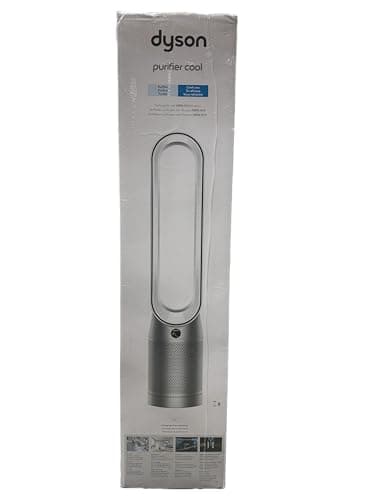
| 1 | The bladeless benchmark Dyson Purifier Cool TP07 The design is genuinely well executed, and the HEPA purification is a real second function — but the published data does not let you compare it with anything. | A household with small children, or a room that needs air purification too | |
| 2 | 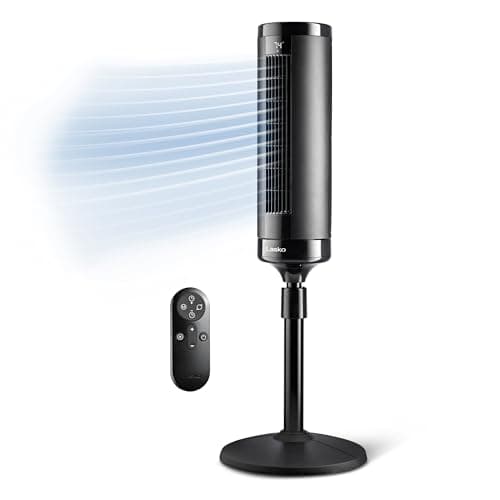 The value alternative Lasko EcoQuiet 42" DC Tower Fan 19 W against 40, 23 dBA published, twelve speeds — and a fraction of the price. | Anyone who wants the airflow without the price or the power draw | |
| 3 | 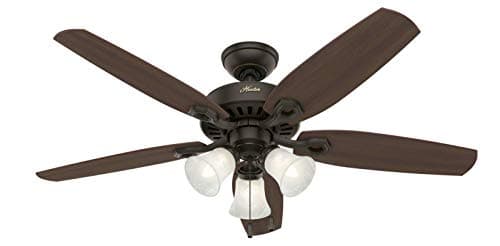 If safety is the reason Hunter Vespucci 52" Ceiling Fan Blades seven feet up are safer than any floor-standing fan, bladeless or not, and it draws 1.8 W on low. | A child's room, where the point is keeping fingers away from blades | |
| — |  The one to skip if you wanted bladeless for airflow Lasko Wind Curve 42" Tower Fan 720 CFM published and 49 W, which is more air than any bladeless fan will admit to and more power than you need. | Living rooms — but not if the bladeless design was the point |
Start with the naming, because it shapes everything people assume about the category.
How it works
Bladeless fans have blades
There is an impeller. It is in the base, out of sight, and it does all the work. Air is drawn in through vents around the pedestal, pushed up into the ring, and forced out through a thin slot around the inside edge of that ring.
The ring’s aerofoil profile then does two things. Air leaving the slot drags surrounding air along with it (entrainment), and the curved surface pulls more air through the middle of the loop. So the volume of air arriving at you is larger than the volume the impeller moved.
That amplification is real, and it is not free. Pushing air through a narrow slot at high pressure costs energy, and the multiplication factor does not recover it. Which is why the Dyson draws up to 40 W where a good DC tower fan draws 19 — the bladeless architecture is a design choice about form and safety, not an efficiency technology.
Worth it for
What the design genuinely buys you
- No exposed blades. The real one. With a toddler in the house, a fan with nothing spinning at finger height is a meaningful difference, and no amount of grille design on a conventional fan matches it.
- Trivial cleaning. A conventional fan accumulates dust on blades and grille, and cleaning it properly means dismantling. A bladeless loop wipes down in seconds. Over years, this also keeps it running as designed — dust on blades unbalances a conventional fan and makes it noisier.
- A smooth airstream. A conventional fan produces a slightly pulsing flow as each blade passes. A bladeless fan’s continuous slot does not, and some people genuinely find that more comfortable over a long period.
- The look. Not a performance argument, and a perfectly legitimate reason to buy something you live with.
Not worth it for
What it does not buy you
Efficiency. 40 W against 19 W, on the published figures. The bladeless architecture costs power rather than saving it.
Silence. Forcing air through a narrow slot generates its own high-frequency noise, which is a different character from blade noise but not obviously less noticeable. We could not verify a decibel figure for the Dyson to put a number on this — and the fact that a competitor publishes 23 dBA while the premium product publishes nothing accessible is itself informative.
Comparable airflow data. This is the one that makes a proper ranking impossible here. Dyson states airflow in gallons per second. Lasko states CFM on some models and nothing on others. ENERGY STAR certifies ceiling fans in CFM per watt. Three units, no conversions published, no common test procedure for portable fans at all.
Say the unwelcome thing
Do not buy a bladeless fan expecting it to use less electricity.
The marketing around these emphasizes engineering sophistication, and it is easy to read that as efficiency. The published numbers say otherwise: 40 W maximum input for the Dyson against 19 W for a DC tower fan, both from the manufacturers themselves.
Over a month of eight-hour nights that is $1.76 against 84¢. Small in absolute terms — fans are cheap to run — but it is the opposite of the direction people expect, and it is worth knowing before paying a large premium.
Buy one for the safety, the cleaning or the looks. Those are real.
Cost
What each option costs to run
| Fan | Max watts | 30 × 8-hr nights |
|---|---|---|
| Hunter Vespucci ceiling fan, low | 1.8 W | 7.9¢ |
| Lasko EcoQuiet DC tower, high | 19 W | 84¢ |
| Dyson Purifier Cool TP07 | 40 W | $1.76 |
| Lasko Wind Curve tower, high | 49 W | $2.16 |
Wattages from manufacturer publications and the ENERGY STAR certified ceiling fan dataset; costs are our arithmetic at 18.34¢/kWh.
All of these are cheap. The point is not that the Dyson is expensive to run — it is that it is not cheaper to run, which is the thing people assume.
Where the money goes is the purchase price, and that is where the purification function matters. If you were going to buy an air purifier anyway, the combined appliance is a different calculation from fan-versus-fan.
In full
Every pick, and what is wrong with it
Published specifications only, each linked to the page it came from. Where a manufacturer publishes nothing, the row says so — we do not fill blanks in.
1. The bladeless benchmark
Dyson Purifier Cool TP07
Dyson · model TP07
The design is genuinely well executed, and the HEPA purification is a real second function — but the published data does not let you compare it with anything.
40 W maximum input power, under 0.5 W standby, per Dyson’s own technical specification. At 18.34¢/kWh that is about $1.76 for a month of eight-hour nights at full power.
Put that next to the DC tower fan below at 19 W — 84¢ for the same hours — and the efficiency claim people make for bladeless designs does not survive contact with the numbers. The impeller in the base still has to do all the work, and the amplification effect does not come free.
The airflow figure is the frustrating part. Dyson states airflow in gallons per second, which is a volume rate, but nobody else in the industry uses that unit and Dyson does not publish an equivalent CFM. So there is no way to compare its airflow with a Lasko’s 720 CFM or a certified ceiling fan’s CFM-per-watt. We could not verify a decibel figure either — Dyson’s product page blocks automated access and the technical specification PDF would not decode.
What it genuinely offers: no exposed blades, which is a real consideration with a toddler; a housing you can wipe rather than a grille and blade assembly you have to dismantle; and HEPA plus activated carbon filtration, which is a second appliance rather than a fan feature. If you want an air purifier and a fan and have one socket, that combination has value the spec sheet does not capture.
What’s wrong with it
Dyson publishes airflow in gallons per second rather than CFM, and no dBA figure we could verify. At 40 W maximum input it draws more than twice a comparable DC tower fan, and it costs several times as much.
Running cost — TP07
| Nameplate power | 40 W | manufacturer's published figure |
|---|---|---|
| Energy, 8-hour night | 0.32 kWh | 40 ÷ 1000 × 8 |
| Cost per hour | 0.7¢ | at 18.34¢/kWh |
| Cost per 8-hour night | 5.9¢ | on the highest speed |
| Cost per 30 nights | $1.76 | 9.6 kWh |
Rate: 18.34¢/kWh, the US average residential price for June 2026 (EIA Electric Power Monthly, Table 5.3). Yours will differ — swap it in: (watts ÷ 1000) × hours × your rate.
| Maximum input power | 40 W |
|---|---|
| Standby power | Under 0.5 W |
| Air delivery (CFM) | Not published — Dyson states airflow in gallons per second, which is not comparable to a CFM figure |
| Noise (dBA) | Not published |
| Dimensions | Not published on the accessible spec sheet |
| Weight | Not published on the accessible spec sheet |
| Filter | HEPA and activated carbon (purifier function) |
Every figure above is from Dyson Purifier Cool TP07 technical specification (dyson.com). Blanks are shown as “not published” rather than filled in.
2. The value alternative
Lasko EcoQuiet 42" DC Tower Fan
Lasko · model T42710
19 W against 40, 23 dBA published, twelve speeds — and a fraction of the price.
2.9 to 19 W against the Dyson’s 40, and 23 dBA on low published where Dyson publishes no figure we could verify. 84¢ against $1.76 over a month of nights.
Twelve speeds on a DC motor, an 8-hour timer, 7.8 lb, and a 2-year warranty. On every specification that is published by both, this wins.
The tall slim column produces a similar spread of air to a bladeless tower from a similar footprint. What it does not give you is the open-loop aesthetic or the enclosed impeller.
What’s wrong with it
It has conventional blades behind a grille, so it is not the choice in a household with small fingers, and cleaning means getting into the grille rather than wiping a surface.
Running cost — T42710
| Nameplate power | 2.9 W – 19 W | manufacturer's published figure |
|---|---|---|
| Energy, 8-hour night | 0.15 kWh | 19 ÷ 1000 × 8 |
| Cost per hour | 0.3¢ | at 18.34¢/kWh |
| Cost per 8-hour night | 2.8¢ | on the highest speed |
| Cost per 30 nights | 84¢ | 4.6 kWh |
| Same month, lowest speed | 13¢ | at 2.9 W |
Rate: 18.34¢/kWh, the US average residential price for June 2026 (EIA Electric Power Monthly, Table 5.3). Yours will differ — swap it in: (watts ÷ 1000) × hours × your rate.
| Power | 2.9 W - 19 W (0.06-0.303 A at 120 V) |
|---|---|
| Noise | 23 dBA low, 46 dBA high |
| Speeds | 12 |
| Height | 41.6 in |
| Footprint | 12.8 x 12.8 in |
| Weight | 7.8 lb |
| Timer | 8 hours |
| Air delivery (CFM) | Not published |
| Warranty | 2 years |
Every figure above is from Lasko product page, T42710. Blanks are shown as “not published” rather than filled in.
3. If safety is the reason
Hunter Vespucci 52" Ceiling Fan
Hunter · model Vespucci
Blades seven feet up are safer than any floor-standing fan, bladeless or not, and it draws 1.8 W on low.
If the reason you are looking at bladeless fans is a small child, this is worth considering before you spend several hundred dollars.
A ceiling fan’s blades are mounted at least seven feet from the floor. That is not “safer than a bladed floor fan” — it is out of reach entirely, including for a child who has learned to climb, which a floor-standing bladeless fan is not.
1.8 W on low at a certified 366.7 CFM per watt, about 7.9¢ for a month of nights — roughly a twentieth of the Dyson’s running cost, with certified airflow data behind it. The full ranking is here.
What’s wrong with it
Permanent installation with wiring, so it is not an option in most rentals, and it needs adequate ceiling height for safe clearance.
Running cost — Vespucci
| Nameplate power | 1.8 W – 13.9 W | manufacturer's published figure |
|---|---|---|
| Energy, 8-hour night | 0.11 kWh | 13.9 ÷ 1000 × 8 |
| Cost per hour | 0.3¢ | at 18.34¢/kWh |
| Cost per 8-hour night | 2.0¢ | on the highest speed |
| Cost per 30 nights | 61¢ | 3.3 kWh |
| Same month, lowest speed | 7.9¢ | at 1.8 W |
Rate: 18.34¢/kWh, the US average residential price for June 2026 (EIA Electric Power Monthly, Table 5.3). Yours will differ — swap it in: (watts ÷ 1000) × hours × your rate.
| Blade span | 52 in |
|---|---|
| Efficiency | 366.7 CFM per watt |
| Power, high speed | 13.9 W |
| Power, low speed | 1.8 W |
| Standby power | 0.8 W |
| Type | Indoor, fan only (no light kit) |
| Warranty | 3 years, components |
| ENERGY STAR | Certified |
Every figure above is from ENERGY STAR Certified Ceiling Fans dataset. Blanks are shown as “not published” rather than filled in.
Skip this one
Lasko Wind Curve 42" Tower Fan
Lasko · model 2554
720 CFM published and 49 W, which is more air than any bladeless fan will admit to and more power than you need.
We include this to close the loop on a common reasoning path: “bladeless fans look efficient, but I actually just want plenty of air, so I will get a big conventional tower.”
720 CFM published — genuinely useful, and the only airflow number in this roundup that is comparable with anything. But 37–49 W, which is $2.16 a month of nights against 84¢ for the DC tower, and Lasko publishes no noise figure for it.
If you want maximum air, this delivers. If you want the best combination of airflow, quiet and running cost, the DC tower above is the better buy, and neither of these is bladeless. The tower fan comparison is here.
What’s wrong with it
37-49 W with no published noise figure. If you came here for the safety or the looks of a bladeless design, this offers neither, and if you came for efficiency the DC tower beats it.
Running cost — 2554
| Nameplate power | 37 W – 49 W | manufacturer's published figure |
|---|---|---|
| Energy, 8-hour night | 0.39 kWh | 49 ÷ 1000 × 8 |
| Cost per hour | 0.9¢ | at 18.34¢/kWh |
| Cost per 8-hour night | 7.2¢ | on the highest speed |
| Cost per 30 nights | $2.16 | 11.8 kWh |
| Same month, lowest speed | $1.63 | at 37 W |
Rate: 18.34¢/kWh, the US average residential price for June 2026 (EIA Electric Power Monthly, Table 5.3). Yours will differ — swap it in: (watts ÷ 1000) × hours × your rate.
| Power | 37 W - 49 W (0.4 A at 120 V) |
|---|---|
| Air delivery | 720 CFM |
| Speeds | 3 |
| Height | 42.5 in |
| Footprint | 13 x 13 in |
| Weight | 10.62 lb |
| Timer | 7.5-hour auto-off |
| Noise | Not published |
| Warranty | 1 year |
Every figure above is from Lasko product page, 2554. Blanks are shown as “not published” rather than filled in.
We are not linking a buy button for this one. If you want to look at it anyway, it is easy enough to find — but we would rather send you to something that fits your room.
Questions people actually ask
Frequently asked
Do bladeless fans actually have blades?
Yes, hidden in the base. An impeller draws air in through vents in the pedestal and pushes it up into the ring, where it exits through a thin slot and drags surrounding air along with it. The blades are enclosed rather than absent, which is exactly what makes the design safer.
Are bladeless fans more energy efficient?
No. Dyson publishes a 40 W maximum input for the TP07; a Lasko DC tower fan draws up to 19 W. Forcing air through a narrow slot at pressure costs energy, and the amplification effect does not recover it. Over a month of nights that is $1.76 against 84¢.
Are bladeless fans quieter?
Not demonstrably. Air forced through a narrow slot generates its own high-frequency noise, a different character from blade noise rather than obviously less of it. We could not verify a published decibel figure for the Dyson, while a competing DC tower fan publishes 23 dBA.
How much air does a bladeless fan move?
Hard to say, because Dyson publishes airflow in gallons per second rather than CFM and provides no conversion. There is also no common test procedure for portable fans, so even where CFM figures exist they are not comparable between brands.
Are bladeless fans worth it for safety with children?
It is the strongest argument for them — an enclosed impeller is genuinely safer than any grille. But a ceiling fan puts blades seven feet up, out of reach even for a child who climbs, and draws 1.8 W on low. If safety is the whole reason, consider that first. Ceiling fans ranked.
Is a bladeless fan worth the price?
For the safety, the wipe-clean housing, the smooth airstream and the looks, potentially. For airflow, efficiency or quiet, no — a DC tower fan beats it on published wattage and publishes a noise figure it can be held to. If the model includes HEPA purification you would otherwise buy separately, that changes the calculation.
Sources
Where these numbers came from
Read next
Where to go from here
Back to Fans, or read how we pick.