The picks
The best swamp coolers for a garage
This is the application evaporative cooling was built for: a big leaky space with the door open, where refrigeration would be throwing money outside.
By Sawyer V. · Published
The short answer
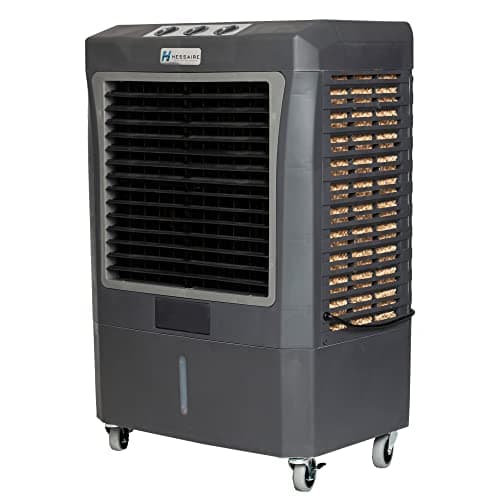
The Hessaire MC37M: 3,100 CFM on 250 W, the best airflow-per-watt figure we found, with a 10.3 gallon tank that will run a working day. About $11 for thirty eight-hour days. Works only where afternoon humidity is below roughly 40%.
Fan & Frost earns a commission when you buy through our links, at no cost to you. It never changes a ranking, and we say so when the right answer is the cheaper unit or nothing at all. Full disclosure · How we pick.
At a glance
The picks, ranked
Tap any row to jump to the full reasoning. Prices are live from Amazon where we have them, and read “check price” where we don’t — never a number we cannot verify today.
| # | Product | Best for | Price |
|---|---|---|---|
| 1 | Best for a two-car garage Hessaire MC37M Mobile Evaporative Cooler The most airflow per watt here and a tank big enough to last a working day without refilling. | 400-600 sq ft with the door open, in dry air | |
| 2 | Best documented, and best pads Honeywell CO60PM Indoor/Outdoor Evaporative Cooler Effectively tied on efficiency, with triple-sided pads, a bigger tank and every specification published. | A garage or workshop where you want the full spec sheet | |
| 3 | 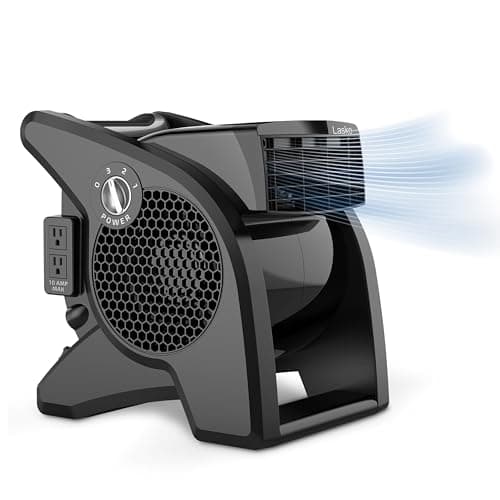 If your air is too humid for any of this Lasko Max Performance 15" Air Mover It cannot cool the air, but 178 W of high-velocity airflow is the honest answer where evaporation is not available. | A humid-climate garage, where evaporative cooling cannot work | |
| — | The one to skip for a garage Honeywell CL25AE Indoor Evaporative Cooler 764 CFM in a 500 sq ft garage is a quarter of the airflow you need, at nearly the same power draw. | A single room, not a garage |
Almost every application of evaporative cooling comes with an awkward caveat about needing a window open. A garage does not have that problem, because the door is already open. This is the one place in the house where the technology’s main constraint simply is not a constraint.
Why here
Why a garage is the ideal application
- The ventilation requirement is already satisfied. An evaporative cooler adds moisture continuously and needs airflow through the space or the humidity climbs and the cooling stops. An open garage door is exactly that.
- Refrigeration would be futile here anyway. A garage is typically uninsulated, often has an uninsulated roof, and has a large door that opens. Trying to hold a temperature in that with a compressor means paying to cool the outdoors. Evaporative cooling does not attempt to hold a temperature — it delivers a continuous stream of cooled air, which is the right approach for a leaky space.
- The noise does not matter. 61–65 dBA is a problem in a bedroom and irrelevant next to a compressor or a saw.
- Water and drainage are easy. A concrete floor, a tap, and usually a drain. Filling a 10 gallon tank is a non-event in a garage and a chore in a living room.
- Humidity in the space matters less. Raising the humidity of a garage has few consequences. Doing the same in a bedroom affects sleep and, over time, the building.
Sizing
How much airflow a garage needs
Sizing an evaporative cooler is not a BTU calculation. There is no ENERGY STAR table for these, because they do not hold a temperature. The useful measure is air changes: how many times per hour the unit replaces the volume of the space.
Work it out in three steps:
- Volume. Floor area in square feet × ceiling height in feet. A two-car garage at 20 × 20 with a 9 ft ceiling is 3,600 cubic feet.
- Target air changes. For a garage with the door open, aim for roughly 30 to 40 air changes per hour — you want the air genuinely moving through, not circulating.
- Required CFM. Volume × air changes ÷ 60. For our 3,600 cubic foot garage at 35 changes: 3,600 × 35 ÷ 60 = 2,100 CFM.
| Garage | Approx. volume | CFM needed |
|---|---|---|
| Single car, 12 × 20, 9 ft | 2,160 cu ft | 1,260 |
| Single car deep, 14 × 24, 9 ft | 3,024 cu ft | 1,764 |
| Two car, 20 × 20, 9 ft | 3,600 cu ft | 2,100 |
| Two car large, 24 × 24, 10 ft | 5,760 cu ft | 3,360 |
Our arithmetic at 35 air changes per hour. This is a rule of thumb for a ventilated space, not a manufacturer specification.
So the Hessaire’s 3,100 CFM comfortably covers a standard two-car garage and is marginal for a large one; the Honeywell’s 2,697 CFM covers a two-car garage adequately. The 764 CFM indoor unit does not reach even a single-car garage, which is why it is the skip pick above.
Note that this arithmetic makes no reference to square-footage coverage claims. That is deliberate: every coverage claim in this category turns out to be CFM divided by 1.64, so it tells you nothing the airflow figure did not.
Say the unwelcome thing
Check your afternoon humidity before you buy any of this.
Everything on this page assumes dry air. Below about 40% relative humidity on a hot afternoon these work well. Above about 60% an evaporative cooler is a fan that adds moisture, and buying a bigger one does not help — the limit is the air’s capacity to absorb water, not the machine’s ability to supply it.
The two-minute check on your own climate is here. If you fail it, the third pick above — a high-velocity air mover — is the honest alternative, and the garage page covers the rest of the options.
Setting it up
Getting the most out of it
- Put it near the open door, blowing inward. It should draw the driest available air — outside air — through the pads. A cooler in the back corner recirculates air it has already humidified, which is exactly the failure mode to avoid.
- Give the air somewhere to leave. If the garage has a side door or a window, open it. Cross-flow is what makes this work: in one side, out the other.
- Plumb it if you can. A continuous water connection turns a daily chore into a non-issue, and both top picks support one.
- Rinse the pads and drain it in fall. In hard-water areas mineral scale builds up over a season and restricts airflow. Pads are consumables; budget for them.
- Do not leave it running in a closed garage. Pumping moisture into a sealed space with tools and metal in it is how you get rust.
In full
Every pick, and what is wrong with it
Published specifications only, each linked to the page it came from. Where a manufacturer publishes nothing, the row says so — we do not fill blanks in.
1. Best for a two-car garage
Hessaire MC37M Mobile Evaporative Cooler
Hessaire · model MC37M
The most airflow per watt here and a tank big enough to last a working day without refilling.
3,100 CFM on 250 W is 12.4 CFM per watt. In a garage, airflow is the specification that matters most: you are not trying to hold a temperature in a sealed box, you are trying to push a continuous stream of cooled air through a large leaky space and out the open door.
The 10.3 gallon tank is what makes it practical rather than annoying. A smaller tank on a hot day means stopping work to refill, and the whole point of a garage cooler is that you are doing something else. It also takes a continuous water connection if you have a tap nearby.
37¢ for an eight-hour day at 18.34¢/kWh, $11 for thirty of them. Cooling the same space with refrigeration is not merely more expensive — in an uninsulated garage with a door that opens, it is close to pointless.
What’s wrong with it
Hessaire publishes no noise figure and no speed count, which in a garage matters little but is a gap. At 40 lb plus 10.3 gallons of water, a full unit is heavy to reposition despite the casters.
Running cost — MC37M
| Nameplate power | 250 W | manufacturer's published figure |
|---|---|---|
| Energy, 8-hour night | 2.00 kWh | 250 ÷ 1000 × 8 |
| Cost per hour | 4.6¢ | at 18.34¢/kWh |
| Cost per 8-hour night | 37¢ | on the highest speed |
| Cost per 30 nights | $11 | 60.0 kWh |
Rate: 18.34¢/kWh, the US average residential price for June 2026 (EIA Electric Power Monthly, Table 5.3). Yours will differ — swap it in: (watts ÷ 1000) × hours × your rate.
| Air delivery | 3,100 CFM |
|---|---|
| Power | 250 W / 2.4 A |
| Water tank | 10.3 gallons, continuous hookup capable |
| Dimensions | 24 L x 16 W x 38 H in |
| Weight | 40 lb |
| Pads | Industrial-grade cooling pads |
| Coverage claim | Not published on the product page |
Every figure above is from Hessaire product page, MC37M. Blanks are shown as “not published” rather than filled in.
2. Best documented, and best pads
Honeywell CO60PM Indoor/Outdoor Evaporative Cooler
Honeywell · model CO60PM
Effectively tied on efficiency, with triple-sided pads, a bigger tank and every specification published.
2,697 CFM on 220 W is 12.3 CFM per watt, within a rounding error of the Hessaire. Two things separate it.
Triple-sided honeycomb pads. Three wet surfaces rather than one means more evaporative area for the same airflow, and evaporative area is where the cooling happens. In a garage where you want maximum effect from a fixed footprint, this is a real advantage.
A 15.9 gallon tank, the largest here, plus a continuous water hookup and a water level indicator. It will run longer unattended than anything else on this page.
Honeywell also publishes what Hessaire does not: 61–65 dBA, 30 ft throw, 3 speeds with oscillation, 39.2 lb. The noise figure is the one to weigh — that is conversational volume, which is unremarkable in a workshop and intrusive if you take calls in there.
What’s wrong with it
61-65 dBA is genuinely loud — fine over power tools, less fine if the garage doubles as a home office. It also claims 1,643 sq ft coverage, which is a derived number rather than a measured one.
Running cost — CO60PM
| Nameplate power | 220 W | manufacturer's published figure |
|---|---|---|
| Energy, 8-hour night | 1.76 kWh | 220 ÷ 1000 × 8 |
| Cost per hour | 4.0¢ | at 18.34¢/kWh |
| Cost per 8-hour night | 32¢ | on the highest speed |
| Cost per 30 nights | $9.68 | 52.8 kWh |
Rate: 18.34¢/kWh, the US average residential price for June 2026 (EIA Electric Power Monthly, Table 5.3). Yours will differ — swap it in: (watts ÷ 1000) × hours × your rate.
| Air delivery | 2,697 CFM |
|---|---|
| Power | 220 W |
| Water tank | 15.9 gallons, continuous hookup |
| Air throw | 30 ft |
| Noise | 61-65 dBA |
| Speeds | 3, with oscillation |
| Pads | Triple-sided honeycomb |
| Dimensions | 27.6 W x 18.3 D x 40 H in |
| Weight | 39.2 lb |
| Manufacturer coverage claim | 1,643 sq ft |
| Warranty | 1 year |
Every figure above is from Honeywell Air Comfort product page, CO60PM. Blanks are shown as “not published” rather than filled in.
3. If your air is too humid for any of this
Lasko Max Performance 15" Air Mover
Lasko · model U15720
It cannot cool the air, but 178 W of high-velocity airflow is the honest answer where evaporation is not available.
If you are in Houston or Atlanta, the top two picks will not work, and no larger evaporative cooler will fix that — the limit is the air, not the machine. This is what is left.
A pivoting air mover at 160–178 W does one thing well: it drives a hard, directed stream of air at a person working. That speeds sweat evaporation, which is the same physics as the swamp cooler except your body supplies the water. In a humid garage it is the most effective thing available.
Two useful details for a workshop: two 120 V accessory outlets on the unit, and a 9.5 ft cord, which in a garage with one badly placed socket matters more than it should. Lasko publishes no CFM, which is a real gap for a machine sold on airflow.
$7.83 for thirty eight-hour days.
What’s wrong with it
178 W for air movement alone, and it does not lower the temperature at all. It is also the loudest thing here by construction — an air mover is not designed to be pleasant.
Running cost — U15720
| Nameplate power | 160 W – 178 W | manufacturer's published figure |
|---|---|---|
| Energy, 8-hour night | 1.42 kWh | 178 ÷ 1000 × 8 |
| Cost per hour | 3.3¢ | at 18.34¢/kWh |
| Cost per 8-hour night | 26¢ | on the highest speed |
| Cost per 30 nights | $7.83 | 42.7 kWh |
| Same month, lowest speed | $7.04 | at 160 W |
Rate: 18.34¢/kWh, the US average residential price for June 2026 (EIA Electric Power Monthly, Table 5.3). Yours will differ — swap it in: (watts ÷ 1000) × hours × your rate.
| Power | 160 W - 178 W (1.35-1.53 A at 120 V) |
|---|---|
| Speeds | 3 |
| Dimensions | 14.5 H x 14.0 D x 11.5 W in |
| Weight | 12.55 lb |
| Extras | Two 120 V accessory outlets, 9.5 ft cord, pivoting head |
| Air delivery (CFM) | Not published |
| Warranty | 1 year |
Every figure above is from Lasko product page, U15720. Blanks are shown as “not published” rather than filled in.
Skip this one
Honeywell CL25AE Indoor Evaporative Cooler
Honeywell · model CL25AE
764 CFM in a 500 sq ft garage is a quarter of the airflow you need, at nearly the same power draw.
This is a decent indoor unit in the wrong place, and it is an easy mistake because it is cheaper and lighter.
764 CFM on 235 W is 3.3 CFM per watt. The Hessaire manages 12.4 and the Honeywell CO60PM 12.3. This unit uses more power than the CO60PM while moving 28% of the air. You would pay $10 a month against $9.68 and get a quarter of the effect.
In a garage, that is decisive. You are trying to move a large volume of air through a large leaky space, and 764 CFM will not reach the far end of a two-car garage in any useful quantity.
It is a reasonable choice for a single dry room with a window open, where its 52–60 dBA and 7.5-hour timer earn their keep. Not here.
What’s wrong with it
3.3 CFM per watt against the Hessaire's 12.4 — it draws MORE watts than the large outdoor units while moving a quarter of the air. In a garage that is the worst combination available.
Running cost — CL25AE
| Nameplate power | 235 W | manufacturer's published figure |
|---|---|---|
| Energy, 8-hour night | 1.88 kWh | 235 ÷ 1000 × 8 |
| Cost per hour | 4.3¢ | at 18.34¢/kWh |
| Cost per 8-hour night | 34¢ | on the highest speed |
| Cost per 30 nights | $10 | 56.4 kWh |
Rate: 18.34¢/kWh, the US average residential price for June 2026 (EIA Electric Power Monthly, Table 5.3). Yours will differ — swap it in: (watts ÷ 1000) × hours × your rate.
| Air delivery | 764 CFM |
|---|---|
| Power | 235 W |
| Water tank | 6.6 gallons |
| Air throw | 33 ft |
| Noise | 52-60 dBA |
| Speeds | 3, oscillating louvers |
| Timer | Up to 7.5 hours |
| Dimensions | 18.9 x 14.6 x 33.3 in |
| Weight | 25.4 lb |
| Manufacturer coverage claim | 466 sq ft |
| Warranty | 1 year |
Every figure above is from Honeywell Air Comfort product page, CL25AE. Blanks are shown as “not published” rather than filled in.
We are not linking a buy button for this one. If you want to look at it anyway, it is easy enough to find — but we would rather send you to something that fits your room.
Questions people actually ask
Frequently asked
What is the best swamp cooler for a garage?
The Hessaire MC37M on published figures: 3,100 CFM on 250 W, the best airflow-per-watt ratio we found, with a 10.3 gallon tank that runs a working day. The Honeywell CO60PM is effectively tied on efficiency and has a larger tank and triple-sided pads.
What size evaporative cooler do I need for a two-car garage?
Roughly 2,100 CFM for a 20 by 20 garage with a 9 ft ceiling. Multiply floor area by ceiling height for volume, multiply by about 35 air changes per hour, and divide by 60. Ignore the square-footage claims on the box — they are airflow divided by a constant.
Do swamp coolers work in a garage?
Very well, in a dry climate, because a garage with the door open already provides the ventilation these units require. Refrigeration in an uninsulated garage with an opening door is largely wasted, whereas evaporative cooling delivers a continuous stream of cooled air, which suits a leaky space.
Can I use a swamp cooler in a closed garage?
No. The unit adds moisture continuously, so in a sealed garage the humidity climbs until evaporation slows and the cooling stops — and you are pumping moisture into a space full of tools and metal, which invites rust. It needs the door or a window open.
How much does it cost to run a swamp cooler in a garage?
At 18.34¢/kWh, a 250 W unit costs about 37¢ for an eight-hour day and $11 for thirty of them. A 1,300 W portable air conditioner would cost roughly $57 over the same period, and would struggle to hold any temperature in a garage anyway.
What if my climate is too humid for a swamp cooler?
Use a high-velocity air mover instead. It cannot lower the air temperature, but a directed stream of air speeds sweat evaporation from the person working, which is the most effective thing available in humid conditions. Insulating the garage door is the other high-value move. Cooling a garage, all options.
Sources
Where these numbers came from
Read next
Where to go from here
Back to Evaporative Coolers, or read how we pick.