Guide and picks
ENERGY STAR vs Most Efficient, explained
Two labels, one of them widely misunderstood — and a shortlist that is either genuinely selective or almost meaningless depending on what you are shopping for.
By Sawyer V. · Published
The short answer
ENERGY STAR certification is a minimum standard a product must exceed. Most Efficient is a narrower annual recognition for the top performers within that. How narrow varies enormously: we counted 88.7% of certified mini-splits qualifying, against 0% of range hoods. So the label is a useful filter in some categories and close to meaningless in others — it depends entirely on what you are shopping for.
Fan & Frost earns a commission when you buy through our links, at no cost to you. It never changes a ranking, and we say so when the right answer is the cheaper unit or nothing at all. Full disclosure · How we pick.

At a glance
The picks, ranked
Tap any row to jump to the full reasoning. Prices are live from Amazon where we have them, and read “check price” where we don’t — never a number we cannot verify today.
| # | Product | Best for | Price |
|---|---|---|---|
| 1 | 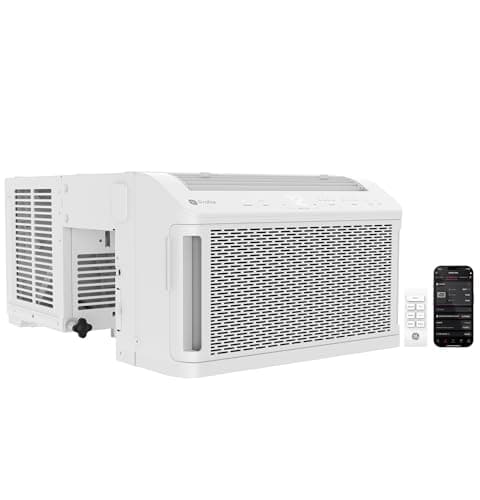 Certified and Most Efficient GE Profile ClearView Window Air Conditioner, 8,000 BTU CEER 16, 375 kWh a year, 47% below the federal standard — certified, and on the Most Efficient list. | Seeing what both labels look like on one product | |
| 2 | Why the label cannot replace sizing Midea Window Air Conditioner, 6,000 BTU CEER 16 and 281.3 kWh a year, the lowest annual consumption in the certified dataset, and Most Efficient listed. | A small room — where the efficient choice is also the small one | |
| 3 | 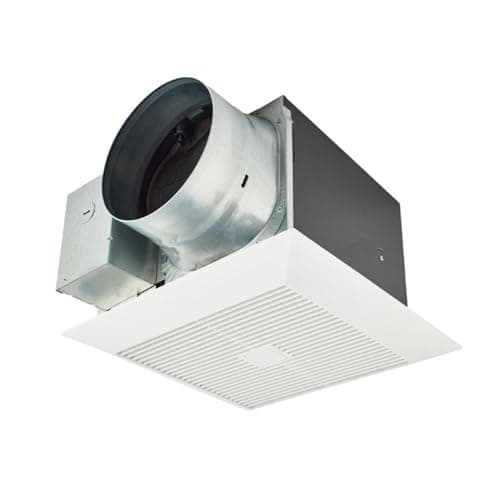 Where the label is genuinely selective Panasonic WhisperGreen Select FV-0511VK3 Ventilation Fan 16.7 CFM per watt at 0.1 sones, and one of only 80 bathroom fans out of 912 to carry Most Efficient. | A bathroom fan — the category where Most Efficient means most | |
| — | Where the label does not exist at all Best HBN536212SS Range Hood 16.6 CFM per watt — three times the range hood category median — and not Most Efficient, because none of them are. | Understanding that a missing badge is not a verdict |
Two blue labels appear on cooling products and they are not the same thing. One is a floor. The other is a shortlist — but how short varies so much between categories that the label means something different depending on what you are shopping for.
The two labels
Certification and recognition
ENERGY STAR certified means the product exceeds a defined federal minimum efficiency standard by a defined margin, tested to a specified procedure and verified by a third party. It is a threshold: pass it and you carry the mark.
This is why certified listings state things like “47% less energy than the federal standard” — the standard is the reference point the whole program is built on.
ENERGY STAR Most Efficient is a separate annual recognition for products at the top of the certified field, against criteria set for that year and that category. It is a subset of certification, not an alternative to it.
The reasonable assumption is that Most Efficient identifies a comparably-selective top slice everywhere. We checked, and it does not.
Our count
How selective it actually is
We pulled the complete certified datasets for five categories and counted what share of each carries the Most Efficient flag.
| Category | Most Efficient | Of | Share |
|---|---|---|---|
| Mini-split heat pumps | 10,190 | 11,494 | 88.7% |
| Room air conditioners | 171 | 485 | 35.3% |
| In-line ventilating fans | 16 | 74 | 21.6% |
| Ceiling fans | 205 | 1,398 | 14.7% |
| Bathroom / utility fans | 80 | 912 | 8.8% |
| Range hoods | 0 | 91 | 0.0% |
Counted by us across the ENERGY STAR certified datasets for room air conditioners, mini-split heat pumps, ceiling fans and ventilating fans, US-market records.
From 0% to 88.7%. Those are not variations on a theme; they are different tools.
Mini-splits at 88.7%. Nearly nine in ten certified units qualify, so the badge excludes almost nobody. Using it to shortlist a mini-split removes about one unit in nine. It is close to useless as a filter there, and you should be reading SEER2, HSPF2 and COP at 5°F instead.
Bathroom fans at 8.8%. This is the label working as intended — nine hundred products down to eighty, which is a real shortlist you could shop from.
Range hoods at 0%. The criteria sit beyond where the field reaches, so the badge is unobtainable. Its absence on a range hood carries no information at all.
This one is not a DIY job
What neither label tells you. Both are efficiency measures and nothing else, and the gaps matter more than people expect.
Noise. Not one certified room air conditioner publishes a noise rating — the program does not measure it. Ventilating fans do publish sones, which is why that category can be shopped on quiet.
Capacity suitability. A Most Efficient badge on a unit twice the size your room needs still gives you a machine that short-cycles and leaves the room clammy.
Build quality, durability and warranty. None of it is in scope.
Whole categories. There is no ENERGY STAR program for portable air conditioners or portable fans at all, so nothing about those is certified or verified.
How to use it
A filter, in the categories where it filters
Use Most Efficient as a first filter in bathroom fans, ceiling fans and in-line fans — 8.8%, 14.7% and 21.6% respectively. In those categories it genuinely narrows a large field to a shortlist worth reading properly.
Use it as a mild preference in room air conditioners at 35.3%. It removes about two thirds of the field, which is helpful but not decisive — capacity and format matter more.
Ignore it for mini-splits. At 88.7% it barely discriminates. Read the underlying figures instead, particularly for heating, where the cooling rating correlates with cold-weather performance at just 0.11.
Ignore its absence for range hoods. Nobody has it. Read CFM per watt and sones directly.
And in every category: size the product to the job before applying any efficiency filter. Sizing first, always.
Where the data lives
You can check all of this
Every figure on this page comes from a public dataset that anyone can query without an account. The Most Efficient flag is a field in each one, so the counts above are reproducible in a few lines of code.
That is worth knowing generally. Retail listings paraphrase these labels, sometimes loosely, and going to the dataset settles it — along with the CEER, the annual kWh, the sones and the dimensions. What each field means.
Say the unwelcome thing
Do not shop on the label instead of the numbers.
A badge compresses a lot of information into one bit, and how much it compresses depends on a category boundary you cannot see from the product page.
If you filter mini-splits on Most Efficient you have excluded roughly one unit in nine and learned almost nothing. If you dismiss a range hood for lacking it, you have applied a criterion no product in that category meets.
The underlying numbers are published for every certified product and they are the same few fields every time: CEER or CFM per watt for efficiency, annual kWh or wattage for running cost, sones where the program measures it, and capacity matched to your room.
Use the label to shorten the list where it shortens the list. Then read the figures.
In full
Every pick, and what is wrong with it
Published specifications only, each linked to the page it came from. Where a manufacturer publishes nothing, the row says so — we do not fill blanks in.
1. Certified and Most Efficient
GE Profile ClearView Window Air Conditioner, 8,000 BTU
GE Profile · model PWJV08W
CEER 16, 375 kWh a year, 47% below the federal standard — certified, and on the Most Efficient list.
375 kWh a year, about $69 for a cooling season, at CEER 16 and 47% less energy than the federal standard.
That last figure is what the base certification is measured against. ENERGY STAR is not a badge for being efficient in the abstract — it means exceeding a defined federal minimum by a defined margin.
Most Efficient is the second layer, and in this category it is moderately selective: 171 of 485 units carry it, about 35%.
Worth knowing what neither label covers: there is no noise rating anywhere in this dataset.
What’s wrong with it
In room air conditioners, 171 of 485 units carry Most Efficient, so it narrows the field by about two thirds rather than to a handful.
Running cost — PWJV08W
| Annual energy use | 375 kWh | ENERGY STAR certified figure |
|---|---|---|
| Annual cost | $69 | 375 × 18.34¢/kWh |
| Per cooling month | $17 | spread over a four-month season |
The annual figure is the certified value from the ENERGY STAR Certified Room Air Conditioners dataset, which models a standard cooling season rather than your actual summer. It is more useful than a nameplate wattage here, because a variable-speed compressor spends most of its life well below nameplate.
Rate: 18.34¢/kWh, the US average residential price for June 2026 (EIA Electric Power Monthly, Table 5.3). Yours will differ — swap it in: (watts ÷ 1000) × hours × your rate.
| Cooling capacity | 8,000 BTU/h |
|---|---|
| CEER | 16 |
| Annual energy use | 375 kWh/yr |
| vs federal standard | 47% less energy |
| Dimensions | 12.6 H x 18.6 W x 15.3 D in |
| Weight | 46.2 lb |
| Refrigerant | R-32 |
| Installation | Does not straddle the windowsill |
| Compressor | Variable speed |
| ENERGY STAR | Certified, and on the Most Efficient list |
Every figure above is from ENERGY STAR Certified Room Air Conditioners dataset. Blanks are shown as “not published” rather than filled in.
2. Why the label cannot replace sizing
Midea Window Air Conditioner, 6,000 BTU
Midea · model MAW06S1KWT-A
CEER 16 and 281.3 kWh a year, the lowest annual consumption in the certified dataset, and Most Efficient listed.
281.3 kWh a year — about $52 for a whole season, the lowest annual figure of any certified room air conditioner.
That number illustrates the label’s central limitation. It is lowest because the machine is smallest, not because it is uniquely well engineered — the certified 18,000 BTU units use around 844 kWh, and some of those are Most Efficient too.
So a Most Efficient badge tells you a unit is good within its class. It says nothing about whether that class suits your room.
CEER 16, 45% below the federal standard, 31.6 lb. Size first, then filter.
What’s wrong with it
6,000 BTU covers a small room only. A Most Efficient badge on the wrong capacity still gives you the wrong machine.
Running cost — MAW06S1KWT-A
| Annual energy use | 281.3 kWh | ENERGY STAR certified figure |
|---|---|---|
| Annual cost | $52 | 281.3 × 18.34¢/kWh |
| Per cooling month | $13 | spread over a four-month season |
The annual figure is the certified value from the ENERGY STAR Certified Room Air Conditioners dataset, which models a standard cooling season rather than your actual summer. It is more useful than a nameplate wattage here, because a variable-speed compressor spends most of its life well below nameplate.
Rate: 18.34¢/kWh, the US average residential price for June 2026 (EIA Electric Power Monthly, Table 5.3). Yours will differ — swap it in: (watts ÷ 1000) × hours × your rate.
| Cooling capacity | 6,000 BTU/h |
|---|---|
| CEER | 16 |
| Annual energy use | 281.3 kWh/yr |
| vs federal standard | 45% less energy |
| Dimensions | 12.1 H x 16.0 W x 13.3 D in |
| Weight | 31.6 lb |
| Installation | Does not straddle the windowsill |
| Support bracket | Not required |
| Compressor | Variable speed |
| Refrigerant | R-32 |
| ENERGY STAR | Certified, and on the Most Efficient list |
Every figure above is from ENERGY STAR Certified Room Air Conditioners dataset. Blanks are shown as “not published” rather than filled in.
3. Where the label is genuinely selective
Panasonic WhisperGreen Select FV-0511VK3 Ventilation Fan
Panasonic · model FV-0511VK3
16.7 CFM per watt at 0.1 sones, and one of only 80 bathroom fans out of 912 to carry Most Efficient.
Bathroom and utility fans are where the Most Efficient designation does the most work: 80 of 912 certified fans, about 8.8%.
That is a genuine shortlist. Filtering a category of nine hundred products down to eighty is exactly the job people assume the label is doing everywhere — and it is not.
16.7 CFM per watt at 110 CFM, against a category median of 4.7. And 0.1 sones, the floor of the measurement scale.
Its middle speed is more efficient than its top: 18.4 CFM per watt at 80 CFM. Which is true of most fans in the category.
What’s wrong with it
The certified dataset publishes no wattage for it, so you cannot compute a running cost from the listing directly.
Running cost
Panasonic does not publish a wattage for the FV-0511VK3, so we cannot calculate what it costs to run. We are not going to estimate one. If Panasonic publishes a nameplate figure, this block will show the arithmetic.
| Noise | 0.1 sones |
|---|---|
| Air delivery, high | 110 CFM at 0.25 in w.g. |
| Air delivery, medium | 80 CFM |
| Air delivery, low | 50 CFM |
| Efficacy, high | 16.7 CFM per watt |
| Efficacy, medium | 18.4 CFM per watt |
| Efficacy, low | 14.7 CFM per watt |
| Duct size | 6 in diameter |
| Speeds | 3 or more |
| Lighting | None |
| Power | Not published in the certified dataset |
| ENERGY STAR | Certified, and on the Most Efficient list |
Every figure above is from ENERGY STAR Certified Ventilating Fans dataset. Blanks are shown as “not published” rather than filled in.
Skip this one
Best HBN536212SS Range Hood
Best · model HBN536212SS
16.6 CFM per watt — three times the range hood category median — and not Most Efficient, because none of them are.
The clearest illustration on this page. Zero of 91 certified range hoods carry Most Efficient. Not a small number — none.
This hood manages 16.6 CFM per watt, roughly three times the category median, and it is still not on the list. The criteria for that category are simply set beyond where the field currently reaches.
Which is the practical lesson: the absence of a Most Efficient badge tells you nothing on its own. In some categories it is a meaningful signal; in this one it is unobtainable.
Separately, we would not trust its 0.0 sone filing — eight range hoods carry that value and none of them are silent.
What’s wrong with it
It is also filed at 0.0 sones, which is not a physically meaningful value for a fan moving 200 CFM.
Running cost
Best does not publish a wattage for the HBN536212SS, so we cannot calculate what it costs to run. We are not going to estimate one. If Best publishes a nameplate figure, this block will show the arithmetic.
| Air delivery | 200 CFM at 0.25 in w.g. |
|---|---|
| Efficacy | 16.6 CFM per watt |
| Duct size | 10 in diameter |
| Unit type | Range hood |
| Noise | 0.0 sones as filed in the certified dataset |
| ENERGY STAR | Certified |
Every figure above is from ENERGY STAR Certified Ventilating Fans dataset. Blanks are shown as “not published” rather than filled in.
We are not linking a buy button for this one. If you want to look at it anyway, it is easy enough to find — but we would rather send you to something that fits your room.
Questions people actually ask
Frequently asked
What is the difference between ENERGY STAR and ENERGY STAR Most Efficient?
Certification is a threshold — the product exceeds a defined federal minimum by a defined margin, verified by a third party. Most Efficient is a separate annual recognition for top performers within the certified field, against criteria set per category per year.
How selective is the Most Efficient label?
It varies enormously by category. We counted 88.7% of certified mini-splits qualifying, 35.3% of room air conditioners, 14.7% of ceiling fans, 8.8% of bathroom fans, and 0% of range hoods. It is a real shortlist in some categories and meaningless in others.
Why do no range hoods have the Most Efficient label?
The criteria for that category sit beyond where the field currently reaches — zero of 91 certified range hoods carry it, including one managing three times the category median efficacy. So its absence on a range hood carries no information.
Does ENERGY STAR certification cover noise?
Only for ventilating fans, which publish sones. Not one certified room air conditioner publishes a noise rating — the program records capacity, CEER, annual kWh, dimensions and weight, with no acoustic field at all.
Should I only buy Most Efficient products?
Use it as a first filter where it filters — bathroom fans, ceiling fans, in-line fans. Treat it as a mild preference for room air conditioners, and ignore it for mini-splits where nearly nine in ten qualify. Always size the product to the job first. Sizing first.
Are portable air conditioners ENERGY STAR certified?
No. There is no program for portable air conditioners or portable fans at all, so nothing about them is independently certified or verified — every efficiency figure on one is a manufacturer claim.
Sources
Where these numbers came from
- ENERGY STAR Certified Room Air Conditioners dataset — Most Efficient flag across 485 records
- ENERGY STAR Certified Mini-Split Heat Pumps dataset — Most Efficient flag across 11,494 US records
- ENERGY STAR Certified Ceiling Fans dataset — Most Efficient flag across 1,398 US records
- ENERGY STAR Certified Ventilating Fans dataset — Most Efficient flag by unit type (912 bathroom, 91 range hood, 74 in-line US records)
Read next
Where to go from here
Back to Guides & Calculators, or read how we pick.