Guide and picks
Cooling a tent
Every cooling decision you make at home assumes a wall socket. Take that away and the whole hierarchy of what matters inverts.
By Sawyer V. · Published
The short answer
Pitch and ventilation do more than any appliance. Shade in the afternoon, both doors open for cross-flow, and the rainfly off or rolled back if the forecast allows. Then move air on a battery, where airflow and runtime are the same budget: a 400 CFM fan runs up to 16 hours on one pack, an 850 CFM one about 3 hours on high.
Fan & Frost earns a commission when you buy through our links, at no cost to you. It never changes a ranking, and we say so when the right answer is the cheaper unit or nothing at all. Full disclosure · How we pick.

At a glance
The picks, ranked
Tap any row to jump to the full reasoning. Prices are live from Amazon where we have them, and read “check price” where we don’t — never a number we cannot verify today.
| # | Product | Best for | Price |
|---|---|---|---|
| 1 | 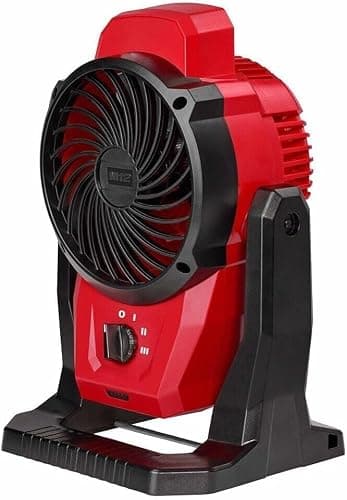 Longest runtime Milwaukee M12 Mounting Fan Up to 16 hours on a single M12 XC 6.0 battery, at 4.41 lb, with magnets and a clamp so it hangs from anything. | One person, one tent, for a whole night without recharging | |
| 2 | 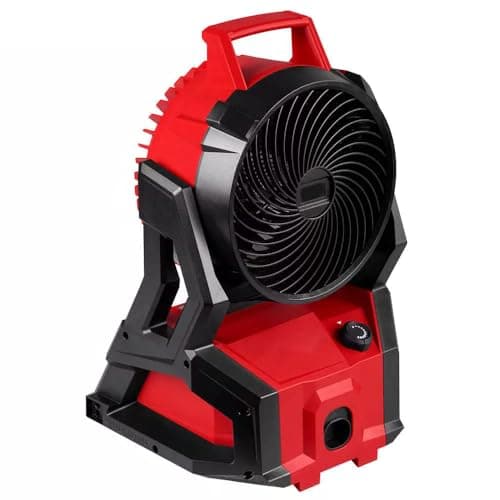 Best for a family tent Milwaukee M18 Brushless PACKOUT Fan 850 CFM with over 3 hours on high or 6.5 at 75% speed — the only fan here that publishes runtime at more than one setting. | A larger tent, or a group that needs air moved rather than aimed | |
| 3 | 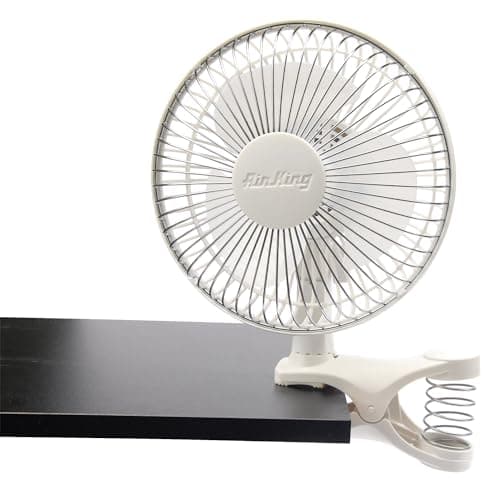 Best at a powered pitch Air King 6" Commercial Grade Clip-On Fan 9 to 12 W at up to 190 CFM with a spring clip, at a draw small enough that a modest power supply carries it all night. | A campground with hook-up, or a camper van with an inverter | |
| — | Not a camping product Whynter ARC-14S Dual Hose Portable Air Conditioner 1,300 W and 11.6 A. A portable generator that can start this is a different class of machine from the one people take camping. | A building with mains power — not a tent |
Everything on this site assumes a wall socket and a building. Camping removes both, and what remains is a much shorter list of things that genuinely work.
First
The pitch is worth more than any fan
A tent in full afternoon sun will reach temperatures no battery appliance can address. Everything below costs nothing and outperforms everything you could buy.
- Pitch where there will be afternoon shade, not morning shade. The sun moves; a spot that is shaded at 9 a.m. may be in full sun at 4 p.m., which is when it matters.
- Orient the doors for the prevailing wind so air crosses through rather than swirling. Two open doors on opposite sides is worth far more than one.
- Take the rainfly off or roll it back if the forecast allows. The fly traps a layer of hot air against the inner tent, which is its job in the cold and works against you in the heat.
- Open every mesh panel and vent. Tents have more ventilation than people use, and the high vents are the ones that matter, because hot air leaves at the top.
- Get off the ground if it is radiating heat — a cot allows air under you, which a mat on hot ground does not.
Batteries
Airflow and runtime are the same budget
This is the trade that governs every battery cooling decision, and it is rarely stated plainly.
| Fan | Airflow | Published runtime | Mains option |
|---|---|---|---|
| Milwaukee M12 mounting fan | Up to 400 CFM | Up to 16 h on XC 6.0 | No |
| Milwaukee M18 PACKOUT fan | 850 CFM | 3 h+ high, 6.5 h at 75% | Yes, integrated |
| Ryobi ONE+ 18V Whisper 14 in | 2,300 CFM high | Not published | Yes, adapter |
400 CFM for 16 hours. 850 CFM for 3. And the 2,300 CFM unit publishes no runtime figure at all, which on a product bought for use away from power is a real gap rather than an oversight we should paper over.
The M18 makes the relationship explicit: over 3 hours on high, 6.5 at 75% speed. Dropping one notch roughly doubles the time. The camping lesson is simply to run everything slower than feels satisfying, because a fan that stops at 2 a.m. is worse than a gentler one that does not — the battery fan category in full.
This one is not a DIY job
If you already own a cordless tool platform, buy the fan that matches it. The expensive part of battery cooling is the batteries, and you have them — along with a charger and, usually, spares. Buying into a second platform for one fan is the most common way to overspend here.
Direction
Point it at a person, not at the tent
A fan does not lower air temperature. It speeds the evaporation of sweat from skin, which makes a person feel several degrees cooler in unchanged air — the mechanism in full.
In a tent that has two consequences. First, aiming the fan at a sleeping person is by far the best use of a limited battery. Second, running it in an empty tent achieves nothing at all and drains the pack you will want later.
There is one exception worth knowing. If the tent is genuinely stuffy — several people, closed up against rain — then aiming a fan at a high vent to push stale air out does real work, because you are exchanging air rather than cooling skin.
Hot nights
When it is above about 95 degrees
This is the safety point, and it applies more sharply to camping than to anywhere else on this site.
A fan cools you by evaporation and warms you by convection. Below skin temperature, evaporation wins. Above roughly 95°F, moving air starts delivering more heat than it carries away, and in humid conditions the crossover comes lower because sweat cannot evaporate efficiently.
In genuine extreme heat, the things that work are: water on skin so evaporation continues, shade and elevation, drinking well before you feel thirsty, and being honest about whether to be out there at all. A fan is a supplement, not a plan.
Heat stroke is a medical emergency. Confusion, stopping sweating, or loss of consciousness means evacuate and call for help rather than trying to manage it at the pitch.
Van or camper
A camper van is a different problem
If you are in a van, an RV or a camper rather than a tent, the envelope is real: it has walls, a roof and doors that close. That changes what is worth doing, because cooling you generate can actually be retained.
The whole set of options opens up — roof vents with fans, a leisure battery with an inverter, and in some cases a genuine rooftop air conditioner at a powered pitch — cooling an RV or camper in detail.
Say the unwelcome thing
Do not buy an evaporative cooler for a tent.
It looks like the obvious answer — low power, no compressor, works off a battery — and it fails for a reason specific to tents.
An evaporative cooler works by adding water vapor to the air, which only cools when the air has capacity to absorb it. A closed tent with people breathing in it saturates quickly, at which point the cooler is adding humidity and no longer cooling. Condensation on the inner tent is the usual result.
It needs a continuous supply of water and a permanently open vent to exhaust the humidified air, which in a tent means undoing the shelter you pitched. In a dry desert campsite with the doors open it can work — the humidity limit — but as general camping advice it is wrong. Sixteen hours of airflow on one pack is the answer that actually travels.
In full
Every pick, and what is wrong with it
Published specifications only, each linked to the page it came from. Where a manufacturer publishes nothing, the row says so — we do not fill blanks in.
1. Longest runtime
Milwaukee M12 Mounting Fan
Milwaukee · model 0820-20
Up to 16 hours on a single M12 XC 6.0 battery, at 4.41 lb, with magnets and a clamp so it hangs from anything.
The correct shape of answer for camping, because runtime is the spec that decides whether a fan is useful at 3 a.m.
Up to 16 hours on an M12 XC 6.0 battery. That covers a full night with margin, from one pack, which nothing else here approaches.
Up to 400 CFM and 14 MPH air speed — personal airflow rather than tent airflow. That is the honest framing, and in a tent it is also the right one: you are cooling a person in a sleeping bag, not a room.
4.41 lb, with magnets, a 2-inch spring clamp, keyholes and pass-throughs. It clips to a tent pole or hangs from the ceiling loop, which matters more than it sounds when there is no flat surface anywhere.
What’s wrong with it
400 CFM is personal airflow, and there is no mains option at all.
Running cost
Milwaukee does not publish a wattage for the 0820-20, so we cannot calculate what it costs to run. We are not going to estimate one. If Milwaukee publishes a nameplate figure, this block will show the arithmetic.
| Air delivery | Up to 400 CFM |
|---|---|
| Air speed | Up to 14 MPH |
| Run time | Up to 16 hours on an M12 XC 6.0 battery |
| Speeds | 3 (high, medium, low) |
| Power source | M12 battery only, no AC option |
| Weight | 4.41 lb |
| Mounting | Magnets, 2 in spring-loaded clamp, keyholes, pass-through holes |
| Noise | Not published |
| Warranty | 1 year |
Every figure above is from Milwaukee Tool product page, 0820-20. Blanks are shown as “not published” rather than filled in.
2. Best for a family tent
Milwaukee M18 Brushless PACKOUT Fan
Milwaukee · model 0818-20
850 CFM with over 3 hours on high or 6.5 at 75% speed — the only fan here that publishes runtime at more than one setting.
A six-person tent is a room-sized volume, and 400 CFM aimed at one sleeping bag does not address it.
Over 3 hours on high and 6.5 hours at 75% speed on an M18 REDLITHIUM XC5.0. That is the most useful published figure in this whole category, because it shows the trade rather than hiding it.
850 CFM and up to 20.5 MPH, with a variable-speed dial rather than fixed steps — so you can trade airflow for hours precisely rather than in jumps.
An integrated AC plug and a 300-degree head, which makes it earn its keep at home the rest of the year. Neither weight nor noise is published, which we note rather than fill in.
What’s wrong with it
Over 3 hours on high is a fraction of the M12's 16, and it is the heaviest option.
Running cost
Milwaukee does not publish a wattage for the 0818-20, so we cannot calculate what it costs to run. We are not going to estimate one. If Milwaukee publishes a nameplate figure, this block will show the arithmetic.
| Air delivery | 850 CFM |
|---|---|
| Air speed | Up to 20.5 MPH |
| Blade size | 7 in |
| Run time, high | Over 3 hours on an M18 REDLITHIUM XC5.0 battery |
| Run time, 75% speed | 6.5 hours on the same battery |
| Power source | M18 battery or integrated AC plug |
| Head rotation | 300 degrees |
| Speeds | Variable-speed dial |
| Weight | Not published |
| Noise | Not published |
| Warranty | 1 year |
Every figure above is from Milwaukee Tool product page, 0818-20. Blanks are shown as “not published” rather than filled in.
3. Best at a powered pitch
Air King 6" Commercial Grade Clip-On Fan
Air King · model 9145
9 to 12 W at up to 190 CFM with a spring clip, at a draw small enough that a modest power supply carries it all night.
A powered pitch changes the problem completely, and the right answer stops being a tool battery.
9 to 12 W at up to 190 CFM — about 1.8¢ for an eight-hour night at 18.34¢/kWh, and a draw small enough that even a modest portable power supply will run it for many hours.
34 to 37 dBA published, which is genuinely quiet, and a spring-loaded non-marking clip that grips a tent pole or a bunk rail.
ETL listed and OSHA compliant at 2.22 lb with a 6 ft three-conductor cord. Built for a job site, which is the right kind of robustness for a campsite — clip-on fans compared.
What’s wrong with it
It needs mains power, which is exactly what camping usually lacks.
Running cost — 9145
| Nameplate power | 9 W – 12 W | manufacturer's published figure |
|---|---|---|
| Energy, 8-hour night | 0.10 kWh | 12 ÷ 1000 × 8 |
| Cost per hour | 0.2¢ | at 18.34¢/kWh |
| Cost per 8-hour night | 1.8¢ | on the highest speed |
| Cost per 30 nights | 53¢ | 2.9 kWh |
| Same month, lowest speed | 40¢ | at 9 W |
Rate: 18.34¢/kWh, the US average residential price for June 2026 (EIA Electric Power Monthly, Table 5.3). Yours will differ — swap it in: (watts ÷ 1000) × hours × your rate.
| Power | 9 W - 12 W (0.1-0.2 A at 120 V) |
|---|---|
| Air delivery | Up to 190 CFM |
| Noise | 34 dBA low, 37 dBA high |
| Speeds | 2 |
| Mounting | Spring-loaded clip, non-marking |
| Dimensions | 10.38 H x 6.25 L x 8.13 W in |
| Weight | 2.22 lb |
| Cord | 6 ft, 3-conductor |
| Listing | ETL listed, OSHA compliant |
| Warranty | 1 year |
Every figure above is from Air King product page, 9145 (via Lasko). Blanks are shown as “not published” rather than filled in.
Skip this one
Whynter ARC-14S Dual Hose Portable Air Conditioner
Whynter · model ARC-14S
1,300 W and 11.6 A. A portable generator that can start this is a different class of machine from the one people take camping.
Included because “portable air conditioner” sounds like a camping product and is not one, and because the follow-up thought is usually a generator.
1,300 W running, 11.6 A at 115 V. That is the steady figure. A compressor’s starting current is substantially higher, and a generator sized to the running number frequently cannot start it at all.
Even if you could power it, a tent cannot be sealed, so the cooling leaves as fast as it arrives, and the hose has nowhere to go.
Never run a generator inside or beside a tent. Carbon monoxide is colorless, odorless and lethal, and a tent has no ventilation standard behind it. This is the same rule that applies in a power outage at home, and it matters more here.
What’s wrong with it
Compressor starting current far exceeds running current, so the nameplate understates what a generator needs.
Running cost — ARC-14S
| Nameplate power | 1300 W | manufacturer's published figure |
|---|---|---|
| Energy, 8-hour night | 10.40 kWh | 1300 ÷ 1000 × 8 |
| Cost per hour | 24¢ | at 18.34¢/kWh |
| Cost per 8-hour night | $1.91 | on the highest speed |
| Cost per 30 nights | $57 | 312.0 kWh |
Rate: 18.34¢/kWh, the US average residential price for June 2026 (EIA Electric Power Monthly, Table 5.3). Yours will differ — swap it in: (watts ÷ 1000) × hours × your rate.
| Marketing capacity | 14,000 BTU (ASHRAE-128) |
|---|---|
| DOE-rated capacity | 9,500 BTU SACC |
| Hoses | Dual |
| Power | 1,300 W / 11.6 A at 115 V |
| Noise | Under 51 dBA low, under 56 dBA high |
| Dehumidification | 71 pints/day |
| Refrigerant | R-32 |
| Dimensions | 16 W x 19 D x 35.5 H in |
| Weight | 73 lb |
| Manufacturer coverage claim | 500 sq ft |
| Warranty | 1 year unit, 3 years compressor |
Every figure above is from Whynter product page, ARC-14S. Blanks are shown as “not published” rather than filled in.
We are not linking a buy button for this one. If you want to look at it anyway, it is easy enough to find — but we would rather send you to something that fits your room.
Questions people actually ask
Frequently asked
How do you keep a tent cool?
Pitch for afternoon shade rather than morning shade, orient the doors for cross-flow, take the rainfly off if the forecast allows, and open every high vent. Then aim a battery fan at a person rather than at the tent. The pitch matters more than any appliance.
How long does a battery fan run while camping?
It depends entirely on airflow, because they are the same budget. A 400 CFM mounting fan runs up to 16 hours on one pack; an 850 CFM fan publishes over 3 hours on high and 6.5 at 75% speed. Run everything slower than feels satisfying. Battery fans compared.
Should I take the rainfly off to keep the tent cooler?
If the forecast allows, yes. The fly traps a layer of hot air against the inner tent — which is exactly its job in the cold and works against you in the heat. Rolling it back partway keeps some rain protection while releasing most of the trapped heat.
Can you use a portable air conditioner in a tent?
No, sensibly. It draws 1,300 W, a tent cannot be sealed so cooling leaves as fast as it arrives, and the exhaust hose has nowhere to go. A generator sized to the running figure often cannot start a compressor at all, and generators must never run near a tent.
Do evaporative coolers work in a tent?
Only in a genuinely dry climate with the doors open. They cool by adding water vapor to the air, and a closed tent with people breathing in it saturates quickly — at which point you are adding humidity, not cooling, and condensing water on the inner tent. The humidity limit.
Is it safe to use a fan in extreme heat while camping?
Up to a point. Above roughly 95°F moving air delivers more heat by convection than it removes by evaporation, and in humid conditions the crossover comes lower. Keep skin wet so evaporation continues, and treat confusion or stopping sweating as an emergency.
Sources
Where these numbers came from
- Milwaukee M12 mounting fan product page — up to 400 CFM, up to 16 h on M12 XC 6.0, 4.41 lb
- Milwaukee M18 PACKOUT fan product page — 850 CFM, 20.5 MPH, 3 h+ high and 6.5 h at 75% on XC5.0, integrated AC plug
- Ryobi ONE+ 18V Hybrid Whisper Series 14 in fan product page — 2,300 CFM high, 3 speeds, no published runtime
- Air King product page, 9145 — 9 to 12 W, up to 190 CFM, 34 to 37 dBA, ETL listed
- Whynter ARC-14S product page — 1,300 W / 11.6 A at 115 V
- EIA Electric Power Monthly, Table 5.3 — average residential electricity price
Read next
Where to go from here
Back to Room Cooling, or read how we pick.