The picks
The best 12V fans for a camper, van or boat, ranked on airflow per amp
On a house battery, a fan is not measured in watts or dollars. It is measured in amp-hours out of a bank you have to put back, which makes airflow per amp the only honest ranking — and one maker is the only one that publishes both halves of it.
By Sawyer V. · Published
The short answer
The SEEKR Sirocco II is the pick: 185 CFM on 0.35 A at 12 V, and 125 CFM on 0.12 A on low — which is 1,042 CFM per amp, the best figure in the category by our arithmetic. For the most air for the least money, the SEEKR Ultimate 757 moves 200 CFM on 0.41 A.
Fan & Frost earns a commission when you buy through our links, at no cost to you. It never changes a ranking, and we say so when the right answer is the cheaper unit or nothing at all. Full disclosure · How we pick.
At a glance
The picks, ranked
Tap any row to jump to the full reasoning. Prices are live from Amazon where we have them, and read “check price” where we don’t — never a number we cannot verify today.
| # | Product | Best for | Price |
|---|---|---|---|
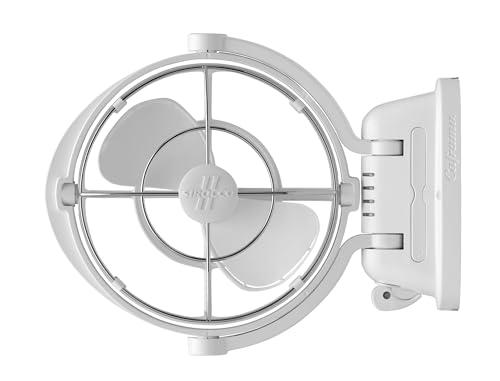
| 1 | Best overall SEEKR by Caframo Sirocco II 12/24 V Cabin Fan 125, 155 and 185 CFM across three speeds, on 0.12 A low and 0.35 A high at 12 V. On low that is 1,042 CFM per amp, and it is the only 12 V fan here with a published decibel figure. | A van conversion or a boat berth where the fan will run all night off the house bank — the lowest current draw per unit of airflow published by anybody, and the only noise figure in the category | |
| 2 |  Most air for the money SEEKR by Caframo Ultimate 12 V Direct-Wire Cabin Fan 200 CFM on high, the most airflow on this page, on 0.41 A at 12 V, from a two-speed grill-free fan that costs roughly half what the Sirocco II does. | A galley, a workshop corner of a van, a boat cabin that needs real air movement rather than a quiet night breeze — and a build on a budget | |
| 3 | 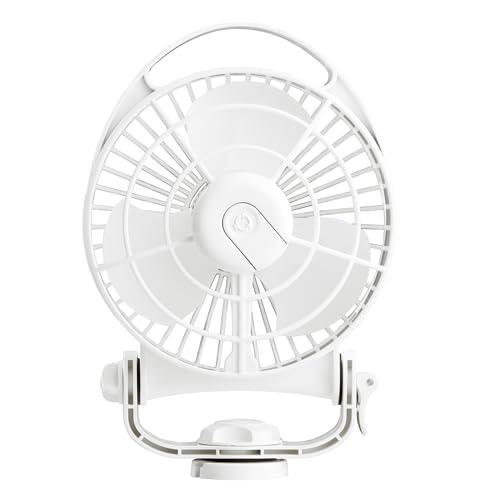 Lowest draw and smallest footprint SEEKR by Caframo BORA II 12/24 V Cabin Fan 90 to 125 CFM at 12 V on 0.13 to 0.27 A, from a 1.19 lb fan on a locking cam mount that will point sideways, up or down. On 24 V it rises to 110 to 155 CFM on 0.08 to 0.23 A. | A narrow berth, a bunk, a pilot house or any mounting point where nothing bigger will fit — and a 24 V system, where it gains airflow instead of losing it | |
| 4 | 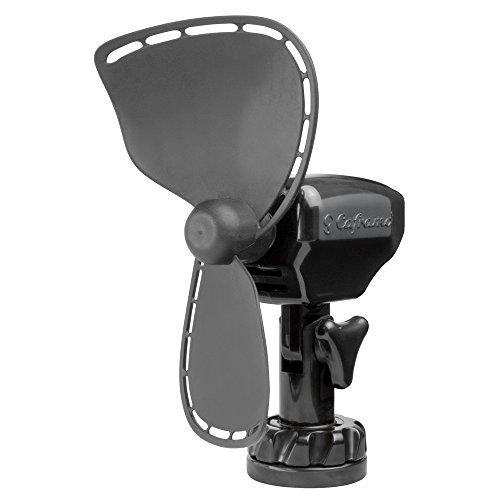 No wiring at all SEEKR by Caframo Ultimate 12 V Lighter-Plug Cabin Fan 150 and 200 CFM on 0.28 and 0.41 A, identical to the direct-wire Ultimate, on a six-foot cord with a lighter plug and a suction cup or screw-down base. | A hired camper, a rented berth, a borrowed boat or a build you have not wired yet — the same fan as the Ultimate 757 with a plug on the end instead of bare wires | |
| — |  The one to skip Aletbo 12 V 2-Speed Dash Fan A two-speed 12 V fan with an adjustable mount, for a fraction of the cost of a marine fan. No airflow figure, no current draw, no noise rating. | A truck cab for an afternoon — it is a quarter of the price of anything else here and it publishes nothing you could use to plan a battery around |
A mains fan is judged on watts, because the socket behind it is effectively infinite. A fan wired into a van, a camper or a boat is judged on amps, because every one of them comes out of a battery you have to put back with an alternator, a solar panel or a hookup fee.
Which makes airflow per amp the only ranking that means anything here — and makes this one of the few fan categories where the figures to do it exist.
The arithmetic
CFM per amp, and what it does to a 100 amp-hour bank
Caframo publishes, for each of its SEEKR cabin fans, both the airflow and the current draw at more than one speed. That is unusual enough to be the reason this page is almost entirely one brand: nobody else in 12 V cabin fans publishes the pair.
| Fan | CFM low / high | Amps low / high | CFM per amp, low | Hours on low | Noise |
|---|---|---|---|---|---|
| SEEKR Sirocco II | 125 / 185 | 0.12 / 0.35 | 1,042 | 417 | 54 dB high |
| SEEKR BORA II | 90 / 125 | 0.13 / 0.27 | 692 | 385 | Not published |
| SEEKR Ultimate 757 | 150 / 200 | 0.28 / 0.41 | 536 | 179 | Not published |
| SEEKR Ultimate plug-in | 150 / 200 | 0.28 / 0.41 | 536 | 179 | Not published |
| Aletbo 12 V dash fan | Not published | Not published | — | — | Not published |
CFM and amp figures are Caframo’s own, at 12 V. The last three columns are our arithmetic: CFM divided by amps, and runtime from a 100 amp-hour battery discharged to 50 percent (so 50 usable amp-hours), ignoring inverter and wiring losses because there are none — these fans run on DC directly.
The spread in that fourth column is almost two to one, between fans from the same manufacturer. The Sirocco II on low moves nearly twice the air per amp that the Ultimate does, which over a week of wild camping is a real difference in how much solar you need.
And the fifth column is the one to take to a build spreadsheet. A fan that runs 417 hours on half a 100 Ah battery is effectively free. A fan that runs 179 hours is still fine. A fan with no published draw cannot be planned at all.
Voltage
What Caframo says about running at 14 volts
This is the most useful thing in Caframo’s FAQ and it appears nowhere in the marketing:
“Caframo 12V model fans will operate within a range of 9-15V. Our 24V model fans will operate within a range of 18-30V”, and — the part that matters — “Operation above 14V for our 12V models ... is not recommended for continuous use”.
A van or boat house system does not sit at 12 volts. It sits at 12.6 when resting, and a charging alternator or a solar controller in absorption will hold it at 14.4 to 14.8 volts for hours. Which means a fan left running while you drive, or while the panels are in bulk charge, is above the manufacturer’s recommended continuous range for that whole time.
That is not a reason to avoid these fans. It is a reason to know why a cheap DC fan dies in its second season, and a reason to prefer the 12/24 V auto-sensing models if your system runs hot.
This one is not a DIY job
A 12 V fan and a tool-battery fan solve the same problem from opposite directions. Hardwired 12 V draws from the bank that also runs the fridge, the pump and the lights, but it is permanently installed, silent to operate and uses a tenth of the current of anything on a removable battery. A tool battery keeps the load off the house bank and moves far more air, and has to be charged. Battery and tool-platform fans, with published run times, and the whole RV and camper cooling question.
Mounting
Hardwired, suction cup or lighter plug
The install decides which of these fans is right as much as the airflow does:
- Direct wire with a screw-down base or backing plate — the Sirocco II and the Ultimate 757. Permanent, tidy, no socket consumed, and the fan is where you want it rather than where there is a socket. The Sirocco II’s plate takes six #6 screws.
- Locking cam mount — the BORA II, which can be set sideways, upright or downwards. The right answer for a bunk face or a headliner.
- Lighter plug on a six-foot cord — the plug-in Ultimate, which needs no wiring at all and no permission from a landlord, a leaseholder or a marina. The only option in a rented or hired vehicle.
One detail about blades, since two of these publish it: Caframo’s FingerSafe blades are polyethylene, and the Ultimate is grill-free. A grille-less fan at head height in a bunk is a deliberate design choice built around a soft blade, and it is also the easiest thing in a galley to clean. Fan safety, where small hands are involved.
Say the unwelcome thing
Do not run a 12V fan through an inverter.
It happens more than it should: an inverter is already fitted for the laptop, a mains fan is cheaper and moves more air, so the mains fan goes in. The arithmetic is brutal. An inverter costs you a conversion loss and an idle draw of its own, and then the mains fan draws several times what a DC fan does to move the same air.
The published figures make the point: 185 CFM for 0.35 A at 12 V is about four watts. A domestic box fan moves ten times the air and draws a hundred watts at the wall. Per unit of air, the DC cabin fan is the efficient machine — and it stays efficient only if nothing converts its power twice.
In full
Every pick, and what is wrong with it
Published specifications only, each linked to the page it came from. Where a manufacturer publishes nothing, the row says so — we do not fill blanks in.
1. Best overall
SEEKR by Caframo Sirocco II 12/24 V Cabin Fan
Caframo · model 7010 (SKU 7010CAWBX)
125, 155 and 185 CFM across three speeds, on 0.12 A low and 0.35 A high at 12 V. On low that is 1,042 CFM per amp, and it is the only 12 V fan here with a published decibel figure.
125 / 155 / 185 CFM at 1,200 / 1,500 / 1,800 RPM, drawing 0.12 A on low and 0.35 A on high at 12 V (0.06 A and 0.21 A at 24 V). Our arithmetic on those pairs: 1,042 CFM per amp on low and 529 on high, both the best in this comparison.
What that means on a real battery: at 0.12 A, a 100 amp-hour bank discharged to half would run this fan for about 417 hours. On high it is about 143 hours. Nothing else here gets close on low, and low is where a sleeping fan lives.
54 dB on high — and it is the only published noise figure for any 12 V cabin fan we found. Caframo publishes no low-speed figure and prints it as “dB” rather than dBA, so treat it as indicative rather than comparable with a certified household rating. What fan noise figures mean.
7-inch FingerSafe polyethylene blade, 12/24 V auto-sensing DC, a 3-year limited warranty, and 9.5 x 12.25 x 3.75 inches that folds to 3.8 inches deep against the wall. The auto-sensing supply is the detail that makes it work on a 24 V boat and a 12 V van without a second part number.
What’s wrong with it
Hardwire installation is required and the backing plate takes six screws, so it is a permanent fitting rather than something you move. At 2.78 lb it is also the heaviest here, and Caframo publishes the current draw for the low and high speeds only — the middle speed is unstated.
Running cost
Caframo does not publish a wattage for the 7010 (SKU 7010CAWBX), so we cannot calculate what it costs to run. We are not going to estimate one. If Caframo publishes a nameplate figure, this block will show the arithmetic.
| Air delivery | 125 / 155 / 185 CFM low / medium / high (212 and 314 m³/h at the ends) |
|---|---|
| Current draw at 12 V | 0.12 A low, 0.35 A high. Medium not published |
| Current draw at 24 V | 0.06 A low, 0.21 A high |
| Voltage | 12/24 V auto-sensing DC. Caframo rates its 12 V fans for 9 - 15 V |
| Speeds | 3 (1,200 / 1,500 / 1,800 RPM) |
| Blade | 7 in (178 mm) FingerSafe polyethylene |
| Noise | 54 dB on high. Low not published |
| Dimensions | 9.5 W x 12.25 H x 3.75 D in; 3.8 in stowed depth |
| Weight | 2.78 lb (1.26 kg) |
| Mounting | Direct wire, must be mounted; backing plate takes six #6 screws |
| Warranty | 3-year limited |
Every figure above is from SEEKR by Caframo store, Sirocco II 7010CAWBX — 125/155/185 CFM, 0.12 A low and 0.35 A high at 12 V (0.06/0.21 at 24 V), 3 speeds at 1,200/1,500/1,800 RPM, 7 in FingerSafe blade, 54 dB on high, 2.78 lb, 3-year warranty. Blanks are shown as “not published” rather than filled in.
2. Most air for the money
SEEKR by Caframo Ultimate 12 V Direct-Wire Cabin Fan
Caframo · model 757 (SKU 757DCWBX)
200 CFM on high, the most airflow on this page, on 0.41 A at 12 V, from a two-speed grill-free fan that costs roughly half what the Sirocco II does.
150 CFM on low and 200 CFM on high (340 m³/h), on 0.28 A and 0.41 A at 12 V. Our arithmetic: 536 CFM per amp on low and 488 on high — behind the Sirocco II, but it is the only fan here that breaks 200 CFM.
Grill-free, with a 7-inch FingerSafe blade. That is a real design decision rather than a marketing line: no grille means nothing to clean grease and salt out of, which in a galley or a cockpit is the difference between a fan you can wipe and a fan you cannot.
1.37 lb on a permanent screw-down base, 7 x 8 x 5 inches, direct wire. It is half the weight of the Sirocco II and takes a fraction of the wall.
Two gaps worth knowing. There is no published noise figure, only “whisper-quiet”. And Caframo’s spec table says 0.41 A on high while its own More Information table says 0.40 A. A hundredth of an amp changes nothing; a maker disagreeing with itself on one page is worth noticing.
What’s wrong with it
Two speeds rather than three, so there is no quiet middle setting, and Caframo's own two tables disagree about the high-speed draw — 0.41 A in the spec table and 0.40 A in the information table. It publishes no noise figure at all, and the warranty is one year against the Sirocco's three.
Running cost
Caframo does not publish a wattage for the 757 (SKU 757DCWBX), so we cannot calculate what it costs to run. We are not going to estimate one. If Caframo publishes a nameplate figure, this block will show the arithmetic.
| Air delivery | 150 CFM low, 200 CFM high (340 m³/h) |
|---|---|
| Current draw at 12 V | 0.28 A low, 0.41 A high (Caframo's More Information table says 0.40 A high — the two disagree) |
| Voltage | 12 V DC |
| Speeds | 2 |
| Blade | 7 in FingerSafe, grill-free |
| Noise | Not published |
| Dimensions | 7 W x 8 H x 5 D in |
| Weight | 1.37 lb |
| Mounting | Permanent screw-down base, direct wire |
| Warranty | 1-year limited |
Every figure above is from SEEKR by Caframo store, Ultimate direct-wire 757DCWBX — 150 CFM low and 200 CFM high, 0.28 A low and 0.41 A high at 12 V, 2 speeds, 7 in FingerSafe grill-free blade, screw-down base, 1-year warranty. Blanks are shown as “not published” rather than filled in.
3. Lowest draw and smallest footprint
SEEKR by Caframo BORA II 12/24 V Cabin Fan
Caframo · model 7483 (white SKU 7483CAWBX; figures below are Caframo's for the 7483 BORA II)
90 to 125 CFM at 12 V on 0.13 to 0.27 A, from a 1.19 lb fan on a locking cam mount that will point sideways, up or down. On 24 V it rises to 110 to 155 CFM on 0.08 to 0.23 A.
12 V: 90 to 125 CFM on 0.13 to 0.27 A. 24 V: 110 to 155 CFM on 0.08 to 0.23 A. Our arithmetic on the low end: 692 CFM per amp at 12 V — second only to the Sirocco II, from a fan that weighs a third as much.
The 24 V column is the interesting one. On a 24 V system it moves more air for less current, which is the whole argument for 24 V house systems in one specification. If your boat is 24 V, this is the fan on this page that rewards it.
1.19 lb, 4.1 x 6.22 x 9.1 inches, on a locking cam mount that takes it sideways, upright or downwards, with three speeds on a digital push-button. For a bunk or a narrow cabinet face, the mounting flexibility is worth more than the airflow difference.
Two-year limited warranty, and two published gaps: no blade diameter and no noise figure — only a claim to be “quietest in its class”, with no figure behind it.
What’s wrong with it
It is the only fan here that publishes neither a blade diameter nor any noise figure, Caframo states figures for its first and third speeds only, and the specification set we could read was the black colorway's. Its 125 CFM maximum is a third less air than the Ultimate's.
Running cost
Caframo does not publish a wattage for the 7483 (white SKU 7483CAWBX; figures below are Caframo's for the 7483 BORA II), so we cannot calculate what it costs to run. We are not going to estimate one. If Caframo publishes a nameplate figure, this block will show the arithmetic.
| Air delivery | 90 - 125 CFM at 12 V; 110 - 155 CFM at 24 V. Middle speed not published |
|---|---|
| Current draw | 0.13 - 0.27 A at 12 V; 0.08 - 0.23 A at 24 V. Middle speed not published |
| Voltage | 12/24 V auto-sensing DC |
| Speeds | 3, digital push-button control |
| Blade | High-efficiency, front and back guards. Diameter not published |
| Noise | Not published |
| Dimensions | 4.1 L x 6.22 W x 9.1 H in (104 x 158 x 231 mm) |
| Weight | 1.19 lb (0.54 kg) |
| Mounting | Locking cam mount; sideways, upright or downwards |
| Warranty | 2-year limited |
Every figure above is from SEEKR by Caframo store, BORA II 7483 — 90-125 CFM and 0.13-0.27 A at 12 V (110-155 CFM and 0.08-0.23 A at 24 V), 3 speeds with digital control, locking cam mount, 1.19 lb, 2-year warranty, no noise figure published. Blanks are shown as “not published” rather than filled in.
4. No wiring at all
SEEKR by Caframo Ultimate 12 V Lighter-Plug Cabin Fan
Caframo · model 747 (SKU 747DCBBX; the spec table prints 747DCBCS)
150 and 200 CFM on 0.28 and 0.41 A, identical to the direct-wire Ultimate, on a six-foot cord with a lighter plug and a suction cup or screw-down base.
150 CFM low and 200 CFM high, on 0.28 A and 0.41 A at 12 V — the same figures as the direct-wire Ultimate above, because it is the same fan with a different tail. Same 7-inch grill-free FingerSafe blade, same two speeds.
Six-foot cord with a lighter plug adapter, and a mount that is either a suction cup or a permanent screw-down base. That combination is the entire argument: nothing to wire, nothing to drill if you do not want to, and nothing to explain to whoever owns the vehicle.
Check which battery the socket is on before you rely on it. In many vans and boats the accessory socket is fed from the starting battery, not the house bank — which means a fan left running overnight is draining the one battery you need in the morning. On a properly split system it is fed from the house side and this is a non-issue.
Two small untidinesses, reported because this site reports them: Caframo prints the SKU as 747DCBBX and the model in its own spec table as 747DCBCS, and it publishes no noise figure for this fan or the direct-wire version.
What’s wrong with it
A lighter socket is usually on the starter battery circuit rather than the house bank, which is the opposite of what you want overnight, and the cord has to reach. It publishes no noise figure, carries a one-year warranty, and Caframo prints two different model numbers for it on the same page.
Running cost
Caframo does not publish a wattage for the 747 (SKU 747DCBBX; the spec table prints 747DCBCS), so we cannot calculate what it costs to run. We are not going to estimate one. If Caframo publishes a nameplate figure, this block will show the arithmetic.
| Air delivery | 150 CFM low, 200 CFM high (340 m³/h) |
|---|---|
| Current draw at 12 V | 0.28 A low, 0.41 A high (Caframo's More Information table says 0.40 A high — the two disagree) |
| Voltage | 12 V DC. A separate 24 V model has its own part number |
| Speeds | 2 |
| Blade | 7 in FingerSafe, grill-free |
| Power connection | 6 ft cord with a lighter plug adapter |
| Mounting | Suction cup or permanent screw-down base |
| Dimensions | 5.25 W x 8 H x 2.5 D in (13.3 x 20.3 x 6.4 cm) |
| Weight | 1.54 lb |
| Noise | Not published |
| Certification | CE |
| Warranty | 1-year limited |
Every figure above is from SEEKR by Caframo store, Ultimate lighter-plug 747 — 150 CFM low and 200 CFM high, 0.28 A low and 0.41 A high at 12 V, 2 speeds, 7 in grill-free FingerSafe blade, 6 ft lighter-plug cord, suction cup or screw-down base, 1.54 lb, 1-year limited warranty. Blanks are shown as “not published” rather than filled in.
Skip this one
Aletbo 12 V 2-Speed Dash Fan
Aletbo · model Not stated on the listing
A two-speed 12 V fan with an adjustable mount, for a fraction of the cost of a marine fan. No airflow figure, no current draw, no noise rating.
There is a whole shelf of these: a 12 V motor, a cage, a clamp or a dash mount, two speeds, a very low price and a brand name that returns nothing but the listing.
For a truck cab on a hot afternoon with the engine running, that is a perfectly sensible purchase and we would not argue with it.
For a van, a boat or a camper off a battery, it fails the only test this page applies. There is no published current draw and no published airflow, so there is no CFM per amp, and no way to work out what it does to your bank overnight. Every Caframo fan above publishes both figures at more than one speed.
It is real and purchasable, which is why it is here. We would rather you spent three times as much on numbers somebody will print. How we pick.
What’s wrong with it
On a house battery, current draw is the whole specification, and there is none. A fan that might draw 0.2 A or might draw 1.5 A cannot be planned around, and on a 50 amp-hour usable bank that difference is the difference between a week and a night.
Running cost
Aletbo does not publish a wattage for the Not stated on the listing, so we cannot calculate what it costs to run. We are not going to estimate one. If Aletbo publishes a nameplate figure, this block will show the arithmetic.
| Voltage | 12 V |
|---|---|
| Speeds | 2 |
| Mounting | Adjustable angle, dash or wall |
| Air delivery | Not published on the listing |
| Current draw | Not published on the listing |
| Noise | Not published on the listing |
| Blade | Not published on the listing |
| Warranty | Not published on the listing |
Every figure above is from Aletbo 12 V dash fan product listing — 12 V, 2 speeds, adjustable angle. No manufacturer specification page could be found for this brand, and the listing publishes no airflow or current figure. Blanks are shown as “not published” rather than filled in.
We are not linking a buy button for this one. If you want to look at it anyway, it is easy enough to find — but we would rather send you to something that fits your room.
Questions people actually ask
Frequently asked
What is the best 12V fan for a camper van?
The SEEKR by Caframo Sirocco II, on published figures: 125, 155 and 185 CFM across three speeds, drawing 0.12 A on low and 0.35 A on high at 12 V. On low that is 1,042 CFM per amp by our arithmetic, the best in the category, and it is the only 12 V cabin fan with a published noise figure (54 dB on high).
How much current does a 12V cabin fan draw?
Between about 0.12 and 0.41 amps on the fans here, which is the useful range to expect. Caframo publishes 0.12 A low and 0.35 A high for the Sirocco II, 0.13 to 0.27 A for the BORA II and 0.28 to 0.41 A for the Ultimate, all at 12 V. Commodity 12 V fans generally publish no current figure at all.
How long will a 12V fan run off a leisure battery?
Our arithmetic, from a 100 amp-hour battery discharged to half — so 50 usable amp-hours: about 417 hours for a Sirocco II on low, 385 for a BORA II on low, and 179 for an Ultimate on low. On high, the Sirocco II gives about 143 hours. Because these are DC fans there is no inverter loss to subtract.
Is a 12V fan better than a rechargeable one in a van?
They answer different questions. Hardwired 12 V draws a tenth of the current, is permanently installed and never needs charging — but it comes out of the same bank as the fridge and the lights. A tool-platform or rechargeable fan moves far more air and keeps the load off the house bank, at the cost of charging it and finding somewhere to stow it. Rechargeable and tool-battery fans.
Can a 12V fan run on a 24V boat system?
Only if it is built for it. Caframo's Sirocco II and BORA II are 12/24 V auto-sensing and publish figures for both — and the BORA II actually moves more air for less current at 24 V, 110 to 155 CFM on 0.08 to 0.23 A. The Ultimate direct-wire and plug-in models are 12 V, with separate 24 V part numbers.
What voltage range can a 12V fan handle?
Caframo states 9 to 15 volts for its 12 V fans and 18 to 30 for its 24 V fans, and adds that operation above 14 volts is not recommended for continuous use. That matters because a charging alternator or a solar controller in absorption will hold a house bank at 14.4 to 14.8 volts for hours at a time.
Should I run a mains fan through my inverter instead?
No. You pay a conversion loss plus the inverter's own idle draw, and then the mains fan draws several times what a DC fan needs for the same air. A Sirocco II moves 185 CFM on about four watts at 12 V; a domestic box fan moves ten times the air for a hundred watts at the wall. What a mains box fan draws.
Sources
Where these numbers came from
- SEEKR by Caframo store, Sirocco II 7010CAWBX — 125/155/185 CFM, 0.12 A low and 0.35 A high at 12 V (0.06/0.21 at 24 V), 3 speeds at 1,200/1,500/1,800 RPM, 7 in FingerSafe polyethylene blade, 54 dB on high, 2.78 lb, 3-year limited warranty
- SEEKR by Caframo store, Ultimate direct-wire 757DCWBX — 150 CFM low and 200 CFM high (340 m3/h), 0.28 A low and 0.41 A high at 12 V with 0.40 A high in the information table, 2 speeds, 7 in grill-free FingerSafe blade, 1.37 lb, 1-year limited warranty
- SEEKR by Caframo store, BORA II 7483 — 90-125 CFM and 0.13-0.27 A at 12 V, 110-155 CFM and 0.08-0.23 A at 24 V, 3 speeds with digital control, locking cam mount, 1.19 lb, 2-year limited warranty, no noise figure published
- SEEKR by Caframo store, Ultimate plug-in 747DCBCS — 150/200 CFM, 0.28/0.41 A at 12 V, 2 speeds, 6 ft cord with lighter plug adapter, suction cup or permanent screw-down base, 1-year limited warranty, and the FAQ statement that 12 V fans operate from 9-15 V with continuous operation above 14 V not recommended
- Aletbo 12 V dash fan product listing — 12 V, 2 speeds, adjustable angle, with no airflow, current or noise figure published and no manufacturer specification page
Read next
Where to go from here
Back to Fans, or read how we pick.