The picks
Best fans for allergies
The uncomfortable part of this question is that a plain fan is actively unhelpful if you have allergies. What you want is filtration.
By Sawyer V. · Published
The short answer
A plain fan re-suspends settled dust, pollen and dander and blows it at you, which is why people with allergies often feel worse with one running. What helps is filtration: the Dyson TP07 combines HEPA and activated carbon with airflow on 40 W. The alternative worth knowing is extraction — a certified ventilating fan removes air rather than recirculating it, at 0.1 sones and 16.7 CFM per watt.
Fan & Frost earns a commission when you buy through our links, at no cost to you. It never changes a ranking, and we say so when the right answer is the cheaper unit or nothing at all. Full disclosure · How we pick.
At a glance
The picks, ranked
Tap any row to jump to the full reasoning. Prices are live from Amazon where we have them, and read “check price” where we don’t — never a number we cannot verify today.
| # | Product | Best for | Price |
|---|---|---|---|
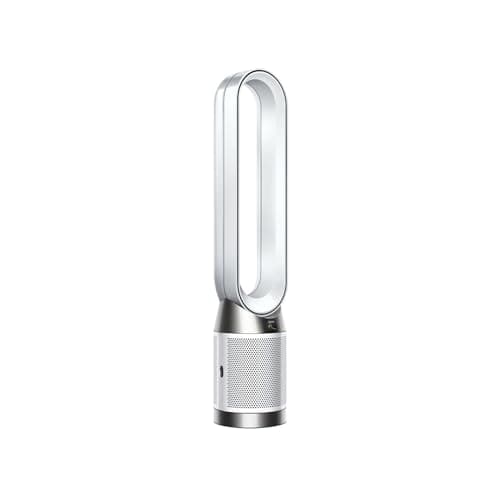
| 1 | The only fan here that filters Dyson Purifier Cool TP07 HEPA and activated carbon filtration with 40 W maximum input power and under 0.5 W standby. | A room where you want airflow and cleaner air from one object | |
| 2 | 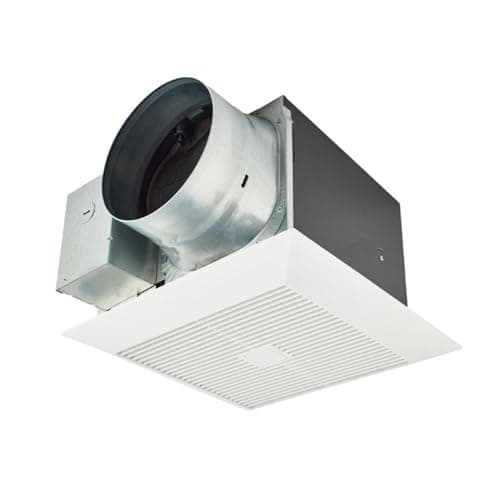 Removal beats recirculation Panasonic WhisperGreen Select FV-0511VK3 Ventilation Fan 110 CFM at 0.1 sones and 16.7 CFM per watt, certified — it takes air out of the building rather than filtering it. | A bathroom, laundry or any room where damp drives the problem | |
| 3 | 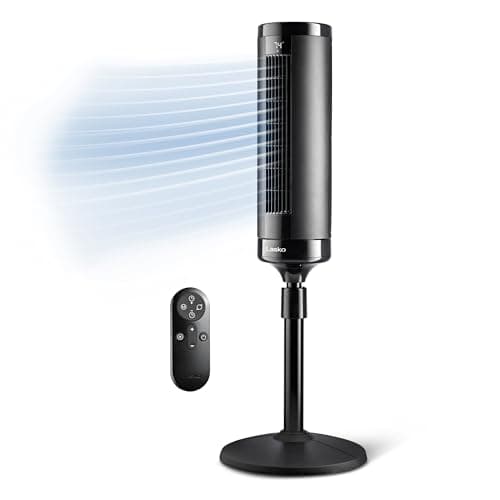 If you want a plain fan anyway Lasko EcoQuiet 42" DC Tower Fan 2.9 W on low at 23 dBA — an enclosed impeller that is far easier to keep clean than an open bladed fan. | Airflow in an already-clean room, aimed away from you | |
| — | The worst format for this Lasko Power Plus 20" Box Fan An open bladed fan with a riveted grille you cannot easily open to clean the blades. | A window or garage — not a room where allergens are a problem |
This question usually arrives after someone has noticed they feel worse with a fan on, not better. That observation is correct, and the reason is straightforward.
The problem
A fan re-suspends what has settled
Dust, pollen, pet dander and mold spores settle out of still air onto floors, shelves and soft furnishings. Sitting there, they are not in your breathing zone.
A fan puts them back into the air. Moving air lifts settled particles from surfaces, and a fan aimed across a room is effectively a re-suspension device — then it directs the result at whoever it is pointed at.
Two secondary effects make it worse:
- The fan itself is a reservoir. Blades and guards collect felted dust, and some of it is thrown back into the room at every start.
- Air movement dries mucous membranes, which can make eyes and nose more reactive over a long session.
None of that makes fans useless. It means a plain fan is not an allergy product, and treating it as one produces the disappointment people report.
What helps
Filtration, and what it does not do
A filtering fan pulls air through a HEPA element that captures fine particles before returning the air to the room. Over time, that reduces the airborne particle load rather than simply relocating it.
Three honest limits worth knowing:
- It only cleans air that passes through it. Room size, placement and how long it runs all matter, and a filter in a corner of a large room is doing less than the specification implies.
- It does nothing about carbon dioxide. Filtration is not ventilation, so a stuffy closed room stays stuffy. Why that distinction matters.
- Filters are a recurring cost, and a loaded filter restricts airflow the same way a dirty fan blade does.
This one is not a DIY job
We are not going to make medical claims. Whether a particular product helps a particular person’s allergies is a question for a doctor, not for a site that reviews fans, and we have no clinical data.
What we can report is what is published: which products filter, what the filter media is, and what the airflow and power figures are where manufacturers state them.
What we can also say is that source control beats filtration in every published guidance we are aware of — removing the source, keeping windows shut during high pollen, washing bedding, and extracting moist air before it drives growth.
A fan is the last item on that list, not the first.
The other route
Removing air beats cleaning it
Filtration recirculates. Extraction removes. For some allergen sources the second is more effective and considerably cheaper to run.
A certified ventilating fan takes air out of the building entirely — the particles in it go too, with no filter to load or replace. The best certified units manage 16.7 CFM per watt at 0.1 sones.
This matters most where the problem is moisture-driven. Damp encourages growth, growth produces spores, and a filter then has to keep up with a source that is continuously replenishing. Extracting the moisture addresses the cause.
Bathroom and utility fans, ranked, and the laundry case.
Practical
Using a fan without making things worse
- Clean it far more often. Blades, guard front and back, and motor vents. In a home with pets or during pollen season, monthly rather than twice a season. The procedure.
- Choose an enclosed format. A tower fan’s impeller collects less than open blades and is less exposed.
- Aim it across the room, not at your face. You keep the air movement without directing the re-suspended load at yourself.
- Run it lower. Less air speed means less lifting of settled particles, and on a DC fan far less power.
- Do not ventilate during high pollen. A window fan is excellent for cooling and is importing outdoor air, which during pollen season is the opposite of what you want.
- Vacuum before you switch on, not after — otherwise the fan lifts what the vacuum was about to collect.
Say the unwelcome thing
Do not buy a plain fan expecting it to help with allergies.
It is the mismatch that brings most people to this page, and the mechanism works directly against them.
A fan lifts settled dust, pollen and dander back into the air, throws some of its own accumulated load off the blades at every start, and aims the result at whoever it is pointed at. Nothing about it removes anything.
If the goal is cleaner air, the purchase is a filtering unit or an extract fan — and source control before either.
If the goal is comfort and you also have allergies, a plain fan is fine — enclosed, cleaned often, run low, and aimed across the room rather than at you.
In full
Every pick, and what is wrong with it
Published specifications only, each linked to the page it came from. Where a manufacturer publishes nothing, the row says so — we do not fill blanks in.
1. The only fan here that filters
Dyson Purifier Cool TP07
Dyson · model TP07
HEPA and activated carbon filtration with 40 W maximum input power and under 0.5 W standby.
HEPA and activated carbon. HEPA captures fine particles — the pollen, dust and dander fraction that matters for allergies — and the carbon layer adsorbs some gases and odors.
That combination is the reason to consider this over any other fan on the site. A plain fan moves allergens around; this removes a proportion of them from the air passing through it.
40 W maximum — about 8.8¢ for a twelve-hour day at full — and under 0.5 W standby.
The honest gaps: Dyson states airflow in gallons per second, which is not comparable to CFM, and publishes no dBA figure at all. Filters are a recurring cost the specification does not quantify.
What’s wrong with it
No published CFM, no published dBA, and no dimensions or weight on the accessible spec sheet.
Running cost — TP07
| Nameplate power | 40 W | manufacturer's published figure |
|---|---|---|
| Energy, 8-hour night | 0.32 kWh | 40 ÷ 1000 × 8 |
| Cost per hour | 0.7¢ | at 18.34¢/kWh |
| Cost per 8-hour night | 5.9¢ | on the highest speed |
| Cost per 30 nights | $1.76 | 9.6 kWh |
Rate: 18.34¢/kWh, the US average residential price for June 2026 (EIA Electric Power Monthly, Table 5.3). Yours will differ — swap it in: (watts ÷ 1000) × hours × your rate.
| Maximum input power | 40 W |
|---|---|
| Standby power | Under 0.5 W |
| Air delivery (CFM) | Not published — Dyson states airflow in gallons per second, which is not comparable to a CFM figure |
| Noise (dBA) | Not published |
| Dimensions | Not published on the accessible spec sheet |
| Weight | Not published on the accessible spec sheet |
| Filter | HEPA and activated carbon (purifier function) |
Every figure above is from Dyson Purifier Cool TP07 technical specification (dyson.com). Blanks are shown as “not published” rather than filled in.
2. Removal beats recirculation
Panasonic WhisperGreen Select FV-0511VK3 Ventilation Fan
Panasonic · model FV-0511VK3
110 CFM at 0.1 sones and 16.7 CFM per watt, certified — it takes air out of the building rather than filtering it.
The route people forget. A filter cleans air and returns it; an extract fan removes it from the building, allergens and all.
That matters most where the allergen source is moisture-driven — damp in a bathroom or laundry encourages growth that filtration then has to keep up with continuously.
16.7 CFM per watt at 110 CFM, against a category median of 4.7, and 0.1 sones — the floor of the measurement scale, and a certified figure rather than a claim.
Its middle speed is the efficient one: 18.4 CFM per watt at 80 CFM, which suits the continuous low-rate running this job wants. Full comparison.
What’s wrong with it
It is a ceiling-mounted ducted fan, so it is an installation rather than something you plug in.
Running cost
Panasonic does not publish a wattage for the FV-0511VK3, so we cannot calculate what it costs to run. We are not going to estimate one. If Panasonic publishes a nameplate figure, this block will show the arithmetic.
| Noise | 0.1 sones |
|---|---|
| Air delivery, high | 110 CFM at 0.25 in w.g. |
| Air delivery, medium | 80 CFM |
| Air delivery, low | 50 CFM |
| Efficacy, high | 16.7 CFM per watt |
| Efficacy, medium | 18.4 CFM per watt |
| Efficacy, low | 14.7 CFM per watt |
| Duct size | 6 in diameter |
| Speeds | 3 or more |
| Lighting | None |
| Power | Not published in the certified dataset |
| ENERGY STAR | Certified, and on the Most Efficient list |
Every figure above is from ENERGY STAR Certified Ventilating Fans dataset. Blanks are shown as “not published” rather than filled in.
3. If you want a plain fan anyway
Lasko EcoQuiet 42" DC Tower Fan
Lasko · model T42710
2.9 W on low at 23 dBA — an enclosed impeller that is far easier to keep clean than an open bladed fan.
If you want comfort airflow and are managing allergens some other way, the enclosed format is the better choice of plain fan.
An open bladed fan collects felted dust on every blade and then throws some of it back into the room every time it starts. A tower fan’s enclosed impeller collects less and is less exposed.
2.9 W on low — 0.4¢ for an eight-hour night — at 23 dBA, the quietest published figure on this site.
Clean it more often than you would otherwise, and aim it across the room rather than at your face. The procedure.
What’s wrong with it
It does not filter anything. Everything it stirs up, it will keep moving around the room.
Running cost — T42710
| Nameplate power | 2.9 W – 19 W | manufacturer's published figure |
|---|---|---|
| Energy, 8-hour night | 0.15 kWh | 19 ÷ 1000 × 8 |
| Cost per hour | 0.3¢ | at 18.34¢/kWh |
| Cost per 8-hour night | 2.8¢ | on the highest speed |
| Cost per 30 nights | 84¢ | 4.6 kWh |
| Same month, lowest speed | 13¢ | at 2.9 W |
Rate: 18.34¢/kWh, the US average residential price for June 2026 (EIA Electric Power Monthly, Table 5.3). Yours will differ — swap it in: (watts ÷ 1000) × hours × your rate.
| Power | 2.9 W - 19 W (0.06-0.303 A at 120 V) |
|---|---|
| Noise | 23 dBA low, 46 dBA high |
| Speeds | 12 |
| Height | 41.6 in |
| Footprint | 12.8 x 12.8 in |
| Weight | 7.8 lb |
| Timer | 8 hours |
| Air delivery (CFM) | Not published |
| Warranty | 2 years |
Every figure above is from Lasko product page, T42710. Blanks are shown as “not published” rather than filled in.
Skip this one
Lasko Power Plus 20" Box Fan
Lasko · model B20801
An open bladed fan with a riveted grille you cannot easily open to clean the blades.
Listed as a skip specifically for allergy sufferers, and the reason is maintenance access rather than build quality.
The blades are large, open and exposed, so they collect dust readily. And the grille is typically riveted or heat-staked rather than screwed, so cleaning them properly means damaging the fan.
The result is a fan that accumulates allergens on surfaces you cannot reach, then redistributes them every time it runs.
73 to 102 W — 15¢ a night — also makes it the expensive way to do this. The comparison.
What’s wrong with it
It collects dust on exposed blades, cannot be properly cleaned, and blows the result around at 73 to 102 W.
Running cost — B20801
| Nameplate power | 73 W – 102 W | manufacturer's published figure |
|---|---|---|
| Energy, 8-hour night | 0.82 kWh | 102 ÷ 1000 × 8 |
| Cost per hour | 1.9¢ | at 18.34¢/kWh |
| Cost per 8-hour night | 15¢ | on the highest speed |
| Cost per 30 nights | $4.49 | 24.5 kWh |
| Same month, lowest speed | $3.21 | at 73 W |
Rate: 18.34¢/kWh, the US average residential price for June 2026 (EIA Electric Power Monthly, Table 5.3). Yours will differ — swap it in: (watts ÷ 1000) × hours × your rate.
| Power | 73 W - 102 W (0.6-0.9 A at 120 V) |
|---|---|
| Speeds | 3 |
| Dimensions | 21.25 H x 22.5 x 4.75 in |
| Weight | 10.1 lb |
| Motor | Weather-resistant |
| Air delivery (CFM) | Not published |
| Warranty | 2 years |
Every figure above is from Lasko product page, B20801. Blanks are shown as “not published” rather than filled in.
We are not linking a buy button for this one. If you want to look at it anyway, it is easy enough to find — but we would rather send you to something that fits your room.
Questions people actually ask
Frequently asked
Do fans make allergies worse?
A plain fan generally does. Moving air lifts settled dust, pollen and dander back into your breathing zone, and the fan's own blades accumulate a load that gets thrown off at every start.
What kind of fan is best for allergies?
One that filters. A HEPA and carbon filtering fan removes fine particles from the air passing through it rather than simply relocating them. Failing that, an enclosed tower fan collects less dust than open blades and is easier to keep clean.
Is an extract fan better than an air purifier for allergies?
For moisture-driven problems, often yes. A filter recirculates and has to keep up with a source that keeps replenishing; an extract fan removes the air and the moisture driving the growth — at 16.7 CFM per watt and 0.1 sones on the best certified units. Extract fans, ranked.
Does a filtering fan help with stuffiness?
No. Filtration captures particles and some gases but does not exchange air, so it does nothing about carbon dioxide — which is what makes a closed room feel stuffy. That requires ventilation.
How often should I clean a fan if I have allergies?
Far more often than the usual twice a season — monthly is reasonable during pollen season or in a home with pets. Blades, guard front and back, and the motor vents, all of which accumulate a load the fan then redistributes.
Should I use a window fan during pollen season?
No. A window fan works by importing outdoor air, which during high pollen is exactly what you are trying to avoid. Keep it for cooling outside pollen season, and use recirculating filtration instead.
Sources
Where these numbers came from
- Dyson Purifier Cool TP07 technical specification — 40 W maximum, under 0.5 W standby, HEPA and activated carbon filtration
- ENERGY STAR Certified Ventilating Fans dataset — CFM at 0.25 in w.g., CFM per watt by speed and sones
- Lasko T42710 EcoQuiet product page — 2.9-19 W, 23-46 dBA
- EIA Electric Power Monthly, Table 5.3 — electricity rate
Read next
Where to go from here
Back to Fans, or read how we pick.